

What Happened In Brief
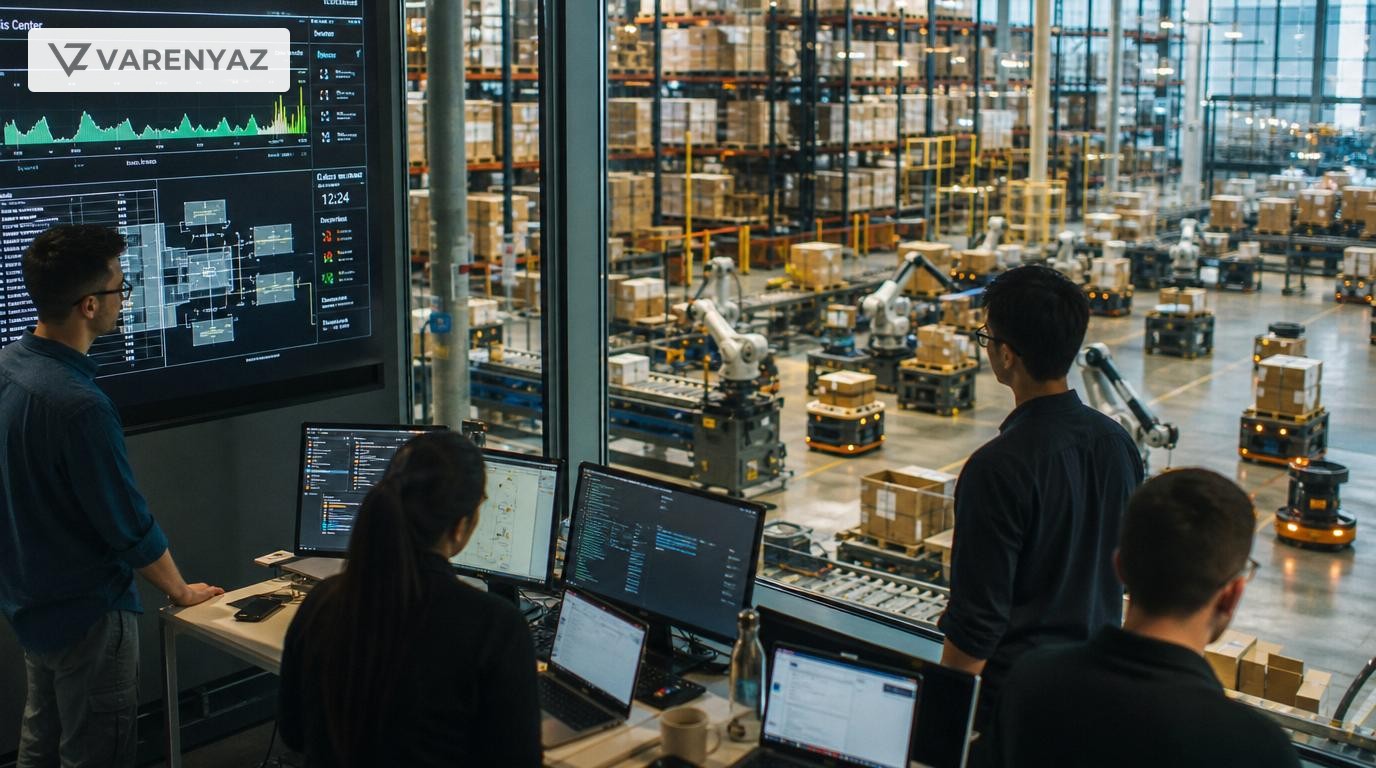
Travis Kalanick’s robotics and industrial AI startup Atoms has raised $1.7 billion in funding led by Andreessen Horowitz, with Uber participating. Atoms says it will use robotics, computer vision, and AI to modernize physical operations such as warehouses, fulfillment centers, and logistics hubs. For enterprises, the round signals intensifying investment in end-to-end automation platforms, with potential impacts on supply-chain resilience, labor models, and how software products integrate with real-world, robot-enabled infrastructure.
News Desk
LiveEditorial Review
VarenyaZ Editorial Desk, Managing Editor
Global
In This Story
Coverage Signals
Key Takeaways
- Travis Kalanick’s robotics startup Atoms has raised approximately $1.7 billion in fresh funding led by Andreessen Horowitz (a16z).
- Uber is among the strategic investors, highlighting a continued relationship between the ride-hailing giant and its former CEO in the logistics and automation space.
- Atoms positions itself as an industrial AI and robotics platform aimed at modernizing warehouses, fulfillment centers, and broader physical operations.
- The scale of the round signals investor conviction that robotics and AI will underpin the next wave of logistics and supply-chain modernization.
- For enterprises, this move accelerates the need to rethink warehouse management, data architecture, and systems integration around robotics-ready infrastructure.
- Risks remain around execution, regulatory scrutiny, labor impact, and the maturity of Atoms’ technology, which so far has been described in broad, high-level terms.
- Technology leaders should explore how APIs, data pipelines, and custom apps can plug into robotics platforms to orchestrate end-to-end automated workflows.
- Partners like VarenyaZ can help design and build web, AI, and automation layers that connect existing enterprise systems with emerging robotics ecosystems.
Travis Kalanick’s Atoms raises $1.7B to bet big on industrial AI and robotics
Travis Kalanick is back with a mega-round. His robotics and industrial AI startup Atoms has raised about $1.7 billion in funding, led by Andreessen Horowitz (a16z), with Uber among the participating investors. The company is promising to use "industrial AI" to modernize the physical world—starting with warehouses and logistics.
For founders, CTOs, operations leaders, and investors, this is more than a high-profile comeback story. It is a signal that the next major platform battle may not be in consumer apps or cloud software, but in the automation of physical operations.
What happened: Inside Atoms’ $1.7 billion funding round
Atoms has been operating in relative stealth, but the new financing round thrusts it squarely into the spotlight. The roughly $1.7 billion raise, led by a16z, immediately places Atoms among the best-funded robotics and industrial AI startups globally.
Key facts based on current reporting:
- Round size: Approximately $1.7 billion in equity and/or related financing instruments.
- Lead investor: Andreessen Horowitz (a16z), one of Silicon Valley’s most active backers of AI and infrastructure startups.
- Strategic investor: Uber, signaling continued alignment between Kalanick and the company he previously led.
- Focus: Applying robotics, computer vision, and AI to transform industrial operations, particularly warehousing and logistics.
Atoms has described its mission in broad terms—"modernizing the world" through industrial AI—rather than detailing specific products. But from hiring patterns and positioning, it looks like an attempt to build an integrated automation platform across hardware, software, and operations.
Direct answer: What does this funding mean for businesses?
Atoms’ $1.7 billion funding round means enterprises should prepare for a new wave of robotics-driven automation in warehouses, fulfillment centers, and logistics networks. Large capital inflows into industrial AI signal that automation is shifting from experimental pilots to core infrastructure. Technology and operations leaders will need to modernize data, APIs, and system integrations so their software and workflows can connect with robots, real-time decision engines, and AI-based orchestration platforms.
Why it matters: Industrial AI moves center stage
For the past decade, Kalanick has been synonymous with the digitization of transportation via Uber. With Atoms, he is turning to the digitization and automation of physical infrastructure.
The significance for the market:
- Industrial AI as a new platform layer: Investors are betting that robotics, computer vision, and AI will become as foundational to physical operations as cloud computing was to software.
- From point solutions to platforms: Many warehouses already use robotics, but often as isolated tools. Atoms is positioning itself as an integrated platform that orchestrates robots, workflows, and data end-to-end.
- Logistics as a strategic battleground: E-commerce, retail, and manufacturing are under pressure to deliver faster, cheaper, and more reliably. Automation is becoming a competitive necessity, not a nice-to-have pilot.
For AI and software leaders, this is a reminder that the next generation of products will increasingly interact with the physical world—robots, conveyors, sorters, and sensors—not just web or mobile interfaces.
Business impact: What leaders should be planning for now
Atoms’ funding will not transform your warehouse tomorrow, but it changes the medium-term landscape for operations, IT, and product teams.
1. Automation will demand better data and integration
Robotics platforms are only as good as the data and systems they connect to. Enterprises still running fragmented ERPs, legacy WMS solutions, or spreadsheet-driven planning will face integration friction.
To be automation-ready, organizations should:
- Standardize operational data models for inventory, locations, and workflows.
- Expose key operations via APIs instead of tightly coupled integrations.
- Adopt event-driven architectures for real-time warehouse and logistics updates.
- Use dashboards and digital twins to monitor performance across humans and robots.
2. The labor and skills mix inside warehouses will shift
Industrial AI does not simply replace humans; it changes the roles inside operations. Expect a shift toward technicians, robot operators, system integrators, and data analysts working alongside pickers and packers.
Leaders should consider:
- Reskilling frontline staff for collaborative robotics environments.
- Building cross-functional squads across operations, engineering, and data.
- Designing safety, training, and governance frameworks for mixed human-robot workflows.
3. Vendor strategy becomes a long-term architectural decision
Adopting a robotics platform—whether Atoms or a competitor—isn’t a simple SaaS subscription; it can reshape facility layouts, workflows, and IT architecture.
That raises strategic questions:
- How do you avoid full vendor lock-in while still benefiting from integrated solutions?
- What is your fallback plan if a robotics vendor fails or pivots?
- How will your core systems (ERP, WMS, TMS, e-commerce) communicate with robotics layers?
Building a strong internal integration layer—APIs, middleware, and custom applications—will be critical to maintaining flexibility.
AI, software, and search relevance: Beyond the warehouse floor
Atoms brands itself as an "industrial AI" company, not just a robotics manufacturer. That framing matters for software leaders and product teams.
Key AI and software angles:
- AI decision engines: Orchestrating hundreds of robots, orders, and dock doors requires optimization algorithms, reinforcement learning, and simulation—AI workloads similar to what powers ride matching or ad auctions.
- Real-time data platforms: Continuous data feeds from sensors, cameras, and IoT devices demand robust streaming and observability stacks.
- Developer ecosystems: If Atoms follows the platform playbook, third-party and in-house developers will need APIs, SDKs, and web interfaces to extend and customize functionality.
- Search and discovery: As operations generate more granular data, search-like interfaces—"find the root cause of this bottleneck"—will become essential for decision support.
For companies building software around logistics, retail, manufacturing, or e-commerce, the challenge will be to design products that plug into these new industrial AI layers rather than operating in isolation.
Risks and open questions around Atoms
Despite the massive raise, Atoms is still relatively opaque. That raises several questions decision-makers should monitor:
- Technology maturity: How proven are Atoms’ robotics systems outside controlled pilots? Are they modular enough for brownfield sites, or mainly suited to greenfield builds?
- Economic model: Will Atoms sell hardware, offer robotics-as-a-service, or bundle everything as an end-to-end managed operation? The model will shape ROI and adoption risk.
- Regulation and labor: Large-scale automation can attract attention from regulators and labor organizations, especially in markets like the US and UK.
- Competition: Incumbents in robotics, material handling, and warehouse software are not standing still. Atoms will need real differentiation beyond its founder’s profile and capital base.
Until the company reveals more concrete deployments, enterprises should treat Atoms as a directional signal rather than a guaranteed solution.
What happens next: Signals to watch
Over the next 12–24 months, business and technology leaders should watch for:
- Flagship deployments: Named customers, especially large retailers, 3PLs, or manufacturers, and case studies showing throughput and cost impact.
- Product clarity: Documentation, developer tools, and technical detail on how Atoms integrates with WMS, ERP, and e-commerce platforms.
- Regional expansion: Whether Atoms targets the US first or quickly moves into markets like India and Europe where logistics modernization is accelerating.
- Partnerships: Alignments with cloud providers, system integrators, and software vendors that can help enterprises adopt Atoms at scale.
For investors, the sheer size of the round makes Atoms a bellwether for industrial AI valuations. For operators, it is a prompt to revisit automation roadmaps and architectural decisions.
How enterprises can prepare their stack for industrial AI
Whether or not Atoms becomes your vendor of choice, the broader trend is clear: physical operations will be increasingly coordinated by software and AI.
Practical steps for CTOs, CPOs, and COOs:
- Audit current warehouse and logistics systems for integration readiness and data quality.
- Move toward event-driven, API-first architectures that can talk to robotics platforms.
- Invest in operational analytics and observability to measure automation impact.
- Prototype small automation projects with clear ROI and expand based on learnings.
- Align product, data, and operations teams on a shared automation roadmap.
If you are planning to modernize your logistics, warehouse, or industrial workflows, you can explore a tailored web, AI, and automation architecture with VarenyaZ by reaching out at https://varenyaz.com/contact/.
Where VarenyaZ fits: Connecting web, AI, and robotics
Atoms and similar platforms will succeed or fail based on how well they integrate into the broader digital stack—e-commerce storefronts, internal tools, planning systems, and analytics layers.
VarenyaZ can help organizations:
- Design automation-ready architectures: Build web and custom applications that interface cleanly with robotics and industrial AI APIs.
- Develop AI-driven dashboards: Real-time monitoring, anomaly detection, and predictive insights for warehouses and logistics operations.
- Implement orchestration layers: Custom middleware and control panels that unify data flows across ERPs, WMS, TMS, and robotics platforms.
- Prototype and iterate: Rapid pilots that prove value before large-scale capex commitments.
Conclusion: A new phase for logistics, and a new stack for leaders
Travis Kalanick’s Atoms raising $1.7 billion, led by a16z with Uber investing, sends a clear message: industrial AI and robotics are moving to the center of the innovation agenda. The winners in this next phase will be the organizations that treat automation not as a bolt-on, but as a core part of their digital operating system.
By rethinking web experiences, back-office systems, and data pipelines through an automation-first lens—and partnering with teams like VarenyaZ for web design, custom development, and AI-driven automation—enterprises can be ready for whichever robotics platform ultimately shapes the future of physical operations.
Editorial Perspective
"The scale of Atoms’ $1.7B raise suggests investors now see robotics and industrial AI as foundational infrastructure, similar to cloud computing a decade ago."
"For CTOs and operations leaders, this is a clear signal to future-proof warehouses and supply chains with integration-ready data, APIs, and automation-friendly architecture."
"Kalanick’s return, backed by a16z and Uber, will intensify competition in warehouse automation and force incumbents to accelerate their industrial AI roadmaps."
Frequently Asked Questions
What is Travis Kalanick’s new robotics company Atoms?
Atoms is a robotics and industrial AI startup founded by former Uber CEO Travis Kalanick. The company aims to modernize physical operations, such as warehouses and logistics hubs, using robotics, computer vision, and AI-driven optimization. While still relatively stealthy, Atoms presents itself as an infrastructure platform for automated, data-driven industrial workflows.
How much funding did Atoms raise and who led the round?
Atoms has raised about $1.7 billion in new funding. The round is led by prominent venture capital firm Andreessen Horowitz (a16z), with participation from other investors, including Uber. The size of the round places Atoms among the better-capitalized robotics and industrial AI startups globally.
Why is Uber investing in Travis Kalanick’s robotics company?
Uber’s investment suggests a strategic interest in the next generation of logistics and automation infrastructure. Atoms’ focus on industrial AI, warehouses, and physical operations aligns with Uber’s broader ambitions in delivery, freight, and logistics networks. It also underlines a pragmatic relationship between Uber and its former CEO around shared operational interests.
What does Atoms’ funding mean for enterprises and operations leaders?
For enterprises, Atoms’ funding signals that robotics and industrial AI are moving from experimental to strategic infrastructure. Operations and technology leaders should expect faster innovation in automated warehouses, fulfillment, and supply-chain orchestration. This will require more robust data architecture, API-first systems, and custom software that can integrate with robotics platforms and AI-driven decision engines.
What are the main risks or open questions around Atoms?
Key risks include the gap between Atoms’ ambitious, high-level promises and the current maturity of its technology; the complexity of integrating robotics into legacy facilities; potential labor and regulatory challenges; and competitive pressure from established automation vendors. Until more technical detail and customer deployments are visible, it remains difficult to assess how differentiated Atoms’ platform truly is.
How can companies prepare their tech stack for industrial AI and robotics platforms like Atoms?
Companies should focus on clean, accessible operational data; microservices and API-first architectures; real-time event streaming; and modular warehouse or logistics systems that can plug into robotics platforms. Partnering with specialists in web, AI, and automation development can help build dashboards, orchestration tools, and custom apps that connect existing systems to emerging robotics ecosystems.
Selected References
Stay Ahead
Get concise, actionable insights on AI, digital strategy, and innovation. No spam, just value.
More Coverage
Related News
Jul 22, 2026
Passionfroot Raises $15M to Scale B2B Creator Marketplace in US
Passionfroot, a German startup building a B2B creator marketplace, has raised $15M in Series A funding led by Insight Partners to drive its expansion into the US market. The platform focuses on professional creators and brands, streamlining sponsorships and campaign workflows. For marketing leaders and product teams, this signals a maturing creator economy where workflow, data, and integrations matter as much as reach. The move also creates opportunities for martech, CRM, and AI-powered tooling to plug into a rapidly formalizing brand-creator collaboration stack.
Jul 21, 2026
Gritt Raises $34M to Deploy Construction Robots for Solar Farms
Robotics startup Gritt has exited stealth with $34 million in funding to automate some of the most dangerous and physically intense tasks on construction sites, starting with utility-scale solar farms. The company is building rugged field robots that handle repetitive, heavy material workflows to reduce labor bottlenecks, cut safety incidents, and accelerate renewable energy deployment. For construction, energy, and infrastructure leaders, Gritt signals a practical shift from lab robotics to jobsite-ready automation that could reshape project planning, workforce strategy, and capital allocation over the next decade.
Jul 20, 2026
Applied Computing Targets Whole-Plant AI Model for Oil & Gas
Applied Computing has raised a $20M Series A round to build a foundation AI model tailored to oil, gas and petrochemical plants. Instead of point solutions for individual assets, the startup aims to model the entire plant, integrating sensor data, engineering diagrams and operational histories. The goal is to improve uptime, reduce energy use, enhance safety and support more accurate decision-making. For operators, this signals a shift toward plant-scale digital twins and unified AI layers that sit on top of existing OT and IT systems, with implications for data strategy and vendor selection.