

What Happened In Brief
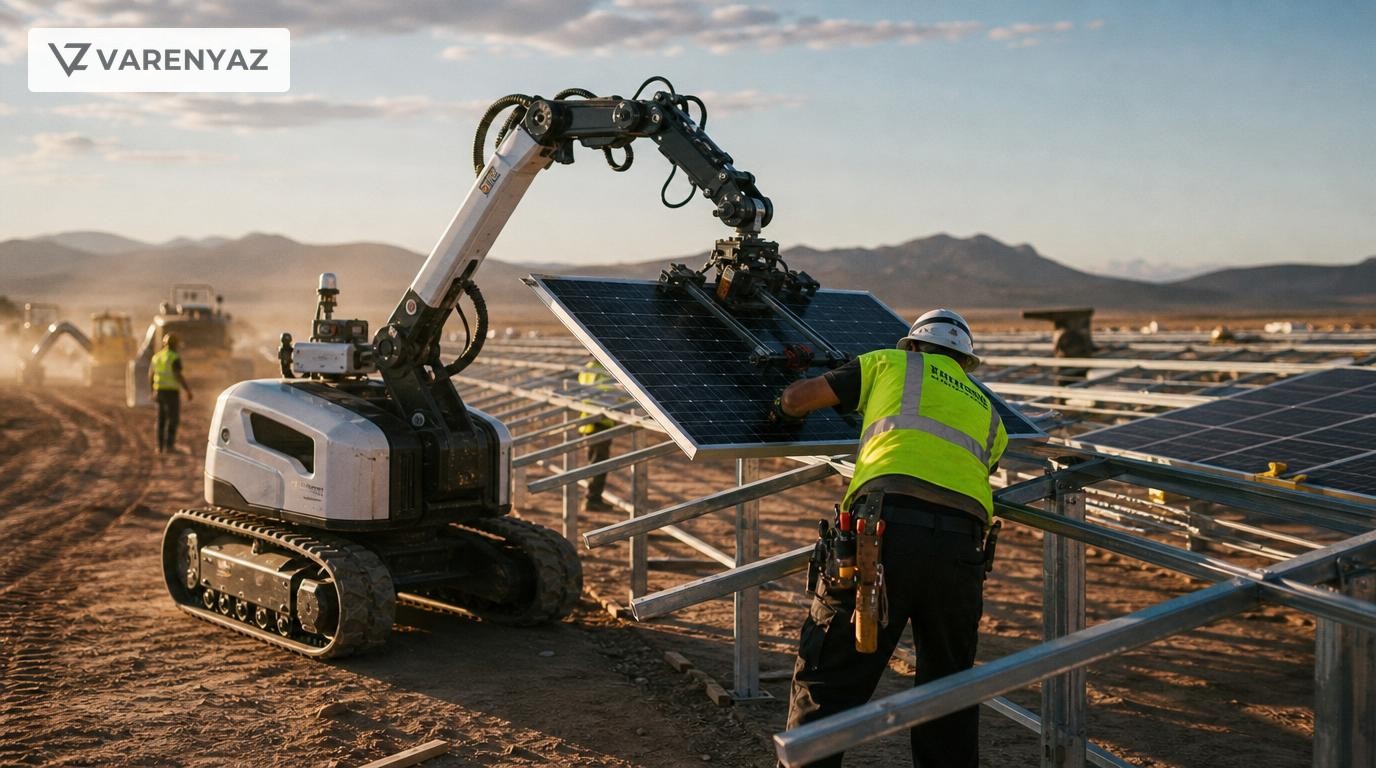
Robotics startup Gritt has exited stealth with $34 million in funding to automate some of the most dangerous and physically intense tasks on construction sites, starting with utility-scale solar farms. The company is building rugged field robots that handle repetitive, heavy material workflows to reduce labor bottlenecks, cut safety incidents, and accelerate renewable energy deployment. For construction, energy, and infrastructure leaders, Gritt signals a practical shift from lab robotics to jobsite-ready automation that could reshape project planning, workforce strategy, and capital allocation over the next decade.
News Desk
LiveEditorial Review
VarenyaZ Editorial Desk, Managing Editor
Global
In This Story
Coverage Signals
Key Takeaways
- Gritt exited stealth with $34 million in funding to build robots for high-risk, high-intensity construction work, starting with solar farms.
- The company targets repetitive, heavy material workflows that are difficult to staff and dangerous for human workers.
- Solar plant construction is Gritt’s beachhead, but its roadmap clearly points toward broader infrastructure and commercial construction automation.
- For developers and EPCs, construction robotics can unlock faster build-out of renewable energy, with potential savings in schedule and safety incidents.
- Adoption will require robust digital workflows, high-fidelity site data, and integration between robotics, project management, and design systems.
- Risks include technology reliability on rugged sites, regulatory and safety approvals, and labor relations as robots enter the field.
- Investors should watch how quickly Gritt moves from pilots to repeatable deployments and whether it can standardize workflows across geographies.
- Digital-first partners like VarenyaZ can help firms prepare by modernizing data pipelines, automation strategies, and AI-enabled project tools.
Gritt exits stealth with $34M to put robots on solar sites first
Construction robotics is moving from glossy demos to muddy jobsites. Gritt, a field robotics startup, has exited stealth with $34 million in funding and a clear mission: automate the hardest, most hazardous tasks on construction sites, starting with utility-scale solar plants.
Rather than chasing fully autonomous, general-purpose robots, Gritt is targeting specific high-intensity workflows where the economics and safety case are strongest. Solar farms are the beachhead: vast sites, repetitive layouts, heavy materials, and pressing timelines driven by climate and policy targets.
What Gritt is building and why solar is the first testbed
Gritt’s core bet is that outdoor construction sites can be systematically automated, much like factories were in previous decades, once robots are robust enough and the workflows are tightly defined.
On a solar plant, that typically means tasks such as:
- Handling and placing heavy racking and mounting structures
- Positioning and fastening solar modules in highly repetitive patterns
- Navigating uneven terrain while carrying substantial loads
- Aligning components within tight tolerances to design specifications
These tasks are difficult to staff reliably, carry ongoing safety risks, and are sensitive to scheduling delays. A robot that can move predictably, precisely, and for longer shifts in harsh outdoor environments could deliver measurable returns in safety, schedule, and quality.
While the company is not positioning itself as a pure AI play, Gritt’s systems are likely to rely on computer vision, sensor fusion, and planning algorithms to operate in semi-structured environments. The value lies in combining rugged hardware with software that understands both the site and the project plan.
Why this matters now: Construction robotics meets the energy transition
The timing is not accidental. Global solar capacity is on a steep growth curve, and much of that capacity depends on utility-scale projects that must be built quickly and safely. Labor availability, safety incidents, and site variability have become chronic constraints.
Gritt’s emergence highlights three converging trends:
- Energy transition pressure: Governments and utilities are under pressure to deploy renewables faster, with aggressive targets in markets like the United States, India, and the United Kingdom.
- Labor and safety realities: Construction faces persistent skilled labor shortages, aging workforces, and higher safety expectations for physically intensive jobs.
- Digitization of construction: BIM, drones, LiDAR, and digital project controls are finally creating the data environment robots need to operate reliably on complex sites.
Put simply, the market is more ready than it was even five years ago. Solar is a logical proving ground where designs are repeatable, economics are tight, and scaling constraints are visible in every project pipeline.
Business impact: How leaders should interpret Gritt’s move
For founders, EPCs (engineering, procurement, and construction firms), developers, and investors, Gritt’s funding round is less about one startup and more about a category maturing.
Key implications include:
- Robotics as a line item, not an experiment: Construction and energy players should expect robotics to move from innovation budgets into project P&L as deployment models stabilize.
- Workflow redesign, not just bolt-on robots: Productivity gains will come when scheduling, design, logistics, and robotics are integrated. Robots work best when upstream data is clean and downstream processes can adapt.
- Safety and compliance as differentiators: Companies that can demonstrate rigorous safety frameworks around robots will have an advantage with regulators, insurers, and clients.
- New data exhaust: Every robot on a site becomes a mobile sensor. That data will influence asset management, performance analytics, and future design decisions.
Investors should watch whether Gritt can standardize its deployments across geographies and project types, and how quickly its robots shift from pilot projects to repeatable, revenue-generating units on multiple sites.
AI, software, and the digital backbone behind field robotics
Robots cannot deliver value on construction sites without a strong digital backbone. Gritt’s hardware will need to plug into a software ecosystem that spans:
- Design and engineering tools like BIM platforms and CAD models that dictate exact positions and tolerances.
- Project management systems that orchestrate sequencing, dependencies, and resource allocation.
- Site intelligence tools such as drone mapping, SLAM-based localization, and IoT sensors for conditions and safety.
- Analytics and AI layers to optimize paths, predict delays, and flag issues in real time.
For CTOs and product leaders, that raises a critical question: Is your digital infrastructure ready to work with autonomous systems, or is it still built around paper, spreadsheets, and siloed tools?
This is where software and AI partners matter. Construction and energy firms increasingly need custom web apps, automation platforms, and integrations that:
- Unify data from planning, robotics, and field execution
- Expose APIs for robotics platforms to consume project context
- Provide visual dashboards for operations and safety oversight
- Use AI to surface anomalies and recommendations from jobsite data
If your organization is exploring robotics or automation in construction or energy, you can start a focused conversation with our team at https://varenyaz.com/contact/.
Risks, constraints, and open questions
No matter how compelling the vision, field robotics faces real-world constraints.
Leading questions leaders should consider include:
- Reliability in harsh environments: Can robots operate consistently in dust, mud, heat, and variable weather without excessive downtime?
- Safety and regulation: How will local regulators view autonomous or semi-autonomous machines on live sites, and what certification frameworks will be required?
- Workforce strategy: How will unions, subcontractors, and local labor markets react? Can upskilling and new roles (robot operators, maintenance technicians, data specialists) offset displacement concerns?
- Integration overhead: How much change management is required to integrate robotics into existing construction processes and contracts?
- Vendor lock-in: If critical workflows depend on a single robotics provider, what are the long-term implications for cost and flexibility?
Gritt’s long-term promise—"then, everything else" beyond solar—will hinge on how it navigates these non-technical challenges as much as on its engineering milestones.
What happens next: Signals to track
Over the next 12–24 months, decision-makers should track several signals around Gritt and its peers:
- Pilot-to-production conversion: Are robots remaining in pilot mode, or are they being written into standard project playbooks?
- Deployment geographies: Does adoption cluster in certain regions with favorable regulation and aggressive solar targets (for example, the US Southwest, parts of India, or the UK’s utility-scale projects)?
- Software partnerships: Which BIM, project management, and data platforms integrate deeply with Gritt’s systems?
- Unit economics: How do robotics costs compare against labor and schedule savings at scale?
- Expansion beyond solar: Does Gritt successfully apply its platform to adjacent infrastructure segments like battery storage, data centers, or transmission?
These signals will help investors and operators gauge whether construction robotics is becoming a fundamental layer of project delivery or staying niche.
How VarenyaZ can help organizations prepare for construction robotics
Whether or not you plan to work directly with Gritt, the broader shift to robotics and automation on jobsites is underway. To benefit, organizations need modern, interoperable digital systems that can consume, process, and act on rich site data.
VarenyaZ works with construction, energy, and infrastructure teams to:
- Design and develop custom web applications that centralize project and site data
- Build automation layers that connect scheduling, logistics, and field execution tools
- Integrate AI and analytics to surface insights from sensors, drones, and robotics platforms
- Create developer-friendly APIs and data models that robotics providers can plug into
- Modernize older systems so they can support real-time, automation-ready workflows
As robots like Gritt’s move from concept to commonplace, the winners will be organizations that treat software, data, and automation as core infrastructure—not afterthoughts.
If you are planning large-scale solar, infrastructure, or industrial projects and want to future-proof your digital stack for robotics and AI, VarenyaZ can help you architect and build that foundation—from web interfaces and design systems to integration, automation, and AI-powered decision support.
Editorial Perspective
"Gritt’s emergence signals that construction robotics is moving from experimental pilots to a new operational layer on large jobsites, especially where renewable energy timelines are most aggressive."
"For developers and EPCs, the real unlock is not just the robot itself but the data flows it enables—tying design, scheduling, and field execution into one feedback loop."
"Companies that already treat their sites as data-rich environments will be first in line to leverage construction robotics effectively and safely."
Frequently Asked Questions
What is Gritt and what did it announce?
Gritt is a construction robotics startup that has exited stealth with $34 million in funding. The company is building rugged robots designed to automate some of the hardest, most dangerous, and most repetitive tasks on construction sites, with an initial focus on utility-scale solar plants.
Why is Gritt focusing on solar plant construction first?
Utility-scale solar farms require moving and installing large volumes of heavy, repetitive components across vast outdoor sites. These projects face chronic labor shortages, safety risks, and tight timelines. That combination makes solar a strong initial market for field robotics that can standardize and automate key workflows at scale.
How could construction robots impact project schedules and costs?
By automating repetitive, heavy, and precision-dependent tasks, construction robots can reduce downtime, improve consistency, and extend productive working hours in some conditions. Over time, this can compress project schedules, improve quality, and potentially reduce rework and safety-related costs, though upfront CAPEX and integration effort will be significant.
What should construction and energy leaders do now to prepare for robotics?
Leaders should audit current workflows to identify repetitive, hazardous tasks, invest in digital project controls and site data capture, and begin small-scale pilots where robots can integrate into existing processes. Partnering with technology and software experts can help connect robotics data to design, scheduling, and field management tools.
How is AI involved in construction robotics like Gritt’s?
Construction robots typically use a combination of computer vision, sensor fusion, and planning algorithms to understand terrain, recognize materials, and execute tasks safely. AI helps systems adapt to variable site conditions, optimize paths, and learn from operational data, but deployments still require tight safety constraints and human oversight.
Can companies outside the US benefit from this wave of construction robotics?
Yes. Markets with aggressive renewable and infrastructure build-out plans—such as India, the United States, and the United Kingdom—stand to benefit from faster, safer deployment. Once providers like Gritt prove reliable workflows in one region, they can adapt their platforms to new geographies, regulations, and construction standards.
Selected References
Stay Ahead
Get concise, actionable insights on AI, digital strategy, and innovation. No spam, just value.
More Coverage
Related News
Jul 20, 2026
Applied Computing Targets Whole-Plant AI Model for Oil & Gas
Applied Computing has raised a $20M Series A round to build a foundation AI model tailored to oil, gas and petrochemical plants. Instead of point solutions for individual assets, the startup aims to model the entire plant, integrating sensor data, engineering diagrams and operational histories. The goal is to improve uptime, reduce energy use, enhance safety and support more accurate decision-making. For operators, this signals a shift toward plant-scale digital twins and unified AI layers that sit on top of existing OT and IT systems, with implications for data strategy and vendor selection.
Jul 19, 2026
Sheryl Sandberg Backs $10M AI Vehicle Inspection Startup
Sheryl Sandberg is leading a $10 million investment in a 2021-founded startup that uses AI and computer vision to detect vehicle damage from smartphone photos. Targeting insurers, fleet operators, rental firms, and mobility marketplaces, the platform aims to cut claims costs, reduce fraud, and standardize inspections without special hardware. For business leaders, it signals rapid adoption of AI-driven, mobile-first inspection workflows across automotive and insurance operations.
Jul 18, 2026
Databricks Soars to $188B as Open AI Stack Bets Pay Off
Databricks has surged to a $188 billion valuation, extending its transformation from data lakehouse vendor to full-stack enterprise AI platform. The company is leaning hard into open-weight AI models, publishing research on cost savings for AI-assisted coding compared with closed APIs. For enterprises, this signals a major shift: AI strategy is moving from one-off pilots to platform decisions where data, governance, and model choice converge. Leaders should reassess where to run AI workloads, how to manage costs, and how open models fit into their software delivery and analytics roadmaps.