

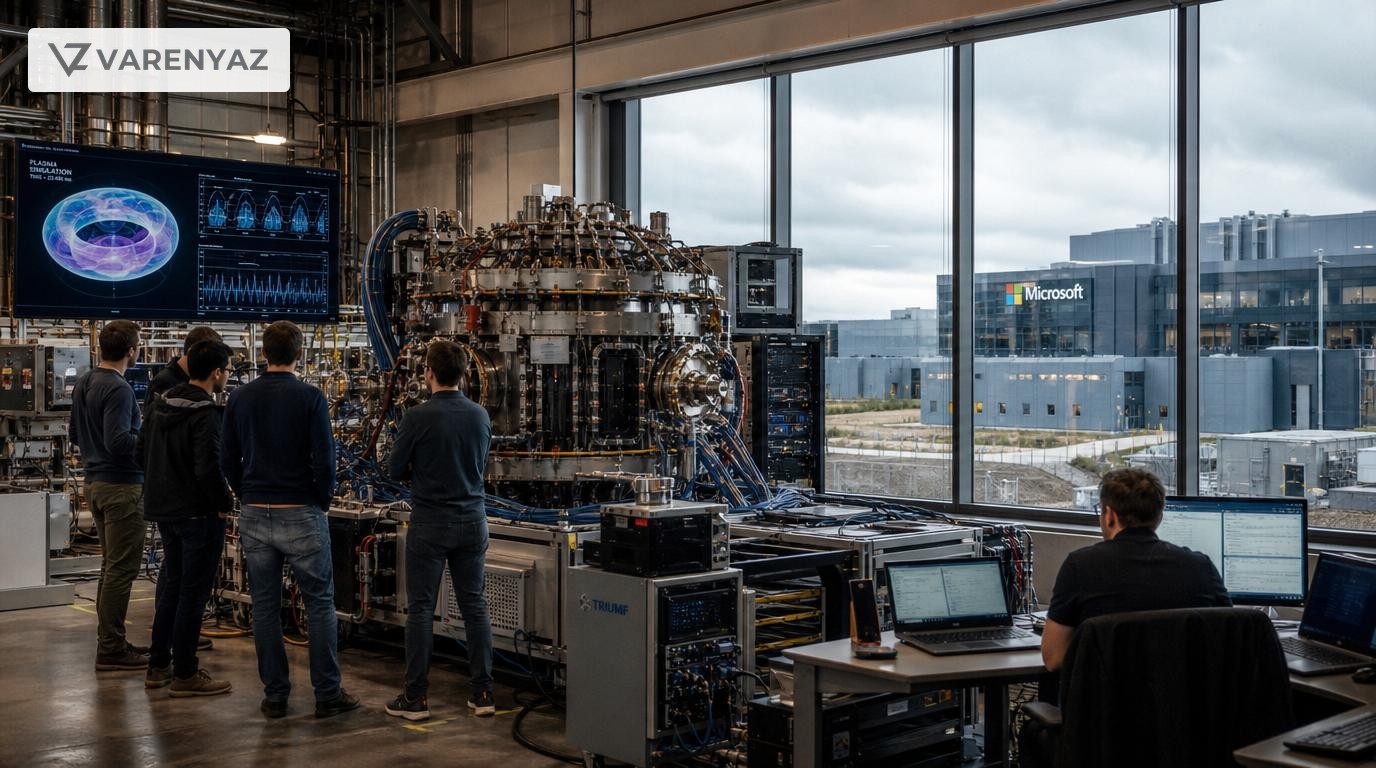
What Happened In Brief
Helion has raised $465 million to accelerate construction of a first-of-its-kind fusion power plant backed by a long-term power purchase agreement with Microsoft, targeting initial electricity supply by 2028. The deal highlights how hyperscalers are scrambling for clean, firm power to support explosive AI and cloud growth. If Helion delivers, it could reshape energy procurement for data centers, but the project still faces major technical, regulatory, and execution risks that leaders should track closely.
News Desk
LiveEditorial Review
VarenyaZ Editorial Desk, Managing Editor
Global
In This Story
Coverage Signals
Key Takeaways
- Helion raised $465 million to accelerate a commercial fusion power plant intended to supply electricity to Microsoft by 2028.
- The project is backed by a long-term power purchase agreement, signaling growing corporate appetite for early-stage clean firm power.
- AI and cloud workloads are driving unprecedented energy demand, pushing hyperscalers to explore nuclear, fusion, and direct grid partnerships.
- Fusion remains technically unproven at commercial scale, so the Helion-Microsoft deal carries significant technology and execution risk.
- If successful, fusion-backed PPAs could reshape how enterprises think about energy procurement for digital infrastructure.
- Regulators, utilities, and local communities will heavily influence permitting timelines and integration with existing grids.
- Technology leaders should model multiple energy price and availability scenarios into long-term AI and data center roadmaps.
- Digital businesses can prepare by modernizing apps, automating operations, and adopting AI-driven efficiency to balance rising energy costs.
Helion’s $465M bet to power Microsoft with fusion by 2028
Helion, the Sam Altman-backed fusion startup, has raised $465 million to accelerate construction of a first-of-its-kind fusion power plant intended to supply electricity to Microsoft as early as 2028. The deal is anchored by a long-term power purchase agreement (PPA), effectively turning an experimental clean energy technology into a contracted part of Microsoft’s future power mix.
For founders, tech leaders, and investors, this is not just another climate-tech funding headline. It is a clear signal that energy strategy is now inseparable from AI, cloud, and software growth plans.
What exactly happened?
Helion Energy announced a new funding round of $465 million to advance its fusion technology toward commercial deployment. A key driver is its PPA with Microsoft, under which Helion has committed to deliver a specified quantity of electricity from a planned fusion facility by around 2028, once it becomes operational and passes regulatory approvals.
The agreement follows earlier announcements that Microsoft would be Helion’s first customer, but this fresh capital gives the project a clearer financial runway. The new plant will be designed to connect to the grid, with Helion aiming to demonstrate net electricity production at commercial scale, not just in the lab.
Sam Altman, who has backed Helion for years, remains a central figure. His dual role in AI (via OpenAI) and fusion underscores how tightly energy and AI trajectories are now coupled.
Why this deal matters now
AI and cloud data centers are devouring energy. Training and running large models, powering GPUs at scale, and serving global workloads are all driving electricity demand much faster than traditional grid planning cycles anticipated.
Microsoft, like other hyperscalers, has set aggressive climate targets while also racing to expand AI capacity. That combination is pushing the company to explore “clean firm power” sources—energy that is both low-carbon and dispatchable, unlike intermittent wind and solar. Fusion, if it works, could offer exactly that.
This Helion-Microsoft arrangement is significant because:
- It treats fusion as a real, contracted energy source rather than distant R&D.
- It shows hyperscalers are willing to underwrite early-stage energy technologies in exchange for future supply.
- It raises expectations on how quickly fusion might move from experiment to grid asset.
How Helion’s fusion approach fits into the energy landscape
Helion is developing a pulsed fusion system rather than the massive tokamak designs used by projects like ITER. Its approach aims to compress fuel using magnetic fields in rapid pulses, generating electricity more directly rather than primarily as heat for steam turbines.
Compared to solar, wind, or even traditional nuclear, fusion promises several advantages if it reaches commercial reality:
- High energy density: Very large power output from relatively small plants.
- Minimal fuel and waste: Fusion fuels can be more abundant and produce less long-lived radioactive waste than fission.
- Firm, controllable power: Output that can be ramped as needed, ideal for balancing AI and data center loads.
However, every one of those benefits is still contingent on solving hard physics and engineering problems. No company—including Helion—has yet proven sustained net-energy fusion in a production environment.
Business implications for AI, cloud, and digital infrastructure
For business and technology leaders, the headline number—$465 million—is less important than the directional signal:
- Energy is now a first-class strategic variable in AI and cloud planning, not a background utility bill.
- Hyperscalers are moving upstream into energy procurement, occasionally pre-buying power from technologies that don’t exist at scale yet.
- Digital infrastructure expansion is constrained by grids as much as by chips and capital.
This shift affects more than just Microsoft and Helion. Over the next few years, expect:
- More cloud regions and data centers to be co-located with clean, firm power sources—nuclear, hydro, or advanced tech like fusion.
- Cloud pricing and capacity to increasingly factor in local grid realities and energy contracts.
- Enterprises to be asked, implicitly or explicitly, to optimize workloads for efficiency and energy impact.
For product and engineering teams, that translates into a renewed focus on performance budgets, efficient architectures, and intelligent scaling policies—especially as AI features become default in apps and services.
Risks, execution challenges, and open questions
Helion’s target of delivering power by 2028 is intentionally bold—and very far from guaranteed.
Key risks include:
- Technical risk: Achieving sustained, net-positive fusion energy has never been done commercially. Any unexpected physics or engineering hurdle could delay the timeline by years.
- Regulatory risk: Even if the technology works, the plant must pass safety reviews, environmental assessments, and grid interconnection studies.
- Integration risk: Supplying reliable power to the grid at the contracted levels, without significant downtime, will require robust systems engineering and backup plans.
- Financial risk: Cost overruns are common in frontier energy projects; further capital may be required to reach full-scale operation.
For Microsoft, the structure of the PPA is likely designed to account for these uncertainties—payments and obligations will hinge on concrete milestones. But for the broader market, the move still raises important questions:
- Will other hyperscalers sign similar agreements with fusion or advanced nuclear firms?
- How will regulators treat fusion plants compared with conventional nuclear in terms of permitting speed?
- Will enterprises gain access to “fusion-backed” cloud regions, or will such capacity remain a limited, premium resource?
What leaders should watch next
Whether you run a startup, an enterprise tech stack, or a portfolio, consider monitoring:
- Helion’s technical milestones: Demonstrations of net electricity production, reliability data, and third-party validation.
- New PPAs: Similar deals between hyperscalers and other advanced energy firms will confirm if this is a one-off or the start of a pattern.
- Regulatory signals: Policy moves in the US, UK, and India around fusion classification, licensing, and safety standards.
- Energy-related cloud pricing: Any new pricing tiers or regions explicitly linked to low-carbon or high-availability power sources.
Internally, leadership teams should model energy scenarios into their AI and digital roadmaps: What if power prices spike 30–50%? What if capacity becomes constrained in a key region? What if new clean power unlocks cheaper, more abundant compute?
Implications for software, AI, and automation strategies
Even if fusion remains on the horizon, its pursuit highlights an unavoidable reality: AI-powered digital products are increasingly energy-hungry physical systems in disguise. That has direct consequences for how you design and operate software:
- Architect for efficiency: Right-size models, cache intelligently, and use edge or regional strategies to minimize wasteful data movement.
- Automate aggressively: Use observability, autoscaling, and AI-driven operations to align compute usage with real demand.
- Design for flexibility: Build systems that can shift workloads across regions or providers as energy and capacity conditions change.
If you are planning the next wave of AI-enhanced products or internal automation, this is the moment to bake energy-aware design into your architecture rather than bolt it on later.
How VarenyaZ can help you adapt
Energy and infrastructure constraints will quietly shape which digital strategies succeed. That makes strong architecture, efficient code, and intelligent automation more critical than ever.
VarenyaZ works with teams to:
- Design and build high-performance web platforms and custom applications that make better use of every compute cycle.
- Architect cloud-native systems that scale efficiently across regions and providers.
- Embed AI and automation into workflows to reduce manual overhead and infrastructure waste.
- Modernize legacy systems so they can participate in a more energy-constrained, AI-first future.
If you are rethinking your digital roadmap in light of AI growth, infrastructure limits, or rising energy costs, you can start a conversation with our team at https://varenyaz.com/contact/.
Conclusion: Fusion as a signal, not a certainty
Helion’s $465 million raise and Microsoft’s fusion PPA do not guarantee that your next cloud region will be fusion-powered by 2028. But they do confirm a deeper shift: energy, AI, and software are converging into one strategic equation.
Leaders who respond early—by making their digital products more efficient, flexible, and automation-ready—will be better positioned whether fusion arrives on time, late, or not at all. VarenyaZ is focused on helping businesses build that kind of resilient, future-ready web, app, and AI foundation today.
Editorial Perspective
"The Helion-Microsoft deal turns fusion from a distant research ambition into a concrete part of hyperscale cloud planning, even if the technical odds are still uncertain."
"For digital leaders, the real signal isn’t just fusion—it’s that energy strategy is now inseparable from AI, cloud, and product roadmaps."
"Whether or not Helion hits its 2028 target, this move will accelerate innovation in clean firm power and force enterprises to rethink how they design and deploy energy-intensive software systems."
Frequently Asked Questions
What did Helion just announce?
Helion announced it has raised $465 million to accelerate the development of a commercial fusion power plant that will supply electricity to Microsoft under a long-term power purchase agreement. The company is targeting initial power delivery by 2028, contingent on meeting key technical and regulatory milestones.
Why is Microsoft investing in fusion power?
Microsoft is not directly building a fusion plant, but it has agreed to buy power from Helion once the plant is operational. The company needs large volumes of clean, reliable electricity to support the rapid growth of AI and cloud workloads, and fusion represents a potential source of carbon-free, always-on power if the technology proves viable.
How risky is Helion’s fusion power plant timeline?
Helion’s target of delivering commercial fusion power by 2028 is ambitious and high risk. Fusion has yet to succeed at commercial scale anywhere. The project depends on achieving sustained net energy gain, navigating regulatory approvals, and integrating reliably with the grid. Leaders should treat 2028 as an optimistic scenario, not a guaranteed outcome.
What does this mean for AI and data center planning?
The deal underlines that AI-driven data centers are becoming energy assets as much as digital ones. Cloud and enterprise leaders should assume continued pressure on power prices and availability, diversify energy sources where possible, and invest in software efficiency, workload scheduling, and automation to extract more capacity from every kilowatt-hour.
How can enterprises prepare for the impact of energy constraints on digital projects?
Enterprises can prepare by modernizing legacy applications, optimizing cloud architectures, adopting AI-driven observability and autoscaling, and exploring edge or hybrid models to reduce waste. Partnering with specialists like VarenyaZ for web, app, and AI automation projects can help teams redesign systems for performance, resilience, and energy-aware efficiency from the outset.
Selected References
Stay Ahead
Get concise, actionable insights on AI, digital strategy, and innovation. No spam, just value.
More Coverage
Related News
Jul 22, 2026
Passionfroot Raises $15M to Scale B2B Creator Marketplace in US
Passionfroot, a German startup building a B2B creator marketplace, has raised $15M in Series A funding led by Insight Partners to drive its expansion into the US market. The platform focuses on professional creators and brands, streamlining sponsorships and campaign workflows. For marketing leaders and product teams, this signals a maturing creator economy where workflow, data, and integrations matter as much as reach. The move also creates opportunities for martech, CRM, and AI-powered tooling to plug into a rapidly formalizing brand-creator collaboration stack.
Jul 21, 2026
Gritt Raises $34M to Deploy Construction Robots for Solar Farms
Robotics startup Gritt has exited stealth with $34 million in funding to automate some of the most dangerous and physically intense tasks on construction sites, starting with utility-scale solar farms. The company is building rugged field robots that handle repetitive, heavy material workflows to reduce labor bottlenecks, cut safety incidents, and accelerate renewable energy deployment. For construction, energy, and infrastructure leaders, Gritt signals a practical shift from lab robotics to jobsite-ready automation that could reshape project planning, workforce strategy, and capital allocation over the next decade.
Jul 20, 2026
Applied Computing Targets Whole-Plant AI Model for Oil & Gas
Applied Computing has raised a $20M Series A round to build a foundation AI model tailored to oil, gas and petrochemical plants. Instead of point solutions for individual assets, the startup aims to model the entire plant, integrating sensor data, engineering diagrams and operational histories. The goal is to improve uptime, reduce energy use, enhance safety and support more accurate decision-making. For operators, this signals a shift toward plant-scale digital twins and unified AI layers that sit on top of existing OT and IT systems, with implications for data strategy and vendor selection.