

What Happened In Brief
Fika Jobs has raised $4 million to build an AI video-first hiring platform where AI agents conduct initial interviews with candidates. Instead of screening CVs, employers receive structured, asynchronous video responses and AI-generated insights. For business and HR leaders, this signals a move toward conversational, always-on recruitment with potential gains in speed and consistency, but it also raises questions around bias, explainability, data privacy, and how to re-architect hiring workflows in an AI-mediated funnel.
News Desk
LiveEditorial Review
VarenyaZ Editorial Desk, Managing Editor
Global
In This Story
Coverage Signals
Key Takeaways
- Fika Jobs raised $4M to build an AI-powered, video-first hiring platform where AI agents conduct early-stage interviews.
- The platform aims to replace manual CV screening with structured, asynchronous video conversations and standardized question sets.
- Business leaders could see faster time-to-hire, richer candidate signals, and more consistent evaluation criteria across teams and locations.
- Risks include algorithmic bias, candidate trust, compliance with emerging AI and employment regulations, and the quality of model training data.
- Adoption will force HR and product teams to redesign hiring funnels around conversational AI rather than legacy applicant tracking workflows.
- Technical leaders must ensure secure handling of candidate video data, robust consent flows, and transparent AI explanations where feasible.
- The move reflects a broader shift from document-centric to conversation-centric talent platforms across global markets.
- Companies exploring similar capabilities can partner with firms like VarenyaZ to design, build, and integrate custom AI hiring solutions.
Fika Jobs raises $4M to let AI agents run your first-round interviews
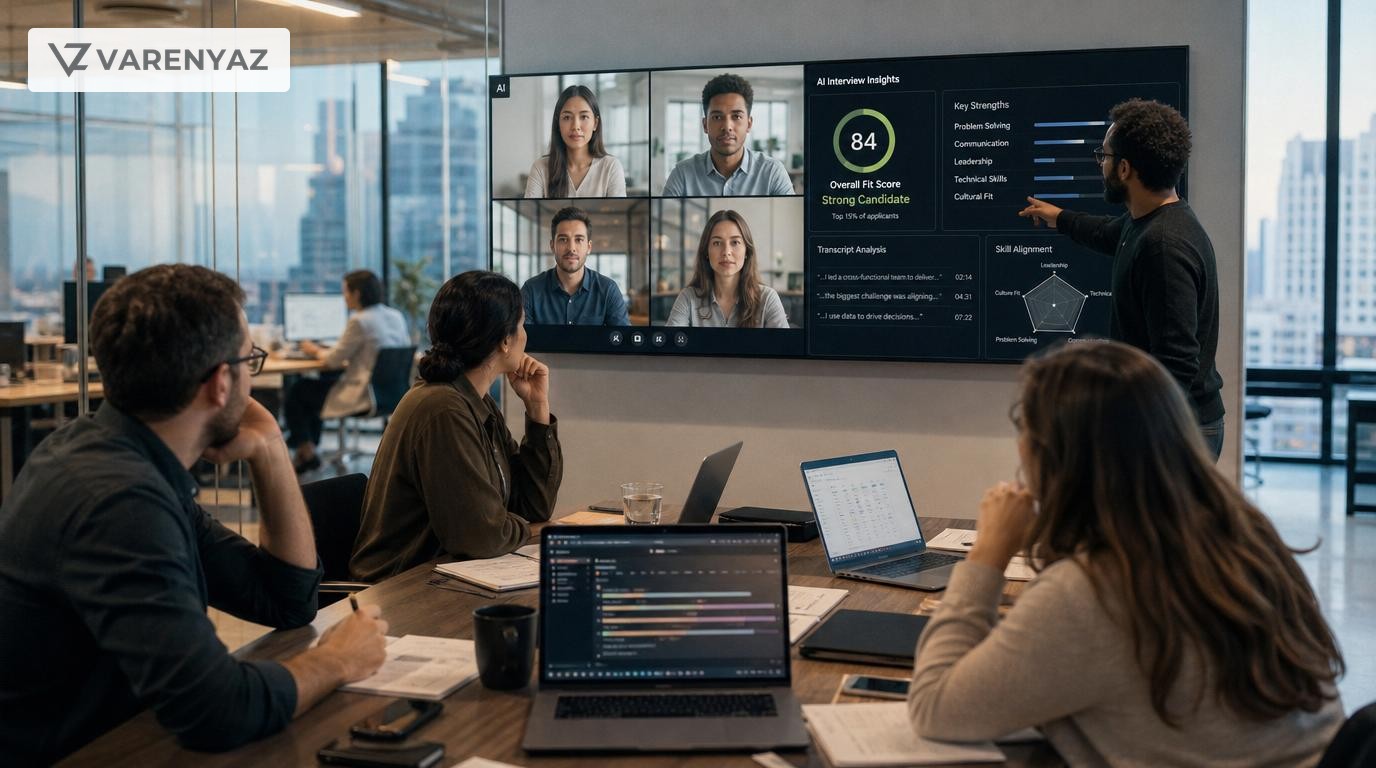
The hiring funnel is shifting from static CVs to live conversations, and Fika Jobs wants AI agents to run those conversations at scale. The startup has raised $4 million to build a video-first hiring platform where candidates interview with AI before a human recruiter ever joins the process.
The funding underscores a larger transformation underway in HR tech: recruitment workflows are being rebuilt around asynchronous video, generative AI, and structured assessments instead of manual screening and unstructured calls.
What Fika Jobs is building
Fika Jobs’ core idea is simple but disruptive: replace the traditional CV-led screening stage with an AI-facilitated conversation that looks and feels much closer to an actual interview.
Instead of submitting a resume and waiting in the dark, candidates are invited to record short video responses to a series of structured questions. An AI agent guides the flow, prompts follow-ups, and ensures every candidate is asked the same core questions for a given role.
On the employer side, hiring managers see:
- Asynchronous video responses they can review on their own time
- Structured summaries of candidate experience and skills
- Highlights of relevant competencies and red flags surfaced by AI
- A consistent set of answers across all applicants for easier comparison
The goal is not to fully automate hiring decisions, but to compress the time and effort spent on first-round screening while standardizing how candidates are evaluated.
Why this funding round matters
Several trends make this round strategically important for business leaders and investors:
- CVs are losing signal: With AI-generated resumes and cover letters, document-based screening is increasingly noisy.
- Recruiter bandwidth is capped: High-volume roles can generate thousands of applications that teams simply cannot thoughtfully review.
- Video is now default behavior: Post-pandemic, candidates are comfortable interviewing over video and asynchronous tools.
- Generative AI has matured: LLMs can structure, summarize, and analyze qualitative responses at a scale that was previously impractical.
Fika Jobs sits directly at the intersection of these dynamics, positioning itself as an alternative to both traditional applicant tracking systems (ATS) and legacy video interviewing tools that lack deep AI analysis.
Direct answer: What does Fika Jobs’ AI video-first hiring platform change?
Fika Jobs changes the early hiring funnel by moving from CV-based screening to structured, AI-led video interviews. Candidates interact with AI agents that ask standardized questions, while employers receive concise summaries and clips to review instead of raw resumes. This promises faster time-to-hire, richer candidate insights, and more consistent evaluations, but also demands new governance around fairness, data privacy, and the role of human judgment.
Business impact: how this reshapes hiring workflows
For founders, HR leads, and operations teams, the potential impact of AI video interviewing goes beyond one tool. It implies a fundamental redesign of how the hiring funnel is structured.
1. Time-to-hire and recruiter productivity
By letting AI handle the repetitive “tell me about yourself” and basic qualification conversations, teams can:
- Reduce the number of live screening calls per role
- Prioritize human time for deeper, later-stage interviews
- Offer candidates a response path even when recruiter bandwidth is constrained
For high-volume roles, this could compress days of scheduling and screening into a few hours of review.
2. Standardization and comparability
AI agents can ensure that every candidate for a given role gets:
- The same core questions
- Structured timing and follow-ups
- Comparable response formats
This makes it easier to generate consistent scorecards, guard against “gut feel” bias in early rounds, and align distributed hiring teams across regions.
3. Richer candidate signals
Compared to resumes, video reveals:
- Communication style and clarity
- Problem-solving approach in real time
- Context behind role transitions and experience
AI can then help summarize and tag these qualitative signals so they become searchable, filterable, and reportable.
AI and software relevance: from document-first to conversation-first
Fika Jobs’ approach reflects a broader trend in software: products are becoming conversation-centric, not document-centric. In hiring, that means:
- Shifting from resume uploads to conversational intake
- Embedding LLMs that interpret and score responses in near real time
- Integrating with ATS, HRIS, and collaboration tools like Slack or Teams
For CTOs and product leaders, this raises architectural questions about how to plug conversational AI into existing recruitment stacks without fragmenting candidate data or duplicating workflows.
Risks, open questions, and regulatory pressure
As promising as AI-led interviews sound, they introduce serious risks that leadership teams cannot ignore.
1. Bias and fairness
AI agents that ask questions and analyze responses might encode or amplify bias, especially if models are trained on unbalanced data. Video adds further complexity: accents, appearance, and environmental factors could inadvertently influence model outputs.
Regulators in the U.S. and Europe are already scrutinizing algorithmic decision-making in employment, and tools like Fika Jobs will sit squarely within that spotlight.
2. Transparency and candidate trust
Candidates need to know:
- When they are interacting with AI instead of humans
- What is being recorded, stored, and analyzed
- How long their video data will be retained and who can access it
Without clear communication and consent, companies risk damaging their employer brand and facing legal challenges.
3. Data privacy and security
Video interviews are highly sensitive personal data. Enterprises must ensure:
- Secure storage and encryption
- Data minimization and retention policies
- Compliance with GDPR, emerging AI regulations, and local employment laws
Vendors like Fika Jobs will need robust security postures and clear governance features to win enterprise trust.
What leaders should watch next
For business decision-makers, several signals will indicate whether AI video-first platforms like Fika Jobs become mainstream or remain niche:
- Regulation: How AI-focused employment rules evolve in the EU, U.S., and major APAC markets.
- Enterprise adoption: Whether large employers adopt such tools for core hiring versus experimental pilots.
- Performance data: Real-world metrics on time-to-hire, candidate satisfaction, diversity impact, and quality-of-hire.
- Integration depth: How smoothly these platforms integrate with leading ATS and HR systems.
Leaders should also expect candidates to become more vocal about their experience with AI interviewers, especially if the process feels opaque or one-sided.
How companies can respond now
Whether or not you adopt Fika Jobs specifically, this funding round is a prompt to reassess your own hiring stack.
- Map your hiring funnel and identify where conversational AI could safely add value.
- Define clear principles for fairness, transparency, and human oversight.
- Prioritize integrations so candidate data remains coherent and auditable.
- Experiment with low-risk roles or internal mobility before scaling to critical hires.
If you are exploring custom AI hiring workflows, you do not have to rely solely on off-the-shelf tools. You can design your own video intake, scoring, and collaboration experiences, tailored to your brand, roles, and compliance requirements. To discuss a custom AI hiring or workflow automation project, contact the VarenyaZ team at https://varenyaz.com/contact/.
Where VarenyaZ fits: building the infrastructure for AI-native hiring
At VarenyaZ, we see Fika Jobs’ funding as part of a wider shift toward AI-native business processes. For recruitment and HR specifically, we help organisations:
- Design candidate journeys that blend AI and human touchpoints without sacrificing transparency
- Build custom web apps for interview scheduling, video intake, and structured assessments
- Integrate LLMs and AI agents into existing ATS and HR workflows
- Implement role-based access, audit trails, and privacy-by-design architectures
- Prototype, test, and iterate new talent experiences quickly using modern web and AI stacks
Conclusion: AI agents at the front door of your organisation
Fika Jobs’ $4M raise is more than another HR tech headline. It signals that AI agents are moving to the very front door of organisations, greeting candidates before human recruiters do.
For forward-looking teams, the opportunity is to harness this shift thoughtfully: pairing AI-led video interviews with strong governance, inclusive design, and deep integration into existing systems. For those who delay, the risk is not just slower hiring, but a growing gap between how top talent expects to engage and how legacy processes actually work.
VarenyaZ helps companies close that gap by designing and building modern web platforms, automation workflows, and AI-driven applications that make hiring faster, fairer, and more transparent—without losing the human judgment that ultimately defines great teams.
Editorial Perspective
"AI-led video interviewing is pushing hiring from static CVs to rich, structured conversations, but the real innovation will be in how companies redesign their workflows and governance around these tools, not just in the agents themselves."
"For founders and HR leaders, platforms like Fika Jobs are an early signal that conversational AI will sit at the very front of the talent funnel, forcing a rethink of how employer brand, candidate experience, and compliance are managed at scale."
Frequently Asked Questions
What is Fika Jobs and what did it announce?
Fika Jobs is a startup building an AI-powered, video-first hiring platform. It announced a $4 million funding round to expand its product, where AI agents conduct initial candidate interviews through structured, asynchronous video conversations instead of traditional CV-based screening.
How does Fika Jobs’ AI video interview platform work?
The platform invites candidates to answer standardized questions via short videos, guided by AI agents. The system structures responses, extracts relevant signals, and surfaces insights and clips to hiring teams, who can then review, compare, and move candidates forward without running dozens of live first-round calls.
Why does an AI video-first hiring platform matter for businesses?
For businesses, an AI video-first platform can compress time-to-hire, scale structured interviews across roles and locations, and give teams richer context than CVs alone. It supports consistent question sets, creates comparable data across candidates, and makes early-stage assessments less dependent on manual recruiter capacity.
What are the main risks of using AI agents to interview candidates?
Key risks include bias in model behavior, uneven candidate experiences, data privacy concerns around sensitive video content, and regulatory scrutiny. Employers also need clear governance, audit trails, and transparent communication so candidates understand when they are interacting with AI rather than a human interviewer.
How should HR and tech leaders prepare for AI-led video interviewing?
HR and tech leaders should map their current hiring funnel, define which stages can be responsibly automated, establish fairness and compliance guardrails, and integrate AI video interviews with their ATS and collaboration tools. Partnering with experienced product and AI teams helps design workflows that enhance, rather than replace, human judgment.
Can companies build custom AI hiring workflows similar to Fika Jobs?
Yes. Organisations with specific domain needs or compliance constraints can design custom AI-led hiring workflows, combining video intake, LLM-based analysis, and ATS integrations. Working with a specialist partner like VarenyaZ can help translate hiring requirements into secure, scalable AI products tailored to internal processes.
Selected References
Stay Ahead
Get concise, actionable insights on AI, digital strategy, and innovation. No spam, just value.
More Coverage
Related News
Jun 22, 2026
Stanford-Backed Clair Health Raises $11M for Noninvasive Hormone Wearable
Clair Health, founded by two Stanford graduates, has raised $11 million to develop a noninvasive hormone-tracking wearable focused on women’s health. The device aims to monitor inflammation, bloating, energy levels and cycle phases to detect irregularities, perimenopause, and hormonal fluctuations earlier and more precisely. For healthtech leaders and investors, this signals an emerging data infrastructure layer in femtech, where continuous hormone and cycle analytics can power new digital health services, clinical decision support tools, and personalized care experiences across apps, telehealth, and enterprise healthcare platforms.
Jun 21, 2026
General Intuition Eyes $2B Valuation On $300M Embodied AI Raise
General Intuition is reportedly in talks to raise around $300 million at an approximate $2 billion valuation, centered on its work in embodied AI and world models. The startup trains AI agents using Medal’s massive dataset of roughly 2 billion gaming videos per year from about 10 million monthly active users. For enterprises, this is a signal that agentic, simulation-trained AI may soon move from research to real-world products in robotics, automation, and interactive applications.
Jun 20, 2026
Fusion startups cross $7B: what deep-tech leaders must know
Fusion startups worldwide have raised more than $7.1 billion, with most of that capital concentrated in a small group of highly funded companies. This marks a shift from pure research to industrial-scale engineering, as private players race to turn fusion into commercial, carbon-free baseload power. For technology and infrastructure leaders, fusion is becoming a strategic factor in long-term power planning, AI data center expansion, and climate commitments. While timelines and technical risk remain uncertain, boards and CTOs should start tracking fusion alongside renewables and grid-scale storage in their energy roadmaps.