

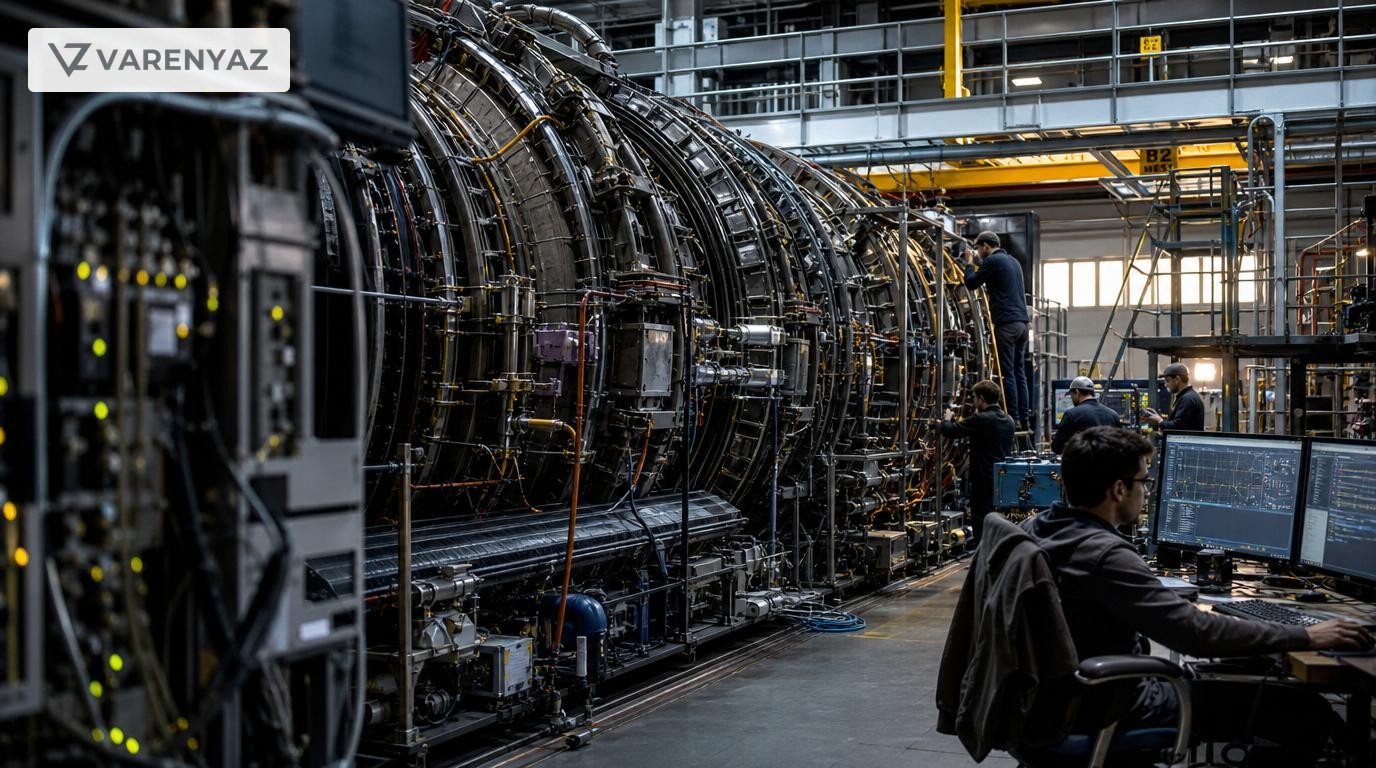
What Happened In Brief
Fusion startups worldwide have raised more than $7.1 billion, with most of that capital concentrated in a small group of highly funded companies. This marks a shift from pure research to industrial-scale engineering, as private players race to turn fusion into commercial, carbon-free baseload power. For technology and infrastructure leaders, fusion is becoming a strategic factor in long-term power planning, AI data center expansion, and climate commitments. While timelines and technical risk remain uncertain, boards and CTOs should start tracking fusion alongside renewables and grid-scale storage in their energy roadmaps.
News Desk
LiveEditorial Review
VarenyaZ Editorial Desk, Managing Editor
Global
In This Story
Coverage Signals
Key Takeaways
- Fusion startups have collectively raised more than $7.1 billion, signaling a major shift from experimental science to commercially driven engineering.
- A small group of fusion companies captures the bulk of capital, creating a high-stakes race among differing technologies and business models.
- AI and cloud data center growth is a powerful demand-side driver, making firm, carbon-free baseload power strategically important.
- Business leaders should treat fusion as a long-horizon option in energy strategy, not a near-term replacement for renewables and storage.
- Technical, regulatory, and supply-chain risks remain high, with uncertain timelines to grid-scale deployment.
- Digital twins, high-fidelity simulation, and AI-driven control systems are becoming core to fusion plant design and operations.
- Investors and innovators should watch for demonstration milestones, power purchase agreements, and early industrial partnerships as key signals.
- VarenyaZ can help energy and infrastructure players build the digital, AI, and automation layers that will sit on top of next-generation power assets like fusion.
Fusion startups have crossed $7.1B — and shifted gears from science to industry
Fusion energy has quietly crossed an important psychological threshold. Private fusion startups worldwide have now raised more than $7.1 billion in funding, and a significant share of that capital is concentrated in a relatively small number of companies that have each secured rounds above $100 million.
This is not yet commercial fusion power. But the funding profile has changed the story: fusion is increasingly being treated as a deep-tech infrastructure bet rather than a distant physics experiment.
What happened: Capital condenses around a few fusion contenders
Over the past few years, fusion companies have moved from tens of millions in early-stage capital to mega-rounds in the hundreds of millions, often backed by a mix of venture capital, strategic energy investors, and high-net-worth individuals.
Several startups have now crossed the $100 million or even billion-dollar mark in cumulative funding, using different technical architectures — including tokamaks, stellarators, magnetized target fusion, and inertial confinement approaches. While their reactor designs differ, they share a common goal: delivering commercially viable, carbon-free baseload power.
Alongside government-backed projects, this private capital has shifted focus toward engineering problems: manufacturability, repeatable operations, materials supply chains, software control systems, and regulatory pathways.
Why this matters now: AI and infrastructure are changing the energy question
The timing of this funding wave is not accidental. Three trends are converging:
- Exploding AI and data center demand: Hyperscale data centers and GPU clusters for generative AI are driving multi-decade power commitments.
- Climate and policy pressure: Governments and enterprises are under pressure to decarbonize without compromising reliability.
- Grid constraints and volatility: Many high-growth regions are already struggling with grid congestion and slow permitting for new transmission and generation.
Fusion promises something that today’s energy mix still struggles to deliver at scale: firm, dispatchable, carbon-free power that can run 24/7 without fuel price volatility. If even a subset of these startups can demonstrate net energy gain and credible cost curves, the downstream impact on AI, cloud, manufacturing, and heavy industry could be profound in the 2030s and beyond.
Direct answer: What does $7.1B in fusion startup funding actually signal?
More than $7.1 billion in funding for fusion startups signals that fusion is moving from a purely scientific endeavor into a commercially framed race to build grid-scale, carbon-free baseload power plants. While timelines remain uncertain, this level of capital means multiple industrial-scale prototypes are likely to be built, tested, and iterated over the next decade.
Business impact: strategic, but long-horizon
For founders, CTOs, CIOs, and operations leaders, fusion is not a near-term procurement decision. It is a long-horizon strategic variable that should start to appear on risk and opportunity maps.
Key business implications include:
- Long-term power contracts will evolve: If fusion demonstrates credible economics, future power purchase agreements (PPAs) could incorporate fusion-backed supply alongside renewables and storage.
- Site selection for data centers and industrial plants may shift: Regions that actively support fusion deployment and grid integration could become even more attractive for energy-intensive operations.
- Capital allocation for climate targets may broaden: Corporates may complement short-term decarbonization levers (efficiency, renewables, offsets) with exposure to longer-horizon technologies like fusion.
- Software and AI become central to plant operations: Fusion reactors are inherently complex cyber-physical systems, requiring advanced simulation, monitoring, and control software.
That last point opens a significant opportunity for software, AI, and automation providers. Fusion plants will not be “just another generator” plugged into the grid; they will be real-time data environments that depend on sophisticated digital infrastructure.
AI, software, and the new fusion tech stack
Although the headlines focus on magnets and plasma, fusion’s viability also rests on software and data capabilities:
- High-fidelity simulation and digital twins: Startups increasingly rely on cloud-scale compute, modeling, and AI to design and optimize reactor components before they are built.
- Real-time control systems: Stabilizing plasma or managing pulsed power cycles requires ultra-reliable, low-latency control stacks and advanced anomaly detection.
- Predictive maintenance and operations analytics: To reach bankable capacity factors, fusion plants will need data-driven maintenance and lifecycle management.
- Grid and market integration platforms: Fusion operators must interact with grid operators, energy markets, and corporate buyers via robust digital interfaces and forecasting tools.
This is where the broader tech ecosystem — from custom web platforms to AI-driven decision support tools — will intersect with fusion infrastructure. Even if your organization never touches a reactor, you may interact with its data, markets, or digital services.
Risks and open questions for leaders
Despite the funding surge, fusion remains a high-risk, uncertain-timeline sector. Decision-makers should be clear-eyed about open questions:
- Technical feasibility at commercial scale: Achieving net energy gain in a lab is not the same as running a grid-connected plant with high uptime and acceptable operating costs.
- Regulation and licensing: Regulators are still working out frameworks for fusion, which differs significantly from traditional fission in risk profile and waste.
- Supply chains and materials: Advanced superconductors, specialized components, and high-precision manufacturing may become bottlenecks.
- Capital expenditures and financeability: First-of-a-kind fusion plants are likely to be extremely expensive, testing investor patience and project-finance models.
- Geopolitical and policy shifts: Supportive policies today could be reversed or diluted, especially across election cycles and changing energy priorities.
For most enterprises, the appropriate stance is to track, not bet the business on, fusion. The practical question is not “Which fusion startup should we back?” but “How will our digital and energy strategy remain flexible if fusion succeeds or fails?”
What to watch next: practical signals, not hype
Rather than chasing every announcement, leaders should focus on a few key indicators over the next five to ten years:
- Repeatable net energy gain demonstrations with independent validation, not just one-off experiments.
- First commercial demonstration plants with clear timelines, partners, and financing structures.
- Long-term offtake or partnership deals between fusion startups and utilities, industrials, or hyperscale cloud providers.
- Regulatory clarity around licensing, safety, and grid interconnection pathways.
- Emerging ecosystems of software, AI, and automation providers around leading fusion players.
These signals will help boards and product leaders decide when fusion transitions from “interesting future” to “real planning variable.”
How digital teams should respond today
Even without buying a watt of fusion power, you can lay foundations that will make your organization fusion-ready — or at least resilient to whatever mix of energy technologies wins:
- Digitize operations and energy data: Build unified, API-accessible energy and operations data layers so you can quickly integrate new power sources or flexible load management.
- Invest in automation and observability: Energy-intensive operations, from data centers to manufacturing, benefit from granular monitoring and control systems that can adapt to changing power conditions.
- Design for multi-scenario planning: Use analytics and AI to model different energy price and availability scenarios, from renewables-only to fusion-augmented futures.
- Modernize customer and partner interfaces: As new energy products emerge, digital channels will become the primary interface for contracts, usage insights, and optimization tools.
If you are planning or scaling digital platforms around energy, infrastructure, AI workload management, or industrial operations, you can speak with VarenyaZ about building resilient web, automation, and AI solutions at https://varenyaz.com/contact/.
Where VarenyaZ fits: building the digital layer on top of next-gen energy
Fusion startups and the ecosystems around them will not succeed on physics alone. They will need robust, secure, user-friendly software systems for everything from plant control rooms to customer portals and data marketplace integrations.
VarenyaZ specializes in:
- Custom web and application development for energy and infrastructure workflows.
- AI and automation solutions that process complex operational data in real time.
- Data platforms and dashboards for decision-makers managing power, emissions, and cost trade-offs.
- Scalable architectures that integrate with cloud, edge, and on-prem environments in highly regulated sectors.
Whether fusion becomes a major part of the energy mix or not, organizations that invest now in flexible digital infrastructure will be better positioned to adapt to whatever future emerges.
Conclusion: Fusion is a strategic narrative, not a 2026 procurement item
The $7.1 billion raised by fusion startups does not mean your next data center will run on fusion. It does mean that the race is real, the stakes are high, and deep-tech energy innovation is increasingly intertwined with AI, cloud, and software infrastructure.
For business leaders, the most practical move today is to build adaptable digital systems — from web platforms to AI-driven operations — that can integrate new power sources and resilience strategies as they become viable. VarenyaZ can help you design and develop that layer, bridging next-generation energy realities with robust web, automation, and AI development.
Editorial Perspective
"The $7.1 billion now in fusion startups signals a clear pivot from purely scientific curiosity to a commercially framed race for clean, firm power that can support the next century of digital infrastructure."
"For AI, hyperscale, and industrial leaders, fusion is no longer science fiction; it is a serious strategic narrative to monitor alongside renewables, storage, and transmission in long-term capacity planning."
"The most important fusion breakthroughs ahead may not be in the reactor core, but in software: digital twins, control systems, and automation platforms that make complex plants operable and financeable."
Frequently Asked Questions
How much funding have fusion startups raised so far?
Private fusion startups have collectively raised more than $7.1 billion to date. While exact figures vary by source and cut-off date, multiple market trackers indicate that capital is increasingly concentrated in a small group of well-funded players pursuing different technological approaches, from tokamaks to stellarators and inertial confinement concepts.
Why is so much capital flowing into a few fusion startups?
Fusion development is capital-intensive, combining advanced materials, superconducting magnets, precision manufacturing, and complex software systems. Investors tend to back a small number of players that appear closest to achieving net energy gain or commercializable designs, leading to a funding concentration where a handful of companies secure most of the multi-hundred-million-dollar rounds.
What does fusion funding mean for AI and data center strategy?
Surging AI workloads and hyperscale data centers are driving massive, long-term power demand. Fusion promises firm, carbon-free baseload energy, which could become strategically important beyond the 2030 horizon. While fusion will not solve near-term capacity constraints, boards and CTOs are beginning to track it as a potential component of long-range digital infrastructure planning.
When could fusion power realistically reach commercial scale?
Most experts suggest that meaningful commercial deployment of fusion power will not occur before the 2030s, and possibly later. Timelines depend on achieving repeatable net energy gain, regulatory approvals, manufacturing scale-up, and financing for first-of-a-kind plants. Business leaders should treat fusion as a long-horizon option rather than a short-term fix for energy or climate targets.
How should enterprises prepare for a potential fusion-powered future?
Enterprises don’t need fusion-specific roadmaps today, but they should build flexible digital infrastructure: software-defined operations, AI-ready data architectures, and automation that can integrate new power sources as they emerge. Monitoring fusion milestones, building energy-resilient data center strategies, and partnering with digital specialists such as VarenyaZ are practical next steps.
Selected References
Stay Ahead
Get concise, actionable insights on AI, digital strategy, and innovation. No spam, just value.
More Coverage
Related News
Jun 19, 2026
Baseten Targets $1.5B Round as AI Inference Arms Race Escalates
AI infrastructure startup Baseten is reportedly closing a $1.5 billion funding round at a valuation of around $13 billion, only months after its last mega-round. The raise highlights the growing strategic importance of AI inference platforms as enterprises shift from model experiments to production-scale deployment. For technology leaders, this marks a critical moment to decide where to build in‑house and where to rely on specialized inference providers to manage costs, latency, and scalability across generative AI applications.
Jun 18, 2026
Odyssey Raises $1.45B Valuation to Lead AI World Model Race
Odyssey, a startup building AI world models, has reached a $1.45 billion valuation in a funding round backed by Amazon and other major investors. World models simulate real environments so AI agents can plan, act, and learn in virtual space before deployment. This shift moves AI beyond text-focused LLMs toward simulation-native platforms for robotics, logistics, digital twins, and autonomous systems. For enterprises, it signals a new competitive phase where operations, infrastructure, and product teams should explore how world models can de-risk automation, optimize physical processes, and integrate with cloud and edge architectures.
Jun 17, 2026
Flutterwave hits $3.2B valuation with new Ripple-backed deal
Flutterwave, one of Africa’s leading payments infrastructure companies, has reached a $3.2 billion valuation following a new funding and strategic partnership with Ripple. The deal strengthens Flutterwave’s position in cross-border payments, combining its pan-African rails with Ripple’s blockchain-based settlement network. For banks, fintechs, and global merchants, this signals faster, cheaper, and more programmable payment options into and out of African markets, while reinforcing Africa’s role as a testbed for next-generation financial infrastructure.