

What Happened In Brief
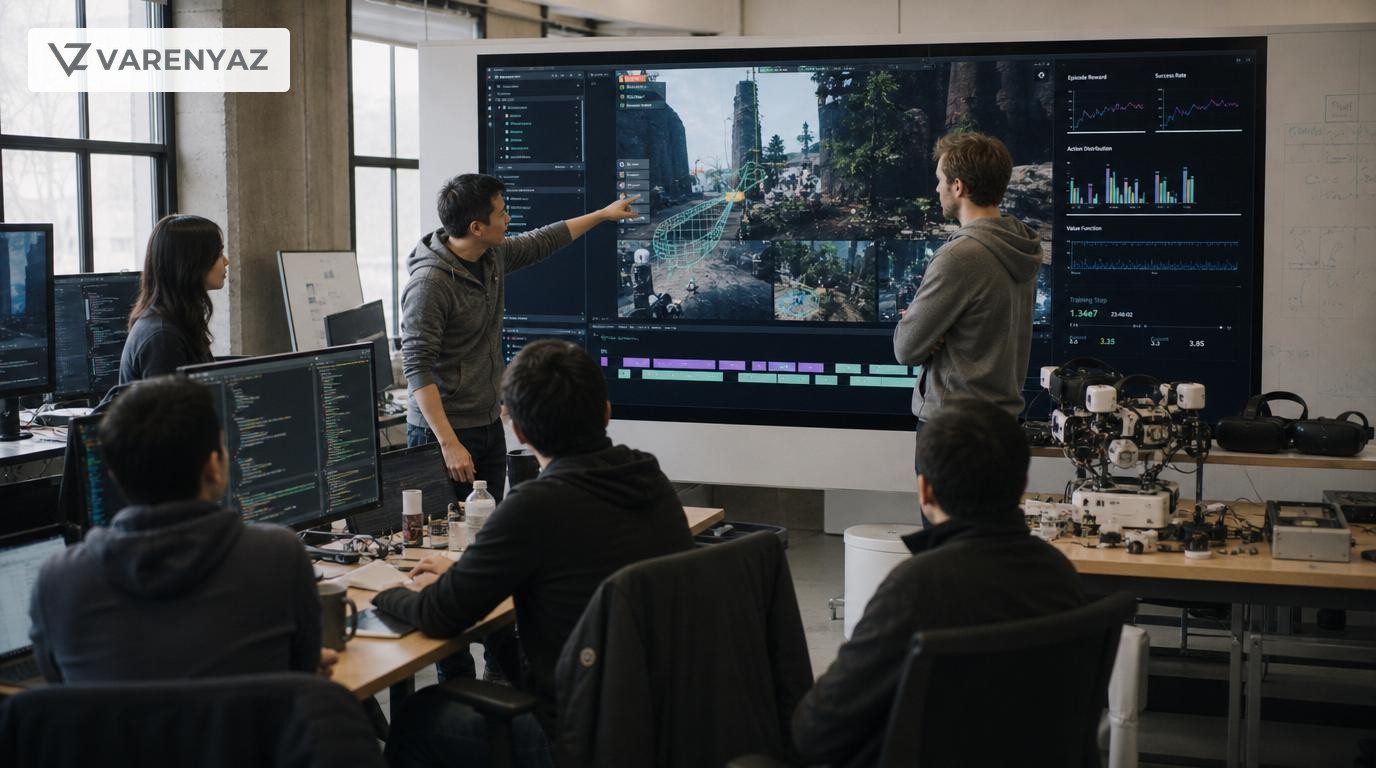
General Intuition is reportedly in talks to raise around $300 million at an approximate $2 billion valuation, centered on its work in embodied AI and world models. The startup trains AI agents using Medal’s massive dataset of roughly 2 billion gaming videos per year from about 10 million monthly active users. For enterprises, this is a signal that agentic, simulation-trained AI may soon move from research to real-world products in robotics, automation, and interactive applications.
News Desk
LiveEditorial Review
VarenyaZ Editorial Desk, Managing Editor
Global
In This Story
Coverage Signals
Key Takeaways
- General Intuition is reportedly raising $300M at an estimated $2B valuation, underscoring investor conviction in embodied AI and world models.
- The startup trains AI agents on Medal’s massive gaming video dataset, said to reach around 2 billion clips per year from 10 million monthly active users.
- Embodied AI shifts focus from text-only models toward agents that perceive, reason, and act in virtual and real environments.
- Gaming and simulated worlds are emerging as critical training grounds for robotics, industrial automation, and complex digital workflows.
- Enterprises should track how agentic AI trained in simulation translates into safer, cheaper experimentation for logistics, support, and operations.
- Data governance, user consent, and IP rights around user-generated gaming content will be key legal and reputational risk areas.
- Product and engineering leaders can start designing modular architectures that plug in world models and embodied agents as services.
- VarenyaZ can help teams prototype agentic interfaces, operational automation, and AI-enabled web apps built on emerging embodied AI capabilities.
General Intuition’s $300M embodied AI bet: why a $2B valuation matters
General Intuition is reportedly in advanced talks to raise around $300 million at an estimated $2 billion valuation, in a funding round that would place the startup among the most highly valued players in embodied AI and world models.
The company’s pitch to investors hinges on an unusual asset: access to Medal’s vast stream of user-generated gaming videos, reportedly approaching 2 billion clips per year from roughly 10 million monthly active users. General Intuition trains AI agents and world models on this river of interaction-rich content, aiming to build systems that can not only understand the world but act inside it.
Direct answer: what this funding means in practical terms
If completed, a $300 million raise at a $2 billion valuation would signal that major investors believe embodied AI is ready to move from research curiosity to platform shift. For enterprises, it means a near-term future where AI agents trained in simulated game worlds begin to power robotics, automation, interactive products, and complex digital workflows—well beyond today’s text-only chatbots.
From chatbots to embodied AI: what General Intuition is building
General Intuition operates in a different lane from many well-known model providers focused primarily on language. Its core thesis: the next generation of AI will be embodied—agents that perceive environments, maintain internal models of the world, plan long-horizon actions, and adapt continuously as conditions change.
To do this, the company leans heavily on world models: AI systems that learn internal representations of how environments evolve over time. When trained on long sequences of gameplay—actions, goals, failures, wins—world models can learn causality, not just correlation.
Medal’s dataset is uniquely suited to this:
- Billions of clips capture diverse games, physics, and environments.
- Each clip encodes goals, rewards, and human strategies.
- Sequential playthroughs give AI agents a timeline of decisions and outcomes.
In effect, General Intuition is trying to compress millions of human-hours of experimentation into machine-learned priors for agents that could later operate in real environments, from virtual control rooms to physical warehouses.
Why gaming video is becoming strategic AI infrastructure
Gaming has often been an early proving ground for AI, but Medal’s scale pushes this into infrastructure territory. Unlike curated datasets, user-generated clips span skill levels, edge cases, glitches, improvisation, and teamwork—all of which matter when deploying AI into messy real-world scenarios.
This kind of data offers several advantages:
- Action-rich sequences: Agents see what people try, not just what they say.
- High-density feedback: Scores, victories, and failures generate rich reward signals.
- Diverse environments: From physics-based simulators to strategy games, agents experience many “mini-worlds.”
For investors, that positions General Intuition less as a single-product company and more as a platform for training general-purpose agents, similar in ambition to early deep reinforcement learning labs.
Business and product implications of embodied AI
For business leaders, the strategic question is not whether your organization will use embodied AI, but where and when. The kinds of capabilities General Intuition is targeting could unlock new patterns in several domains:
- Robotics and logistics: Agents trained in rich simulations can be transferred to robots, improving navigation, manipulation, and decision-making in warehouses and factories.
- Digital twins: Embodied AI can run multi-step simulations inside digital copies of your operations to test changes before they hit production.
- Interactive products: Games, training tools, and immersive experiences can host NPCs and assistants that learn from and adapt to user behavior.
- Complex workflow automation: Instead of static rules, agentic systems can operate software “like a person,” navigating interfaces, reading context, and making decisions across multiple steps.
For CTOs and product leaders, this raises architectural questions: how to integrate agents, how to log and audit their behavior, and how to wrap them in safety and governance layers.
Risks, gaps, and open questions
Despite the excitement, several risks and unknowns remain around General Intuition’s approach and the embodied AI category more broadly.
1. Data rights and user consent
Training on user-generated gaming clips raises crucial questions:
- How are user permissions structured for AI training?
- What protections exist for creators’ rights and privacy?
- Can downstream enterprise users rely on clean data provenance?
Enterprises that later consume such models will increasingly demand transparent documentation on data sources and licenses.
2. Simulation-to-reality transfer
Even if agents perform well in virtual settings, performance can degrade in the real world, where sensor noise, edge cases, and physical constraints differ from games.
Leaders need to treat simulation-trained agents as prototypes that still require rigorous real-world testing, sandboxing, and phased rollouts.
3. Governance of autonomous agents
Agentic AI can take multi-step actions, making them powerful but harder to supervise. Enterprises must consider:
- How are actions logged, audited, and reversible?
- What guardrails prevent unsafe or non-compliant behavior?
- Which tasks remain human-in-the-loop by design?
These governance considerations will shape procurement decisions as embodied AI tools reach the enterprise market.
Signals for investors and technology leaders
For investors, a $2 billion valuation on an embodied AI thesis suggests a few macro signals:
- Capital is rotating from incremental chatbot features to more defensible AI platforms.
- Owning differentiated data streams—such as Medal’s gaming videos—is seen as a durable advantage.
- World models and agents are being framed as the next big “infrastructure layer” in AI.
For CIOs, CTOs, and digital leaders, three practical steps stand out:
- Map candidate processes: Identify operations where agents could act (monitoring dashboards, running simulations, navigating tools).
- Modernize architecture: Move toward API-driven, event-driven systems where agents can safely plug in and observe state.
- Experiment safely: Start with low-risk sandboxes—internal tools, test environments, or simulation-backed training platforms.
How this could reshape web, apps, and automation
If General Intuition and similar players succeed, embodied AI will not stay confined to robotics labs or game studios. It will flow into how web and software experiences are designed:
- Agentic web apps: Instead of clicking through dashboards, users might delegate tasks to embodied agents that act across multiple pages and systems.
- Contextual support: Agents can “look over the shoulder” of users inside complex apps, predicting intent and taking multi-step actions on their behalf.
- Interactive training and onboarding: Simulation-trained agents can guide staff through realistic scenarios, adapting to their decisions in real time.
This requires new UX patterns, robust backend orchestration, and thoughtful observability so teams can understand what agents are doing at any moment.
What leaders should watch next
Over the next 12–24 months, decision-makers should track:
- Whether General Intuition’s round closes at the rumored size and valuation.
- Early public demonstrations or partnerships that move beyond gaming into enterprise pilots.
- Cloud and platform players launching “world model as a service” offerings.
- Regulatory conversations around autonomous agents, data rights for user-generated content, and AI safety standards.
Collectively, these signals will indicate how fast embodied AI is likely to move from speculative to standard capability in the enterprise stack.
How VarenyaZ can help you prepare for agentic and embodied AI
Even if your organization is not training its own world models, you will likely consume services built on them—via APIs, SaaS tools, or embedded capabilities inside platforms you already use.
To be ready, you need web and application architectures that can:
- Integrate with AI and agent APIs securely.
- Instrument and log agent behavior end-to-end.
- Expose data in structures that world models can understand.
- Deliver UX patterns that put humans in control of AI decisions.
VarenyaZ works with teams to design and build modern web platforms, custom applications, and AI-enabled automation that are ready for embodied and agentic AI. If you are evaluating how to introduce AI agents into your product or operations, or want to prototype simulation-backed workflows, reach out to explore tailored options at https://varenyaz.com/contact/.
Conclusion: from games to global operations
General Intuition’s reported $300 million raise at a $2 billion valuation is more than a funding headline. It is a marker that the AI frontier is shifting from static content generation to embodied, action-taking agents trained in rich virtual worlds.
For founders, investors, and enterprise leaders in India, the United States, the United Kingdom, and beyond, the opportunity lies in translating these capabilities into resilient, human-centric systems. VarenyaZ can help you bridge that gap—designing the web experiences, custom applications, and automation workflows needed to safely harness the next wave of embodied AI.
Editorial Perspective
"If this round closes as reported, General Intuition will become one of the clearest market signals that the next AI platform shift is about agents that can act in complex environments, not just answer questions in a chat box."
"By training on billions of gaming videos, General Intuition is trying to compress years of human experimentation, failure, and strategy into transferable skills for AI agents that could later operate in warehouses, support desks, or immersive digital products."
"For CIOs and CTOs, the key takeaway is to architect systems today with the expectation that embodied AI and world models will soon appear as plug-and-play services in cloud and developer ecosystems."
Frequently Asked Questions
What is General Intuition reportedly raising and at what valuation?
General Intuition is reportedly in talks to raise around $300 million in new funding at an approximate $2 billion valuation, according to coverage of the ongoing discussions. The round would significantly increase the company’s capital base to scale its embodied AI and world model research and commercialization.
What makes General Intuition’s embodied AI approach different?
General Intuition focuses on embodied AI and world models trained in rich, interactive environments using Medal’s enormous corpus of gaming videos. Instead of learning only from static text or images, its agents learn from sequences of actions, goals, and outcomes, which can make them better suited to robotics, automation, and interactive digital products.
Why is the Medal gaming video dataset strategically important?
Medal hosts roughly 2 billion user-generated game clips per year from around 10 million monthly active users. This scale and diversity of gameplay, tactics, and environments offer a powerful training signal for AI agents learning how to perceive complex worlds, plan, and adapt—skills that can later be transferred to real-world tasks and simulations.
What are the business implications of embodied AI for enterprises?
Embodied AI can power agents that not only answer questions but also act: navigating 3D spaces, manipulating virtual or physical objects, automating workflows, and running simulations. For enterprises, that translates into potential gains in robotics, warehouse automation, digital twins, gaming, customer support, and complex decision-support systems.
What risks should leaders consider with simulation-trained AI agents?
Leaders should examine data rights and consent around user-generated content, bias in simulated environments, safety controls when transferring skills from games to the real world, and governance over autonomous agents. Clear oversight, robust testing, and careful deployment in constrained environments will be essential as embodied AI moves into production.
How can businesses practically prepare for embodied and agentic AI?
Businesses can start by mapping processes that involve repeated digital or physical actions, then exploring where simulated training or agent-based automation might reduce cost or risk. Partnering with a development firm like VarenyaZ can help teams design pilot projects, build AI-ready web apps, and integrate agentic workflows into existing stacks.
Selected References
Stay Ahead
Get concise, actionable insights on AI, digital strategy, and innovation. No spam, just value.
More Coverage
Related News
Jun 20, 2026
Fusion startups cross $7B: what deep-tech leaders must know
Fusion startups worldwide have raised more than $7.1 billion, with most of that capital concentrated in a small group of highly funded companies. This marks a shift from pure research to industrial-scale engineering, as private players race to turn fusion into commercial, carbon-free baseload power. For technology and infrastructure leaders, fusion is becoming a strategic factor in long-term power planning, AI data center expansion, and climate commitments. While timelines and technical risk remain uncertain, boards and CTOs should start tracking fusion alongside renewables and grid-scale storage in their energy roadmaps.
Jun 19, 2026
Baseten Targets $1.5B Round as AI Inference Arms Race Escalates
AI infrastructure startup Baseten is reportedly closing a $1.5 billion funding round at a valuation of around $13 billion, only months after its last mega-round. The raise highlights the growing strategic importance of AI inference platforms as enterprises shift from model experiments to production-scale deployment. For technology leaders, this marks a critical moment to decide where to build in‑house and where to rely on specialized inference providers to manage costs, latency, and scalability across generative AI applications.
Jun 18, 2026
Odyssey Raises $1.45B Valuation to Lead AI World Model Race
Odyssey, a startup building AI world models, has reached a $1.45 billion valuation in a funding round backed by Amazon and other major investors. World models simulate real environments so AI agents can plan, act, and learn in virtual space before deployment. This shift moves AI beyond text-focused LLMs toward simulation-native platforms for robotics, logistics, digital twins, and autonomous systems. For enterprises, it signals a new competitive phase where operations, infrastructure, and product teams should explore how world models can de-risk automation, optimize physical processes, and integrate with cloud and edge architectures.