

What Happened In Brief
Clair Health, founded by two Stanford graduates, has raised $11 million to develop a noninvasive hormone-tracking wearable focused on women’s health. The device aims to monitor inflammation, bloating, energy levels and cycle phases to detect irregularities, perimenopause, and hormonal fluctuations earlier and more precisely. For healthtech leaders and investors, this signals an emerging data infrastructure layer in femtech, where continuous hormone and cycle analytics can power new digital health services, clinical decision support tools, and personalized care experiences across apps, telehealth, and enterprise healthcare platforms.
News Desk
LiveEditorial Review
VarenyaZ Editorial Desk, Managing Editor
Global
In This Story
Coverage Signals
Key Takeaways
- Clair Health has raised $11 million to develop a noninvasive hormone tracking wearable focused on women’s health.
- The device aims to track inflammation, bloating markers, energy levels, and menstrual cycle phases to surface hormone-related insights.
- Clair Health targets use cases including cycle irregularities, perimenopause, and hormonal fluctuations, going beyond basic period tracking.
- Continuous hormone-related data could become a new infrastructure layer for femtech apps, telehealth, and clinical decision support tools.
- For digital health and SaaS teams, the opportunity lies in integrating such biosensing devices into secure, AI-powered data platforms.
- Key risks include data privacy, clinical validation, regulatory classification, and equitable access beyond affluent consumer segments.
- Investors and product leaders should watch how Clair Health positions its APIs, partnerships, and evidence base over the next 18–24 months.
- Healthtech companies can work with partners like VarenyaZ to build compliant web platforms, integrations, and AI workflows around emerging wearables.
Clair Health’s $11M bet on noninvasive hormone tracking
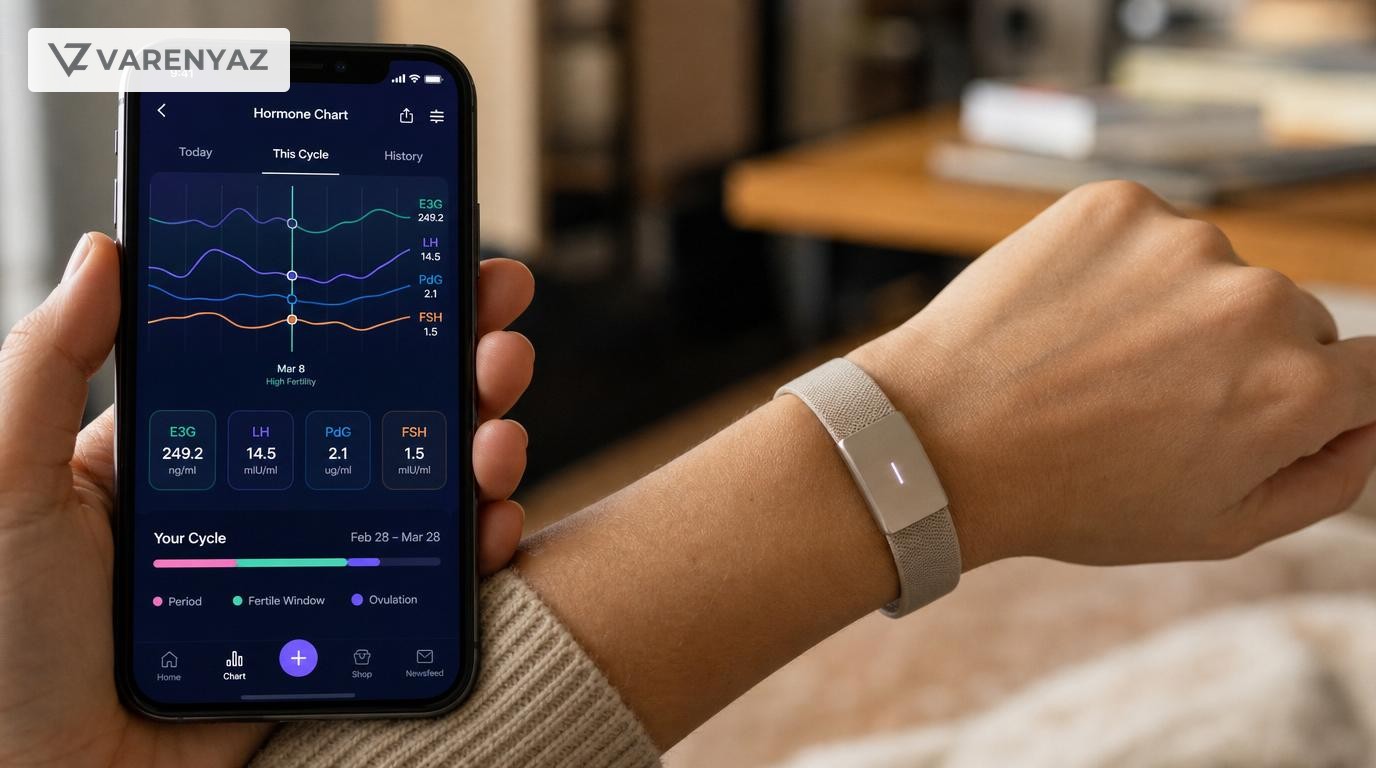
Clair Health, a femtech startup founded by two Stanford graduates, has raised $11 million to build a noninvasive hormone-tracking wearable designed specifically for women’s health. The company’s device aims to measure signals related to inflammation, bloating, energy levels, and cycle phase classification, turning under-served hormonal data into an accessible, continuous data stream.
While consumer period-tracking apps have become mainstream, most still rely on self-reported symptoms and calendar-based prediction. Clair Health is targeting the gap between simple symptom logs and invasive, episodic lab tests by positioning its wearable as a sensor-driven lens into hormonal dynamics across the menstrual cycle and through perimenopause.
What Clair Health’s wearable actually tracks
Clair Health has not disclosed every technical detail of its sensing stack, but the company has outlined several core capabilities it aims to deliver:
- Inflammation and bloating markers: Using noninvasive signals, the wearable seeks to flag patterns that correlate with water retention, bloating, and systemic inflammation that shift across the cycle.
- Energy levels and fatigue: By combining activity, physiological signals, and trends over time, the device is expected to model energy variability linked to hormonal changes.
- Cycle phase classification: Leveraging machine learning, Clair Health plans to classify cycle phases more precisely than calendar-based apps, potentially capturing luteal and follicular phase nuances.
- Irregularity and perimenopause insights: Over time, deviations from a user’s baseline could indicate cycle irregularities or perimenopausal transitions, supporting earlier conversations with clinicians.
Importantly, Clair Health is positioning this as noninvasive and consumer-friendly, seeking to avoid the friction, cost, and compliance overhead associated with continuous blood testing technologies.
Why this matters: from period apps to hormone infrastructure
For years, women’s health tech has been dominated by symptom trackers and fertility apps. Clair Health’s approach signals a shift toward infrastructure-level data for hormones and cycles, similar to how continuous glucose monitors created a new substrate for diabetes care and digital therapeutics.
If successful, Clair Health’s wearable could:
- Provide a richer, longitudinal record of hormone-related patterns than existing tools.
- Serve as a data source for digital health platforms offering personalized coaching, mental health support, or chronic condition management tied to hormonal cycles.
- Give clinicians objective, continuous context that complements lab tests and patient-reported symptoms.
- Open new R&D avenues for pharma and health systems looking at how hormonal shifts influence conditions like migraines, mood disorders, metabolic health, and sleep.
For business leaders, the key takeaway is that hormonal data is being reframed from a niche wellness metric into a potential core signal for women’s health decision-making across the lifespan.
Direct answer: what decision-makers need to know now
Clair Health has raised $11 million to develop a noninvasive hormone tracking wearable that analyzes inflammation, bloating markers, energy levels, and menstrual cycle phases. Its goal is to detect cycle irregularities, perimenopause, and hormonal fluctuations earlier and more precisely than calendar-based apps. For digital health companies, this creates a new biosensing data source that can feed AI models, personalized care journeys, and clinical decision support tools, provided that integrations, privacy controls, and regulatory strategies are robust.
Business impact for healthtech, SaaS, and providers
The implications of Clair Health’s funding extend far beyond one device. They point to a shift in where value accrues in femtech and digital health:
1. New data layer for women’s health platforms
App-only femtech products have been limited by self-reported data and simple rules-based predictions. Clair Health’s sensor-driven approach could enable:
- More accurate cycle and symptom forecasting based on physiological signals rather than guesswork.
- Context-aware interventions such as timing medication reminders, exercise plans, or mental health support around hormone-linked patterns.
- Segmented products for teens, fertility-focused users, perimenopausal women, and patients with hormone-sensitive conditions.
For SaaS and platform leaders, this is an opportunity to build APIs, dashboards, and analytics layers that sit on top of wearable-generated hormone data.
2. Integration with telehealth and employer benefits
Telehealth providers, virtual OB-GYN clinics, and employer health programs increasingly seek differentiation through personalization. Clair Health-style wearables can power:
- Pre-visit data summaries and risk flags for clinicians.
- Evidence-backed wellness programs linked to hormonal cycles.
- Employer benefits that recognize the impact of hormones on energy, mood, and productivity.
For operations teams, the challenge is stitching wearable data into existing EHRs, care pathways, and reporting frameworks without overwhelming clinicians or breaching compliance.
3. Pharma and research partnerships
Continuous hormone-related signals can enrich observational studies and post-market research, especially when combined with symptom and outcome data. That opens monetization routes around:
- De-identified cohort analytics.
- Companion apps and digital biomarkers for clinical trials.
- New endpoints capturing the real-world impact of therapies across the cycle.
However, this will depend heavily on Clair Health’s ability to validate its biomarkers and align with ethical, regulatory, and privacy standards.
AI and software relevance: from raw signals to usable insights
On its own, a hormone tracking wearable is just a stream of raw signals. The value lies in the software and AI stack that interprets those signals and operationalizes them into user experiences, workflows, and decisions.
Key capabilities likely to matter for product and engineering leaders include:
- Signal processing pipelines that clean and normalize sensor data in near real time.
- Machine learning models for cycle phase classification, anomaly detection, and symptom forecasting.
- Explainable UX that translates complex probabilities into clear, actionable guidance for non-expert users.
- Data interoperability through standards-based APIs and secure integration with EHRs, telehealth platforms, and analytics tools.
Building and maintaining this stack demands expertise in AI/ML, regulated data architectures, privacy-by-design, and web and app experience design—areas where external partners can accelerate execution.
Risks, constraints, and open questions
Despite the promise, several unresolved issues will shape how impactful Clair Health becomes:
- Clinical validation: How robustly will Clair’s metrics correlate with lab-based hormone tests and clinical outcomes? Without strong evidence, health systems and regulators may limit its use.
- Regulatory classification: The device could be treated as a general wellness product or, over time, as a medical device, which would change its development, claims, and marketing pathways.
- Data privacy and trust: Hormonal and reproductive data is highly sensitive, particularly in markets with volatile regulatory landscapes. Missteps here could trigger both user backlash and legal exposure.
- Bias and inclusivity: Models trained on narrow demographics may perform poorly for users from different age groups, ethnicities, or health profiles.
- Accessibility and pricing: Premium wearables risk serving only affluent consumers unless payers, employers, or health systems come into the loop.
Business leaders considering partnerships or integrations will need to evaluate how Clair Health addresses these factors in its product and data strategies.
What to watch next
Over the next 18–24 months, CTOs, investors, and product teams should monitor:
- Product milestones: Hardware form factor, battery life, comfort, and reliability in everyday use.
- Evidence generation: Peer-reviewed studies, pilot programs with clinics, or real-world outcome data.
- Platform strategy: Availability of APIs, developer documentation, and integration partnerships with leading health platforms.
- Go-to-market focus: Whether Clair Health prioritizes direct-to-consumer, B2B2C with employers and payers, or direct integration with providers.
- Regulatory positioning: Signals about whether the company aims to remain in wellness or seek formal medical device clearances.
These dimensions will determine whether Clair Health becomes a standalone consumer brand, a behind-the-scenes data provider, or a hybrid.
How digital teams can prepare and respond
For healthtech founders, SaaS leaders, and enterprise healthcare teams, the right move is not to wait passively for hardware to mature, but to prepare the digital foundation now:
- Design architectures that can ingest wearable data securely and at scale.
- Plan for AI and analytics layers that can adapt as new biosignals become available.
- Build user experiences that respect sensitivity around reproductive and hormonal data.
- Anticipate regulatory, consent, and cross-border data transfer implications.
If you are planning to integrate advanced wearables, automate data flows, or build AI-driven health experiences, you can start a focused conversation with the VarenyaZ team at https://varenyaz.com/contact/.
Where VarenyaZ fits: from hardware signal to digital experience
Clair Health’s $11 million raise is one more signal that the next wave of health innovation will be won not only by novel sensors, but by the platforms that make those sensors usable, trustworthy, and scalable.
VarenyaZ partners with healthtech and femtech teams to:
- Design and develop web and app platforms that surface complex health data in clear, user-centric interfaces.
- Build secure backend infrastructures for ingesting and processing wearable and biosensor streams.
- Implement AI workflows that turn raw signals into actionable insights with traceable logic.
- Automate operational processes around onboarding, reporting, and clinician workflows.
As noninvasive hormone tracking moves from concept to reality, the organisations that succeed will be those that treat data, software, and experience design as strategic capabilities. With deep expertise in web development, automation, and AI, VarenyaZ helps teams turn emerging health hardware—like Clair Health’s wearable—into differentiated, trustworthy digital health products.
Editorial Perspective
"Clair Health’s funding points to a shift in femtech from symptom logging to continuous biosensing, where hormone-linked signals become a strategic data asset for digital health platforms and care providers."
"The critical question for leaders is not just whether the wearable works, but how its data can be securely integrated into AI models, clinical workflows, and consumer experiences at scale."
"As hormone tracking moves closer to clinical utility, product teams must design for regulatory scrutiny, explainability, and trust, not just elegant UX or engagement metrics."
Frequently Asked Questions
What is Clair Health building?
Clair Health is developing a noninvasive wearable designed to track hormone-related signals in women, including inflammation, bloating markers, energy levels, and menstrual cycle phases. The goal is to generate actionable insights around cycle irregularities, perimenopause, and broader hormonal fluctuations without requiring blood tests.
How much funding has Clair Health raised?
Clair Health has raised $11 million in funding to accelerate product development, clinical validation, and go-to-market efforts for its noninvasive hormone tracking wearable and supporting data platform.
Why does a hormone tracking wearable matter for businesses?
A hormone tracking wearable like Clair Health’s can create a new data layer for women’s health, enabling digital health platforms, insurers, and providers to deliver more personalized care, build new subscription services, and design targeted interventions for conditions linked to hormonal changes across reproductive life stages.
How could AI be used with Clair Health’s data?
AI models can analyze longitudinal hormone-related signals captured by Clair Health’s device to detect patterns, forecast symptom flares, classify cycle phases, and support clinicians with risk flags or decision support. This requires secure data pipelines, robust model governance, and explainable insights for both patients and providers.
What should healthtech founders watch as Clair Health scales?
Founders should monitor Clair Health’s regulatory strategy, clinical validation results, integration options (such as APIs and SDKs), and partnerships with telehealth, EHR, or employer health platforms. These factors will determine whether the wearable becomes a standalone consumer device or an infrastructure layer embedded across the digital health ecosystem.
How can companies integrate hormone tracking wearables into their products?
Companies can integrate hormone tracking wearables by building secure backend systems for ingesting device data, mapping signals into clinical or wellness workflows, and layering AI for personalization. Partnering with specialists like VarenyaZ can help with API integrations, compliant data architectures, and user-centric web and app experiences.
Selected References
Stay Ahead
Get concise, actionable insights on AI, digital strategy, and innovation. No spam, just value.
More Coverage
Related News
Jun 21, 2026
General Intuition Eyes $2B Valuation On $300M Embodied AI Raise
General Intuition is reportedly in talks to raise around $300 million at an approximate $2 billion valuation, centered on its work in embodied AI and world models. The startup trains AI agents using Medal’s massive dataset of roughly 2 billion gaming videos per year from about 10 million monthly active users. For enterprises, this is a signal that agentic, simulation-trained AI may soon move from research to real-world products in robotics, automation, and interactive applications.
Jun 20, 2026
Fusion startups cross $7B: what deep-tech leaders must know
Fusion startups worldwide have raised more than $7.1 billion, with most of that capital concentrated in a small group of highly funded companies. This marks a shift from pure research to industrial-scale engineering, as private players race to turn fusion into commercial, carbon-free baseload power. For technology and infrastructure leaders, fusion is becoming a strategic factor in long-term power planning, AI data center expansion, and climate commitments. While timelines and technical risk remain uncertain, boards and CTOs should start tracking fusion alongside renewables and grid-scale storage in their energy roadmaps.
Jun 19, 2026
Baseten Targets $1.5B Round as AI Inference Arms Race Escalates
AI infrastructure startup Baseten is reportedly closing a $1.5 billion funding round at a valuation of around $13 billion, only months after its last mega-round. The raise highlights the growing strategic importance of AI inference platforms as enterprises shift from model experiments to production-scale deployment. For technology leaders, this marks a critical moment to decide where to build in‑house and where to rely on specialized inference providers to manage costs, latency, and scalability across generative AI applications.