
Performance Engineering for Modern Manufacturing
Explore how performance engineering transforms manufacturing by optimizing throughput, quality, reliability, and digital systems across plants.

Quick Answer
Performance engineering in manufacturing is the discipline of designing plants, processes, and digital systems to consistently hit throughput, quality, cost, and reliability targets. It combines OT and IT data, real-time monitoring, analytics, and AI to expose bottlenecks and drive continuous improvement. This article explains core concepts, key metrics, target architecture, and implementation patterns, with examples like predictive maintenance, digital twins, and energy optimization. It also covers governance, risks, and vendor choices, then outlines a pragmatic roadmap and how VarenyaZ supports manufacturers with web, data, and AI solutions.
In this article
Coverage signals
14 min
Jul 4, 2026
VarenyaZ Editorial Desk, Technical Content Review
Updated Jul 4, 2026
Key Takeaways
- Performance engineering in manufacturing aligns design, operations, and digital systems around a shared set of throughput, quality, and reliability goals.
- Most value comes from integrating OT and IT data into a usable performance layer, not from any single sensor or machine-learning model.
- Clear, stable metrics such as OEE, FPY, and MTBF are the foundation for benchmarking and continuous improvement across plants.
- Digital twins, predictive maintenance, and energy optimization are powerful but only pay off when fed by high-quality, contextualized data.
- Governance, change management, and worker empowerment matter as much as the technology stack in sustaining performance gains.
- A practical roadmap starts small with one high-impact line, proves ROI, then scales patterns, tooling, and playbooks across the network.
- Partnering with specialists like VarenyaZ can accelerate secure data integration, AI model design, and intuitive performance dashboards.
- Well-designed web and data platforms turn complex manufacturing performance data into clear, role-based insights for every stakeholder.
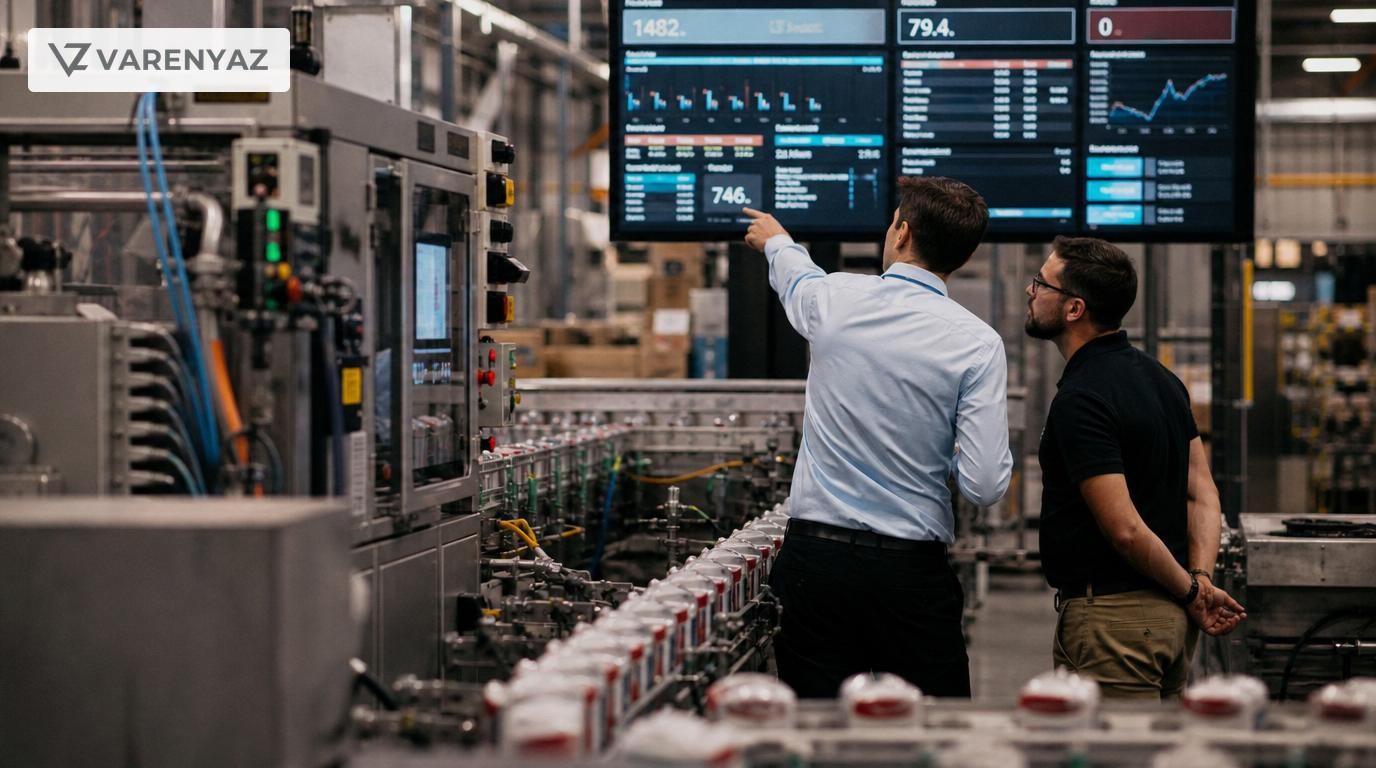
Why performance engineering now defines competitive manufacturing
In manufacturing, most leaders already know where they want to be: higher throughput, lower scrap, fewer surprises, safer plants, and happier customers. The challenge is getting there consistently, across multiple lines, sites, and product variants. That is where performance engineering in manufacturing comes in.
Performance engineering is the discipline of designing, operating, and continually improving plants so they reliably hit agreed targets for throughput, quality, reliability, safety, and cost. It is not a single tool or platform. It is a way of working that ties together machines, data, software, and people.
In the past, performance improvements happened through periodic lean projects, local automation fixes, or a new MES implementation. Today, manufacturers have a richer toolkit: industrial IoT, real-time analytics, digital twins, and AI. But without a performance engineering mindset, those investments become disconnected pilots instead of an integrated capability.
In this article, we will unpack what performance engineering really means in a manufacturing context, how it creates business value, the architectures and metrics that support it, and how to implement it step by step. We will also explore how partners like VarenyaZ help manufacturers turn data and AI into practical, plant-ready performance solutions.
Direct answer: What is performance engineering in manufacturing?
Performance engineering in manufacturing is the intentional design and continuous optimization of processes, equipment, and digital systems to meet defined goals for throughput, quality, reliability, safety, and cost. It brings together:
- Operational technology (OT) such as PLCs, SCADA, DCS, and sensors
- IT systems such as MES, ERP, QMS, and maintenance software
- Data infrastructure spanning edge, on-premise, and cloud platforms
- Analytics, automation logic, and increasingly AI/ML models
- People, playbooks, and governance for continuous improvement
The goal is simple but demanding: give every decision-maker, from operators to executives, an accurate real-time view of performance and the tools to act quickly and confidently.
The business case: Where performance engineering creates value
Performance engineering in manufacturing is not about dashboard aesthetics or technical elegance. It is about financial outcomes that show up in P&L and balance sheets. When done right, it translates into four macro-level benefits.
1. Higher throughput without major capex
Instead of buying another line or machine, many manufacturers can unlock 5–20% more effective capacity from existing assets by reducing micro-stoppages, optimizing changeovers, and balancing line speeds. Detailed performance data reveals where queues form, where machines starve or block, and where human workflows create hidden constraints.
The ability to simulate and test changes (for example, changes in scheduling, batch size, or buffer sizing) through a digital twin or advanced planning model lets plants grow volume without immediately expanding footprint or headcount.
2. Better quality and less waste
Scrap and rework costs are visible, but their underlying causes often are not. A performance engineering approach connects process parameters, material batches, environmental factors, and operator actions with quality results. That makes it possible to:
- Predict which runs are likely to go out of spec
- Identify which process parameters, material lots, or machine states correlate with defects
- Implement automated holds or alerts when risk rises
Over time, the result is higher first pass yield (FPY), more predictable quality, and fewer customer complaints.
3. Increased asset reliability and less unplanned downtime
Unplanned downtime is one of the biggest destroyers of OEE and customer trust. Performance engineering harnesses predictive maintenance, condition monitoring, and root cause analysis to detect issues before they stop the line. That does not mean replacing preventive maintenance, but rather augmenting it with data-driven insights.
By building models on vibration, temperature, current, pressure, and other signals, manufacturers can prioritize maintenance windows based on risk, not just calendar time, improving MTBF and reducing MTTR.
4. Smarter energy and resource usage
Energy, water, compressed air, and other utilities are major cost drivers and sustainability levers. Performance engineering integrates energy data with production context—shift, product, line, speed—to calculate energy intensity per unit and identify when assets are using more than expected.
This supports both cost reduction and sustainability targets, and gives marketing teams tangible, data-backed stories for customers who now expect environmental transparency.
Core metrics: What performance engineering actually optimizes
The foundation of any performance engineering program is a stable, shared set of metrics. These metrics must be simple enough to understand, but rich enough to guide meaningful decisions.
Throughput and capacity metrics
- Throughput: units produced (or processed) per hour or per shift.
- Cycle time: time to complete one unit or one standard operation.
- WIP (work-in-process): inventory between steps, often indicating flow problems.
These metrics are crucial for bottleneck identification and balancing multi-step processes.
Overall Equipment Effectiveness (OEE)
OEE is a widely adopted composite metric that combines:
- Availability (actual runtime versus planned runtime)
- Performance (actual production rate versus ideal rate)
- Quality (good units versus total units produced)
Because OEE ties together downtime, speed loss, and quality loss, it remains a central metric for performance engineering programs across industries.
Quality metrics
- First Pass Yield (FPY): percentage of units that meet quality standards without rework.
- Scrap rate: proportion of material or units discarded.
- Defect rate: defects per million opportunities (DPMO) or per batch.
Performance engineering uses these metrics as feedback signals to tune processes, update standard work, and refine predictive models.
Reliability and maintenance metrics
- Mean Time Between Failures (MTBF): average uptime between breakdowns.
- Mean Time To Repair (MTTR): average time required to restore operation after a failure.
- Planned maintenance compliance: adherence to preventive tasks schedules.
These metrics help shift maintenance strategies from reactive to proactive and predictive.
Energy and sustainability metrics
- Energy per unit: energy consumption normalized by unit produced or tonne processed.
- Peak demand usage: contribution to peak charges on utility bills.
- Carbon intensity: emissions per unit (where data is available).
Capturing these metrics in a standardized way enables plants to make performance and sustainability trade-offs explicit instead of relying on assumptions.
Architecture: How performance engineering connects OT and IT
Delivering on performance engineering requires more than a handful of sensors and spreadsheets. It demands a layered architecture that bridges shop floor control with enterprise systems in a secure, governed way.
Layer 1: Devices and control systems (OT)
At the base are physical assets and their control systems:
- PLCs, PACs, and distributed control systems (DCS)
- SCADA and HMI systems for visualization and control
- Sensors for temperature, vibration, pressure, flow, humidity, power, and more
- Drives, robots, conveyors, and other automation components
This is where data originates and where real-time control decisions are executed, often within milliseconds.
Layer 2: Data collection and edge processing
Next comes the layer that streams, filters, and pre-processes data:
- Industrial protocols (e.g., OPC UA, Modbus) for connecting control systems
- Edge gateways or industrial PCs aggregating data close to machines
- Local buffering and preliminary analytics to support low-latency decisions
Edge processing reduces bandwidth usage, keeps critical control logic local, and improves reliability in environments with intermittent connectivity.
Layer 3: Plant systems (MES, LIMS, CMMS, QMS)
Manufacturing Execution Systems, Quality Management Systems, Laboratory Information Management Systems, and maintenance platforms provide context:
- What product and batch is running
- Which operator or team is on shift
- What work orders, recipes, or routings are in play
- Which inspection plans or maintenance tasks are due
Performance engineering requires this context to make sense of raw machine signals.
Layer 4: Data platform and analytics
On top sits the data platform—on-premise, cloud, or hybrid—that stores and analyzes data across lines and sites:
- Time-series databases for sensor and event data
- Data lakes or warehouses for structured plant and enterprise data
- Streaming pipelines for near real-time processing
- Analytics, BI, and data science workbenches
This is where performance dashboards, anomaly detection, forecasting, and optimization models live.
Layer 5: Applications, dashboards, and APIs
Finally, user-facing applications—web portals, mobile apps, line-side HMIs—deliver insights and actions back to people and systems:
- Performance dashboards for operators, engineers, and managers
- Alerting systems that trigger notifications based on thresholds or anomalies
- APIs connecting performance insights to ERP, planning, and customer systems
This layer is where VarenyaZ often engages, designing intuitive web interfaces, integrating data sources, and embedding AI models into workflows so that performance engineering is not just a back-end exercise but an everyday tool.
Key performance engineering use cases in manufacturing
With architecture and metrics in place, performance engineering becomes real through specific, high-value use cases. Here are some of the most impactful patterns we see across manufacturing sectors.
1. Real-time performance monitoring and alerts
The starting point for many plants is simply seeing what is happening, right now, in a reliable way. Real-time monitoring typically includes:
- Live OEE and throughput views by line, cell, and machine
- Downtime categorization—planned, unplanned, micro-stops
- Quality status and scrap counts across runs
- Visual cues for bottlenecks and queues along the line
Alerts can then be triggered when indicators breach defined thresholds, such as a sudden increase in micro-stoppages, quality drifts, or abnormal energy use.
2. Predictive maintenance and condition monitoring
Predictive maintenance is often one of the most visible applications of performance engineering. The idea is straightforward: watch machine health indicators so you can intervene before a failure stops production.
Implementation usually involves:
- Instrumenting critical assets with vibration, temperature, and current sensors
- Streaming those signals to an analytics platform
- Training models to distinguish normal patterns from early failure signatures
- Integrating alerts with maintenance work order systems
The result is better asset utilization, fewer fire-fighting breakdowns, and more predictable maintenance windows, which can be aligned with production planning.
3. Process optimization and quality prediction
Beyond machine health, performance engineering seeks to optimize the processes themselves. In a continuous process plant, for example, that might mean:
- Analyzing how temperature, pressure, feed rates, and catalyst levels affect product quality
- Using models to suggest optimal set-points for different grades or recipes
- Detecting drifts from golden batches in near real time
In discrete manufacturing, it can involve correlating quality outcomes with tool wear, machine offsets, or operator actions, and automatically adjusting settings or triggering inspections for high-risk units.
4. Energy and resource optimization
Energy usage patterns are often surprisingly opaque at the line or machine level. Performance engineering helps by:
- Measuring energy consumption per asset, line, and product
- Identifying no-load and idle usage that can be eliminated
- Optimizing schedules to avoid peak tariffs where possible
- Highlighting opportunities to change set-points or equipment for better efficiency
These insights are valuable not only for cost control but also for sustainability reporting and customer-facing ESG commitments.
5. Digital twins and scenario simulation
A digital twin is a virtual representation of a physical system that is continually updated with real-world data. In manufacturing, digital twins can model:
- Entire production lines or cells
- Individual assets, such as a critical compressor or furnace
- Plant layouts and logistics flows
By combining historical data, physics-based models, and real-time feeds, digital twins let teams explore scenarios safely: what happens if we increase line speed, change the sequence of operations, add a buffer, or run a new product variant? That capability turns performance engineering into both a diagnostic and a design discipline.
Implementation: A practical roadmap for manufacturers
Many organizations struggle not with the concept of performance engineering, but with where to begin. Here is a pragmatic roadmap to move from idea to impact.
Step 1: Clarify business objectives and constraints
Before discussing tools, define the target. Are you trying to free up capacity for a new product launch? Reduce scrap in a particular process? Improve on-time delivery? Cut energy costs? Your performance engineering program should start with a small number of clear, quantified objectives.
At the same time, define constraints: safety requirements, regulatory compliance, budget limits, legacy systems you must support, and any cybersecurity policies that affect data flows.
Step 2: Choose a lighthouse line or asset
Resist the urge to launch a plant-wide or multi-site initiative immediately. Instead, pick a single line, cell, or asset with:
- High business impact (revenue, margin, or risk)
- Frequent problems (downtime, scrap, delays)
- A motivated local team willing to experiment
This becomes your lighthouse, where you test architecture, data models, dashboards, and governance before scaling.
Step 3: Define metrics and data requirements
With the lighthouse chosen, define the KPIs you need—such as OEE, FPY, MTBF—then work backward to identify data sources:
- Which signals must we collect from machines and sensors?
- What contextual data comes from MES, ERP, QMS, or CMMS?
- How will we align timestamps and units across sources?
This step is where standards like IEC 62264 and ISA-95, which describe enterprise-control system integration models, can guide how you structure data and interfaces between systems.
Step 4: Build a minimal, robust data pipeline
You do not need a perfect, future-proof data platform on day one. Start with a minimal pipeline that:
- Securely collects priority OT data via standard protocols
- Stores time-series data in a durable, queryable form
- Ingests contextual data (orders, batches, maintenance events)
- Supports simple analytics and visualization tools
Focus on reliability, traceability, and security. A smaller, well-governed data set is better than a sprawling but unreliable one.
Step 5: Deliver visible wins with simple analytics first
It can be tempting to jump straight to AI. In practice, many of the earliest wins come from:
- Basic Pareto analysis of downtime reasons
- Trend charts for key process parameters
- Correlation analysis between operating conditions and scrap
- Simple rule-based alerts for tolerances
These tools are easy to explain, validate, and trust. As teams get used to data-driven decisions, you can introduce more advanced analytics and machine-learning models.
Step 6: Embed insights into workflows
Dashboards alone rarely change behavior. Performance engineering becomes real when insights are integrated into daily work:
- Short interval control routines that use live KPIs
- Standard operating procedures that reference digital alerts
- Maintenance workflows that originate from predictive models
- Daily huddles where teams review yesterday’s performance and plan experiments
This is where web design and UX matter: clean, role-based interfaces can turn complex data into a few simple actions per user, per shift.
Step 7: Scale with reusable patterns and governance
Once the lighthouse shows results, the next challenge is scaling without chaos. That requires:
- Standard data models and naming conventions
- Reusable connectors and integration patterns
- Security and access rules that carry across sites
- Shared playbooks for performance reviews and improvement projects
A central performance engineering team—often blending operations, IT, and data skills—can support sites while respecting local autonomy.
Risks, trade-offs, and how to manage them
No performance engineering program is risk-free. The biggest pitfalls are rarely in the algorithms; they lie in people, process, and governance.
Data quality and trust
If users see obviously wrong numbers in dashboards—negative durations, impossible rates—they quickly lose faith. That is why data validation, clear ownership of data sources, and transparent definitions of metrics are essential. In early stages, it is worth running manual cross-checks between system outputs and physical counts to build trust.
Complexity versus maintainability
Advanced AI models can deliver powerful insights, but they also add complexity. Ask whether a simpler rule-based or statistical approach would be easier to maintain with existing skills while still delivering most of the value. Aim for a portfolio of models with differing complexity levels, not a single all-or-nothing solution.
Cybersecurity and safety
Connecting OT and IT systems increases cyber exposure. This must be balanced with safety and operational continuity. Best practices include:
- Network segmentation between critical control systems and external networks
- Use of secure, authenticated protocols and encrypted tunnels
- Strict access controls and monitoring for unusual behavior
- Regular reviews of patches and firmware updates for industrial devices
Performance engineering efforts should be designed hand-in-hand with cybersecurity and safety teams, not as an afterthought.
Change fatigue and workforce adoption
Operators and engineers have seen many initiatives come and go. If performance engineering feels like another short-lived program or a top-down surveillance system, adoption will suffer. Instead, involve frontline teams in problem selection, dashboard design, and validation. Celebrate their improvements and ensure the system helps them do their jobs better, not just report on them.
Vendor and technology lock-in
Given the rapid pace of industrial tech, locking yourself into closed, proprietary stacks can limit future options. Look for solutions that support open standards, flexible APIs, and portable data models. When working with partners like VarenyaZ, clarify from the outset that you want architectures that can evolve over time, including multi-cloud or hybrid scenarios.
Choosing the right partners and platforms
Very few manufacturers will build every component of their performance engineering stack internally. You will likely combine:
- OT and automation vendors (for control systems and sensors)
- MES, ERP, and quality system providers
- Cloud and data platform vendors
- Specialist integrators and development partners
When evaluating partners, consider:
- Domain understanding: Do they understand your processes, constraints, and safety requirements?
- Openness: Do they embrace open standards and integration, or push closed ecosystems?
- UX and adoption focus: Can they design interfaces and workflows that real users will adopt?
- Security posture: Are their architectures aligned with your cybersecurity standards?
- Support model: How will knowledge be transferred so you are not dependent forever?
For the digital layer—web portals, data integration, and AI—partners like VarenyaZ can complement your internal engineering by building scalable performance applications tailored to your plants.
How VarenyaZ supports performance engineering in manufacturing
VarenyaZ operates at the intersection of web development, data engineering, and AI—precisely where performance engineering’s digital layer lives. Our role is not to replace your MES or automation vendors, but to connect, extend, and humanize them.
Web platforms that make performance visible and actionable
We design and build web-based performance portals that unify data from OT systems, MES, ERP, QMS, and maintenance platforms. Our focus is on:
- Role-based dashboards for operators, supervisors, maintenance teams, and executives
- Clear navigation from high-level KPIs to root-cause views
- Responsive design that works across large displays, desktops, and mobile devices
- Contextual alerts that highlight what needs attention now, not everything at once
Good web design is not cosmetic; it determines whether performance engineering data becomes part of daily decision-making.
Data integration and performance data models
Our development teams help integrate disparate data sources into a coherent performance layer. This includes:
- Building secure connectors to plant systems via standard industrial protocols
- Designing time-series and contextual data models aligned with standards such as IEC 62264
- Implementing robust ETL/ELT pipelines and event streams
- Ensuring data lineage and governance so that metrics are trusted
We work with your existing technology stack—cloud, on-premise, or hybrid—to add capabilities rather than forcing a rip-and-replace approach.
AI development for predictive and prescriptive insights
On top of solid data foundations, VarenyaZ develops AI models tailored to your use cases:
- Predictive maintenance models based on vibration, temperature, and process data
- Quality prediction and golden batch detection for process industries
- Anomaly detection for early warning of performance drifts
- Optimization models for scheduling, line balancing, or energy usage
Crucially, we embed these models into user interfaces and workflows so that recommendations are explainable, actionable, and trackable over time.
From pilot to platform
We help clients move beyond pilot purgatory. That means:
- Starting with a lighthouse line or plant to prove value
- Documenting patterns, playbooks, and architectures from day one
- Designing reusable components—dashboards, connectors, models—that scale across sites
- Training internal teams to own and extend the platform over time
If you are exploring how to use performance engineering, data, and AI to improve your plants, you can talk to the VarenyaZ team via https://varenyaz.com/contact/.
Conclusion: Turning performance engineering into a core capability
Performance engineering in manufacturing is not a one-off project or a single software purchase. It is a capability: the ability to see, understand, and continually improve how your plants perform, line by line and shift by shift.
It depends on stable metrics, thoughtful architecture, disciplined data practices, and above all, people who can interpret and act on insights. Technology—from industrial IoT to AI—amplifies that capability, but does not replace it.
VarenyaZ supports this journey by building the digital layer that makes performance engineering usable: high-quality web interfaces, resilient integration and data platforms, and AI models designed around your real constraints and goals. Whether you are optimizing a single line or orchestrating a network of global plants, robust web design, web development, and AI development are now central to unlocking the next level of manufacturing performance.
Editorial Perspective
Expert Review Notes
"Performance engineering in manufacturing is no longer about isolated efficiency projects; it is about building a repeatable digital capability that keeps every line, asset, and team tuned to business goals."
"The real unlock is not just adding sensors or AI models, but creating a unified performance layer where OT data, MES, and business systems come together in a way people can trust and act on quickly."
"Manufacturers that combine strong web platforms, robust data pipelines, and AI-driven insights are the ones turning Industry 4.0 pilots into durable competitive advantage."
Frequently Asked Questions
What is performance engineering in manufacturing?
Performance engineering in manufacturing is the disciplined design and management of processes, equipment, and digital systems to meet specific goals for throughput, quality, reliability, safety, and cost. It connects shop-floor data, analytics, automation, and continuous improvement so that performance can be measured, predicted, and improved in a systematic way.
Which metrics matter most for performance engineering in plants?
While every plant is different, performance engineering initiatives typically focus on metrics such as Overall Equipment Effectiveness (OEE), cycle time, throughput, first pass yield (FPY), scrap and rework rates, mean time between failures (MTBF), mean time to repair (MTTR), and energy usage per unit. These metrics give a balanced picture of efficiency, quality, and reliability.
How does AI contribute to performance engineering in manufacturing?
AI contributes by detecting patterns and anomalies in sensor and process data at a scale that humans cannot. Typical applications include predictive maintenance, quality prediction, energy optimization, and real-time anomaly detection. However, AI only delivers value when built on good data architecture, clear business objectives, and careful validation of models in live operations.
What are the main risks when implementing performance engineering?
Key risks include poor data quality, lack of integration between OT and IT systems, unrealistic expectations about AI, cybersecurity vulnerabilities, and resistance from frontline teams. Mitigating these risks requires clear governance, incremental rollouts, strong cybersecurity practices, and involving operators and engineers early in design and testing.
Where should manufacturers start with performance engineering?
Start by selecting one high-impact bottleneck line or asset, defining a small set of KPIs, and instrumenting it with enough sensors and data connections to see performance in real time. Use this pilot to test dashboards, alerts, and improvement playbooks. Once the business case is proven, standardize the architecture and scale across lines and plants.
How can a partner like VarenyaZ help with performance engineering?
VarenyaZ helps manufacturers build the digital layer of performance engineering. This includes designing web-based performance portals, integrating plant and enterprise data, developing AI models for maintenance and quality, and creating intuitive dashboards and workflows so leaders and operators can act quickly on performance insights.
Selected References
Further Reading
Related perspectives
Top 7 Interactive E‑Learning Best Practices for Healthcare
Interactive e-learning for healthcare works best when it mirrors real clinical decisions, not static slide decks. Focus on scenario-based cases, microlearning modules, spaced repetition, and frequent low-stakes assessment with targeted feedback. Align every interaction to patient outcomes and compliance requirements, and measure performance with analytics tied to your LMS and clinical KPIs. Involve clinicians in content design, validate accuracy, and pilot with small cohorts before scaling. Partnering with a specialist design, development, and AI team can help operationalize these best practices efficiently and safely.
Digital Transformation Roadmaps in Education
A digital transformation roadmap for education is a structured plan that connects institutional strategy, pedagogy, and technology to measurably improve learning outcomes. This article explains how to define learner-centred goals, build governance, align platforms and data, integrate AI responsibly, phase implementation, manage change, and track impact. It details risks, tradeoffs, and decision points for schools, universities, and EdTech providers, and clarifies how to turn disconnected tools into an integrated ecosystem that supports teachers, learners, and administrators.
Secure Payment Gateway Success in Hospitality
Secure payment gateway development is now central to business success in hospitality and entertainment. Modern guests expect instant, card-on-file, and contactless payments across rooms, venues, apps, and on-property experiences. This article explains how to design PCI DSS–compliant, tokenized, omnichannel payment architectures, cut fraud, and unify guest data, while balancing build vs buy decisions and vendor risk. It closes with a practical roadmap and how a partner like VarenyaZ can architect and implement secure, AI-ready payment solutions.