
Digital Transformation Roadmaps in Education
Learn how to design, govern, and execute digital transformation roadmaps that improve education outcomes for learners and institutions.

Quick Answer
A digital transformation roadmap for education is a structured plan that connects institutional strategy, pedagogy, and technology to measurably improve learning outcomes. This article explains how to define learner-centred goals, build governance, align platforms and data, integrate AI responsibly, phase implementation, manage change, and track impact. It details risks, tradeoffs, and decision points for schools, universities, and EdTech providers, and clarifies how to turn disconnected tools into an integrated ecosystem that supports teachers, learners, and administrators.
In this article
Coverage signals
14 min
Jul 2, 2026
VarenyaZ Editorial Desk, Technical Content Review
Updated Jul 2, 2026
Key Takeaways
- A digital transformation roadmap for education must start from learner outcomes and pedagogy, not from technology procurement.
- Governance, roles, and funding models matter as much as platform choices when you want sustainable impact.
- Integrated platforms and a clear data strategy beat a scattered collection of apps and dashboards.
- AI can amplify tutoring, feedback, and analytics, but only with strong guardrails, bias checks, and teacher oversight.
- Phased implementation with pilots, feedback loops, and training reduces risk and builds internal champions.
- Measurable indicators such as completion rates, engagement, and equity gaps should drive roadmap decisions.
- Alignment between academic, IT, operations, and marketing teams is essential for coherent learner journeys.
- Expert partners like VarenyaZ can accelerate design, implementation, and integration across web, mobile, and AI layers.
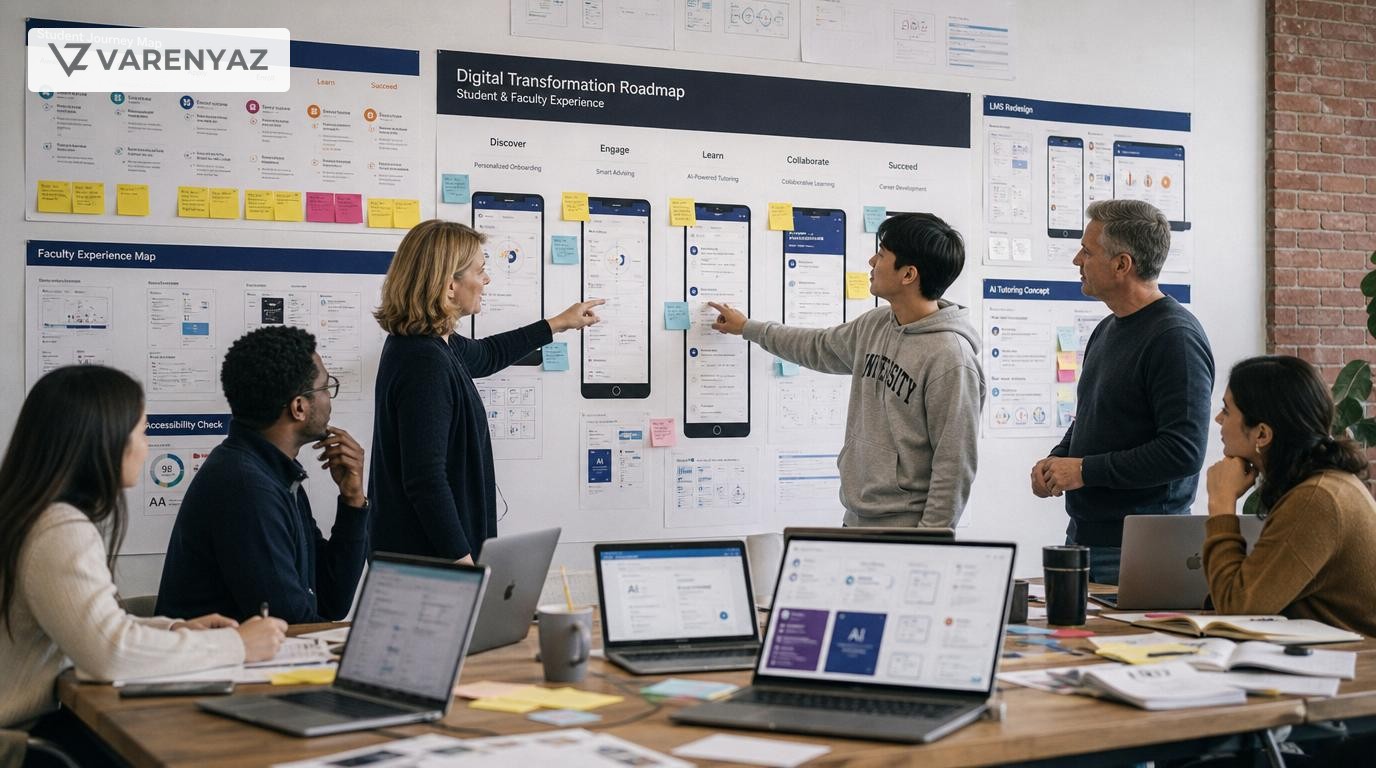
Why education needs a real digital transformation roadmap, not more tools
Across schools, universities, skills academies, and EdTech platforms, the same pattern keeps appearing: overflowing tool stacks, frustrated teachers, and leadership teams unsure whether any of it is actually improving learning.
It is not that education lacks technology. It lacks an integrated digital transformation roadmap for education that connects every investment to clear, measurable learning outcomes.
This article walks through how decision-makers can design and integrate such a roadmap—across web, mobile, data, and AI—so that technology serves students and educators instead of overwhelming them.
Direct answer: What is a digital transformation roadmap for education?
A digital transformation roadmap for education is a multi-year, outcome-focused plan that aligns an institution’s strategy, pedagogy, operations, and technology. It defines where you want to be (vision and learner outcomes), how you will get there (phased initiatives, platforms, and processes), and how you will measure progress (data and feedback loops).
Unlike a procurement list, a roadmap prioritizes:
- Learning outcomes and equity before tools and features
- Integrated platforms and data instead of isolated apps
- Teachers’ and learners’ experience instead of vendor checklists
- Responsible use of AI, guided by policy and pedagogy
- Change management, training, and continuous improvement
The business case: Why learning outcomes should drive your roadmap
For founders, boards, and leadership teams, digital transformation is no longer optional. But the why must be crystal clear.
From buying tools to buying outcomes
When institutions buy tools without a roadmap, they often end up with:
- Multiple learning platforms and logins
- Data trapped in separate systems
- Inconsistent student experiences across departments
- Teachers spending more time managing tech than teaching
By contrast, when they design from outcomes backwards, investments support goals such as:
- Improved course completion and graduation rates
- Better mastery of skills and concepts
- Reduced equity gaps in achievement and access
- Higher student satisfaction and retention
- Stronger employability and lifelong learning readiness
Major organizations like UNESCO and the World Bank consistently emphasize that the value of digital education is realized only when it is strategically aligned to teaching and learning goals, not when technology is deployed for its own sake.1,2,4
Strategic benefits for leadership teams
When executed well, an integrated roadmap delivers benefits beyond pedagogy:
- Clearer capital planning – phased investments over 3–5 years instead of ad-hoc purchases.
- Brand differentiation – a coherent digital learner experience that stands out locally and globally.
- Operational efficiency – streamlined workflows for admissions, enrollment, assessment, and support.
- Better policy compliance – consistent attention to privacy, accessibility, and quality frameworks.
- Attractive to partners – employers and EdTech collaborators prefer institutions with clear architecture and data governance.
Pillars of an integrated education digital transformation roadmap
While each institution is different, most successful roadmaps share six core pillars:
- Vision and governance
- Learner-centred experience design
- Platform and architecture strategy
- Data and analytics strategy
- Responsible AI integration
- Change management and capability building
1. Vision and governance: Who owns the roadmap?
Transformation fails when no one clearly owns it. A strong governance model:
- Anchors decisions in institutional mission and educational philosophy
- Balances academic, IT, operations, and financial perspectives
- Includes student and teacher voices in prioritization
- Sets guardrails for data, ethics, and AI use
Consider establishing:
- A cross-functional steering committee – leadership from academics, IT, finance, operations, and student services.
- Outcome owners – clear accountability for targets like completion rate, digital engagement, or time-to-respond to student queries.
- Decision rights – who approves pilots, who controls data integration, who signs off on vendor contracts.
Governance is your safety net against shiny-object syndrome—and your leverage when you need to say “no” to misaligned initiatives.
2. Learner-centred experience design: Map journeys before platforms
Before choosing tools, you need to understand how learners and educators actually move through your ecosystem today.
Start by mapping key journeys:
- Prospective student – discovery, application, enrollment, onboarding.
- Active learner – attending sessions, accessing content, participating, submitting work, receiving feedback.
- Educator – preparing content, delivering sessions, assessing, giving feedback, tracking progress.
- Alumni or lifelong learner – reskilling, updating skills, networking.
For each journey, identify:
- Moments that really matter (e.g., first week of class, midterm feedback, support during difficulties)
- Existing friction (too many logins, confusing navigation, slow responses)
- Inclusion gaps (connectivity barriers, language issues, accessibility barriers)
This is where thoughtful web design and UX transform your stack from a tangle of tools into a coherent digital campus. A well-architected portal or learning experience platform can unify access to LMS content, events, assessments, and support, tailored for each role.
3. Platform and architecture strategy: From tool sprawl to ecosystem
Most institutions already have some combination of:
- LMS or virtual learning environment
- Student Information System (SIS)
- Content authoring tools and repositories
- Video conferencing and proctoring tools
- CRM or marketing automation
- Analytics dashboards and reporting tools
The problem is not the existence of these tools; it is the lack of an architecture that makes them work together.
Designing a target architecture
A future-ready architecture usually includes:
- Core platforms – LMS/LXP, SIS, identity management (SSO), CRM.
- Integration layer – APIs, event streaming, or middleware to connect systems.
- Experience layer – responsive web portals and mobile apps that surface everything in one place.
- Data and analytics layer – secure data warehouse or lake and BI tools.
- AI services layer – tutoring bots, content generation, recommendation engines, risk alerts.
Decisions you will need to make include:
- Build vs buy – when to use off-the-shelf SaaS vs custom web development.
- Monolithic vs composable – one vendor suite vs best-of-breed integrated by APIs.
- Cloud strategy – public cloud, private cloud, or hybrid, depending on regulation and scale.
For many institutions, a composable architecture works best: keep a strong LMS and SIS as anchors, then layer custom portals and integrations to support your unique workflows, branding, and AI strategies.
4. Data and analytics: Turning activity into insight
Data is the backbone of any credible digital transformation roadmap. UNESCO and the OECD both emphasize that evidence-informed decision-making is critical for improving digital education quality and equity.1,3
Decide what you need to know
Start from questions rather than dashboards:
- Which students are at risk of dropping out, and when?
- Which courses or modules consistently underperform, and why?
- How do engagement patterns differ across demographics or regions?
- Which interventions (tutoring, nudges, content changes) actually help?
Then define the data model and events you need to collect from your LMS, SIS, and other systems to answer these questions.
Build a secure, ethical data foundation
Critical considerations include:
- Privacy and compliance – align with GDPR, FERPA, and local regulations for student data.
- Access controls – role-based access so that teachers, administrators, and vendors see only what they need.
- Data quality – consistent identifiers, clear definitions, logged transformations.
- Bias and fairness – ensure that analytics and risk models do not systematically disadvantage any group.
From here, you can develop learning analytics dashboards that help educators and support teams intervene earlier, personalize recommendations, and continuously improve content and delivery.
5. Responsible AI: Amplifying, not replacing, educators
AI is now a central part of any serious digital transformation roadmap for education, but it must be deployed thoughtfully. UNESCO’s policy framework on AI in education stresses the need for human-centred, transparent, and equitable deployment, with teachers and learners involved in shaping use.1
High-value AI use cases in education
Some practical, high-leverage applications include:
- AI tutoring and Q&A – 24/7 support for concept clarification, with links to your official curriculum.
- Feedback assistants – helping educators provide faster, more consistent formative feedback while they retain final judgment.
- Content generation and localization – generating practice questions, summaries, or language variants aligned with your policies.
- Recommendation engines – suggesting resources or pathways based on learner activity and goals.
- Risk detection – flagging disengagement or performance drops early, with transparent criteria.
Guardrails for trustworthy AI in education
To use AI safely and credibly, your roadmap should include:
- AI governance principles – clarity on transparency, explainability, and human oversight.
- Data boundaries – what data AI can access, and how it is anonymized or pseudonymized.
- Bias evaluations – regular testing for differential performance across learner groups.
- Teacher controls – options to override, edit, or disable AI-generated content and decisions.
When built into your architecture, AI becomes another layer of infrastructure—supporting teachers and learners rather than acting as a black box on the side.
6. Change management and capability building
Transformation in education is a people project long before it is a technology project. The most elegant roadmap will fail if staff and students are not prepared and supported.
Design for adoption
Key practices include:
- Early involvement – bring educators, support staff, and student representatives into design workshops and pilots.
- Targeted training – short, role-based training paths rather than one-size-fits-all sessions.
- Change champions – empower digitally confident teachers and administrators to mentor peers.
- Support channels – in-app guidance, office hours, and responsive helpdesks.
Even in highly digital systems, investing in human support and shared understanding is what unlocks the true value of your platforms and AI tools.
Designing your integrated roadmap: A step-by-step approach
Bringing these pillars together, here is a practical approach for institutions and EdTech providers.
Step 1: Clarify vision and 3–5 key outcomes
Start with a short, concrete set of outcomes, for example:
- Increase first-year course completion rates by 10% in three years.
- Reduce student dropout between terms by 20%.
- Close digital engagement gaps across socio-economic groups.
- Improve learner satisfaction scores for online and blended courses.
These outcomes will drive your prioritization and metrics.
Step 2: Map current journeys and systems
Audit your current state:
- What platforms are in use, and how are they integrated?
- Where do students and teachers face the most friction?
- What data is available today, and where is it stored?
- What policies and regulations shape your possibilities (regional, national, accreditation)?
Summarize this as a visual map—journeys, systems, and data flows. This makes the gaps and redundancies clear for all stakeholders.
Step 3: Define your target architecture and experience
Next, design your desired future state across:
- Experience – what students, teachers, and staff should see and do from a single entry point.
- Platforms – which core systems you will standardize on or replace.
- Integrations – how data and identity will flow between systems.
- AI and analytics – where you want automation, insight, and personalization.
This is where expert web design, web development, and AI architecture decisions converge: a seamless, secure, responsive interface layered over a modular back-end that can evolve over time.
Step 4: Prioritize initiatives into realistic phases
Break the work into 3–5 phases, each with a clear theme and success criteria. For example:
- Phase 1 – Foundations: consolidate LMS, implement SSO, improve core web portal usability, and establish a basic data warehouse.
- Phase 2 – Engagement and analytics: unify student dashboards, deploy early-warning analytics, and launch mobile apps.
- Phase 3 – AI augmentation: roll out AI tutoring pilots, feedback assistants, and recommendation engines with strong guardrails.
- Phase 4 – Continuous optimization: refine based on measured impact, expand to new cohorts, and iterate UX and AI models.
Each phase should be small enough to execute, big enough to matter, and clearly connected to your core outcomes.
Step 5: Define metrics and feedback loops
For each phase, define:
- Leading indicators – logins, time-on-task, assessment submissions, attendance.
- Lagging indicators – course completion, grades, progression, retention.
- Experience indicators – usability ratings, Net Promoter Score, qualitative feedback.
Commit to reviewing these regularly with your steering committee and adjusting the roadmap based on what works.
Risks, tradeoffs, and how to navigate them
Every significant transformation comes with tradeoffs. Expect them; design for them.
Risk 1: Tool fragmentation vs. vendor lock-in
Tradeoff: Best-of-breed tools may serve specific needs better, but increase integration complexity. Single-vendor suites reduce integration work but may compromise on certain features or innovation speed.
Mitigation:
- Adopt a composable architecture where feasible, but standardize on a small set of core platforms.
- Ensure all major platforms support modern APIs and data export.
- Negotiate contracts that allow gradual migration rather than deep lock-in.
Risk 2: Innovation vs. equity and inclusion
Tradeoff: Cutting-edge solutions may assume high connectivity, modern devices, or advanced digital skills that not all learners have.
Mitigation:
- Design for low bandwidth and mobile-first whenever possible.
- Offer offline or asynchronous options for content access.
- Use inclusive design and accessibility standards (e.g., WCAG) from day one.
- Complement digital initiatives with physical support where necessary (labs, community centres).
Risk 3: AI efficiency vs. pedagogical integrity
Tradeoff: AI can accelerate content generation and feedback, but may oversimplify complex skills or propagate bias if not supervised.
Mitigation:
- Keep educators in the loop for final decisions and high-stakes assessments.
- Train staff to critically assess AI suggestions.
- Use AI to augment low-stakes, formative processes rather than core grading, at least initially.
Risk 4: Ambition vs. capacity
Tradeoff: Ambitious roadmaps may overwhelm internal teams, particularly in smaller institutions.
Mitigation:
- Be realistic about internal bandwidth and skills.
- Phase work and focus on a few high-impact initiatives per year.
- Partner with specialized firms for architecture, development, and AI.
Geo realities: India, United States, United Kingdom
While the roadmap principles are global, execution varies by region.
India
India’s rapid expansion of digital education and national initiatives creates both opportunity and complexity. Institutions must balance:
- Diverse connectivity levels across urban and rural areas
- Regional languages and multi-lingual content needs
- Alignment with national frameworks and assessments
Low-bandwidth optimization, vernacular support, and mobile-first designs are essential for equitable outcomes.
United States
In the US, institutions operate in a crowded EdTech landscape and a strong regulatory environment. Key considerations include:
- Compliance with FERPA and state privacy laws
- Integration with existing SIS and LMS ecosystems
- High expectations for accessibility and accommodation services
Here, differentiation often comes from a seamless learner experience and sophisticated data and AI capabilities built on top of solid infrastructure.
United Kingdom
In the UK, educational institutions often balance long-standing academic traditions with digital innovation, especially in higher education.
- Quality assurance frameworks and external reviews influence digital strategy.
- International student cohorts require scalable, consistent experiences.
- Partnerships with industry are increasingly important for skills alignment.
Roadmaps in this context benefit from strong governance, careful vendor selection, and global-ready student journeys.
Implementation patterns that work in practice
Beyond theory, a few implementation patterns tend to succeed across contexts.
Pattern 1: Start with a unified learner portal
Instead of trying to fix every system at once, many institutions gain early wins by launching a unified digital front door:
- One web and mobile interface for courses, grades, schedules, and support.
- Integrated SSO and personalized dashboards.
- Contextual access to help, FAQs, and AI assistants.
This delivers visible value quickly while you work on deeper integrations behind the scenes.
Pattern 2: Pilot AI in low-risk, high-value contexts
Rather than deploying AI everywhere, successful teams:
- Pick a small number of courses, programs, or services.
- Introduce AI tutors or feedback helpers with clear guidance.
- Monitor learner outcomes, satisfaction, and fairness.
- Refine and expand based on evidence.
This builds internal confidence while containing risk.
Pattern 3: Co-create with educators and learners
Educators and students are your richest source of insight. Involving them in roadmap design:
- Surfaces real pain points and underused features.
- Generates creative ideas for AI and analytics use.
- Builds champions who advocate for adoption.
Co-creation workshops, beta programs, and feedback loops should be baked into every phase.
Practical next steps for education leaders
If you are leading digital transformation in a school, university, or EdTech company, here is a concrete starting checklist:
- Assemble a cross-functional steering group with clear sponsorship.
- Agree on 3–5 measurable learner outcomes as your north star.
- Map current learner and educator journeys across web, mobile, and offline touchpoints.
- Audit your platforms, integrations, and data flows.
- Sketch a simple target architecture and prioritized phases.
- Identify quick wins (e.g., unified portal, SSO, small AI pilot).
- Define metrics and a governance cadence for review.
At this stage, many institutions benefit from an external partner with experience in web design, system integration, and AI in education to translate intent into a robust, executable roadmap.
How VarenyaZ can support your education transformation
VarenyaZ works with education providers and EdTech companies to turn digital transformation roadmaps into real outcomes.
Web and product experience design
We help you design learner and educator journeys, then translate them into intuitive, accessible web and mobile experiences that sit on top of your LMS, SIS, and content platforms. Our design focus is on clarity, inclusion, and measurable engagement improvements.
Web development and platform integration
Our engineering teams build custom portals, dashboards, and middleware that connect your systems into a coherent ecosystem. We work with modern stacks, APIs, and cloud platforms to ensure your infrastructure is secure, scalable, and maintainable.
AI development for learning and operations
From AI tutoring assistants to content helpers and analytics models, we design and implement AI components that respect your pedagogy, policies, and data constraints. Guided by international recommendations on AI in education,1,2 we focus on transparency, fairness, and human oversight.
If you are ready to move from scattered tools to a strategic, integrated digital transformation roadmap for education, connect with the VarenyaZ team at https://varenyaz.com/contact/.
Conclusion
Digital transformation in education is no longer about adding platforms or ticking technology boxes. It is about intentionally orchestrating web experiences, data, and AI around learner outcomes, equity, and educator empowerment.
With a clear roadmap, thoughtful governance, and the right partners, institutions can create digital ecosystems that genuinely improve teaching, learning, and long-term success. VarenyaZ brings together web design, web development, and AI development expertise to help you architect and execute that roadmap with confidence.
Editorial Perspective
Expert Review Notes
"The difference between a pile of EdTech tools and a genuine digital transformation roadmap is simple: one adds complexity, the other systematically improves learning outcomes."
"Education leaders who treat data, UX, and AI as core learning infrastructure—not side projects—see faster gains in engagement, completion, and long-term learner success."
"A strong digital roadmap respects the craft of teaching; it uses technology to remove friction for educators, not to squeeze them into rigid workflows."
Frequently Asked Questions
What is a digital transformation roadmap for education?
A digital transformation roadmap for education is a structured, time-phased plan that aligns institutional strategy, pedagogy, processes, and technology to improve learning outcomes. It defines a vision, governance model, prioritized initiatives, technology architecture, data strategy, change management, and measurable success metrics across a multi-year horizon.
How does a digital transformation roadmap improve learning outcomes?
A good roadmap ties every technology investment to specific learning goals such as higher completion rates, improved mastery, or reduced equity gaps. It aligns content, platforms, data, and support around these goals, then tracks indicators like engagement, assessment results, and learner satisfaction, iterating based on evidence rather than assumptions or vendor promises.
Where should schools and universities start with digital transformation?
Start with a current-state assessment and a clear, shared vision for learner outcomes. Map critical learner journeys, identify pain points for students and teachers, and define 3–5 priority outcomes. From there, you can design a phased roadmap that addresses foundational infrastructure, learning platforms, data capabilities, and staff skills in a realistic sequence.
How can we integrate AI into our education roadmap safely?
Integrate AI by starting with low-risk, high-value use cases such as content recommendations, formative feedback, and tutoring support. Establish guidelines for data privacy, transparency, and human oversight, conduct pilot projects, and monitor for bias or unintended effects. Involve educators and learners in evaluating AI tools, and ensure AI augments rather than replaces teachers.
What are the biggest risks in education digital transformation?
Common risks include buying fragmented tools without an architecture plan, underestimating teacher and staff training needs, ignoring data privacy and security, and failing to define success metrics. There is also a risk of widening inequities if access, language, and inclusion are not addressed. Strong governance, pilots, and continuous feedback mitigate these risks.
When should an education institution bring in external partners?
External partners are most useful when you need expertise you do not have in-house, such as architecture design, AI integration, complex LMS or SIS integrations, or learner experience design. They can help turn high-level vision into an implementable roadmap and build robust web, mobile, and AI solutions while your internal teams focus on pedagogy and operations.
Selected References
Further Reading
Related perspectives
Secure Payment Gateway Success in Hospitality
Secure payment gateway development is now central to business success in hospitality and entertainment. Modern guests expect instant, card-on-file, and contactless payments across rooms, venues, apps, and on-property experiences. This article explains how to design PCI DSS–compliant, tokenized, omnichannel payment architectures, cut fraud, and unify guest data, while balancing build vs buy decisions and vendor risk. It closes with a practical roadmap and how a partner like VarenyaZ can architect and implement secure, AI-ready payment solutions.
IoT Fleet Management for Modern Education
IoT fleet management in education connects vehicles, sensors, and software to give real-time visibility into school and university transport. It improves student safety, optimizes routes and fuel use, supports regulatory compliance, and enables data-driven budgeting. This article explains how the technology works, core components, business benefits, risks, and rollout steps. It also covers integration with existing systems, change management, and measurement frameworks so leaders can design a secure, scalable, and future-ready fleet strategy that aligns with educational goals and community expectations.
Why Property CRM Integrations Power Real-Time Manufacturing
Property CRM integrations connect your assets, plants, and customer records into a single real-time view, turning static equipment data into live manufacturing intelligence. By linking CRM with MES, ERP, IIoT platforms, and field service tools, manufacturers gain 360° visibility on each installed asset. That unlocks predictive maintenance, faster service, smarter production planning, and new outcome-based revenue models. The article explains the business value, core architecture, integration patterns, risks, and step-by-step rollout so leaders can design a scalable, secure real-time insight layer across operations.