
Top 7 Interactive E‑Learning Best Practices for Healthcare
Discover seven proven best practices for building interactive healthcare e‑learning that improves knowledge retention, clinical performance, and patient safety.

Quick Answer
Interactive e-learning for healthcare works best when it mirrors real clinical decisions, not static slide decks. Focus on scenario-based cases, microlearning modules, spaced repetition, and frequent low-stakes assessment with targeted feedback. Align every interaction to patient outcomes and compliance requirements, and measure performance with analytics tied to your LMS and clinical KPIs. Involve clinicians in content design, validate accuracy, and pilot with small cohorts before scaling. Partnering with a specialist design, development, and AI team can help operationalize these best practices efficiently and safely.
In this article
Coverage signals
14 min
Jul 3, 2026
VarenyaZ Editorial Desk, Technical Content Review
Updated Jul 3, 2026
Key Takeaways
- The core goal of interactive e-learning for healthcare is safer, more consistent patient care, not just course completion.
- Scenario-based learning grounded in real clinical decisions is more effective than static content for behavior change.
- Short, focused microlearning with spaced repetition improves retention for busy clinicians.
- Immediate, specific feedback and frequent low-stakes assessment help close real skill gaps.
- Analytics should connect learner behavior to quality and safety metrics, not only completion rates.
- Strict clinical validation, data protection, and regulatory alignment are non-negotiable in healthcare education.
- Thoughtful LMS and workflow integration ensures training is accessible at the point of need.
- Partnering with a specialist web and AI development team can accelerate safe, scalable e-learning innovation.
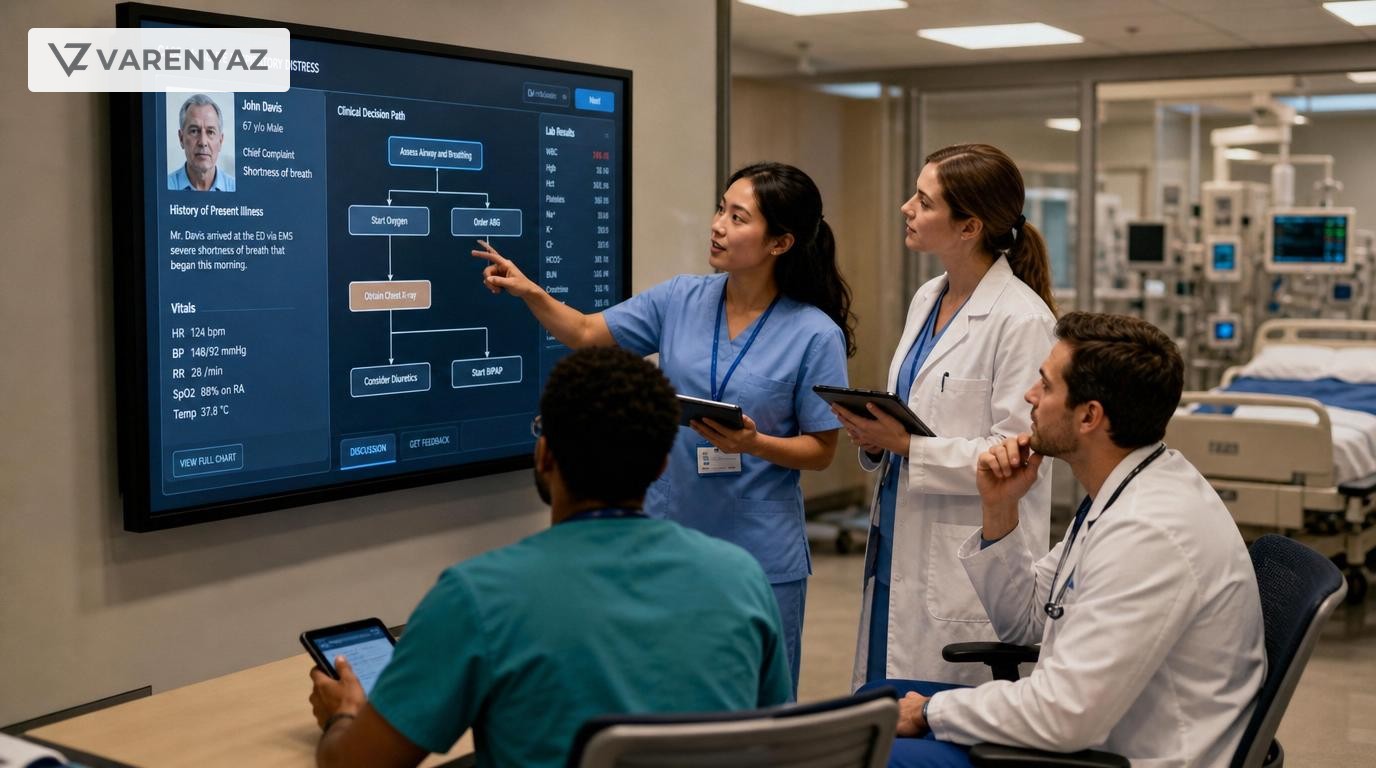
Top 7 Interactive E-Learning Content Best Practices for Healthcare
Healthcare has always been a high-stakes environment. A small gap in knowledge or a missed step in a protocol can have life-or-death consequences. That’s why training has to do more than transfer information – it has to reliably change clinical behavior.
Interactive e-learning is one of the most powerful ways to achieve that, especially for distributed teams and 24/7 operations. But when it’s badly designed, it becomes just another checkbox module that clinicians rush through between shifts.
This article breaks down seven practical best practices for interactive e-learning in healthcare, written for decision-makers and product leaders. We’ll focus on how to design for patient safety, clinical reality, and measurable ROI – and how web, product, and AI teams can build platforms that support that vision.
Direct Answer: What Makes Interactive E-Learning Work in Healthcare?
Effective interactive e-learning for healthcare is grounded in real clinical decisions, not static slide decks. The most impactful programs:
- Use realistic scenarios and cases to mirror day-to-day clinical work.
- Break content into short, focused microlearning units.
- Provide immediate, specific feedback on decisions.
- Use spaced repetition and practice over time.
- Leverage analytics to find risk patterns and skill gaps.
- Protect patient data and align with healthcare regulations.
- Integrate cleanly with your LMS and clinical workflows.
When these elements come together, e-learning stops being a compliance task and becomes a real lever for safer, more consistent care.
1. Design Around Real Clinical Decisions, Not Slide Decks
Most healthcare e-learning still starts from the wrong place: the existing presentation. Slides are converted into long, linear modules with a quiz at the end. Learners click through, pass, and remember little.
A better approach is to design from the decision outward.
Shift from content-first to decision-first
Start by asking:
- What real-world decisions should this training improve? (e.g., antibiotic selection, sepsis recognition, escalation pathways).
- What behaviors do we want to see more (or less) of in clinical practice?
- Which errors or variations in practice are causing risk or inefficiency?
Only once you have clear answers should you decide what content, interactions, and assessments you need.
Use scenarios as the backbone
Scenarios are the core of interactive e-learning in healthcare:
- Branching patient cases: Learners choose assessments, investigations, and treatments, then see evolving vitals and outcomes.
- Protocol navigation: Learners apply guidelines step-by-step to a patient story rather than reading them in isolation.
- Role-play interactions: Simulated conversations with patients, families, or colleagues to practice communication and shared decision-making.
Evidence from health professions education consistently supports active and scenario-based learning as more effective than passive lectures, particularly for complex decision-making and clinical reasoning.[1][2]
Business value
- Higher impact: Training tailored to real decisions is much more likely to reduce adverse events and variation in care.
- Better engagement: Clinicians are more willing to invest time in training that clearly reflects their daily challenges.
- Clearer ROI: It’s easier to link scenario-based assessments with specific clinical KPIs.
Implementation considerations
- Involve frontline clinicians in mapping real decisions and pain points.
- Keep scenarios short but deep: one specific decision per micro-scenario.
- Use a case library you can update without rebuilding the whole course.
Risks and tradeoffs
- More design time upfront: Scenario design takes more effort but pays off in effectiveness.
- Need for validation: Clinical content must be peer-reviewed and periodically updated as guidelines evolve.
2. Use Microlearning That Fits Clinical Workflows
Healthcare teams are constantly multitasking: ward rounds, clinics, administrative work, on-call duties. Expecting them to complete 60-minute modules is unrealistic and often counter-productive.
What microlearning looks like in healthcare
Microlearning breaks training into small, self-contained units, often 5–15 minutes each, focused on a single learning objective or decision.
Examples:
- A 10-minute module on early sepsis recognition featuring one patient vignette, a quick quiz, and immediate feedback.
- A 7-minute refresher on insulin sliding scales with interactive dose calculations.
- A 5-minute scenario on consent and shared decision-making for a specific procedure.
Why microlearning works for clinicians
- Flexible timing: Fits into small gaps between patients or after shifts.
- Reduced cognitive overload: Learners focus deeply on one concept at a time.
- Better retention: Frequent, short sessions over time support long-term memory.
Business value
- Higher completion rates: Short modules are easier to schedule and less likely to be abandoned.
- Operational continuity: Reduces the need to pull staff away from patient care for long training sessions.
- Modular reuse: Micro-units can be reused for onboarding, refresher training, and performance support.
Implementation considerations
- Design each unit around a single clear outcome (“After this module, you will reliably recognize X, choose Y, or perform Z”).
- Use mobile-first design for on-the-go access on ward computers, tablets, or phones.
- Structure modules into playlists or journeys for specific roles (e.g., ICU nurses, junior doctors, pharmacists).
Risks and tradeoffs
- Fragmentation risk: If poorly designed, microlearning can feel disjointed. Use clear pathways and progression.
- Underestimated complexity: Some topics need deeper exploration; combine microlearning with longer simulation or in-person training when necessary.
3. Provide Immediate, Actionable Feedback
Interactivity alone is not enough. The value lies in what happens after the learner makes a choice.
Make feedback specific and clinical
Instead of generic “Correct/Incorrect”, tie feedback directly to patient outcomes and guidelines:
- Explain the rationale and potential consequences of each option.
- Reference national or local guidelines and protocols.
- Highlight common pitfalls and misconceptions clearly.
For example, after an incorrect antibiotic choice, feedback might say:
This antibiotic doesn’t cover the most likely pathogens for community-acquired pneumonia in this region. Current guidelines recommend X or Y as first-line options unless the patient has a documented allergy.
Use multiple feedback layers
- Immediate feedback: Right after each decision or question.
- Module summary: Recap key takeaways and common error patterns.
- Periodic dashboards: Aggregate feedback to departments or cohorts for targeted follow-up.
Business value
- Faster skill correction: Clinicians see and correct misunderstandings before they appear in real practice.
- Reduced supervision burden: Well-designed feedback can scale coaching across large workforces.
- Better compliance assurance: Documented, guideline-linked feedback supports audits and accreditation.
Implementation considerations
- Design feedback templates for common question types to keep authoring scalable.
- Involve clinical educators in writing feedback text, not just questions.
- Use adaptive feedback that changes based on repeated errors.
Risks and tradeoffs
- Overloading learners: Too much text can be overwhelming; keep feedback concise and layered (expandable details, links to references).
- Maintenance load: Feedback referencing specific guidelines must be updated when guidelines change.
4. Embed Spaced Repetition and Ongoing Practice
Healthcare knowledge changes rapidly. One-off training events quickly become outdated, and single exposures to content rarely stick.
Why spaced repetition matters
Spaced repetition – revisiting key concepts at increasing intervals – is a well-established learning science principle that supports long-term retention. For healthcare professionals, this is especially critical for:
- High-stakes protocols (e.g., anaphylaxis management, sepsis bundles).
- Infrequently used but critical skills (e.g., emergency response procedures).
- New or updated guidelines and pathways.
How to implement spacing in healthcare e-learning
- Automated refreshers: Short recap modules or quizzes scheduled weeks or months after the initial training.
- Push notifications: Micro-cases sent via email or app based on risk areas (e.g., seasonal infection surges).
- Role-based calendars: Annual or quarterly refreshers automatically assigned based on role and department.
Business value
- More durable change: Repetition reduces skill decay, especially important for competencies tied to patient safety.
- Evidence for regulators: Demonstrates an ongoing commitment to continuous professional development and quality improvement.
- Efficient onboarding: New staff can join existing spaced programs, not wait for annual training days.
Implementation considerations
- Use an LMS or custom platform that supports scheduled assignments and notifications.
- Tag content to competency frameworks (e.g., infection control, medication safety) so you can plan repetition strategically.
- Combine automated spacing with analytics (frequent errors trigger more frequent refreshers).
Risks and tradeoffs
- Compliance fatigue: Too many notifications can cause disengagement; prioritize high-impact topics.
- Perception of micromanagement: Communicate clearly why repetition matters for patient safety, not just compliance.
5. Align Content with Clinical Standards and Local Context
Healthcare training cannot live in a vacuum. It must align with national guidelines, local protocols, and institutional culture.
Anchor to recognized standards
Whenever possible, align content with:
- National or regional clinical guidelines (e.g., infectious disease, chronic disease management).
- Professional competency frameworks (e.g., for infection control staff, emergency responders).[4]
- Health professions education frameworks promoted by organizations such as WHO and national academies.[1][2]
Make these links visible to learners to build trust and relevance.
Localize for your organization
- Reflect local care pathways, formularies, and equipment.
- Include institution-specific policies (e.g., escalation chains, documentation standards).
- Use realistic details like local ward names, typical case mixes, and local epidemiology.
Business value
- Regulatory alignment: Easier to demonstrate that training supports national standards and accreditation requirements.
- Reduced clinical risk: Fewer discrepancies between “what the module says” and “what we actually do here”.
- Higher clinician buy-in: Content that matches real practice is more trusted and more likely to change behavior.
Implementation considerations
- Establish a clinical governance process for content: reviewers, approval workflows, and update schedules.
- Maintain a single source of truth for guidelines and policies your content references.
- Version-control content so you can trace who learned what, when, against which version of a guideline.
Risks and tradeoffs
- Update burden: Frequent changes in guidelines require a streamlined content update process.
- Localization complexity: Multi-site organizations may need variants for different hospitals or regions.
6. Use Analytics to Improve Both Learning and Care
One of the biggest advantages of interactive e-learning is the data it generates. But many organizations stop at completion reports.
What to measure beyond completion
- Decision accuracy: How often learners choose the optimal option in scenarios.
- Error patterns: Which misconceptions repeat across individuals, departments, or roles.
- Time on task: Where learners hesitate or abandon modules.
- Progress over time: Changes in performance after refreshers or interventions.
Wherever possible, connect these data points to clinical outcomes (e.g., changes in infection control audits, medication error reporting, readmission rates).
Examples of analytics-driven improvement
- High error rates in dosing scenarios trigger targeted microlearning and a review of real-world charts.
- Repeated confusion about a sepsis pathway leads to a simplified protocol and updated modules.
- Low completion in a certain unit prompts scheduling adjustments or local champions to support uptake.
Business value
- Smarter investment: Focus content development where data shows the biggest risk or gap.
- Audit-ready evidence: Demonstrate not just that training exists, but that it’s improving performance.
- Product insight: For healthtech companies, analytics from training tools can inform product design and clinical decision support features.
Implementation considerations
- Choose or build platforms that support granular event tracking (e.g., via xAPI), not just page views.
- Set clear metrics at the start of each program (e.g., reduce a specific type of error by X%).
- Ensure data privacy and security; avoid linking training data to identifiable patients and handle learner data sensitively.
Risks and tradeoffs
- Data overload: Too many metrics can obscure meaningful patterns; prioritize a small set of strategic indicators.
- Cultural concerns: Use analytics for learning and system improvement, not punitive surveillance.
7. Architect for Compliance, Security, and Integration
Even the best-designed content fails if it lives in a silo. To be effective and safe, interactive e-learning must slot into your existing technology, governance, and compliance landscape.
Core technical considerations
- LMS integration: Ensure content is compatible with your learning management system (SCORM/xAPI) or plan for a modern, interoperable LMS if you’re upgrading.
- Single sign-on (SSO): Reduce friction with role-based access using your existing identity provider.
- Responsive web design: Optimize for desktops on wards, tablets in clinics, and mobile devices.
- Performance and uptime: Healthcare teams access training 24/7; downtime is costly.
Data protection and compliance
- Avoid using real patient identifiers in scenarios; use de-identified or synthetic data.
- For real-world data integrations, ensure adherence to HIPAA, GDPR, and local regulations as applicable.
- Maintain audit logs for access, changes, and completions to support governance and investigations.
AI and automation opportunities – used responsibly
AI can enhance healthcare e-learning through:
- Adaptive learning paths based on learner performance.
- Natural language feedback on free-text responses or reflection notes.
- Smart recommendations for next modules based on role and recent errors.
However, AI-generated medical content should never bypass clinical review. Design workflows where AI assists with drafting but clinicians approve and own the final training material.
Business value
- Reduced friction: SSO and integration increase usage and simplify user management.
- Stronger governance: Well-architected platforms support audits, risk management, and regulatory reviews.
- Scalable innovation: AI-enabled features and modular architecture let you expand and personalize training over time.
Implementation considerations
- Involve IT, infosec, and clinical leaders early in platform decisions.
- Document a data protection impact assessment for your e-learning ecosystem.
- Design for role-based access and content mapping (e.g., by specialty, seniority, and location).
Risks and tradeoffs
- Complex integrations: Older hospital systems may require custom integration work.
- AI governance: Without clear policies, AI usage can drift into unsafe or non-compliant territory.
Putting It All Together: A Practical Roadmap
If you’re responsible for digital learning in a healthcare organization or building a healthtech product with education features, it’s easy to feel overwhelmed. Here’s a pragmatic roadmap to apply these best practices.
Step 1: Clarify outcomes and priorities
- List 3–5 clinical or operational problems training should help solve (e.g., central line infections, delayed diagnosis of X, documentation errors).
- Define a few simple KPIs per problem (e.g., audit compliance, error reports, turnaround times).
Step 2: Pick one high-impact pilot area
- Choose an area where risk and volume are both high (e.g., emergency triage, medication safety, infection control).
- Identify a small group of clinical champions to co-design scenarios and feedback.
Step 3: Design one microlearning journey
- Create a short sequence of 3–5 micro modules, each focused on one decision or competency.
- Ensure each module includes:
- A realistic scenario.
- An interactive decision point.
- Immediate, practical feedback.
- A short recap of key takeaways.
Step 4: Pilot, measure, iterate
- Run the modules with a small cohort first.
- Track completion, decision accuracy, and feedback from learners.
- Make quick adjustments to content, interaction difficulty, and pacing.
Step 5: Scale with governance and integration
- Once proven, roll out to more units with clear ownership for content updates.
- Integrate with your LMS and HR systems for automated enrollments.
- Implement spaced repetition schedules and role-based learning paths.
How VarenyaZ Can Help You Build Better Healthcare E-Learning
Designing interactive e-learning that genuinely changes clinical behavior is part educational science, part product design, and part engineering. Many healthcare organizations and healthtech teams have deep clinical expertise but limited capacity on the technology and experience side.
That’s where VarenyaZ comes in.
Strategic design for healthcare learning
VarenyaZ works with healthcare leaders to translate clinical and regulatory goals into clear digital learning strategies. This includes:
- Identifying high-impact training areas aligned with patient safety and quality initiatives.
- Designing scenario-based, microlearning journeys mapped to real decisions and workflows.
- Creating content structures that support spaced repetition and continuous improvement.
Web and product development for learning platforms
On the technology side, VarenyaZ’s web and product teams help you:
- Build or enhance secure, responsive e-learning platforms that integrate with your LMS and identity systems.
- Implement analytics dashboards that surface skill gaps, error patterns, and trend lines.
- Architect your stack for scalability, uptime, and data protection across regions like India, the US, and the UK.
AI-enabled learning, governed by clinicians
AI is transforming how healthcare professionals learn – but only when it’s deployed responsibly. VarenyaZ’s AI development practice supports you with:
- Adaptive learning engines that adjust difficulty and content based on performance.
- AI-assisted authoring tools for draft scenarios and feedback that remain under clinical review.
- Natural language interfaces for on-demand, guideline-aligned explanations embedded in training.
All of this is underpinned by strong governance, security, and compliance-by-design, so innovation never compromises patient safety or data protection.
If you’re ready to transform your healthcare training into interactive experiences that clinicians respect and that leadership can measure, you can start a conversation with the VarenyaZ team here: https://varenyaz.com/contact/
Conclusion
Interactive e-learning in healthcare succeeds when it is tightly aligned to clinical reality, grounded in educational best practices, and delivered through robust, secure technology. The seven best practices in this guide – from scenario design and microlearning to analytics and AI – provide a framework to build training that genuinely improves patient care.
VarenyaZ combines web design expertise for intuitive learning experiences, web development depth for secure, integrated platforms, and AI development capabilities for adaptive, data-driven education. Together, these capabilities help healthcare organizations and healthtech innovators move beyond checkbox training to digital learning ecosystems that support safer, smarter care at scale.
Editorial Perspective
Expert Review Notes
"If your healthcare e-learning could be printed as a PDF with no loss of effectiveness, it’s not truly interactive. The value comes from decisions, consequences, and feedback that mirror real clinical work."
"The most impactful digital training in healthcare is designed backwards from patient and safety outcomes, not forwards from slide decks or subject matter notes."
"Analytics in healthcare e-learning should help you spot risky patterns in clinical decision-making, not just who clicked ‘next’."
Frequently Asked Questions
What is interactive e-learning for healthcare?
Interactive e-learning for healthcare uses digital modules where clinicians and staff actively participate through cases, branching scenarios, questions, simulations, and decision points instead of passively reading or watching. It is designed to mirror real clinical decisions and workflows, so learners practice judgment, not just recall information.
Why is interactivity so important in clinical e-learning?
Healthcare professionals must apply knowledge under pressure in complex situations. Interactive elements such as scenarios, simulations, and decision trees trigger deeper cognitive processing than static slides, leading to better knowledge retention, problem‑solving, and transfer to real patient care. Evidence from health professions education consistently links active learning with improved learning outcomes and, in some cases, better clinical performance.
How long should a healthcare e-learning module be?
For busy clinicians, 5–15 minutes is a practical range for a single e-learning unit. Complex topics can be split into a series of microlearning modules, each focused on one clear decision or competency. This format fits into clinical schedules and aligns well with spaced repetition and mobile learning on shift breaks.
How can we measure if interactive e-learning is working in healthcare?
Move beyond completion rates and scores. Track performance on scenario-based assessments, error patterns in decision points, and improvement over time. Where possible, correlate training completion and assessment trends with clinical KPIs such as adherence to care pathways, medication error rates, infection control compliance, or patient experience measures. Use these insights to refine content continuously.
What technologies are commonly used for interactive healthcare e-learning?
Common technologies include learning management systems (LMS) like Moodle or commercial platforms, SCORM/xAPI-compatible authoring tools, web-based simulation tools, and increasingly AI-driven engines for adaptive learning and natural language feedback. Custom web apps with secure APIs and strong authentication are often needed for deeper simulation and integration with hospital systems.
How can VarenyaZ help with healthcare e-learning projects?
VarenyaZ helps healthcare organizations and healthtech companies design and build interactive e-learning platforms, custom web-based simulations, and AI-driven learning experiences. The team combines UX design, secure web development, LMS and API integration, and healthcare-aware AI development to deliver scalable, compliant training products tailored to your workflows.
Selected References
- World Health Organization – Transforming and Scaling Up Health Professionals' Education and Training
- Institute of Medicine (US) – Health Professions Education: A Bridge to Quality
- AAMC – Effective Use of Educational Technology in Medical Education
- European Centre for Disease Prevention and Control – Core competencies for infection control and hospital hygiene
Further Reading
Related perspectives
Digital Transformation Roadmaps in Education
A digital transformation roadmap for education is a structured plan that connects institutional strategy, pedagogy, and technology to measurably improve learning outcomes. This article explains how to define learner-centred goals, build governance, align platforms and data, integrate AI responsibly, phase implementation, manage change, and track impact. It details risks, tradeoffs, and decision points for schools, universities, and EdTech providers, and clarifies how to turn disconnected tools into an integrated ecosystem that supports teachers, learners, and administrators.
Secure Payment Gateway Success in Hospitality
Secure payment gateway development is now central to business success in hospitality and entertainment. Modern guests expect instant, card-on-file, and contactless payments across rooms, venues, apps, and on-property experiences. This article explains how to design PCI DSS–compliant, tokenized, omnichannel payment architectures, cut fraud, and unify guest data, while balancing build vs buy decisions and vendor risk. It closes with a practical roadmap and how a partner like VarenyaZ can architect and implement secure, AI-ready payment solutions.
IoT Fleet Management for Modern Education
IoT fleet management in education connects vehicles, sensors, and software to give real-time visibility into school and university transport. It improves student safety, optimizes routes and fuel use, supports regulatory compliance, and enables data-driven budgeting. This article explains how the technology works, core components, business benefits, risks, and rollout steps. It also covers integration with existing systems, change management, and measurement frameworks so leaders can design a secure, scalable, and future-ready fleet strategy that aligns with educational goals and community expectations.