
Modernizing Hospitality Systems with Predictive Analytics
Learn how hospitality and entertainment businesses can modernize legacy systems using predictive analytics for demand forecasting, dynamic pricing, and guest personalization.

Quick Answer
Hospitality and entertainment businesses can modernize legacy systems by layering predictive analytics on top of existing PMS, POS, CRM, and ticketing platforms instead of replacing them overnight. The key is to unify data into a central platform, prioritize high-value use cases like demand forecasting, dynamic pricing, and guest personalization, and deploy models via APIs back into day-to-day workflows. This article outlines architecture options, integration patterns, change management, and governance considerations, and explains how a partner like VarenyaZ can design and build modern web, data, and AI solutions tailored to hotels, resorts, cinemas, and venues.
In this article
Coverage signals
14 min
May 26, 2026
VarenyaZ Editorial Desk, Technical Content Review
Updated May 26, 2026
Key Takeaways
- Predictive analytics in hospitality delivers quick wins when layered on top of core legacy systems instead of replacing them outright.
- Unifying data from PMS, POS, CRM, channel managers, and ticketing platforms is the foundation for reliable forecasting and personalization.
- Start with focused use cases such as demand forecasting, dynamic pricing, and guest churn prediction to prove value and fund further modernization.
- A modular, API-first architecture lets you plug predictive models into existing tools staff already use, reducing training friction.
- Data governance, privacy compliance, and explainability are essential to maintain guest trust and regulatory alignment.
- Change management and frontline adoption matter as much as model accuracy; make predictions visible inside day-to-day workflows.
- Modern web applications and dashboards help operational teams act quickly on predictive insights across locations and brands.
- A partner like VarenyaZ can bridge legacy infrastructure with modern web, data, and AI capabilities tailored for hospitality and entertainment.
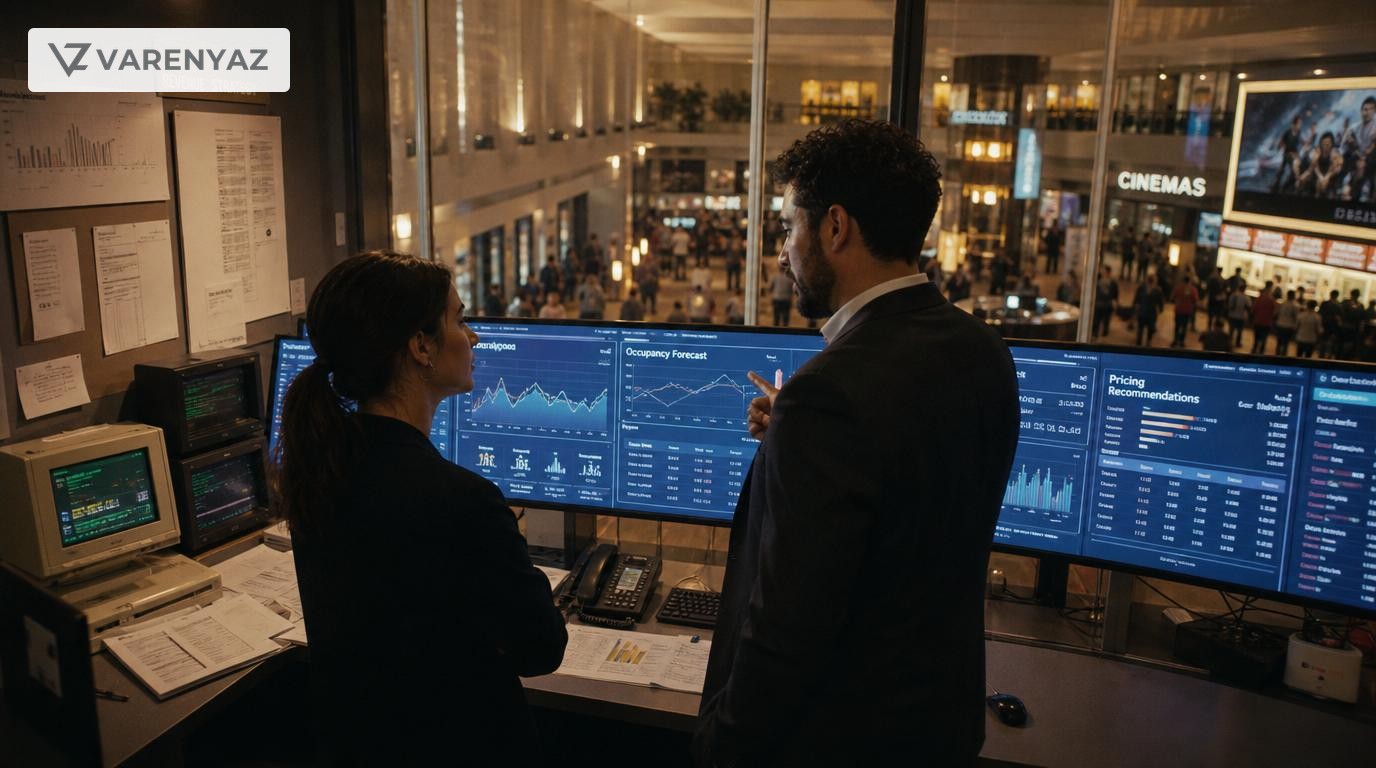
Why predictive analytics is the most practical path off legacy rails
Hospitality and entertainment businesses live with a paradox. On one side, there are decades-old systems: property management systems (PMS), point-of-sale (POS), central reservation systems (CRS), ticketing tools, and loyalty databases that actually keep the business running. On the other side, there’s pressure to act like a digital-native brand: personalized offers, dynamic pricing, AI chat, and real-time operations decisions.
Ripping out legacy systems in a hotel group, resort chain, theme park, or cinema network is risky, disruptive, and expensive. Yet, standing still isn’t an option.
Predictive analytics offers a middle path. Instead of starting with a “big bang” replacement, you can:
- Unlock data trapped in legacy PMS, POS, and ticketing systems
- Use machine learning to forecast demand, spend, cancellations, and churn
- Feed those insights back into the tools your teams already use
- Modernize your architecture piece by piece, guided by value, not hype
This article explores how to do exactly that, with a focus on practical steps for hospitality and entertainment decision-makers.
Direct answer: how to modernize legacy systems with predictive analytics
To modernize legacy systems in hospitality and entertainment using predictive analytics, follow a layered approach:
- Unify data: Extract data from PMS, POS, CRM, channel managers, and ticketing systems into a central data platform.
- Prioritize use cases: Start with high-impact scenarios like demand forecasting, dynamic pricing, and guest churn prediction.
- Build models: Train predictive models on historical and real-time data, validating against clear business KPIs.
- Integrate via APIs: Expose model outputs through APIs or dashboards and plug them back into existing systems and workflows.
- Iterate and scale: Monitor performance, refine models, and gradually modernize surrounding web applications and services.
This approach avoids disruptive rip-and-replace programs while delivering measurable revenue, efficiency, and experience gains.
Legacy systems in hospitality and entertainment: what are we really dealing with?
Before talking about modernization, it helps to be clear about the landscape. Typical hospitality and entertainment businesses run a patchwork of systems:
- PMS (Property Management System) – Manages room inventory, check-in/out, housekeeping, folios, and sometimes basic CRM.
- CRS and channel managers – Distribute rates and availability to OTAs, direct web, GDS, and corporate channels.
- POS systems – Capture restaurant, bar, spa, room service, and concession spend.
- Ticketing and access control – For cinemas, stadiums, theme parks, museums, and attractions.
- Loyalty and CRM platforms – Track guest profiles, stay history, preferences, and engagement.
- Spreadsheets and ad hoc tools – Built by revenue managers, finance, or operations to fill in gaps.
Most of these systems weren’t designed for modern AI workloads or real-time analytics. Data is often siloed, reporting is slow, and integrations are brittle or proprietary.
The good news: you don’t need to replace everything to unlock predictive power. You need a way to get data out of these systems reliably and a home for analytics that can scale.
Where predictive analytics delivers tangible value
Predictive analytics isn’t an abstract technology; it’s a set of capabilities you can apply to specific business decisions. For hospitality and entertainment, some of the highest-value areas are well understood.
1. Demand forecasting for rooms, seats, and experiences
Accurately forecasting demand is the foundation for revenue management and staffing. Advanced analytics can outperform rule-of-thumb approaches by incorporating more signals: booking pace, search data, events, weather, and macro trends.1,2
Typical applications:
- Room demand by night and segment across a portfolio of hotels
- Showtime or event attendance forecasts for cinemas, arenas, and theaters
- Theme park or attraction footfall prediction by day and time slot
Better forecasts feed smarter decisions in pricing, availability, and operations.
2. Dynamic pricing and intelligent promotions
Dynamic pricing adjusts rates or offers based on predicted demand, competitor behavior, and guest sensitivity. In hospitality and entertainment, that can mean:
- Optimizing room prices across channels in near real time
- Adjusting ticket prices or bundles for off-peak showtimes and events
- Targeting promotions where demand is soft or inventory is perishable
Predictive models can also estimate price elasticity for different segments, helping you discount strategically instead of uniformly.
3. Guest personalization and upsell recommendations
Modern guests expect your brand to “remember” them and anticipate their needs. Predictive models can power that by analyzing:
- Stay history, spend patterns, and channel behavior
- Content and offer engagement in email or apps
- On-property activity such as dining or spa visits
Common use cases include personalized upsell suggestions (room upgrades, late checkout, spa slots), tailored F&B offers, and relevant content for entertainment or experiences. These recommendations can surface in booking flows, pre-arrival emails, mobile apps, and at the front desk.
4. Churn prediction and loyalty optimization
Not all guests are equal in lifetime value. Predictive analytics can flag guests who are likely to defect, downgrade, or reduce visits, enabling proactive outreach, tailored benefits, or win-back campaigns.
For example, a model might score loyalty members on churn risk based on their booking cadence, spend, and engagement. High-risk, high-value guests can receive specific retention initiatives, while offers for low-risk guests are optimized for profitability.
5. Operational efficiency: staffing, inventory, and maintenance
Predictive insights don’t stop at revenue. They can support operational planning:
- Staffing – Match housekeeping, F&B, front desk, security, or concessions staffing to predicted footfall and events.
- Inventory – Forecast usage of key ingredients, amenities, and consumables to reduce waste.
- Maintenance – Use equipment and usage data to anticipate failures and schedule preventive maintenance.
For multi-property and multi-venue brands, even modest percentage improvements at each site compound into significant savings.
Modernization strategy: layer, don’t rip and replace
Enterprise-wide system replacement is tempting as a “clean slate” but risky. A layered modernization strategy mitigates that risk by introducing predictive capabilities in controllable steps.
Step 1: Build a unified data foundation
Your first modernization milestone is a data platform that can ingest and combine information from:
- PMS and CRS (bookings, stays, room inventory, rates)
- POS (spend, item-level detail, outlet performance)
- Ticketing and access systems (tickets, scans, no-shows)
- CRM and loyalty (profiles, campaigns, engagement)
- External data (events, holidays, weather, competitor rates)
Technically, this can be a cloud data warehouse or lakehouse with ETL/ELT pipelines that run at configured intervals. The key is consistency: business decisions should be based on a single, trusted version of the truth, however imperfect the underlying systems might be.
Step 2: Choose high-impact, low-friction use cases
Once data is in one place, the temptation is to solve everything. Resist that. Instead, pick two or three use cases that:
- Use data you already collect consistently
- Have clear KPIs (e.g., RevPAR, ticket yield, ancillary revenue, labor cost)
- Fit naturally into an existing process (revenue meetings, lineup briefings, campaign planning)
For many hospitality and entertainment brands, practical first steps are:
- Short-term demand forecasting (30–90 days) per property or venue
- Dynamic pricing recommendations for selected segments or dates
- No-show and cancellation prediction for targeted overbooking and deposit rules
Step 3: Build and validate predictive models
With defined use cases, your data and AI teams can:
- Engineer features from historical bookings, prices, events, and guest attributes
- Train models using suitable algorithms (e.g., gradient boosting, time-series models, or neural networks where appropriate)
- Back-test predictions against known outcomes to estimate financial impact
Crucially, validation isn’t only about accuracy metrics. It’s about whether predictions lead to better decisions in practice: higher revenue, reduced waste, fewer over- or understaffed days.
Step 4: Integrate model outputs into real workflows
Predictive analytics only creates value when people act on it. That means integration.
Common integration patterns include:
- Dashboards – Web-based BI dashboards that surface forecasts, pricing suggestions, and risk scores for revenue and operations teams.
- APIs into legacy systems – Model outputs are written back to the PMS or pricing engine through an API, file import, or scheduled batch job.
- Embedded widgets – Web components or widgets embedded in existing intranet portals or property tools.
This is where thoughtful web and application development matters. If the user experience is clunky, adoption will stall even if the model is brilliant.
Step 5: Iterate, govern, and scale
Once you’ve delivered one or two successful predictive use cases:
- Review performance regularly and retrain models as patterns change
- Formalize data and model governance (ownership, approvals, monitoring)
- Expand use cases property by property or segment by segment
- Gradually modernize front-end tools that consume predictive insights
This iterative loop turns predictive analytics from a one-off project into a core capability of your brand.
Architecture options: from legacy islands to modern platforms
Every hospitality or entertainment organization has different constraints, but three architectural patterns show up often.
1. Analytics sidecar: fast path for experimentation
The analytics sidecar is an external platform that sits alongside your existing stack:
- Data is periodically extracted from PMS, POS, and ticketing into a cloud data platform
- Models are trained and run there
- Results are returned as reports, dashboards, or files
This is the simplest way to start without deep integration work. It’s ideal for pilots and proof-of-value projects.
The downside is latency and manual effort; insights may be daily instead of real time, and staff may need to switch tools.
2. API-first integration: operationalizing predictions
Once value is proven, more advanced setups expose models and data via APIs:
- Legacy systems call APIs to retrieve forecasts or pricing suggestions
- Web and mobile applications display predictions contextually
- Central services manage authentication, logging, and rate limits
This pattern turns predictive analytics into a shared service your properties and products can rely on. It’s a natural fit for groups operating across multiple geographies like India, the US, and the UK, with varying local tech stacks.
3. Gradual re-platforming: from monoliths to modular services
Over time, you may decide to migrate components of your legacy stack to more modern, modular systems:
- Replacing reporting modules with modern BI and analytics interfaces
- Isolating rate and inventory management as standalone services
- Rebuilding guest-facing web and app experiences on modern frameworks
In this scenario, predictive services remain the constant backbone. As each piece is modernized, it connects to the same data and analytics core, gradually reducing legacy dependencies.
Risk, governance, and compliance: modernizing responsibly
With data-intensive modernization, new responsibilities emerge. Guests trust you with their data; regulators expect you to manage it well. Predictive analytics amplifies both the opportunity and the duty of care.
Data privacy and regulatory considerations
Hospitality and entertainment brands often operate across multiple legal regimes: GDPR in the UK and EU, the DPDP Act in India, and evolving privacy rules in the US and elsewhere. A unified governance approach is critical.
Practical steps include:
- Mapping what data you collect, where it lives, and who can access it
- Applying principles from frameworks such as the NIST Privacy Framework to guide risk-based decisions3
- Using pseudonymization or anonymization for analytics whenever full identity is not required
- Implementing consent and preference management across channels
Bias, explainability, and fairness
Predictive models learn from historical data, and that data may reflect past biases. For example, certain guest segments might historically receive fewer upgrades or offers.
Mitigation strategies include:
- Regularly auditing models for unintended disparate impact
- Limiting or carefully reviewing the use of sensitive attributes
- Providing human-understandable explanations for key automated recommendations
This is not just an ethical issue; it’s a brand and regulatory risk as well.
Operational risk and resilience
Predictive systems should be treated like any other critical system:
- Monitor model performance and data quality in production
- Define fallback rules if predictions are unavailable (e.g., revert to rule-based pricing)
- Train staff to recognize and escalate anomalies
Done well, predictive analytics improves resilience—spotting demand shocks or operational issues earlier, so you can respond faster.
Change management: making predictive analytics stick
The hard part is rarely the model; it’s the people and processes around it.
Design for front-line adoption
Your teams—revenue managers, front office, marketing, operations—already use a mosaic of tools. To win adoption:
- Integrate predictions into the systems they already log into daily
- Use simple, clear language in interfaces (e.g., “Expected demand: High” with a numeric range)
- Explain the rationale behind key recommendations when possible
Align incentives and KPIs
If your models recommend unpopular decisions (like price increases on peak days), people may push back. To handle that:
- Co-create KPIs with business leaders (e.g., RevPAR uplift, labor cost per occupied room)
- Run side-by-side tests where teams can compare predictive vs. traditional approaches
- Celebrate wins and transparently discuss misses
Modernization should feel like support for your people, not surveillance or a threat.
Building internal capability over time
Many organizations start with external partners to accelerate delivery. Over time, a hybrid model works well:
- Core data and analytics platform managed in partnership
- Internal analysts and product owners who understand local context
- Shared backlogs and governance forums that align technology and operations
That balance ensures you retain strategic control while benefiting from specialized expertise.
What this looks like in practice: example scenarios
To make this concrete, consider how different types of hospitality and entertainment businesses might apply predictive analytics.
Multi-property hotel group
A hotel group operating across major Indian metros and UK cities wants to improve RevPAR and reduce forecasting guesswork.
Predictive modernization might include:
- Centralizing booking, rate, and events data across all properties
- Training property-level forecasting models that also learn from regional patterns
- Providing a unified web dashboard for regional revenue managers
- Integrating rate recommendations with existing channel managers
The hotels keep their existing PMS but make better, faster decisions daily.
Cinema chain or multiplex operator
A cinema chain in the US wants to optimize showtimes, ticket pricing, and concessions.
With predictive analytics, they can:
- Forecast attendance for each movie and time slot using historical sales, movie genre, ratings, and local data
- Adjust showtime schedules to maximize occupancy and reduce empty screenings
- Align concessions inventory and staffing with predicted footfall
Modern web dashboards and alerts help local managers act on predictions without changing their core ticketing system.
Theme park or attraction
A theme park operator needs to manage long queues, seasonal surges, and guest satisfaction.
Modernization via predictive analytics might include:
- Footfall prediction per day and time slot
- Ride-level queue forecasting based on weather, day type, and past patterns
- Proactive messaging and offers in the park app to redistribute crowds
Behind the scenes, predictive services feed into operations dashboards, while the guest experiences are delivered through a modern, responsive web and app interface.
Practical next steps for decision-makers
If you’re a founder, CTO, or operations leader in hospitality or entertainment, here’s a pragmatic sequence to move forward.
1. Audit your data and systems
Start with a brief assessment:
- List all core systems (PMS, POS, ticketing, CRM, loyalty)
- Identify where and how data can be accessed (APIs, exports, reports)
- Evaluate current analytics and reporting tools
- Note major regulatory regimes you operate under (e.g., GDPR, DPDP)
2. Define business questions, not just models
Ask targeted questions like:
- Which decisions today rely on intuition or manual spreadsheets?
- Where do we see the biggest revenue or cost volatility?
- What would we do differently if we could reliably forecast demand or churn?
Translate these into one or two pilot use cases with specific KPIs.
3. Design a minimal viable architecture
With partners or internal teams, define:
- A basic data platform (cloud, storage, compute)
- Initial data sources and pipelines
- Model development and monitoring workflows
- Where results will appear (dashboard, API integration, or both)
Keep the first iteration lean but extensible.
4. Run a time-boxed pilot
Commit to an 8–16 week pilot around a clearly defined property set or region. During this period:
- Measure impact rigorously (e.g., test vs. control periods or sites)
- Collect feedback from front-line users
- Document technical and process learnings
This forms the basis of your business case for scaling.
5. Scale, standardize, and modernize surrounding systems
Once the business value is clear, you can:
- Roll out successful models to more properties and venues
- Standardize data definitions and governance practices
- Invest in modern web interfaces and microservices around predictive services
The objective is a gradual but clear shift from legacy-bound decisions to a modern, data-driven operating model.
How VarenyaZ can help hospitality and entertainment brands modernize
Modernizing legacy systems with predictive analytics touches multiple domains: data engineering, machine learning, web development, UX, and integration with industry-specific platforms. Few in-house teams can cover all of that at the pace the market demands.
This is where a focused partner can reduce risk and accelerate value. VarenyaZ works at the intersection of web, AI, design, and development, with a practical approach tailored to hospitality and entertainment contexts.
Our team can help you:
- Design a scalable data and analytics architecture that respects your existing PMS, POS, CRM, and ticketing systems while preparing for future modernization.
- Build data pipelines and predictive models for demand forecasting, pricing optimization, guest personalization, and operational efficiency.
- Develop modern web dashboards and internal tools that surface predictions where your teams make decisions, without overwhelming them.
- Create guest-facing digital experiences—websites, booking flows, and apps—that use predictive insights to personalize content and offers.
- Ensure governance and compliance through sound data practices aligned with frameworks like the NIST Privacy Framework and regional regulations.
If you’re ready to explore how predictive analytics can help you modernize legacy systems without derailing day-to-day operations, connect with the VarenyaZ team at https://varenyaz.com/contact/.
By combining thoughtful web design, robust web development, and deeply integrated AI development, VarenyaZ helps hospitality and entertainment businesses turn predictive analytics from an experiment into a competitive advantage—one that modernizes legacy environments at a pace your organization can manage.
Editorial Perspective
Expert Review Notes
"The most successful hospitality modernization programs don’t start by ripping out legacy systems; they start by unlocking the data those systems already hold and feeding it into focused predictive use cases."
"Predictive analytics becomes truly valuable in hotels, resorts, and venues when it’s wired directly into the tools revenue, marketing, and operations teams already use every day."
"A modular, API-first architecture lets hospitality and entertainment brands treat analytics as a shared capability across properties rather than a one-off project in a single hotel or venue."
Frequently Asked Questions
What is predictive analytics in hospitality and entertainment?
Predictive analytics in hospitality and entertainment uses historical and real-time data to forecast future outcomes, such as room or seat demand, guest spending, cancellations, and churn. By applying machine learning and statistical models to PMS, POS, CRM, and ticketing data, brands can set smarter prices, tailor offers, optimize staffing, and reduce operational risk.
Do we need to replace our legacy PMS or ticketing system to use predictive analytics?
Not necessarily. Many hospitality and entertainment businesses get faster ROI by layering predictive analytics on top of existing PMS, POS, CRM, and ticketing systems. Data is extracted into a central platform, models are trained there, and insights are pushed back into the legacy tools via APIs, file exchanges, or embedded dashboards. Full system replacement can remain a longer-term roadmap item.
Which predictive analytics use cases should we prioritize first?
Prioritize use cases that are measurable, operationally simple, and close to revenue. For most hospitality and entertainment brands, this means demand forecasting for rooms or seats, dynamic pricing and promotions, no-show and cancellation prediction, and guest churn or loyalty risk. These areas usually yield quick, visible financial impact while using data you already have.
How can we ensure data privacy and compliance when modernizing systems?
Begin with a data governance framework that clarifies data ownership, access controls, retention rules, and consent management. Use pseudonymization or anonymization for analytics where possible, follow standards like the NIST Privacy Framework, and align with regional regulations such as GDPR in the UK and EU or the DPDP Act in India. Regular audits, clear documentation, and staff training are essential.
What skills or partners do we need to implement predictive analytics?
You’ll need a mix of domain experts, data engineers, data scientists or ML engineers, and web or product developers. Many hospitality and entertainment organizations work with external partners to fill these gaps. A partner like VarenyaZ can help design the architecture, build data pipelines, develop predictive models, and create modern web and AI interfaces that integrate with your legacy systems.
How long does it take to see value from predictive analytics projects?
For focused, well-scoped use cases such as demand forecasting for one region or a pilot dynamic pricing model, many organizations see early value within 8–16 weeks. The timeline depends on data quality, integration complexity, and internal decision speed. Starting small with clear metrics and iterating lets you de-risk the program before scaling across properties or venues.
Selected References
Further Reading
Related perspectives
Performance Engineering for Modern Manufacturing
Performance engineering in manufacturing is the discipline of designing plants, processes, and digital systems to consistently hit throughput, quality, cost, and reliability targets. It combines OT and IT data, real-time monitoring, analytics, and AI to expose bottlenecks and drive continuous improvement. This article explains core concepts, key metrics, target architecture, and implementation patterns, with examples like predictive maintenance, digital twins, and energy optimization. It also covers governance, risks, and vendor choices, then outlines a pragmatic roadmap and how VarenyaZ supports manufacturers with web, data, and AI solutions.
Top 7 Interactive E‑Learning Best Practices for Healthcare
Interactive e-learning for healthcare works best when it mirrors real clinical decisions, not static slide decks. Focus on scenario-based cases, microlearning modules, spaced repetition, and frequent low-stakes assessment with targeted feedback. Align every interaction to patient outcomes and compliance requirements, and measure performance with analytics tied to your LMS and clinical KPIs. Involve clinicians in content design, validate accuracy, and pilot with small cohorts before scaling. Partnering with a specialist design, development, and AI team can help operationalize these best practices efficiently and safely.
Digital Transformation Roadmaps in Education
A digital transformation roadmap for education is a structured plan that connects institutional strategy, pedagogy, and technology to measurably improve learning outcomes. This article explains how to define learner-centred goals, build governance, align platforms and data, integrate AI responsibly, phase implementation, manage change, and track impact. It details risks, tradeoffs, and decision points for schools, universities, and EdTech providers, and clarifies how to turn disconnected tools into an integrated ecosystem that supports teachers, learners, and administrators.