
IoT Fleet Management for Modern Education
Discover how IoT-driven fleet management helps schools and universities improve safety, cut costs, and unlock new operational insights.

Quick Answer
IoT fleet management in education connects vehicles, sensors, and software to give real-time visibility into school and university transport. It improves student safety, optimizes routes and fuel use, supports regulatory compliance, and enables data-driven budgeting. This article explains how the technology works, core components, business benefits, risks, and rollout steps. It also covers integration with existing systems, change management, and measurement frameworks so leaders can design a secure, scalable, and future-ready fleet strategy that aligns with educational goals and community expectations.
In this article
Coverage signals
14 min
Jun 30, 2026
VarenyaZ Editorial Desk, Technical Content Review
Updated Jun 30, 2026
Key Takeaways
- IoT fleet management in education connects vehicles, sensors, and platforms to give real-time visibility over school and campus transport.
- The primary value drivers are student safety, route and fuel optimization, maintenance planning, and transparent communication with parents.
- Core components include GPS trackers, telematics devices, on-board safety sensors, connectivity, and integrated fleet software.
- Data governance, privacy compliance, and clear policies for student and driver monitoring are essential to maintain trust.
- A phased rollout—starting with a pilot set of vehicles—reduces risk and builds an internal business case using real data.
- Success requires cross-functional collaboration between operations, IT, academic leadership, and communications teams.
- Integrations with school ERPs, parent apps, and access control systems unlock higher ROI from the same IoT data.
- Partnering with a specialist like VarenyaZ accelerates implementation with custom web apps, dashboards, and AI-driven analytics.
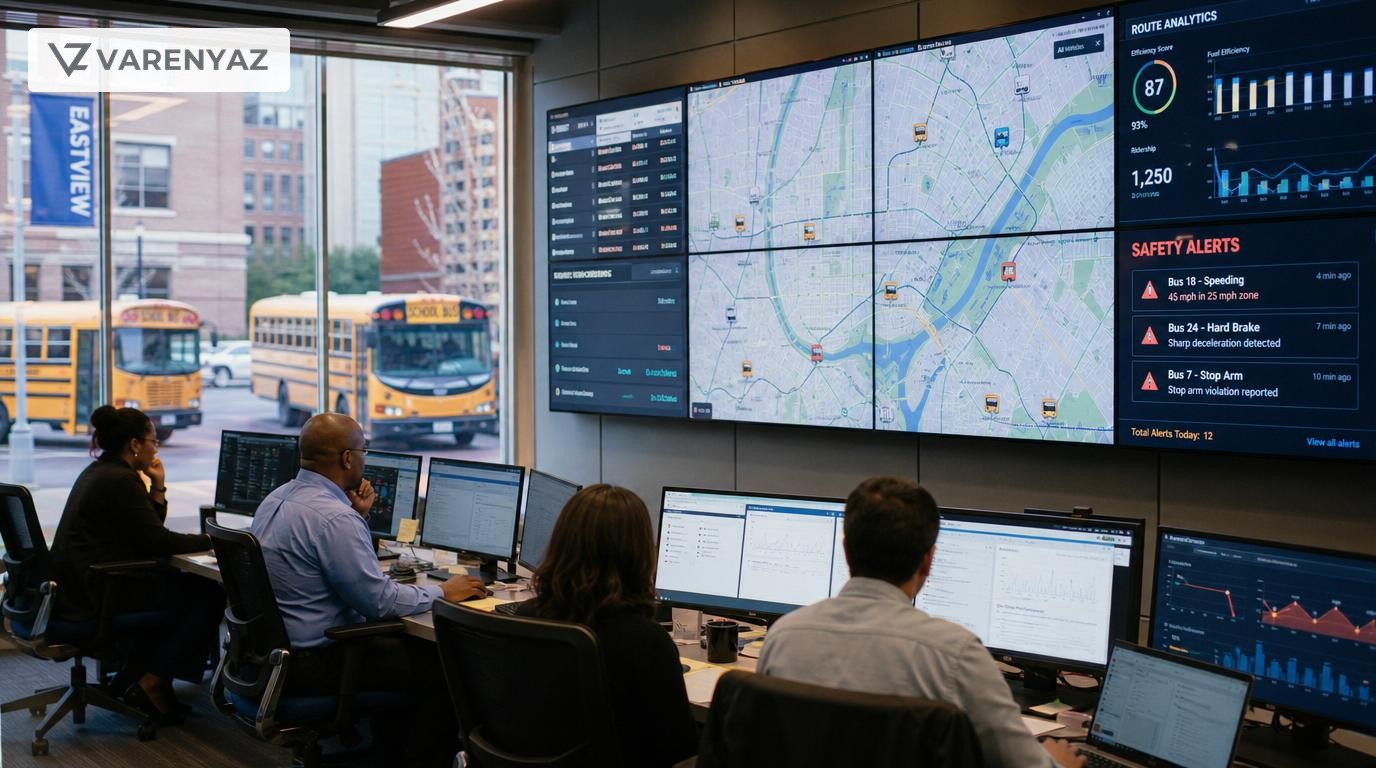
Why IoT Fleet Management Is Becoming Essential for Education
School and university transport has traditionally been treated as a necessary cost center: buses need to run, drivers must be scheduled, and everyone hopes things go smoothly. But expectations have changed. Parents want real-time visibility. Regulators demand better safety data. Budgets are under intense pressure. And students expect seamless experiences on and off campus.
This is where IoT fleet management in education comes in. By connecting buses, shuttles, and campus vehicles with sensors and software, institutions can turn transport from an opaque expense into a transparent, data-driven service.
In this article, we will unpack what IoT fleet management looks like in an educational setting, the business value it delivers, the risks and tradeoffs leaders should consider, and how to design a pragmatic rollout that aligns with your institution’s digital strategy.
Quick Definition: What Is IoT-Driven Fleet Management in Education?
IoT-driven fleet management in education is the use of connected devices, GPS, sensors, and cloud platforms to monitor and manage all vehicles that serve a school, college, or university. That includes school buses, staff shuttles, campus security vehicles, maintenance vans, and in some cases, shared micro-mobility (like golf carts or electric buggies).
At a minimum, an IoT fleet solution will provide:
- Real-time vehicle tracking via GPS and cellular connectivity.
- Route history and geofencing for predefined paths, depots, and campuses.
- Driver behavior data such as harsh braking, speeding, and idling.
- Vehicle health insights from engine diagnostics and telematics.
- Alerts and notifications for incidents, delays, and off-route events.
More advanced deployments connect this data with student information systems, parent apps, and AI-powered analytics to transform transport into a strategic capability.
Why Education Needs Smarter Fleet Management Now
1. Safety and Duty of Care Are Under the Microscope
For many institutions, transport is the most visible and risk-exposed part of daily operations. Accidents, missed pickups, or children left on buses are not just operational failures; they are reputational crises.
Education transport bodies worldwide emphasize structured risk management and data use to improve school journeys. For example, the International Transport Forum highlights the importance of safe and sustainable journeys to school, stressing that better data and monitoring are key levers for safety improvement across cities and regions.[1]
IoT systems help educational institutions actively manage this duty of care by providing reliable, time-stamped data on where students, vehicles, and staff are, and how they are moving.
2. Budgets Are Tight, But Expectations Keep Rising
Transport is one of the largest non-academic cost lines for schools and universities. Fuel prices, maintenance, insurance, and staffing all trend upward. Yet parents and students expect:
- On-time arrivals and departures.
- Clear communication when something changes.
- Safe, comfortable, and predictable journeys.
Without data, leaders have little leverage to optimize routes, right-size fleets, or negotiate with vendors. IoT fleet management surfaces detailed usage and performance insights, allowing institutions to design more efficient services and build stronger business cases for investment or change.
3. Urban Congestion and Sustainability Pressures
Many campuses sit within congested cities competing for road space. Urban transport policies increasingly favor intelligent transport systems (ITS) and data-driven planning to reduce congestion and emissions.[2] Education fleets that plug into this ecosystem gain advantages—priority lanes, synchronized signals, or shared data partnerships with local authorities.
IoT-based optimization can also reduce unnecessary trips and idling, supporting institutional sustainability goals and reporting frameworks.
Core Components of an IoT Fleet Management Stack
Before jumping to business benefits, it helps to understand the building blocks of a typical IoT fleet implementation for education.
1. On-Vehicle Hardware
- GPS/telematics units: Installed in each vehicle, capturing location, speed, ignition status, and often diagnostic data via OBD-II or CAN bus.
- Connectivity modules: Embedded SIM or eSIM for 4G/5G connectivity, sometimes with Wi-Fi fallback on campus.
- Safety sensors (optional but increasingly popular): Door sensors, seat-occupancy or pressure mats, CCTV/DVR systems, and panic buttons for driver or student emergencies.
- Driver ID mechanisms: Key fobs, RFID cards, or mobile apps to associate trips with specific drivers.
2. Student and Asset Identification Layers
To move from simple vehicle tracking to student-centric safety and visibility, many institutions add:
- RFID or NFC cards for students scanning on and off buses.
- Bluetooth beacons or tags for more passive tracking in specific zones.
- Integration with student information systems to link transport events with class schedules.
3. Cloud Platform and Data Infrastructure
- Ingestion layer for high-frequency GPS and sensor data.
- Real-time processing to trigger alerts, update dashboards, and push notifications.
- Storage and data models to support analytics, reporting, and historical queries.
- APIs and webhooks to integrate with school ERPs, HR systems, and mobile apps.
4. Applications and Interfaces
- Operations dashboard for transport managers and administrators to monitor fleets.
- Mobile apps for drivers to see routes, instructions, and report incidents.
- Parent and student apps for real-time bus tracking, ETAs, and notifications.
- Analytics and reporting portals for finance and leadership teams.
5. Security, Governance, and Compliance
Underpinning all of this must be robust security and data governance:
- Role-based access control and audit logs.
- Encryption in transit and at rest.
- Retention policies aligned with local regulations.
- Privacy impact assessments and clear consent processes where required.
Business Value: Where IoT Fleet Management Unlocks Potential
1. Stronger Safety and Risk Management
Safety is the non-negotiable starting point. IoT enables a shift from reactive problem-solving to proactive risk reduction.
- Real-time tracking lets administrators see where every vehicle is, whether it is sticking to its route, and how long it has been stopped.
- Geofencing can send alerts when a bus enters or leaves designated zones such as campuses, depots, or unsafe areas.
- Driving behavior analytics can flag speeding, harsh braking, or aggressive acceleration, enabling coaching or policy interventions.
- Boarding and alighting records help confirm that no student is left behind, a major concern for primary and secondary schools.
In some regions, insurers and regulators are increasingly open to recognizing connected-vehicle data as a factor in risk assessments, which can influence insurance costs over time.
2. Cost Optimization and Budget Control
IoT fleet management enables more precise control of transport costs through:
- Route optimization: Reducing overlapping routes, deadheading, and unnecessary stops.
- Fuel management: Flagging excessive idling and inefficient driving patterns.
- Predictive maintenance: Using engine and mileage data to schedule maintenance before breakdowns occur, reducing downtime and emergency repair costs.
- Utilization analytics: Showing which vehicles are underused or overloaded, guiding future procurement and leasing decisions.
Over time, this moves budgeting conversations from intuition to evidence, which is especially valuable for multi-campus groups, large universities, or municipalities managing fleets across many schools.
3. Parent Trust, Student Experience, and Brand Differentiation
For fee-paying schools and competitive universities, transport quality is now part of the brand promise. Parents are more likely to choose and stay with institutions that demonstrate reliable, transparent, and safe transport.
IoT enables:
- Live bus tracking in parent apps, with ETAs and delay notifications.
- Automated absence or no-show alerts when a student expected on a route does not board.
- Clear communication during disruptions such as weather events, strikes, or traffic incidents.
These capabilities not only improve daily satisfaction but can also reduce inbound call volumes to front desks and transport teams.
4. Data-Driven Planning and Policy
When transport data is granular and reliable, it can inform decisions beyond the fleet itself, such as:
- Staggered start times to spread peak loads on local roads.
- New route design based on where students actually live and travel.
- Campus access policies for private vehicles vs. institutional shuttles.
- Collaboration with city authorities on safe crossings, bus lanes, or shared mobility programs.
These are core themes in intelligent transport systems and city-school collaboration discussions globally, where data sharing and integrated planning aim to create safer, more sustainable journeys to school.[1][2]
5. Future-Proofing with Connected and Autonomous Vehicle Trends
The vehicle ecosystem is moving toward more connectivity and, over time, higher levels of automation. Cellular Vehicle-to-Everything (C-V2X) technologies, for instance, allow vehicles to communicate with each other and with road infrastructure.[4]
By building an IoT-ready fleet stack today, educational institutions position themselves to benefit from future innovations, including:
- Smart traffic management integrated with city systems.
- Enhanced collision-avoidance alerts.
- Gradual introduction of advanced driver assistance and, eventually, automated shuttles on closed campuses.
Implementation Considerations: Architecture, Scale, and Tradeoffs
1. Build vs. Buy vs. Partner
Leaders typically face three options:
- Off-the-shelf platforms from telematics vendors, often with basic configuration options.
- Fully custom solutions built in-house or by a development partner like VarenyaZ.
- Hybrid approaches that combine vendor hardware with custom dashboards, analytics, or integrations.
Off-the-shelf may be fastest but can limit flexibility with school-specific workflows. Fully custom builds offer deep integration with existing systems but require a more deliberate product and engineering effort. Hybrid, where you use proven devices and a cloud backbone but customize the experience for your stakeholders, is often a pragmatic middle ground.
2. Data Volume, Latency, and Connectivity
Education fleets produce a lot of data. Each bus may send location updates every few seconds plus additional sensor readings. Multiply that by dozens or hundreds of vehicles, and you need to consider:
- Update frequency (e.g., every 5 vs. every 30 seconds) and its cost-performance tradeoff.
- Offline behavior when vehicles move through poor signal areas; data buffering and sync policies.
- Regional connectivity constraints in rural areas versus dense city campuses.
Designing for graceful degradation (e.g., estimated ETAs when live position drops) is crucial for user experience.
3. Privacy, Consent, and Ethics
Monitoring vehicles is relatively straightforward; monitoring people—especially children—is more sensitive. Schools must balance safety benefits with ethical and regulatory obligations.
Key actions include:
- Defining clear purposes for data collection and limiting data to those purposes.
- Ensuring role-based visibility so only authorized staff can view location or identity data.
- Establishing policies for video, audio, and biometrics if used, which may fall under stricter rules.
- Communicating transparent notices to parents, staff, and students with options for queries or redress.
Data-protection regimes like GDPR in the UK and EU and sectoral rules like FERPA in the US set baselines for how education data should be collected, stored, and shared. While specifics differ by region, the direction of travel is clear: privacy by design is no longer optional.
4. Change Management and Culture
Even the best technology can fail if people do not trust or understand it. Common concerns include:
- Drivers worrying about surveillance or punitive use of data.
- Parents unsure about how their child’s information will be handled.
- Administrators facing new workflows and responsibilities.
Successful programs invest early in:
- Training and clear policies on how data will and will not be used.
- Feedback channels for drivers, parents, and staff.
- Visible wins, such as reduced delays or faster incident response, to build confidence.
Step-by-Step: A Practical Rollout Roadmap
Step 1: Clarify Objectives and Constraints
Start by aligning stakeholders on the primary goals. For example:
- Reduce transport incidents by a set percentage over two years.
- Cut fuel costs by optimizing routes and idling time.
- Improve parent satisfaction scores related to transport.
- Provide stronger evidence for compliance and insurance.
At the same time, define constraints such as maximum budget, regulatory requirements, IT capacity, and procurement timelines.
Step 2: Audit Your Existing Fleet and Systems
Conduct a structured audit that covers:
- Number and types of vehicles, their ages, and usage patterns.
- Existing GPS or tracking solutions, if any.
- Current software landscape (ERPs, HR, student systems, apps).
- Policies and contracts with external transport providers.
This baseline will inform hardware choices, integration needs, and rollout complexity.
Step 3: Design Your Solution Architecture
With objectives and constraints clear, work with your IT team and partners like VarenyaZ to design:
- Hardware strategy: Device models, installation plans, and maintenance responsibilities.
- Cloud and application layers: Which components are commercial solutions vs. custom-built.
- Data models and governance: What you will store, for how long, and who can access it.
- Integration map: How data flows between fleet systems, ERPs, student systems, HR, and parent apps.
Step 4: Pilot with a Limited Fleet and Clear Metrics
Rather than a big-bang rollout, select a small but representative subset of routes or campuses. Define success metrics such as:
- On-time performance improvement.
- Reduction in reported incidents or near-misses.
- Fuel and maintenance cost trends.
- Parent and driver feedback scores.
Use this pilot to test hardware reliability, software usability, and processes for incident response and communications.
Step 5: Iterate, Standardize, and Scale
After the pilot, refine:
- Device configurations and data collection frequencies.
- Alert thresholds and escalation paths.
- Training material for drivers, staff, and parents.
- Reporting dashboards for leadership.
Then plan incremental expansion—by route, campus, or region—ensuring support structures scale as well.
Step 6: Layer on Advanced Analytics and AI
Once your foundation is stable, you can start unlocking higher-order value:
- Demand forecasting for bus capacity using historical ridership and enrollment trends.
- Dynamic routing adjustments based on predicted traffic or weather patterns.
- Risk scoring for routes or vehicles using incident history and driving behavior.
This is where AI and ML techniques can significantly augment human planning and decision-making, especially in large or multi-city education networks.
Risks, Tradeoffs, and How to Mitigate Them
1. Over-Complexity and Feature Bloat
It is easy to buy or build a system with more features than your team can realistically use. This leads to low adoption and a poor return.
Mitigation: Start with a focused feature set that directly supports your top three objectives. Add advanced capabilities only once the basics are embedded in daily workflows.
2. Vendor Lock-In
Some fleet solutions tightly couple proprietary hardware, software, and data formats, making it hard to switch providers later.
Mitigation: Prefer open protocols, documented APIs, and clear data export options. Where possible, negotiate contractual rights to your transport data.
3. Security and Data Breach Risks
Connected vehicles and cloud platforms expand the attack surface. Given the sensitivity of student data, any breach can be severe.
Mitigation: Conduct security assessments, enforce strong identity and access management, and ensure your partners adhere to best practices in encryption, patching, and incident response.
4. Resistance from Staff and Transport Partners
Drivers, unions, or outsourced transport vendors may view IoT tracking as a threat or a burden.
Mitigation: Involve them early, explain the safety and efficiency benefits, and use data primarily for coaching and systemic improvements rather than punishment. Co-design policies with their input where feasible.
Measuring Success: What to Track Over Time
To ensure your IoT fleet investment continues to deliver value, define a set of core KPIs and review them regularly.
Operational KPIs
- On-time arrival and departure rates.
- Average route duration and variability.
- Vehicle utilization rates by time of day and route.
- Breakdowns and unplanned maintenance events per vehicle.
Financial KPIs
- Fuel costs per kilometer or mile.
- Maintenance costs per vehicle.
- Insurance premiums and claims trends, where applicable.
- Cost per transported student per month or term.
Safety and Experience KPIs
- Number and severity of incidents and near-misses.
- Harsh driving events per 1,000 km or miles.
- Parent satisfaction scores specific to transport.
- Response time to incidents or breakdowns.
Regional Perspectives: India, United States, and United Kingdom
India
In India, rapid urbanization and dense school clusters create complex transport challenges. Many private schools operate large fleets or depend on vendor networks, while regulations are tightening around school bus safety. IoT fleet systems can help standardize safety practices, reduce unauthorized route deviations, and demonstrate compliance to state boards and parents.
United States
US school districts often manage sizable fleets with aging vehicles and constrained budgets. Safety expectations are high, and pressure is growing for better environmental performance. Connected fleet solutions can support grant applications, inform electrification strategies, and provide data to justify upgrades or route redesigns, while aligning with guidance from organizations such as the National Association for Pupil Transportation.[3]
United Kingdom
In the UK, a mix of local authority and independent school transport models exists, often overlapping with public transit. Intelligent transport systems initiatives and low-emission zones place new demands on fleet operations. IoT insights can help institutions coordinate with councils, select appropriate vehicles, and showcase progress on sustainability and safety to inspectors and families.
How VarenyaZ Helps Build IoT-Driven Fleet Solutions for Education
IoT fleet management in education is not just a hardware decision; it is a digital product, data, and user-experience challenge. This is where a partner like VarenyaZ can accelerate your journey.
Custom Fleet Dashboards and Web Applications
Generic fleet platforms rarely match the nuances of education: multiple bell times, extracurricular trips, multi-campus routing, and parent-specific communication flows. VarenyaZ designs and builds custom web dashboards and admin portals tailored to your roles and workflows, from transport managers to principals and compliance officers.
Integration with Existing Education Systems
To unlock full value, transport data must flow into your existing systems. VarenyaZ’s web and backend development teams can integrate IoT platforms with:
- School and university ERPs.
- Student Information Systems (SIS).
- HR and payroll systems for driver scheduling.
- Parent and student mobile apps.
This integration ensures that the same trusted data powers real-time tracking, billing, reporting, and communications.
AI-Driven Analytics and Decision Support
Beyond basic tracking, VarenyaZ’s AI development capabilities help you build advanced analytics and decision-support tools on top of your IoT data, including:
- Route and capacity optimization engines.
- Predictive maintenance models informed by telematics.
- Risk scoring dashboards for leadership.
- Natural-language interfaces so non-technical staff can query fleet data.
Human-Centered UX and Communication Design
Parents, students, and drivers will only embrace technology that feels intuitive and respectful of their needs. VarenyaZ’s design team focuses on human-centered UX for web and mobile interfaces, ensuring:
- Parents receive clear, timely, and non-intrusive notifications.
- Drivers can quickly understand routes and alerts with minimal taps.
- Administrators see the right information at the right level of detail.
From Strategy to Launch
Whether you are a single school, a university, or a multi-campus group, VarenyaZ can support you from discovery workshops and architecture design to development, integration, and rollout support. If you are ready to explore how IoT-driven fleet management can transform your education transport, start a conversation with the team at https://varenyaz.com/contact/.
Conclusion: Turning Transport into a Strategic Advantage
IoT fleet management is about far more than dots on a map. For education leaders in India, the United States, the United Kingdom, and beyond, it is a pathway to safer journeys, smarter budgeting, and stronger trust with families and communities.
By connecting vehicles, data, and people with thoughtful design and governance, institutions can transform transport from a daily headache into a strategic asset. With deep expertise in web design, web development, and AI development, VarenyaZ helps education providers build the digital foundations of this transformation—turning real-time fleet data into actionable insight, compelling experiences, and long-term value.
Editorial Perspective
Expert Review Notes
"For education leaders, IoT fleet management is not just about tracking buses; it is about redesigning the entire transport experience around safety, transparency, and data-driven decisions."
"When IoT fleet data is integrated with school ERPs, parent apps, and analytics dashboards, it becomes a strategic asset for budgeting, capacity planning, and long-term campus mobility design."
"The most successful education deployments treat IoT fleets as a cross-functional transformation project, with clear governance across IT, operations, academics, and communications."
Frequently Asked Questions
What is IoT fleet management in education?
IoT fleet management in education uses connected devices, GPS, sensors, and cloud software to monitor and manage school buses, university shuttles, and campus service vehicles in real time. It provides live location, route history, safety alerts, maintenance data, and analytics to improve safety, efficiency, and compliance.
How does IoT fleet management improve student safety?
IoT fleet management improves student safety through real-time bus tracking, geofencing around routes and campuses, emergency alerts, harsh-driving detection, and integration with access or RFID systems for boarding and alighting events. These capabilities help institutions respond faster to incidents and give parents more transparency and peace of mind.
What are the main costs and ROI drivers for IoT fleet systems?
Costs include hardware (GPS and telematics devices, sensors), connectivity (SIM or eSIM data plans), platform or license fees, and implementation. ROI typically comes from reduced fuel consumption, optimized routes, fewer breakdowns, lower insurance risk, better asset utilization, and improved parent satisfaction and retention, especially for fee-paying schools and universities.
How should schools handle privacy and data protection in IoT fleets?
Schools should define clear data governance policies, limit data collection to what is necessary, and comply with regional regulations such as GDPR in the UK and EU or FERPA in the US where applicable. This includes secure data storage, role-based access, audit logs, and transparent communication with parents and staff about what data is collected and why.
Can IoT fleet management integrate with our existing school systems?
Yes. Modern fleet platforms usually offer APIs or webhooks that can integrate with school ERPs, student information systems, parent mobile apps, identity and access systems, and even digital signage. A development partner like VarenyaZ can help design and implement these integrations so transport data flows smoothly between systems.
How long does it take to implement IoT fleet management in a school or university?
For a small fleet pilot, basic implementation can often be completed in 4–8 weeks, including hardware installation, platform configuration, and training. Larger multi-campus or multi-region deployments may take several months, especially if there are complex integrations, procurement steps, or strict data-protection assessments.
Selected References
- International Transport Forum – Safe and Sustainable Journeys to School
- European Commission – Intelligent Transport Systems (ITS) in Urban Areas
- National Association for Pupil Transportation (NAPT) – School BUSRide Safety & Technology Resources
- GSMA – Cellular Vehicle-to-Everything (C-V2X) and Connected Vehicles
Further Reading
Related perspectives
Why Property CRM Integrations Power Real-Time Manufacturing
Property CRM integrations connect your assets, plants, and customer records into a single real-time view, turning static equipment data into live manufacturing intelligence. By linking CRM with MES, ERP, IIoT platforms, and field service tools, manufacturers gain 360° visibility on each installed asset. That unlocks predictive maintenance, faster service, smarter production planning, and new outcome-based revenue models. The article explains the business value, core architecture, integration patterns, risks, and step-by-step rollout so leaders can design a scalable, secure real-time insight layer across operations.
Future-Proofing Your Business with AI
AI solutions for small business are now accessible, affordable, and essential for staying competitive. Startups and SMBs can use AI to automate routine work, personalize customer experiences, improve decisions, and test new products faster. This article explains where AI creates real value, how to choose the right use cases, assess your data, decide between off‑the‑shelf and custom AI, manage risks, and roll out a phased roadmap that fits limited budgets and teams.
How AI Drives Revenue Growth in Transport & Logistics
AI solutions help transportation and logistics companies grow revenue by improving asset utilization, optimizing prices and routes, reducing delays, and enabling new digital services for shippers. This article explains the main AI use cases, how they translate into measurable revenue, and the data, technology, and change-management foundations required. It also covers risks like biased pricing, operational disruption, and integration complexity, and offers a practical roadmap to move from pilots to production. The article closes with how VarenyaZ supports web, product, and AI development for logistics players.