
Interactive E-Learning for Healthcare Growth
Explore how interactive e-learning content drives growth in healthcare through better training, compliance, and patient outcomes.

Quick Answer
Interactive e-learning in healthcare combines digital simulations, microlearning, scenarios, and assessments to upgrade clinical skills and compliance at scale. It lowers training costs, reduces errors, and speeds onboarding while supporting distributed teams. Successful programs align with clinical priorities, use secure and interoperable tech, and embed analytics. Healthcare leaders should start with high-impact use cases, pilot blended learning, standardize governance, and partner with experienced web and AI development teams to build sustainable learning ecosystems.
In this article
Coverage signals
14 min
May 30, 2026
VarenyaZ Editorial Desk, Technical Content Review
Updated May 30, 2026
Key Takeaways
- Interactive e-learning in healthcare directly supports growth by improving clinical quality, compliance, and workforce scalability.
- Simulations, branching scenarios, and microlearning are the most effective formats for busy clinicians and care teams.
- A blended model that mixes digital content with live mentorship often outperforms purely online or classroom-only approaches.
- Governance, content accuracy, and regulatory alignment are essential for safe, defensible digital training in healthcare.
- AI can personalize learning paths, surface just-in-time support, and flag risk areas based on performance data.
- Selecting the right technology stack requires balancing security, interoperability, usability, and long-term maintainability.
- Start small with high-impact use cases, prove value with data, then scale content libraries and integrations systematically.
- Partnering with experienced web, product, and AI teams like VarenyaZ accelerates the move from pilots to a strategic learning ecosystem.
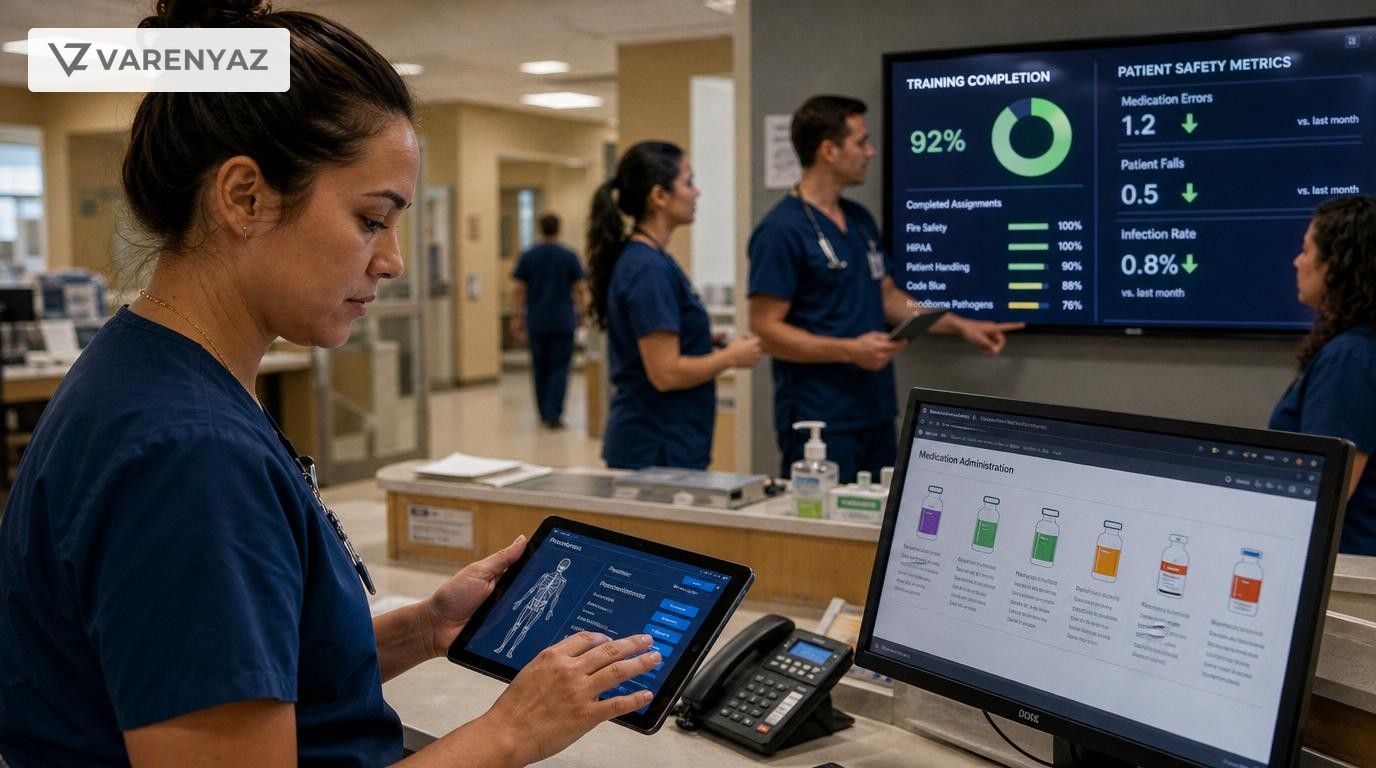
Interactive e-learning in healthcare: from checkbox training to a growth engine
Healthcare is under relentless pressure: talent shortages, rising patient volumes, new technologies, and constantly shifting regulations. In this environment, training cannot just be a compliance checkbox. It has to be a lever for safer care, faster onboarding, and smarter operations.
That is where interactive e-learning in healthcare becomes a catalyst for growth. When designed well, it upgrades skills, standardizes practice, and frees up scarce expert time, all while generating data that leadership can actually use.
This article unpacks how healthcare decision-makers can turn interactive digital learning into a strategic asset—what it looks like in practice, the technology behind it, the risks to watch, and how to phase implementation in a realistic, low-friction way.
What interactive e-learning in healthcare really means
Interactive e-learning goes beyond PDFs and slide decks uploaded to a learning portal. It requires the learner to make decisions, solve problems, and receive feedback in real time.
Core characteristics
In a healthcare context, interactive e-learning typically includes:
- Scenario-based learning: Clinicians walk through branching case studies (e.g., chest pain assessment, medication reconciliation) and see consequences of their choices.
- Simulations: Virtual patients, operating rooms, or emergency scenarios where learners practice procedures or protocols in a risk-free environment.
- Microlearning modules: Short, focused lessons—5–10 minutes—that target a single concept, such as a new guideline or device workflow.
- Interactive assessments: Quizzes, drag-and-drop exercises, and image-based questions that test applied knowledge, not rote memorization.
- Feedback loops: Immediate explanations, hints, or references when a learner makes a suboptimal decision.
The goal is not just engagement for its own sake. It is to simulate the cognitive load of real clinical work—triaging information, making time-sensitive decisions, and applying protocols under pressure—without putting patients at risk.
Why now? The healthcare context
Three systemic pressures make interactive e-learning especially relevant today:
- Workforce shortages: Global projections show a continuing gap between healthcare workforce supply and demand, forcing organizations to upskill existing staff more efficiently.
- Rapid change: New medications, devices, digital tools, and care pathways require continuous learning rather than occasional classroom days.
- Distributed care models: Telehealth, community clinics, and home-based care demand consistent training across geographies and time zones.
Traditional in-person training alone simply cannot keep up with this pace and scale.
How interactive e-learning drives growth in healthcare
For healthcare executives and product leaders, the key question is not whether interactive e-learning is interesting—it is whether it moves the needle on growth, quality, and sustainability.
1. Faster, more consistent onboarding
Every day a new nurse, doctor, or allied professional spends in classroom training or shadowing is a day of limited clinical productivity. Interactive digital pathways can front-load foundational knowledge before day one, then support on-the-job learning with targeted simulations and checklists.
This enables:
- Shorter time-to-competency for new staff and rotating residents.
- Standardized onboarding across locations, reducing variability in practice.
- Better utilization of senior clinicians’ time, who can focus on nuanced mentorship rather than repeating basic orientations.
2. Improved clinical quality and patient safety
There is growing evidence that well-designed digital and online learning can be at least as effective as traditional education in healthcare, especially when it incorporates interactivity and real-world cases. Aligning interactive content with evidence-based guidelines and institutional protocols helps organizations:
- Reduce preventable errors through repeated practice in simulations and scenarios.
- Reinforce critical pathways (e.g., sepsis bundles, stroke pathways) with high-frequency microlearning.
- Train interdisciplinary teams together on communication and handoff scenarios.
Over time, this contributes to more predictable quality and supports patient-safety initiatives.
3. Regulatory and commercial advantage
Compliance is often seen as an obligation, but it can also be a differentiator:
- Hospitals and health systems that can demonstrate robust, documented training for accreditation and audits have stronger risk profiles.
- Medical device and pharma companies with compelling, interactive training on safe use of their products are more attractive partners for providers.
- Healthtech platforms that embed training directly into their workflows can reduce customer churn and support expansion into new markets.
Interactive e-learning systems that generate defensible records of participation, assessment scores, and remediation plans can be a strategic part of clinical governance and commercial positioning.
4. Operational efficiency and cost control
Consider the hidden costs of traditional education:
- Travel and accommodation for centralized training events.
- Lost clinical hours while staff attend in-person sessions.
- Printing and updating physical materials whenever guidelines change.
Interactive e-learning does not eliminate all in-person training—but it significantly reduces the need for it, especially for foundational knowledge and routine refreshers. Once built, digital modules can be reused, localized, and updated at marginal cost.
The operational upside includes:
- Lower recurring training costs per learner.
- Less disruption to staffing through flexible, self-paced modules.
- Continuous availability of training resources for night shifts and remote clinics.
5. Data for strategic decision-making
A major advantage of digital, interactive content is the data exhaust it generates:
- Completion rates by role, specialty, location, and team.
- Question-level performance highlighting weak areas.
- Time on task and drop-off points indicating usability issues.
- Correlations between training and operational metrics when integrated with other systems.
When this data is integrated into dashboards and analytics, leaders can prioritize interventions, refine content, and even support staffing and product decisions based on actual learning behavior rather than assumptions.
Key interactive formats that work in healthcare
Not every interactive trick is worth implementing. Healthcare audiences are time-poor and highly skeptical of anything that feels gimmicky. The following formats have consistently high value-to-effort ratios.
Simulation-based learning
Simulation is the gold standard for high-stakes skills. While not every organization has access to high-fidelity manikins and physical simulation labs, digital simulations can replicate many cognitive and decision-making aspects:
- Virtual patient cases with changing vitals and lab results.
- Interactive medication reconciliation with potential interactions.
- Perioperative checklists and timeouts in a virtual OR.
- Emergency response pathways for stroke, myocardial infarction, or sepsis.
Simulations can be delivered via standard web or mobile apps, or through more advanced AR/VR setups where appropriate and feasible.
Branching scenarios and case-based learning
Branching scenarios are powerful for teaching diagnostic reasoning, communication, and ethics. A learner’s choice at each step changes the story and outcomes, illustrating real trade-offs and complexities.
Examples include:
- End-of-life discussions with patients and families.
- Managing suspected domestic violence disclosures.
- Cross-cultural communication in primary care.
- Escalation decisions in deteriorating patient scenarios.
These modules help learners explore consequences in a psychologically safe environment and build situational awareness.
Microlearning for busy clinicians
Microlearning consists of short, sharply focused modules that can be completed between tasks or during breaks. In healthcare, it is ideal for:
- Reinforcing updated protocols, dosing changes, or new device workflows.
- Delivering quick refreshers before scheduled procedures.
- Supporting just-in-time learning in clinics and on wards.
Microlearning can be delivered as interactive cards, swipeable stories, or short quizzes—always optimized for mobile.
Interactive checklists, pathways, and tools
Instead of static PDFs, clinical pathways and checklists can be transformed into interactive tools:
- Guided decision trees based on symptoms and risk factors.
- Dynamic dosage calculators with safety checks.
- Structured handoff templates that prompt for critical information.
These tools blur the line between learning and doing, embedding knowledge directly into the workflow.
Social and collaborative learning
Many clinical insights are tacit, shared through peer discussions and informal mentoring. Digital platforms can extend this through:
- Case discussion boards and peer comments on scenarios.
- Embedded debrief spaces after simulations.
- Mentor feedback on submitted reflections or practice tasks.
The key is moderation and governance to maintain confidentiality and clinical accuracy.
The technology stack behind effective healthcare e-learning
To make interactive e-learning sustainable, healthcare organizations and healthtech builders need to think beyond individual courses and toward a learning ecosystem.
Core components
- Learning platform (LMS or LXP)
Your central hub for user management, course enrollment, tracking, and reporting. For healthcare, it must support role-based access, multilingual content, and strong security controls.
- Authoring tools
Software used to create interactive content—quizzes, simulations, branching scenarios, and responsive layouts. These might be off-the-shelf tools, custom-built editors, or a combination.
- Content delivery and media infrastructure
Video hosting, content delivery networks (CDNs), and caching optimized for clinical settings where bandwidth may be constrained, particularly in rural or low-resource areas.
- Analytics and reporting
Dashboards, data warehouses, or embedded analytics that unify data from the learning platform, HR systems, and possibly clinical data sources (where appropriate and compliant).
- Security, identity, and integrations
Single sign-on, role-based access control, encryption, and integrations with HRIS, scheduling, and clinical systems for seamless onboarding and attribution.
Interoperability and standards
For scalable ecosystems, interoperability matters. Standards such as SCORM and xAPI allow content to move between systems while preserving tracking. In some advanced setups, learning systems also interact with broader health IT ecosystems that conform to interoperability frameworks.
Choosing standards-based tools where possible minimizes lock-in and supports long-term maintainability.
Where AI fits in the stack
AI can enhance interactive e-learning but should not replace strong instructional and clinical design. Practical use cases include:
- Adaptive learning paths: Automatically adjusting difficulty or recommending modules based on performance.
- Conversational assistants: Chat-based helpers embedded in platforms to clarify concepts or reference guidelines, with curated, verified content sources.
- Content acceleration: Drafting outlines, practice questions, and feedback suggestions that are then reviewed by subject-matter experts.
- Risk flagging: Identifying learners or teams with persistent knowledge gaps that may warrant targeted support.
All AI capabilities must operate under strict governance, with careful attention to clinical accuracy, data privacy, and transparency.
Implementation models: build, buy, or hybrid?
Healthcare leaders have three broad routes to implement interactive e-learning.
1. Buy: off-the-shelf platforms and content
Off-the-shelf solutions offer speed to value. Many vendors provide generic clinical, compliance, and safety content libraries, along with hosted learning platforms.
Pros:
- Fast deployment and predictable pricing.
- Maintenance and updates handled by the vendor.
- Good for baseline compliance and general clinical topics.
Cons:
- Limited alignment with local protocols and workflows.
- Less flexibility for deep integration with existing systems.
- Content differentiation is minimal—competitors may use the same modules.
2. Build: fully custom platforms and content
Some organizations, particularly larger systems or healthtech companies, choose a custom route: their own platform, their own content, their own integrations.
Pros:
- Full alignment with local practice, branding, and workflows.
- Flexible integration with clinical systems, HR, and operations tools.
- Ability to innovate and differentiate via UX, analytics, and AI.
Cons:
- Higher upfront cost and longer timelines.
- Requires ongoing engineering, product, and content capacity.
- Risk of technical debt without strong governance.
3. Hybrid: the pragmatic path
For many, a hybrid approach is best:
- Use off-the-shelf content for generic, high-volume topics (e.g., hand hygiene, basic life support).
- Develop custom interactive content for local protocols, high-risk pathways, and proprietary products.
- Integrate both into a central learning platform with unified analytics.
This balances speed and differentiation, especially when supported by a technology partner who understands both healthcare constraints and modern product development.
Risks, trade-offs, and how to manage them
Interactive e-learning carries specific risks in healthcare. Addressing them upfront builds trust and prevents costly rework.
Clinical accuracy and safety
If content is outdated or incorrect, it can lead to unsafe practice. To mitigate this:
- Establish a clinical editorial board to review and approve content.
- Implement version control and clear update logs.
- Set review cadences tied to external guideline updates.
- Clearly label educational content versus institutional policy where necessary.
Regulatory compliance and privacy
Learning platforms handling staff or learner data must meet relevant privacy and security requirements. For organizations operating across multiple jurisdictions, overlapping obligations can be complex.
Mitigation strategies include:
- Data minimization and explicit access controls.
- Encryption in transit and at rest, with monitored access logs.
- Vendor evaluations that include security posture, certifications, and incident-response processes.
- Regular audits and penetration testing for custom platforms.
Change fatigue and adoption barriers
Clinicians are already dealing with EHRs, portals, and digital tools. Adding another system can backfire if not carefully designed.
To maximize adoption:
- Invest in user-centered design for the learning experience.
- Embed learning access in existing tools (e.g., SSO from intranet or clinical portal).
- Start with high-relevance topics that clearly save time or reduce friction.
- Recognize and reward completion in ways that matter to clinicians, such as credits or recognition within teams.
Over-reliance on automation
AI and automation are powerful, but they should augment—not replace—expert clinical judgment and oversight in content and assessment.
Guardrails should include:
- Human review of AI-generated educational materials.
- Clear documentation of AI roles and limitations.
- Opt-out or escalation paths if learners encounter incorrect or confusing AI outputs.
Direct answer: how interactive e-learning accelerates healthcare growth
Interactive e-learning in healthcare accelerates growth by improving clinical quality, reducing training costs, and enabling faster onboarding across distributed teams. It uses simulations, case-based scenarios, microlearning, and data-driven assessments to standardize practice and identify skill gaps. When integrated into secure, interoperable platforms with strong governance, interactive e-learning supports better patient outcomes, stronger regulatory compliance, and more scalable operations—freeing leaders to expand services, adopt new technologies, and enter new markets confidently.
A practical roadmap for healthcare leaders
Turning vision into a practical program requires a phased, evidence-based approach.
Step 1: Clarify goals and constraints
Start with a simple but rigorous set of questions:
- Which outcomes matter most in the next 12–24 months—reduced onboarding time, fewer errors, better compliance performance, improved patient experience?
- Which audiences are most critical—nurses, junior doctors, allied health, frontline staff, or partners?
- What constraints exist—budget, technical infrastructure, bandwidth, regulatory environment?
Define 2–3 measurable goals, such as reducing time-to-competency for new nurses by a percentage or increasing completion of key safety modules.
Step 2: Identify high-impact learning use cases
Look for areas where interactive e-learning will be most visible and valuable, for example:
- Onboarding for high-turnover roles.
- High-risk clinical pathways (e.g., sepsis, stroke, anticoagulation).
- New device rollouts or digital tools.
- System-wide policy changes or regulatory requirements.
Prioritize use cases that combine clear business value with manageable scope for an initial pilot.
Step 3: Design the learning experience first
Technology comes second. First, define:
- What the learner needs to do differently after the module.
- Which decisions, scenarios, or skills must be practiced.
- How you will assess that behavior has changed.
Only then decide whether the right format is a simulation, branching case, interactive checklist, or microlearning series.
Step 4: Build or configure the platform stack
Once the experience vision is clear, configure or build:
- A secure platform for enrollment, delivery, and tracking.
- Authoring capabilities (in-house, partner, or vendor tools).
- Analytics pipelines and dashboards.
- Integrations with HR and identity systems.
This is where a partner with web, product, and AI expertise can significantly accelerate progress.
Step 5: Pilot, measure, and iterate
Run a pilot with a defined population and timeframe. Measure both learning metrics (completion, performance) and business metrics (onboarding time, incidents, support tickets, or time saved in live training).
Hold structured debriefs with learners, educators, and managers. Use their feedback to refine content, UX, and operational processes.
Step 6: Scale and institutionalize governance
After proving value, expand to additional topics and audiences, while formalizing:
- Editorial and clinical governance for content.
- Release cycles and content lifecycle management.
- Data governance for analytics and AI components.
- Budgeting and ownership across departments (education, IT, operations).
The aim is to treat your learning ecosystem like any mission-critical clinical system: planned, governed, and continuously improved.
Design and UX principles for clinician-centered learning
Even the best content fails if the experience is clunky. Healthcare-specific UX principles include:
- Low friction access: Single sign-on, mobile-first layouts, offline options where bandwidth is limited.
- Clear time expectations: Display approximate completion time for every module and respect clinicians’ schedules.
- Cognitive load management: Avoid overwhelming screens; use progressive disclosure and chunk information logically.
- Inclusive design: Accessible color contrasts, captions for all audio/video, and localization for key languages.
- Integration into real workflows: QR codes at equipment, deep links from intranet pages, reminders tied to shift patterns.
When UX is aligned with clinical reality, adoption and completion rates increase without heavy enforcement.
Using AI responsibly in healthcare e-learning
AI has enormous promise, but it must be implemented with a healthcare-grade safety mindset.
High-value AI use cases
- Smart recommendations: Suggesting the next best module based on role, past performance, and organizational priorities.
- Guideline summarization: Turning lengthy documents into structured outlines and interactive questions for expert review.
- Virtual mentors: Assistants that explain key concepts, point to authoritative references, and help troubleshoot learning tasks.
- Analytics augmentation: Identifying patterns in performance and engagement that humans might miss.
Non-negotiables for safety and trust
To maintain trust:
- Keep AI outputs within well-defined boundaries and require human review for clinical content.
- Provide transparency about how recommendations are generated.
- Ensure that sensitive data is de-identified or kept within secure environments.
- Align governance with broader organizational AI and digital-health frameworks.
How VarenyaZ can help build your healthcare learning ecosystem
Interactive e-learning in healthcare is no longer optional—it is one of the few scalable levers organizations have to improve quality, protect staff, and unlock growth. But making it work requires more than buying a generic LMS. It demands thoughtful content strategy, robust technology, and responsible AI.
VarenyaZ collaborates with healthcare providers, healthtech startups, and medical education organizations to design and build web and mobile learning platforms, craft interactive learning experiences, and develop AI-powered tools that make training faster, safer, and more engaging. From user research and UX to backend architecture, interoperability, and analytics, we help you move from isolated courses to a cohesive, data-driven learning ecosystem that aligns with your clinical and growth objectives.
If you are exploring or scaling interactive e-learning for your healthcare organization, contact the VarenyaZ team at https://varenyaz.com/contact/ to discuss how we can support your strategy.
By approaching interactive e-learning as a strategic product—supported by modern web design, robust development, and carefully governed AI—you can create an enduring advantage in how your organization learns, adapts, and ultimately cares for patients.
Editorial Perspective
Expert Review Notes
"Interactive e-learning only becomes a growth engine for healthcare when it is tightly mapped to real clinical workflows, not just built as generic courses sitting in a disconnected LMS."
"The most successful healthcare learning ecosystems combine thoughtful UX, rock-solid security, and responsible AI so that both clinicians and compliance teams can trust the platform."
"If your e-learning data never leaves a spreadsheet, you are missing half its value; integrated analytics should inform staffing, quality initiatives, and product strategy."
Frequently Asked Questions
What is interactive e-learning in healthcare?
Interactive e-learning in healthcare is digital training content that requires active participation from clinicians, staff, and sometimes patients. Instead of passively watching videos, learners work through simulations, branching scenarios, quizzes, and case-based activities that mimic real clinical decisions. This approach supports better skill transfer, retention, and behavior change than static materials.
How does interactive e-learning improve patient outcomes?
Interactive e-learning improves patient outcomes by strengthening clinical decision-making, standardizing protocols, and reducing variability in care. Scenario-based training lets clinicians practice complex situations safely, while data from assessments helps organizations identify and close skill gaps. Well-designed modules aligned with evidence-based guidelines support safer procedures, better communication, and more consistent adherence to best practices.
What technology do we need to implement healthcare e-learning?
At a minimum, you need a secure learning platform (LMS or LXP), a content authoring workflow, and integration with identity and HR systems. Many organizations also add simulation engines, video hosting, analytics, and AI components such as recommendation engines or chat-based assistants. The stack should comply with healthcare security and privacy regulations and support interoperability standards where needed.
How can we keep interactive healthcare content up to date?
Treat learning content like a product, not a one-off project. Establish editorial governance with clinical reviewers, version control, and review cycles tied to guideline updates. Use modular content so you can update a single protocol, checklist, or decision path without rebuilding entire courses. Analytics can highlight modules with poor performance or engagement that need refreshes.
Is AI necessary for effective healthcare e-learning?
AI is not strictly necessary, but it can significantly enhance impact once the basics are in place. AI can personalize learning paths, summarize guidelines into microlearning, power clinical-case chatbots, and flag at-risk learners based on performance. However, it must be deployed with strict guardrails, transparent oversight, and alignment with regulatory and ethical expectations.
How can VarenyaZ support our healthcare e-learning strategy?
VarenyaZ helps healthcare and healthtech organizations design and build end-to-end learning ecosystems: from UX-driven web and mobile platforms to secure backend architectures and AI-powered learning assistants. The team works with your clinical, operations, and product leaders to translate training needs into interactive experiences, robust integrations, and dashboards that directly support quality and growth goals.
Selected References
- World Health Organization – Global Strategy on Human Resources for Health
- World Health Organization – Digital Education for Health Workforce
- BMJ – Effectiveness of Digital and Online Learning in Healthcare Education
- International Council of Nurses – Guidelines on Continuing Professional Development
- U.S. Department of Health & Human Services – Health IT and Interoperability Standards
Further Reading
Related perspectives
Performance Engineering for Modern Manufacturing
Performance engineering in manufacturing is the discipline of designing plants, processes, and digital systems to consistently hit throughput, quality, cost, and reliability targets. It combines OT and IT data, real-time monitoring, analytics, and AI to expose bottlenecks and drive continuous improvement. This article explains core concepts, key metrics, target architecture, and implementation patterns, with examples like predictive maintenance, digital twins, and energy optimization. It also covers governance, risks, and vendor choices, then outlines a pragmatic roadmap and how VarenyaZ supports manufacturers with web, data, and AI solutions.
Top 7 Interactive E‑Learning Best Practices for Healthcare
Interactive e-learning for healthcare works best when it mirrors real clinical decisions, not static slide decks. Focus on scenario-based cases, microlearning modules, spaced repetition, and frequent low-stakes assessment with targeted feedback. Align every interaction to patient outcomes and compliance requirements, and measure performance with analytics tied to your LMS and clinical KPIs. Involve clinicians in content design, validate accuracy, and pilot with small cohorts before scaling. Partnering with a specialist design, development, and AI team can help operationalize these best practices efficiently and safely.
Digital Transformation Roadmaps in Education
A digital transformation roadmap for education is a structured plan that connects institutional strategy, pedagogy, and technology to measurably improve learning outcomes. This article explains how to define learner-centred goals, build governance, align platforms and data, integrate AI responsibly, phase implementation, manage change, and track impact. It details risks, tradeoffs, and decision points for schools, universities, and EdTech providers, and clarifies how to turn disconnected tools into an integrated ecosystem that supports teachers, learners, and administrators.