
Hybrid Cloud Integration for Hospitality & Entertainment
Explore how hybrid cloud integration helps hospitality and entertainment brands modernize legacy systems, personalize experiences, and improve resilience.

Quick Answer
Hybrid cloud integration connects on-premises hotel and venue systems with modern public cloud services, allowing hospitality and entertainment brands to modernize without disrupting operations. By exposing legacy platforms via APIs, synchronizing data, and using edge computing where needed, teams can unlock personalization, real-time analytics, and resilient operations. This article explains benefits, key architectures, governance, risk, and costs, then outlines a practical roadmap tailored to hotels, resorts, casinos, and entertainment venues, concluding with how a partner like VarenyaZ can support secure, scalable web, app, and AI solutions.
In this article
Coverage signals
15 min
May 28, 2026
VarenyaZ Editorial Desk, Technical Content Review
Updated May 28, 2026
Key Takeaways
- Hybrid cloud integration bridges legacy on-premises platforms with modern cloud services, avoiding a disruptive all-or-nothing migration.
- For hospitality and entertainment, it enables real-time personalization, dynamic pricing, and operational resilience across properties and venues.
- API-led connectivity, event-driven design, and edge computing are core patterns for reliable, low-latency hybrid architectures.
- Data governance, security, and role-based access are non-negotiable, especially where payments, identity, and health data are involved.
- Costs must be modeled across network, storage, compute, and licensing; smart workload placement avoids surprise cloud bills.
- Start with a focused use case such as unified guest profiles or real-time occupancy, then iterate toward a broader hybrid platform.
- Cross-functional collaboration between IT, operations, and marketing is critical to convert technical integration into revenue and loyalty gains.
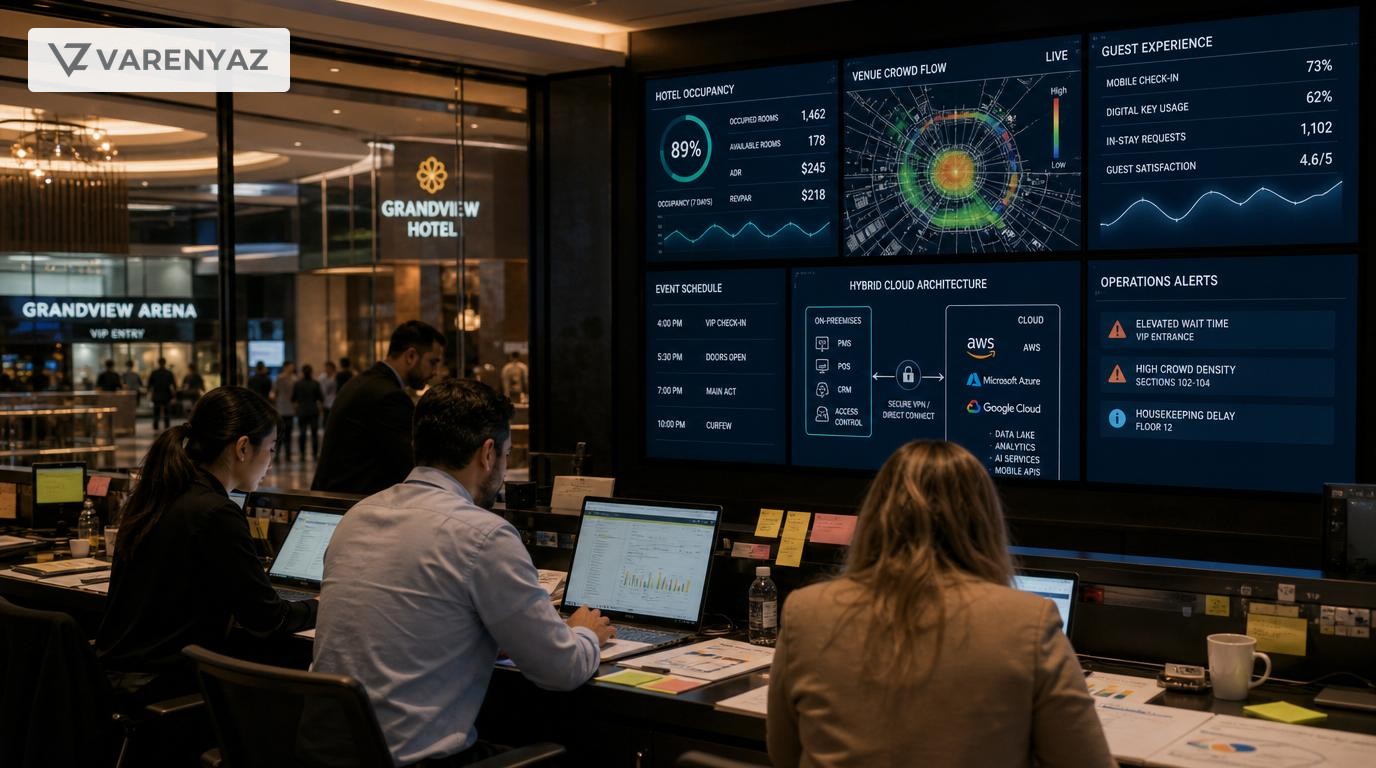
Exploring Hybrid Cloud Integration: A Pathway to Enhanced Hospitality & Entertainment
Why hybrid cloud is suddenly on every hospitality and entertainment roadmap
Walk through any modern hotel, resort, casino, theme park, or stadium and you’ll see a familiar tension. Front-of-house experiences are getting slicker—mobile check-in, digital keys, dynamic ticketing, smart signage—while the back-of-house still runs on a maze of legacy systems that predate smartphones.
For many operators, a full rip-and-replace cloud migration is a non-starter. Property management systems (PMS), point-of-sale (POS), ticketing, access control, and revenue management are deeply embedded, highly customized, and often mission-critical 24/7. Turning them off, even briefly, can mean lost revenue, reputational damage, or regulatory headaches.
This is where hybrid cloud integration becomes a practical pathway instead of a buzzword. It allows hospitality and entertainment brands to keep core systems running on-premises while gradually unlocking cloud-powered innovation—personalization, real-time analytics, AI, and scalable digital experiences.
Direct answer: What is hybrid cloud integration for hospitality & entertainment?
Short definition for quick decisions
Hybrid cloud integration for hospitality and entertainment is the practice of securely connecting on-premises systems (like PMS, POS, ticketing, and access control) with public or private cloud services so that data, workflows, and digital experiences flow seamlessly across both environments without requiring a full system replacement.
In practical terms, it means:
- Exposing legacy systems through APIs instead of direct database access.
- Synchronizing data between properties, venues, and cloud platforms in near real time.
- Running guest-facing and analytics workloads in the cloud while keeping latency-sensitive or regulated workloads on-site.
- Controlling security, compliance, and governance consistently across everything.
Why hospitality and entertainment are natural fits for hybrid cloud
1. Continuous operations: Always on, never offline
Hotels never truly close. Casinos, resorts, and major venues often operate around the clock. Even theme parks and theaters have tight event schedules. Any prolonged downtime in PMS, ticketing, or access control is unacceptable.
Hybrid cloud integration respects that reality. Instead of one big “go-live” weekend with a risky cutover, it enables gradual change:
- Introduce an API layer over your existing PMS so mobile apps can read and write bookings.
- Synchronize ticketing data to the cloud for analytics without modifying the core system.
- Roll out new digital features in the cloud, then integrate them step-by-step with on-premise systems.
2. Complex estates: Chains, franchises, and venues
Few industries have estates as varied as hospitality and entertainment. A global hotel group might run dozens of brands across regions, each with different property types, contract models, and legacy platforms. Venue operators manage arenas, theaters, and fan zones, often with different vendors for ticketing, security, and concessions.
Hybrid cloud integration makes it possible to:
- Standardize how systems connect (via APIs and event streams) even if the underlying systems differ.
- Aggregate data into a cloud-based platform for analytics and personalization without forcing all properties to use the same tech stack on day one.
- Pilot innovative solutions in flagship properties or venues, then replicate patterns across the portfolio.
3. Rich data, fragmented systems
Hospitality and entertainment brands collect a huge volume of data: bookings, preferences, spend, dwell time, feedback, loyalty interactions, even in-venue movements. But it’s often trapped in silos: PMS, CRM, POS, access control, ticketing, Wi-Fi systems, and more.
By integrating these systems into a hybrid cloud architecture, you can create:
- A unified guest profile that spans booking, on-property spend, loyalty, and in-venue behavior.
- Real-time triggers for offers and service interventions—e.g., a high-value guest waiting too long in a queue.
- Cross-property and cross-venue insights for revenue management, staffing, and marketing.
Business value: Where hybrid cloud moves the needle
1. Elevating guest and fan experiences
From a guest’s perspective, they don’t care whether your systems are on-prem or in the cloud. They care about frictionless, personalized experiences:
- Mobile-first journeys: Check-in, room preferences, digital keys, order-at-seat, and one-tap upgrades, all powered by APIs talking to PMS and POS in the background.
- Connected venues: Tickets, parking, food & beverage, and merchandise tied to one identity and payment profile with consistent experiences across websites, apps, kiosks, and on-site staff.
- Proactive service: Staff get alerts when a high-value guest arrives, a VIP fan enters a zone, or a room has a recurring issue.
Hybrid cloud integration enables these flows to run across systems that were never originally designed to talk to each other.
2. Smarter revenue management and dynamic pricing
Revenue teams in hotels and venues have long used forecasting and optimization, but often with delayed, siloed data. Connecting on-premise systems to cloud-based analytics and machine learning allows you to:
- Combine historical reservations and ticket sales with real-time demand signals (web/app searches, abandoned carts, event sentiment).
- Run dynamic pricing and packaging models that adjust by customer profile, inventory, and context.
- Push optimized prices and offers back into PMS, ticketing, and CRM systems through APIs.
Cloud platforms are well-suited for elastic compute and large-scale data processing, while hybrid integration lets you close the loop with on-premise inventory and booking engines.
3. Operational resilience and compliance
Hybrid cloud offers architectural options that reduce your operational risk profile:
- Local autonomy, cloud intelligence: Critical systems such as door locks, safety infrastructures, and access control remain functional on-site, even if connectivity to the cloud is impaired.
- Geo-resilience: Key data and services can be mirrored across regions in the cloud, supporting business continuity plans.
- Compliance-aware placement: Sensitive payment and identity data can remain in controlled environments (often on-premises or private cloud), while less sensitive workloads—like marketing analytics—operate on public cloud.
The goal is not to put everything in the cloud, but to put the right things in the right place.
4. Faster innovation, lower vendor lock-in
By investing in an integration layer—APIs, event streams, and standardized connectors—you decouple your digital experiences from individual back-end vendors. This helps you to:
- Swap or upgrade systems behind the scenes without rewriting every app.
- Test new cloud services (e.g., AI recommendations, computer vision for queues) without heavy upfront investment.
- Negotiate better terms with suppliers because your architecture is less locked into any one proprietary stack.
Core hybrid cloud integration patterns for hospitality & entertainment
1. API-led connectivity
Modern hybrid architectures are built around APIs. Instead of hardwiring systems to each other, you introduce an API layer that exposes capabilities and data in a controlled, secured way.
For a hotel or venue, this typically means:
- Wrapping the PMS with APIs for reservation lookup, room assignment, folio management, and preferences.
- Exposing ticketing and event systems for seat availability, pricing, entitlements, and access rules.
- Creating guest profile and loyalty APIs that unify data across CRM, PMS, and marketing platforms.
An API gateway in the cloud (or hybrid gateway spanning on-prem and cloud) handles authentication, rate limiting, and monitoring, while on-premise adapters talk to legacy databases and services.
2. Event-driven integration and streaming
APIs are great for “request–response” flows. But many hospitality and entertainment scenarios are about events: a check-in, a ticket scan, a room change, a concession purchase, a fan entering a VIP zone.
Event-driven architecture harnesses these moments by publishing them to a message broker or streaming platform. For example:
- Each ticket scan at a gate emits an event that can trigger capacity monitoring, security checks, or personalized offers.
- Room status updates from housekeeping systems can update digital signage and staff apps in real time.
- High-spend transactions can trigger loyalty tier upgrades or on-property surprises.
Hybrid cloud means these events may be produced on-prem but consumed by cloud-based analytics, machine learning models, or notification systems.
3. Edge computing for low-latency scenarios
Some operations cannot tolerate latency or loss of connectivity—for instance, access control at turnstiles or room locks, safety systems, and certain POS transactions.
Edge computing patterns place lightweight services closer to where events happen, such as on-site servers or smart gateways. They:
- Keep core functionality running locally if the cloud link drops.
- Cache critical rules and entitlements (e.g., who is allowed through which gate when).
- Batch and synchronize data to cloud systems when connectivity is stable.
Hybrid integration coordinates the data and business logic between edge nodes and cloud platforms while centralizing control and monitoring.
4. Data lake and analytics platform in the cloud
Instead of running analytics against operational systems, many organizations replicate relevant data streams into a cloud-based data lake or warehouse. For hospitality and entertainment, this often includes:
- Reservations and bookings from PMS and central reservation systems.
- Ticketing data, including event, seat, and attendee attributes.
- Transaction logs from POS, online ordering, and merchandising.
- Digital interactions from web, apps, kiosks, and Wi-Fi logins.
By integrating these sources, you can train models for churn prediction, upsell recommendations, staffing optimization, and queue management. Then, via APIs, you can feed insights back into apps, CRM, or on-premise systems.
Implementation roadmap: From “where do we start?” to value in 6 months
Step 1: Clarify your outcomes and constraints
Before drawing any architecture, be concrete about what you’re trying to achieve. Some common objectives for hospitality and entertainment organizations:
- Increase direct bookings or ticket sales vs. intermediaries.
- Improve guest satisfaction scores or fan loyalty metrics.
- Boost ancillary revenue (F&B, spa, experiences, merchandise).
- Reduce queue times or operational incidents during events.
- Meet new compliance or data residency requirements.
In parallel, list your hard constraints: legacy contracts, regulatory obligations, data residency rules, and peak season blackout periods when changes are risky.
Step 2: Inventory your systems and integrations
Next, map your current landscape:
- Core transactional systems: PMS, POS, ticketing, access control, CRM, loyalty.
- How they connect today: flat-file transfers, direct DB connections, proprietary APIs, manual uploads.
- Where data physically resides: on-premise data centers, co-location facilities, vendor-managed hosting, cloud services.
- Performance and stability pain points: slow reports, frequent downtime, difficult upgrades.
This map helps you identify low-hanging fruit—systems with existing APIs or cloud-ready options—as well as critical risks that need careful handling.
Step 3: Choose an initial high-impact use case
Hybrid cloud integration is a journey. Early wins build confidence and funding. Strong candidates include:
- Unified guest profile: Connect PMS, CRM, and loyalty into a single view used by front desk, apps, and marketing.
- Digital guest journey: Introduce mobile check-in, digital keys, and in-stay messaging integrated with PMS and access control.
- Real-time occupancy and crowd visibility: Stream ticket scans and footfall sensors to the cloud for live dashboards, staffing, and incident response.
Keep the first use case contained but representative—touching enough systems to validate your integration patterns.
Step 4: Define your reference architecture
Based on your target use case, design a reference architecture that you can reuse later. At a high level, this usually includes:
- Integration layer: API gateway, service mesh (if using microservices), and on-premise connectors or middleware.
- Data platform: Cloud data lake or warehouse, streaming platform, and ETL/ELT processes.
- Security and identity: Centralized identity provider, role-based access control, and secrets management.
- Observability: Logging, metrics, traces, and alerting spanning on-prem and cloud components.
The aim is to avoid bespoke, one-off integrations. Instead, you’re creating reusable building blocks that future projects can leverage.
Step 5: Establish data governance and security practices
Hybrid cloud multiplies your data flows, so governance cannot be an afterthought. For hospitality and entertainment, important practices include:
- Data classification: Clearly label data as public, internal, confidential, or sensitive (e.g., payments, IDs, special needs).
- Access controls: Enforce least-privilege access for applications, users, and service accounts.
- Encryption: Use encryption in transit and at rest, with centralized key management.
- Audit and compliance: Log data access and changes to support PCI DSS, GDPR, and regional regulations.
Security controls should be consistent across on-premise and cloud, with clear ownership and incident response plans.
Step 6: Build, test, and iterate with the business in the loop
Hybrid projects succeed when technology and operations work as one team. Practically, this means:
- Piloting features in a limited set of properties or venues, then scaling.
- Running joint testing sessions with front office, event staff, finance, and marketing.
- Instrumenting everything so you can see latency, error rates, and usage from day one.
- Adjusting integrations based on real-world feedback, not just lab assumptions.
A product mindset helps—treat your integration platform as a product with a roadmap, backlog, and KPIs, not a one-time project.
Risks, tradeoffs, and how to manage them
1. Complexity vs. control
Hybrid architectures can become complex—multiple clouds, on-premise environments, edge nodes, and vendor-hosted platforms. Without discipline, you get:
- Overlapping services performing similar roles.
- Inconsistent security settings and monitoring tools.
- Hard-to-debug issues where multiple vendors blame each other.
Mitigation: Standardize wherever possible. Use shared patterns (e.g., one favored API gateway, consistent identity provider, common observability stack) and define a reference architecture that new initiatives must align to unless there is a compelling exception.
2. Security and compliance gaps
Every new connection increases the attack surface. Hospitality and entertainment organizations handle payments, identity documents, and sometimes health-related preferences.
Mitigation:
- Apply zero-trust principles: do not assume internal networks are safe.
- Centralize identity and privilege management rather than proliferating local accounts.
- Schedule regular security reviews of APIs, data flows, and vendor access.
- Perform tabletop exercises simulating incidents like credential leaks or misconfigurations.
3. Cost surprises
Cloud economics can be attractive, but hybrid setups add variables—egress charges, data duplication, and overlapping licenses. Hospitality and entertainment workloads are often spiky (seasonal peaks, event days), which magnifies this.
Mitigation:
- Model total cost of ownership, including network, storage, compute, integration platforms, and vendor fees.
- Use autoscaling and rightsizing for cloud workloads.
- Minimize unnecessary data movement; filter and aggregate near the source where feasible.
- Set budgets and alerts for cloud spending, and review cost reports regularly with finance.
4. Organizational silos and change fatigue
Even a well-designed hybrid architecture fails if operational teams don’t trust or understand it. In many properties or venues, staff are already stretched; they fear new tools could break familiar workflows.
Mitigation:
- Involve frontline staff early in design and testing.
- Roll out changes incrementally with clear training and fallback options.
- Communicate not just the what but the why behind integrations—how they reduce manual work and improve guest interactions.
Practical use cases: From concept to concrete value
Use case 1: Unified guest profile across properties and channels
Problem: A guest stays at your city hotel, visits your resort next year, and attends a concert at your venue—but your systems treat each interaction separately. Marketing sends generic offers, and staff lack context.
Hybrid solution:
- Integrate PMS, CRM, loyalty, and ticketing via an API layer.
- Stream key events (stays, visits, spends, feedback) into a cloud data platform.
- Build a unified guest profile service that applications query in real time.
Outcome: Front desk, call centers, mobile apps, and marketing tools all draw from the same, up-to-date profile, enabling tailored experiences and offers.
Use case 2: Mobile-first event and property experiences
Problem: Guests and fans juggle paper tickets, room keycards, and multiple apps with inconsistent logins. Staff rely on radios and manual checks for status updates.
Hybrid solution:
- Expose ticketing, PMS, and access control through secure APIs.
- Build web and mobile apps in the cloud that orchestrate check-in, digital keys or passes, and entitlements.
- Use edge services at doors and gates for offline validation.
Outcome: Guests and fans use a unified digital identity and wallet; operations see real-time flows, and issues surface early.
Use case 3: Real-time venue and property operations
Problem: Operations teams react late to crowding, queue build-ups, and service delays because they rely on periodic reports or manual observations.
Hybrid solution:
- Stream data from scanners, POS, sensors, and apps into a cloud-based event platform.
- Run real-time analytics and alerting for thresholds such as queue times, occupancy, or inventory levels.
- Push notifications to staff apps and digital signage systems on-premise.
Outcome: Better safety, smoother traffic flows, optimized staffing, and an improved fan and guest experience.
Governance, KPIs, and measuring success
Governance that enables, not blocks
Hybrid cloud integration spans IT, digital, operations, legal, and finance. A lightweight governance framework helps align these stakeholders:
- Architecture board: Approves new integrations against reference patterns.
- Data council: Oversees data definitions, privacy, and usage policies.
- Security steering group: Reviews major changes and ensures compliance alignment.
These bodies shouldn’t slow down every decision, but they should provide guidelines, reusable components, and support.
Relevant KPIs for hybrid initiatives
Outcomes matter more than infrastructure metrics. Some useful KPIs include:
- Guest/fan experience: NPS, app ratings, digital adoption rates, average queue times.
- Revenue: Direct booking/ticket share, attachment rates for upsells, cross-property or cross-venue conversion.
- Operations: Incident frequency and duration, staff productivity, time-to-market for new features.
- Technology: API error rates, latency, uptime, cost-per-transaction across hybrid flows.
Geo context: India, US, and UK perspectives
India
In India, rapid growth in domestic tourism, events, and experiential entertainment is driving the need for scalable, cost-conscious architectures. Many operators run mixed estates—some new, some inherited—so hybrid cloud provides a way to modernize selectively without disrupting properties that still rely on older infrastructure or connectivity constraints.
United States
In the US, large hotel brands, resort chains, casinos, and sports franchises are experimenting with AI-driven personalization, dynamic pricing, and smart venues. Hybrid architectures let them leverage hyperscaler innovation while respecting complex regulatory landscapes, union environments, and legacy vendor contracts.
United Kingdom
In the UK, a mix of historic hotels, modern lifestyle brands, theaters, and sports venues creates a patchwork of systems. Compliance with UK data protection laws and expectations around premium guest service make hybrid integration a sensible approach: retain control of sensitive operations while enabling innovative digital experiences for international travelers and local fans alike.
How VarenyaZ can help you design and execute hybrid cloud integration
From strategy to implementation
Hybrid cloud integration is not a single product you buy; it’s an architecture and operating model you design over time. A partner with deep experience in web, application, and AI development can accelerate this journey and help you avoid common pitfalls.
VarenyaZ works with hospitality and entertainment organizations to:
- Clarify business outcomes and map them to realistic, phased hybrid cloud roadmaps.
- Design integration architectures using APIs, event streams, and edge services tailored to your properties and venues.
- Develop guest-facing web and mobile experiences that leverage hybrid back-ends cleanly and securely.
- Implement AI-driven capabilities—recommendation engines, chatbots, demand forecasting—grounded in your existing data.
- Establish observability, governance, and documentation so your teams can operate and extend the platform confidently.
If you’re exploring hybrid cloud integration for your hospitality or entertainment business and want a practical, implementation-ready plan, reach out to VarenyaZ at https://varenyaz.com/contact/.
Conclusion: A pragmatic path to the next generation of experiences
Hybrid cloud integration offers hospitality and entertainment leaders a realistic way to modernize without betting the business on a single big-bang migration. By connecting legacy systems with modern cloud platforms, you can unlock personalized, data-driven experiences; improve operational resilience; and create an architecture flexible enough to adopt future innovations.
VarenyaZ helps turn that vision into an actionable roadmap—bringing together web design, web development, and AI development expertise to build secure, scalable, and guest-centric solutions that work with the systems you have today while preparing you for what comes next.
Editorial Perspective
Expert Review Notes
"For hospitality and entertainment brands, hybrid cloud integration is less about shiny technology and more about sequencing change so that the front desk, the box office, and the operations center never miss a beat."
"The real payoff of hybrid architectures comes when every guest touchpoint—web, app, kiosk, or concierge—pulls from the same real-time understanding of a guest, even if that data lives across multiple systems and locations."
"Successful hybrid cloud projects treat APIs, observability, and governance as first-class products, not afterthoughts tagged on once the integrations are already live."
Frequently Asked Questions
What is hybrid cloud integration in hospitality and entertainment?
Hybrid cloud integration in hospitality and entertainment is the practice of securely connecting on-premises systems such as property management, POS, ticketing, and access control with public and private cloud services. Instead of migrating everything at once, brands expose legacy systems via APIs, synchronize data, and orchestrate workflows across environments to enable new digital experiences while existing operations keep running.
Why choose hybrid cloud instead of full cloud migration?
Full cloud migration is often unrealistic for hotels, resorts, casinos, and venues because many core systems are tightly coupled to hardware, regulated, or mission-critical 24/7. Hybrid cloud allows teams to keep what must remain on-premises while moving analytics, AI, mobile apps, and selected services to the cloud. This reduces risk, preserves past investments, and still unlocks innovation and scalability.
Which hospitality and entertainment systems benefit most from hybrid cloud integration?
High-impact candidates include property management systems (PMS), central reservation systems, loyalty platforms, POS, event ticketing, and access control. Integrating them into a hybrid architecture enables unified guest profiles, cross-property offers, dynamic pricing, mobile check-in and keys, and real-time venue operations. Over time, supporting systems like maintenance, workforce management, and digital signage can also be integrated.
What are the main risks of hybrid cloud integration?
The main risks include inconsistent security controls across environments, poorly governed APIs, fragmented data models, and unexpected costs from data transfer and duplicated workloads. Operationally, weak monitoring or brittle integrations can cause downtime during peak events. These risks are mitigated through clear data governance, a reference architecture, standardized APIs, strong identity and access management, and comprehensive observability.
How long does a typical hybrid cloud project take for a hotel group or venue operator?
Timelines vary widely, but many organizations see meaningful value in 3–6 months by targeting one or two focused use cases—such as mobile guest journeys or unified loyalty—and integrating only the necessary systems. Building out a robust hybrid platform across multiple properties or venues is usually a multi-year journey, but it is staged as incremental releases rather than a single big-bang cutover.
How can a partner like VarenyaZ support hybrid cloud integration?
A partner like VarenyaZ can help you define an architecture, design APIs, modernize web and mobile guest-facing experiences, and embed AI services such as recommendations and chatbots. They also support secure integration with existing PMS, ticketing, and POS systems, build observability dashboards, and create reusable components so new properties or venues can be onboarded faster.
Selected References
Further Reading
Related perspectives
Performance Engineering for Modern Manufacturing
Performance engineering in manufacturing is the discipline of designing plants, processes, and digital systems to consistently hit throughput, quality, cost, and reliability targets. It combines OT and IT data, real-time monitoring, analytics, and AI to expose bottlenecks and drive continuous improvement. This article explains core concepts, key metrics, target architecture, and implementation patterns, with examples like predictive maintenance, digital twins, and energy optimization. It also covers governance, risks, and vendor choices, then outlines a pragmatic roadmap and how VarenyaZ supports manufacturers with web, data, and AI solutions.
Top 7 Interactive E‑Learning Best Practices for Healthcare
Interactive e-learning for healthcare works best when it mirrors real clinical decisions, not static slide decks. Focus on scenario-based cases, microlearning modules, spaced repetition, and frequent low-stakes assessment with targeted feedback. Align every interaction to patient outcomes and compliance requirements, and measure performance with analytics tied to your LMS and clinical KPIs. Involve clinicians in content design, validate accuracy, and pilot with small cohorts before scaling. Partnering with a specialist design, development, and AI team can help operationalize these best practices efficiently and safely.
Digital Transformation Roadmaps in Education
A digital transformation roadmap for education is a structured plan that connects institutional strategy, pedagogy, and technology to measurably improve learning outcomes. This article explains how to define learner-centred goals, build governance, align platforms and data, integrate AI responsibly, phase implementation, manage change, and track impact. It details risks, tradeoffs, and decision points for schools, universities, and EdTech providers, and clarifies how to turn disconnected tools into an integrated ecosystem that supports teachers, learners, and administrators.