
Future-Proof UI/UX for Hospitality & Entertainment
Learn how future-proof UI/UX design in hospitality and entertainment can increase revenue, loyalty, and operational efficiency with practical, low-risk steps.

Quick Answer
Future-proofing hospitality and entertainment requires treating UI/UX design as a revenue and operations lever, not just a visual layer. This article outlines best practices across the full guest journey: frictionless booking, mobile-first experiences, accessibility, personalization, and AI-powered service. It explains how to connect design decisions to metrics like conversion, upsell, and loyalty while managing tradeoffs in cost, complexity, and change management. You also get a phased roadmap and see how a partner like VarenyaZ can support web, product, and AI implementation.
In this article
Coverage signals
14 min
May 29, 2026
VarenyaZ Editorial Desk, Technical Content Review
Updated May 29, 2026
Key Takeaways
- UI/UX in hospitality and entertainment is a revenue, loyalty, and efficiency lever—not just visual design.
- Future-proof experiences start with mapping real guest journeys across web, mobile, kiosks, and physical spaces.
- Accessibility and cross-device consistency reduce friction and expand your market while lowering support costs.
- Personalization and AI-assisted interfaces should be transparent, opt-in, and directly tied to guest value.
- Measure success with product metrics such as booking conversion, upsell rate, task completion time, and NPS/CSAT.
- Treat redesigns as continuous optimization with design systems, component libraries, and experimentation culture.
- Implementation requires alignment across product, marketing, operations, and on-property staff training.
- Specialist partners like VarenyaZ help connect UI/UX strategy with robust web, product, and AI development.
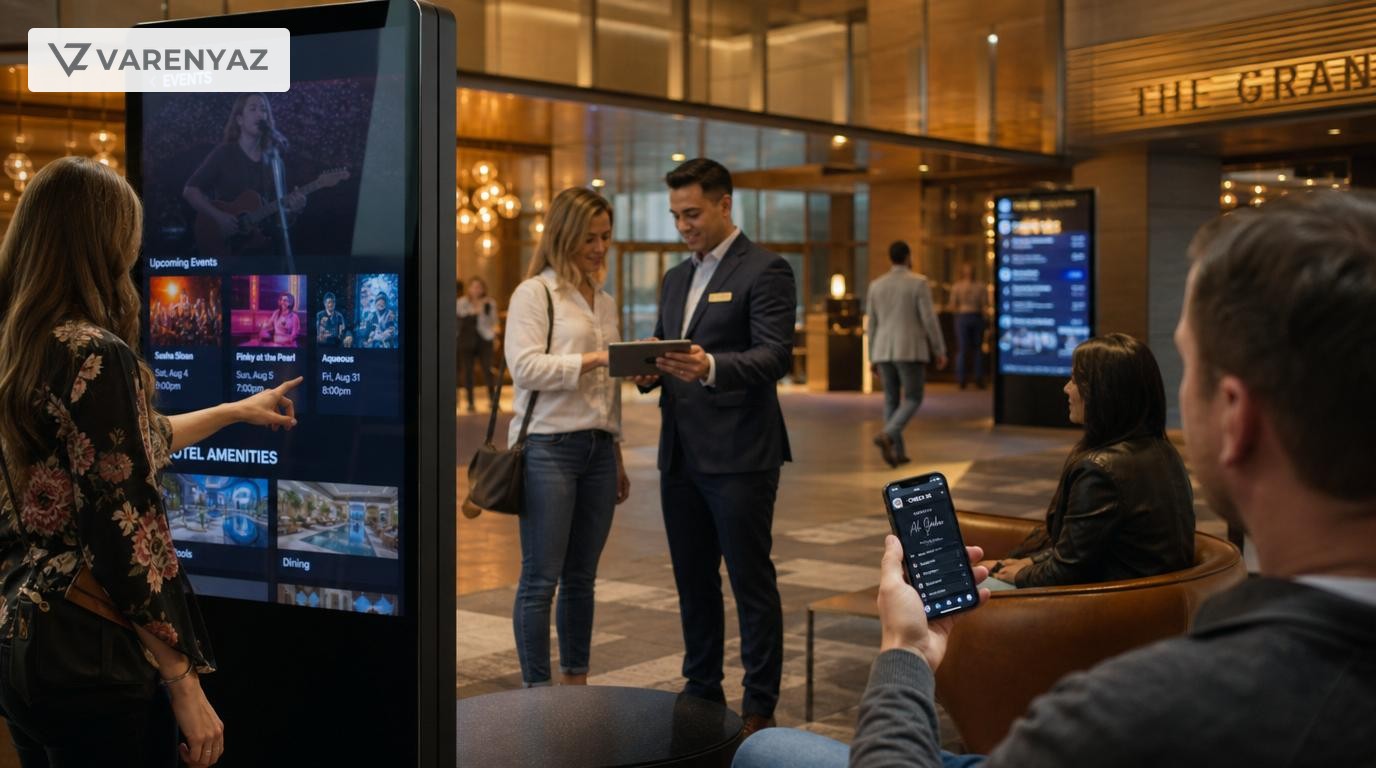
Future-Proofing Your Business with UI/UX Design Best Practices in Hospitality & Entertainment
Why UI/UX Is Now a Core Business Strategy, Not a "Nice-to-Have"
In hospitality and entertainment, the real competition is no longer just the hotel across the street or the theater down the road. You are competing with every frictionless experience your guests have ever had online—from how they book a ride to how they discover a new show to watch tonight.
That is why UI/UX design in hospitality and entertainment has shifted from a cosmetic layer to a core business capability. The interfaces you put in front of guests—websites, apps, kiosks, digital signage, even QR menus—directly affect:
- How easily people discover you
- How confidently they book or buy
- Whether they upgrade, explore, and spend more
- How they rate, review, and recommend your brand
- How efficiently your teams operate behind the scenes
Future-proofing your business means designing digital experiences that can flex with changing guest behavior, devices, and expectations—without requiring a full rebuild every two years.
Direct Answer: How Do You Future-Proof Hospitality & Entertainment with UI/UX?
To future-proof hospitality and entertainment experiences with UI/UX, you need to:
- Map the entire guest journey across channels and devices.
- Fix high-impact friction points in booking, check-in, and service flows.
- Apply accessibility and mobile-first design as non-negotiable foundations.
- Build a design system to keep interfaces consistent and scalable.
- Layer in AI and personalization transparently, where they reduce effort or add clear value.
- Continuously test, measure, and iterate using real-world guest data.
Done well, this approach turns UI/UX from a cost center into a driver of revenue, loyalty, and operational efficiency.
1. Understand the Modern Guest Journey (and Why It Is Not Linear)
From Linear Funnel to Multi-Touch Journey
Most hospitality and entertainment journeys no longer follow a simple path of search → book → visit → review. Instead, they are multi-touch and cross-channel:
- Guests discover your property or event via search, influencers, OTAs, or friend recommendations.
- They research on mobile, bookmark on desktop, and ask family on messaging apps.
- They compare prices, check social proof, and explore add-ons before committing.
- They interact with your brand before, during, and after the stay or event across email, SMS, apps, and on-site experiences.
Future-proof UI/UX starts with mapping this reality, not an idealized funnel.
Map Your Guest Journeys with Real Data
Rather than guessing, use data and qualitative insights:
- Analytics: Identify where users drop off in booking and ticketing flows.
- Session replays and heatmaps: See where people hesitate, scroll, or rage-click.
- On-site interviews: Ask guests what was hard about booking, checking in, or finding information.
- Support and front-desk logs: Spot recurring qestions related to digital experiences.
Use this to map a realistic journey from awareness to loyalty, then highlight friction and opportunity zones where UI/UX changes can have measurable impact.
2. Design Frictionless Booking and Ticketing Experiences
Make Decision-Making Obvious
Booking a room, reserving a table, or buying event tickets is where revenue becomes real. Yet many brands still bury key details behind multiple clicks or clutter the page with distractions.
Future-proof booking UI/UX focuses on clarity and confidence:
- Transparent pricing: Show total cost early, with clear taxes and fees to reduce last-minute abandonment.
- Simple date and time selection: Use large tap targets, clear labels, and helpful defaults.
- Comparability: Let users easily compare room types, seat options, or packages without endless back-and-forth.
- Trust signals: Reviews, ratings, and policies should be accessible without leaving the booking flow.
Reduce Steps, But Not Clarity
Shorter flows are generally better, but compressing too much into one screen can overwhelm users. Instead of obsessing over the number of steps, optimize for cognitive load and task clarity:
- Group related decisions (dates and guests together, add-ons later).
- Provide clear progress indications (Step 1 of 3: Dates & Guests).
- Offer smart defaults like last-searched dates or preferences for signed-in users.
- Use inline validation and helpful error messages that explain how to fix issues.
Support Multiple Pathways to Purchase
Not all guests behave the same way. A future-proof booking experience supports:
- Explorers: People browsing flexible dates or open to different venues or showtimes.
- Task-focused guests: Those who want the fastest route to finalize a known plan.
- Group planners: Organizers managing multiple rooms, tickets, or guests.
Features like flexible date search, quick rebooking, and shareable itineraries or seat maps help accommodate diverse intent without fracturing your UI.
3. Go Mobile-First Across Hospitality & Entertainment Touchpoints
Why Mobile-First is Non-Negotiable
For many hospitality and entertainment brands, mobile accounts for the majority of traffic, especially during discovery and in-stay moments. Designing for desktop first and then squeezing it onto mobile is no longer viable.
A mobile-first approach prioritizes:
- Thumb-friendly navigation: Large buttons, clear hierarchy, and reachable controls.
- Fast loading: Optimized images, minimal blocking scripts, and efficient layouts.
- Offline-conscious design: Graceful handling of poor connectivity, especially in rural resorts or crowded venues.
- Device-native behaviors: Tap-to-call, map integration, mobile wallets, and QR check-ins.
Use Progressive Web Apps (PWAs) Where Apps Are Too Heavy
Many hotels, attractions, and venues do not need a full native app. A well-designed Progressive Web App (PWA) can deliver:
- App-like experiences via the browser
- Home-screen shortcuts
- Offline-friendly features for key content
- Push notifications for updates and offers (where appropriate and consented)
This approach reduces development and maintenance costs while offering guests a smooth, future-ready interface that works across devices.
4. Build Accessibility Into the Core of Your Guest Experience
Accessibility Is About Inclusion and Risk Management
Designing accessible experiences is both the right thing to do and a smart business decision. Guidelines like the W3C Web Content Accessibility Guidelines (WCAG) 2.1 provide a clear, widely recognized framework for making digital content accessible to people with disabilities.
Applying these principles doesn't just benefit guests using assistive technologies. It also improves overall usability by enforcing clarity, consistency, and resilience.
Practical Accessibility Best Practices for Hospitality & Entertainment
Core practices to future-proof your UI/UX include:
- Readable text: Adequate color contrast, scalable font sizes, and consistent headings.
- Keyboard navigation: All interactive elements usable without a mouse.
- Alt text and labels: Descriptions for images and accessible labels for form fields and buttons.
- Error prevention: Clear instructions, confirm screens, and the ability to correct inputs.
- Media alternatives: Captions for promotional videos and explanatory content.
For hospitality and entertainment specifically, ensure key flows like booking, check-in, seating selection, and support are accessible from start to finish, not just on your home page.
5. Design Omnichannel Experiences that Connect Online and On-Property
Stop Treating Digital and Physical as Separate Worlds
Guests do not think in channels; they think in tasks. They want to:
- Find information quickly
- Make and manage reservations
- Access services when they need them
- Resolve issues with minimal friction
Whether those tasks happen on a website, app, kiosk, or at a front desk is secondary. Future-proof UI/UX aligns these channels so guests do not feel like they are starting over every time.
Key Omnichannel Design Principles
To unify online and on-site experiences:
- Consistent information: The same room types, showtimes, menus, and prices across web, mobile, and on-site screens.
- Shared design language: Typography, colors, iconography, and patterns that make each touchpoint feel like part of one system.
- Cross-channel continuity: Start a task on one device and easily continue on another, such as saving an itinerary or digital ticket.
- Integration with operations: Design UI workflows that mirror how your teams actually deliver service, reducing re-keying and miscommunication.
Think of your property or venue as one interface extending across physical and digital surfaces, all speaking the same design language.
6. Use Personalization Carefully, with Clear Guest Benefits
Personalization as a Value Exchange
Personalization in hospitality and entertainment can range from remembering preferred room types to recommending shows or experiences that match past behavior. Research indicates guests are more likely to share data when they see clear, relevant benefits.
The key is to frame personalization as a value exchange:
- Explain what data you collect and why.
- Highlight specific benefits (faster booking, better recommendations, tailored offers).
- Offer control—easy ways to manage preferences and opt out.
Where Personalization Adds Real Value
Some impactful personalization patterns include:
- Pre-filled details: For logged-in guests, pre-fill details to streamline booking or ticketing.
- Smart recommendations: Suggest experiences, shows, or add-ons based on previous stays or purchases.
- Context-aware offers: Highlight relevant upgrades or bundles at the right time in the journey.
- Localized experiences: Tailor content based on language, region, or typical travel patterns.
Always test whether personalized elements actually improve engagement and satisfaction rather than simply adding complexity to your UI.
7. Integrate AI Thoughtfully into Guest-Facing Interfaces
AI as an Assistant, Not a Gatekeeper
AI is reshaping how guests discover, plan, and experience hospitality and entertainment. However, the best experiences use AI as an assistant, not a gatekeeper that blocks access to human help or simple actions.
Examples of AI-enhanced UI/UX include:
- Natural language search: Let guests type or speak intent like “family-friendly activities near the pool this afternoon” and receive structured, bookable results.
- 24/7 support assistants: AI chat or voice bots that handle routine requests (Wi-Fi details, opening hours, simple changes), with seamless handoff to humans.
- Dynamic recommendations: Personalized suggestions for dining, shows, or experiences based on context and history.
- Operational assistance: Behind-the-scenes AI that helps staff prioritize tasks, predict demand, or coordinate service deliveries.
Design Principles for AI in UI/UX
To keep AI future-proof and trustworthy:
- Be transparent: Make it clear when guests are interacting with AI and what it can and cannot do.
- Offer choices: Provide easy ways to bypass AI, reach a human, or use self-service flows.
- Design for failure: Plan for misunderstood queries with polite, helpful fallback responses.
- Protect privacy: Respect consent, data minimization, and secure handling of guest information.
Working with a partner experienced in both UI/UX and AI development can help you avoid disjointed experiences and unintended consequences.
8. Measure What Matters: Connecting UI/UX to Business Outcomes
Go Beyond Page Views and Bounce Rate
To justify investment in UI/UX and keep your strategy aligned to business value, track metrics that map directly to guest tasks and business goals:
- Acquisition and conversion: Search-to-book rate, ticket purchase conversion, quote-to-book rate for events.
- Revenue: Average booking value, upsell attachment (breakfast, spa, VIP seats), ancillary spend per guest.
- Experience quality: Task completion time, error rates, support contact volume, CSAT, NPS.
- Loyalty: Repeat visit rate, direct vs. OTA bookings, loyalty program sign-up and engagement.
Use Experiments to De-Risk UI Changes
Instead of guessing, use controlled experiments:
- A/B tests: Compare variations of booking flows, add-on offers, or navigation structures.
- Multivariate tests: Explore combinations of UI elements for complex experiences like seat selection.
- Pilots by segment: Roll out changes to specific properties, regions, or user segments first.
This allows you to learn what works in your context before rolling out changes globally, reducing risk and building internal confidence in design-led decisions.
9. Manage Tradeoffs: Cost, Complexity, and Change Management
Prioritize High-Impact Journeys First
Future-proofing does not mean redesigning everything at once. Start with journeys that are:
- High-volume: Common tasks like searching, booking, checking in, or buying tickets.
- High-friction: Tasks with high drop-off or high support volume.
- High-value: Experiences linked to premium demand or loyalty, such as memberships or VIP experiences.
Redesigning these flows yields measurable returns and builds momentum for broader transformation.
Balance Customization vs. Maintainability
Highly customized designs can look impressive but may be hard to maintain across multiple properties, languages, and markets. A future-proof approach:
- Uses a design system of reusable components with clear guidelines.
- Supports regional variation in content and offers without forking the core UI.
- Integrates with your existing tech stack rather than duplicating functionality.
This balance lets you adapt quickly while keeping engineering, design, and content teams aligned.
Support Staff Through the Change
Digital UI/UX changes ripple through operations. When you introduce mobile check-in or kiosk ticketing, front-desk teams and on-site staff see shifts in guest behavior and expectations.
Plan for:
- Training: Familiarize staff with new guest flows and interfaces.
- Feedback loops: Listen to staff when guests get stuck or confused.
- Service design alignment: Ensure back-of-house processes align with the new digital experience.
When staff and UI/UX work together, the experience feels seamless instead of fragmented.
10. A Practical Roadmap to Future-Proof UI/UX in Hospitality & Entertainment
Phase 1: Discover and Diagnose (0–60 Days)
- Audit current digital touchpoints: websites, booking engines, apps, kiosks, digital signage.
- Map guest journeys from discovery to loyalty, highlighting friction.
- Review analytics, support logs, and on-site feedback.
- Benchmark against industry best practices and recognized usability and accessibility standards.
Phase 2: Design High-Impact Improvements (60–150 Days)
- Redesign priority flows like booking, check-in, or ticket purchase with mobile-first and accessibility in mind.
- Create or refine a design system that can scale across properties and regions.
- Prototype critical experiences (e.g., digital concierge, seat selection, itinerary builder) and test with real guests or staff.
- Define clear success metrics and experimentation plans.
Phase 3: Implement and Integrate (150–300 Days)
- Build and deploy redesigned experiences across web, PWA, and in-venue interfaces.
- Integrate with core systems: PMS, ticketing, loyalty, CRM, and payment gateways.
- Introduce AI where it clearly supports guest tasks, such as FAQ assistance or recommendations.
- Train staff, update SOPs, and create playbooks that align digital flows with on-site service.
Phase 4: Optimize and Evolve (Ongoing)
- Run continuous A/B tests on key screens and flows.
- Track guest satisfaction, conversion, and support metrics monthly or quarterly.
- Expand your design system with new components and patterns as needs evolve.
- Plan periodic reviews to incorporate emerging technologies and behavior trends.
This roadmap can be adapted for a single property, a chain, or a multi-venue portfolio, with each phase delivering incremental value instead of waiting for a big-bang launch.
11. Global and Regional Nuances: Designing for India, the US, and the UK
Different Markets, Converging Expectations
While local behaviors differ, guest expectations are converging globally thanks to digital platforms. A guest in India who books rides or food via slick mobile apps brings those expectations to a hotel website. A traveler in the United States or the United Kingdom compares your event booking flow to streaming, concert, or airline experiences.
To future-proof UI/UX across regions:
- Localize content, currencies, and payment methods while keeping the core interaction patterns consistent.
- Respect cultural nuances in imagery, tone, and calls-to-action.
- Account for connectivity differences by optimizing performance and offline resilience.
- Align with regional regulations on data, accessibility, and consumer rights.
A strong design system and modular architecture allow you to adapt quickly to local needs without fragmenting your experience.
12. How VarenyaZ Helps You Turn Strategy into Reality
Bringing UI/UX, Web Development, and AI Together
Knowing what to do is only half the challenge; executing across design, engineering, and operations is where many initiatives stall. That is where a partner like VarenyaZ comes in.
VarenyaZ works with hospitality and entertainment brands to:
- Conduct UX research and map guest journeys across channels.
- Design mobile-first, accessible interfaces for booking, ticketing, and on-site experiences.
- Develop high-performance websites, PWAs, and web apps that integrate with your existing tech stack.
- Implement AI-powered assistants, personalization engines, and analytics pipelines.
- Set up design systems, documentation, and governance for long-term scalability.
If you are ready to explore how UI/UX, web development, and AI can future-proof your hospitality or entertainment business, reach out at https://varenyaz.com/contact/.
Conclusion: Design for Change, Not Just for Today
Future-proofing your hospitality or entertainment business is not about predicting every new device, trend, or channel. It is about building a flexible, human-centered foundation: interfaces that reduce friction, journeys that respect guest time and context, and systems that let you adapt quickly.
By investing in robust UI/UX practices, accessible and mobile-first design, and thoughtful AI integration, you position your brand to thrive in a landscape where experiences—not just assets—are your true competitive advantage. With VarenyaZ as your partner for web design, web development, and AI development, you can turn this vision into a cohesive, scalable reality that delights guests today and tomorrow.
Editorial Perspective
Expert Review Notes
"In hospitality and entertainment, UI/UX is not just the website or app; it is the connective tissue between digital journeys and on-property experiences, from search and booking to check-out and re-engagement."
"Future-proofing guest experiences means designing systems, not pages—design systems, analytics, and AI capabilities that can evolve as channels, devices, and traveler behavior change."
"Accessibility, personalization, and automation are not competing priorities; done well, they reinforce each other to make hospitality brands more inclusive, efficient, and profitable."
Frequently Asked Questions
Why is UI/UX design so critical for hospitality and entertainment now?
Guests increasingly expect seamless, mobile-first, and personalized experiences shaped by platforms like Airbnb, Netflix, and ride-hailing apps. In hospitality and entertainment, UI/UX now directly influences booking conversion, ancillary revenue, reviews, and loyalty. Poor interfaces create friction, drive customers to competitors, and increase support costs in already margin-sensitive industries.
What are the first UI/UX areas hospitality brands should fix?
Start with the high-impact, high-traffic journeys: finding a property or venue, browsing availability or events, booking or purchasing tickets, and managing reservations. Improve clarity of options, pricing transparency, mobile usability, and error handling. Then focus on pre-arrival communication, check-in and access, and in-stay requests, often through web apps, mobile apps, or kiosks.
How can we measure ROI from UI/UX improvements?
Tie each design change to specific metrics. For commerce flows, track booking or ticket conversion, average order value, upsell attachment, and abandonment rates. For service flows, monitor task completion time, support contacts, and satisfaction scores like CSAT or NPS. Compare cohorts before and after improvements and track operational metrics such as fewer front-desk calls or shorter queues.
How does accessibility contribute to business value in hotels and entertainment venues?
Accessibility increases your potential guest base, reduces legal and compliance risk, and often improves usability for everyone. Clear content, keyboard navigation, sufficient color contrast, and well-labeled controls make it easier for guests to self-serve. That typically leads to higher conversion, fewer errors, and lower support volume while aligning with global standards and inclusive brand values.
Where does AI fit into UI/UX for guest experiences?
AI is most valuable when it reduces effort or provides meaningful recommendations: personalized offers, natural-language search and support, dynamic content, and real-time assistance during complex tasks. Effective AI in UI/UX is transparent, respectful of privacy, and gives guests clear choices, such as opting out of personalization or escalating to human support when needed.
How can VarenyaZ help us future-proof our digital guest experience?
VarenyaZ brings together UX strategy, interface design, web and product engineering, and AI development. The team can map your guest journeys, redesign critical flows like booking and check-in, build responsive web and web-app experiences, integrate AI assistants, and set up analytics and experimentation frameworks so your hospitality or entertainment brand can continuously adapt to changing expectations.
Selected References
Further Reading
Related perspectives
Performance Engineering for Modern Manufacturing
Performance engineering in manufacturing is the discipline of designing plants, processes, and digital systems to consistently hit throughput, quality, cost, and reliability targets. It combines OT and IT data, real-time monitoring, analytics, and AI to expose bottlenecks and drive continuous improvement. This article explains core concepts, key metrics, target architecture, and implementation patterns, with examples like predictive maintenance, digital twins, and energy optimization. It also covers governance, risks, and vendor choices, then outlines a pragmatic roadmap and how VarenyaZ supports manufacturers with web, data, and AI solutions.
Top 7 Interactive E‑Learning Best Practices for Healthcare
Interactive e-learning for healthcare works best when it mirrors real clinical decisions, not static slide decks. Focus on scenario-based cases, microlearning modules, spaced repetition, and frequent low-stakes assessment with targeted feedback. Align every interaction to patient outcomes and compliance requirements, and measure performance with analytics tied to your LMS and clinical KPIs. Involve clinicians in content design, validate accuracy, and pilot with small cohorts before scaling. Partnering with a specialist design, development, and AI team can help operationalize these best practices efficiently and safely.
Digital Transformation Roadmaps in Education
A digital transformation roadmap for education is a structured plan that connects institutional strategy, pedagogy, and technology to measurably improve learning outcomes. This article explains how to define learner-centred goals, build governance, align platforms and data, integrate AI responsibly, phase implementation, manage change, and track impact. It details risks, tradeoffs, and decision points for schools, universities, and EdTech providers, and clarifies how to turn disconnected tools into an integrated ecosystem that supports teachers, learners, and administrators.