
Digital Transformation Roadmaps for Hospitality
Learn how to design a practical digital transformation roadmap that boosts efficiency and guest experience for hospitality and entertainment brands.

Quick Answer
A digital transformation roadmap in hospitality and entertainment is a structured plan that aligns technology investments with business goals like higher occupancy, faster service, and better guest experience. It maps your current state, prioritizes use cases, builds data and integration foundations, and phases delivery across 12–36 months. Successful programs focus on process redesign, automation, AI-enhanced personalization, and staff enablement, not just new tools. This article breaks down the key stages, risks, metrics, and practical examples—and shows how a partner like VarenyaZ can help design and implement the right roadmap.
In this article
Coverage signals
14 min
May 31, 2026
VarenyaZ Editorial Desk, Technical Content Review
Updated May 31, 2026
Key Takeaways
- A digital transformation roadmap must start from business outcomes, not technology shopping lists.
- Hospitality and entertainment efficiency gains come from rethinking guest journeys and staff workflows end-to-end.
- Data quality, integration, and analytics foundations are the backbone of sustainable digital transformation.
- Automation and AI amplify staff, but only when paired with clear processes and change management.
- Phased delivery over 12–36 months de-risks transformation while creating quick wins for teams.
- Measuring impact via operational and experience KPIs keeps roadmaps grounded in ROI.
- Cybersecurity, privacy, and vendor lock-in should be assessed before large platform commitments.
- Specialist partners like VarenyaZ can help design, prototype, and build scalable web and AI solutions.
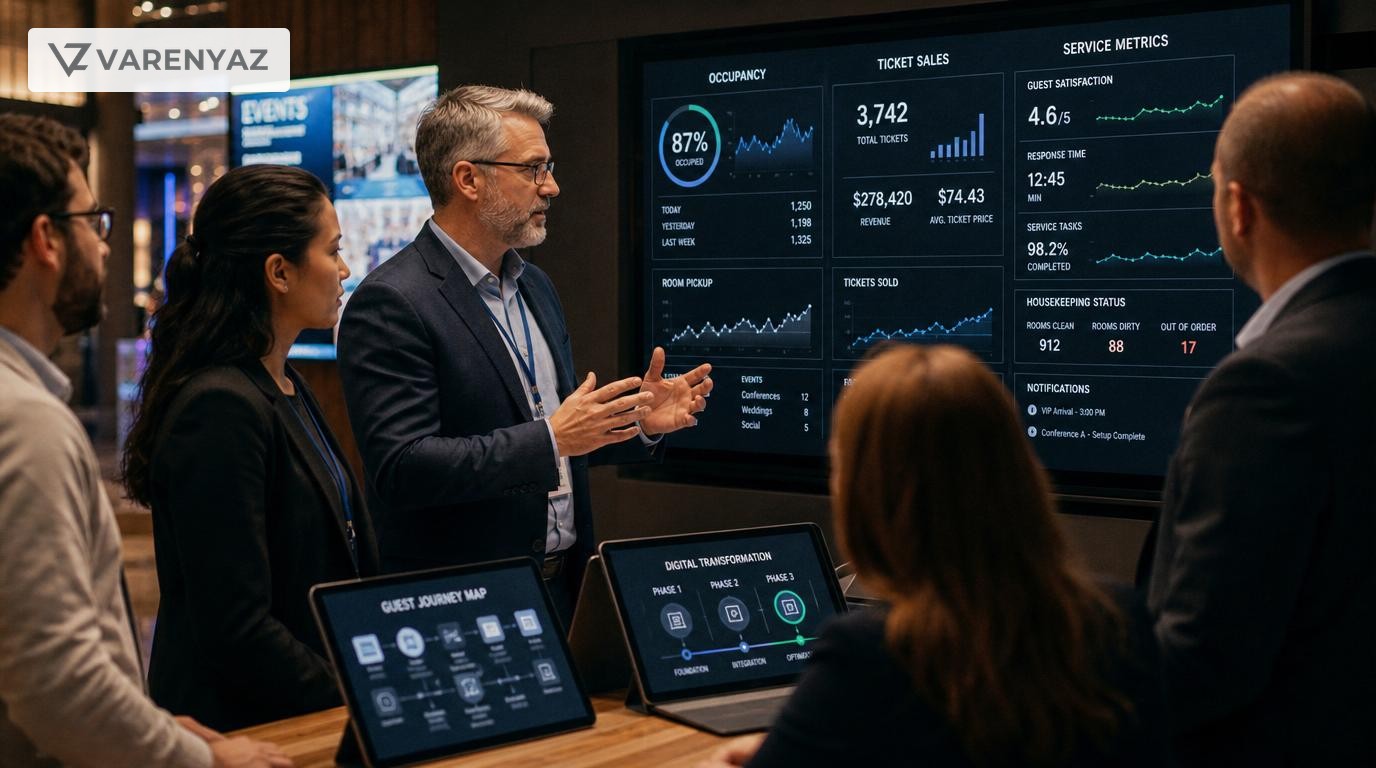
Why digital transformation roadmaps matter in hospitality and entertainment
Hospitality and entertainment are on the same fault line: expectations are rising faster than margins. Guests want instant booking, personalized offers, frictionless check-in, flexible payments, and real-time updates. At the same time, you are dealing with staff shortages, volatile demand, and rising operating costs.
Many brands react by buying more tools—another app, another platform, another dashboard. But without a plan, you end up with disconnected pilots, frustrated teams, and technology that never quite moves the needle.
This is where a digital transformation roadmap becomes essential. It is not just a slide deck of future ideas. It is a pragmatic, time-bound plan that aligns technology investments with very specific business outcomes: higher occupancy, better yield, faster service, fewer errors, and more loyal guests.
In this article, we focus on how to design and execute a digital transformation roadmap for hospitality and entertainment, with a lens on operational efficiency. We will break it down into clear phases, show typical use cases, and highlight risks and tradeoffs—so you can make decisions that are defensible, measurable, and realistic.
Direct answer: what is a digital transformation roadmap in hospitality?
A digital transformation roadmap in hospitality and entertainment is a 12–36 month plan that connects your business goals to specific technology, data, and process changes. It lays out:
- Where you are today (systems, processes, KPIs, guest journeys).
- Where you want to be (target guest and staff experience, efficiency metrics, revenue goals).
- How you will get there (prioritized initiatives, dependencies, budgets, and a realistic timeline).
Instead of isolated tech projects, the roadmap orchestrates upgrades to your property or venue systems, web and mobile experiences, analytics, automation, and AI. The result: fewer manual tasks, more connected guest journeys, and clearer visibility into operations and revenue.
How digital transformation roadmaps impact efficiency
When done well, a roadmap becomes a lever for efficiency across hotels, resorts, cinemas, venues, and theme parks. The biggest impacts tend to show up in five areas.
1. Faster, more reliable guest-facing operations
Digital transformation rethinks how guests interact with you, from discovery to departure.
- Frictionless booking and ticketing: Unified web and mobile flows reduce abandonment, cut call-center load, and ensure accurate data from the start.
- Self-service options: Mobile check-in/check-out, digital key access, seat selection, and in-app ordering shrink queues and reduce pressure on front-line staff.
- Real-time updates: Notifications for room readiness, showtime changes, or queue times reduce confusion and repetitive questions.
These changes reduce manual work at reception desks, box offices, and help counters, helping the same team serve more guests with less friction.
2. Labor optimization during staff shortages
Labor is one of the largest cost lines in hospitality and entertainment. Digital transformation allows operations leaders to do more with the people they already have.
- Digital workflows: Housekeeping, maintenance, and F&B teams can receive tasks on mobile devices, update status in real time, and avoid paperwork or repeated radio calls.
- Forecast-driven staffing: Demand forecasting models help you schedule staff more precisely by hour, day, and event, instead of relying only on historical averages.
- Automation of routine interactions: Chatbots and FAQ flows handle simple questions (Wi‑Fi, timings, directions), allowing staff to focus on complex or high-value interactions.
The goal is not to replace people; it is to free them from repetitive work so they can focus on service quality and upsell opportunities.
3. Reduced errors and operational leakage
Manual processes—from handwritten notes to spreadsheet-based allocations—are error-prone. A good roadmap tackles this directly.
- Single source of truth for inventory: Integrating property management, ticketing, POS, and channel systems reduces overbooking, double-charging, and lost revenue.
- Automated reconciliations: Payments, commissions, and daily closures can be checked automatically, flagging discrepancies for human review.
- Standardized workflows: Digital SOPs embedded into tools ensure staff follow the same steps, reducing variability.
Fewer errors mean fewer refunds, fewer complaints, and more predictable margins.
4. Data-driven decisions instead of guesswork
Hospitality and entertainment generate massive data: bookings, traffic, transactions, reviews, behaviors across digital and physical touchpoints. But much of it sits unused in separate systems.
Your roadmap should define how to bring together and use this data to answer questions like:
- Which channels drive the most profitable guests, not just the most volume?
- Which rooms, seats, or zones are underpriced or overused?
- When does queue time start to materially hurt spend or satisfaction?
- What offers increase conversion for specific audience segments?
With a shared analytics layer, decisions move from anecdote-driven to evidence-based, improving both efficiency and revenue.
5. Consistency across properties and venues
For groups operating multiple hotels, cinemas, or venues across cities or countries, inconsistency kills efficiency.
A well-structured roadmap standardizes key processes and platforms where it makes sense, while leaving space for local tailoring. For example:
- Group-wide CRM and loyalty programs, with local offers and content.
- Standardized booking and check-in flows, with region-specific regulations and languages.
- Shared analytics and dashboards, with local property-level drill-downs.
This balance is critical for multi-market operations in locations such as India, the United States, and the United Kingdom, where cost structures and regulations differ but brand expectations must remain consistent.
Key components of a hospitality & entertainment digital roadmap
Before defining phases, it helps to understand the core components your roadmap should cover. Think of them as the layers of your digital ecosystem.
1. Business outcomes and KPIs
Every roadmap should start with sharp questions:
- Are we trying to increase RevPAR, occupancy, average ticket value, or ancillary spend?
- Do we need to reduce check-in time, queue time, or staff overtime?
- Is the priority reducing costs, boosting revenue, or improving guest satisfaction scores?
Translate those into measurable KPIs—such as check-in time, queue length, labor cost per occupied room or seat, conversion rate, and NPS—that will guide prioritization.
2. Guest journey and staff journey mapping
Next, map the full journey for both guests and staff. For example:
- Guest journey: Discovery → research → booking or ticket purchase → pre-arrival communication → arrival and access → on-property or in-venue experience → checkout or exit → post-stay engagement.
- Staff journey: Scheduling → shift prep → task assignments → real-time issue handling → reporting and handovers.
Highlight pain points, delays, or frequent errors. These maps become your “source of truth” for identifying transformation opportunities that matter.
3. Systems and data architecture
Most hospitality and entertainment businesses already have systems like PMS, ticketing, POS, channel managers, and CRM—but they rarely talk to each other cleanly.
Your roadmap should describe a target architecture where:
- Core systems are integrated via APIs, not manual exports or custom hacks.
- Key operational and guest data feeds into a shared analytics or data platform.
- New tools can be added without breaking existing integrations.
This architecture becomes the foundation for advanced capabilities like AI personalization, dynamic pricing, and predictive maintenance.
4. Experience layer: web, mobile, and on-site interfaces
The experience layer is where guests and staff feel your transformation.
- Guest-facing: Websites, booking flows, mobile apps, kiosks, digital signage, and in-room or in-seat ordering interfaces.
- Back-of-house: Staff portals, mobile task apps, operations dashboards, and admin tools.
Your roadmap should specify which of these experiences need redesign, which should be unified, and which can be retired.
5. Automation and AI capabilities
Automation and AI are not separate projects—they are enhancements to processes you have already digitized.
Common hospitality and entertainment use cases include:
- Chatbots and virtual concierges for FAQs, simple bookings, and basic support.
- Recommendation engines for upselling room upgrades, F&B, experiences, and add-ons.
- Demand forecasting for dynamic pricing, staffing, and inventory.
- Computer vision and sensors for occupancy monitoring and queue management (where appropriate and privacy-compliant).
Your roadmap should prioritize where AI will drive tangible value rather than just novelty.
6. Governance, security, and compliance
Because you are handling sensitive guest data and payments, the roadmap must address:
- Security standards such as PCI DSS for payment security.
- Data privacy obligations in regions like the UK and EU (for example, GDPR) and local regulations elsewhere.
- Role-based access controls for staff, vendors, and partners.
- Vendor governance so that contracts, SLAs, and roadmaps align.
These are non-negotiable foundations for sustainable transformation.
A phased roadmap: from vision to execution
A digital transformation roadmap is easiest to execute when broken into phases. Below is a practical four-phase structure suitable for most hospitality and entertainment organizations.
Phase 0 (0–3 months): Baseline and strategy alignment
This phase builds the “why” and the “where are we now”.
- Stakeholder alignment: Bring together leadership from operations, IT, finance, marketing, and guest experience to agree on objectives and constraints.
- Current-state assessment: Inventory systems, data flows, key processes, and pain points. Document manual workarounds and integration gaps.
- Journey mapping workshops: Map guest and staff journeys across hotel stays, park visits, events, or performances.
- Preliminary business case: Estimate where technology could deliver impact—such as reducing average check-in time by X minutes or lifting direct booking share by Y%.
Deliverables for this phase usually include a clear problem statement, set of prioritized outcomes, and an initial view of high-impact opportunities.
Phase 1 (3–9 months): Foundations and quick wins
In Phase 1, you address foundational gaps while delivering visible improvements.
- Data and integration foundations: Begin integrating core systems (PMS, ticketing, POS, CRM) through APIs or middleware; standardize key data fields.
- Analytics baseline: Set up core dashboards for occupancy, ticket sales, revenue, and key operational metrics; consolidate reporting where possible.
- Experience quick wins: Simplify booking flows on web and mobile, implement better confirmation and pre-arrival communication, and launch or improve basic self-service features.
- Pilot automation: Introduce one or two targeted automations—such as digital housekeeping assignments or a limited-scope chatbot for FAQs.
The aim is to demonstrate that transformation is real and valuable, not just a long-term promise.
Phase 2 (9–18 months): Scale automation and personalization
With the basics in place, you can accelerate automation and start to use AI more effectively.
- Expanded self-service: Roll out mobile check-in, digital keys where feasible, self-service kiosks for check-in or ticket pickup, and in-app ordering.
- Workflow automation at scale: Extend digital tasking across housekeeping, maintenance, and F&B; standardize checklists; automate escalations.
- AI-powered personalization: Use guest and visitor data to tailor offers, upsells, and content across email, apps, and on-site screens, respecting privacy rules.
- Demand forecasting: Implement forecasting models for occupancy or ticket demand to optimize staffing and pricing.
This is usually the phase where measurable efficiency gains and revenue uplifts become clear in reports and P&L.
Phase 3 (18–36 months): Optimization and new business models
Once core operations are digitized and integrated, you can explore more advanced capabilities and even new offerings.
- Advanced analytics: Segment guests or visitors more precisely, analyze lifetime value, and experiment with dynamic packaging and bundles.
- Predictive and preventive operations: Use data to anticipate maintenance needs or crowding and adjust operations proactively.
- New revenue streams: Launch digital memberships, subscriptions, or content experiences that complement physical stays and events.
- Continuous improvement loop: Treat every new feature or operational change as an experiment with clear hypotheses and metrics.
By this phase, your roadmap becomes a living, iterative strategy rather than a one-off project list.
Risks, tradeoffs, and how to avoid common pitfalls
Digital transformation in hospitality and entertainment is complex. Being explicit about risks and tradeoffs helps you avoid expensive missteps.
Risk 1: Technology-led, not outcome-led transformation
Buying a new PMS, CRM, or ticketing system without clear business goals can lead to a costly “lift and shift” that changes very little.
Mitigation: Start from KPIs and journey pain points. For every proposed tool, ask: which metric does this improve, and how will we measure it?
Risk 2: Underestimating change management
Your staff are the ones who must live with new processes and tools. If they do not understand why changes are happening, adoption will be weak and workarounds will appear.
Mitigation: Involve front-line teams early, communicate the vision in practical terms, and invest in training and support. Recognize that some performance dips during transition are normal; design for them.
Risk 3: Vendor lock-in and integration dead-ends
Many hospitality platforms are powerful but closed. Choosing the wrong one can make future integrations hard or expensive.
Mitigation: Prefer vendors with robust, well-documented APIs and a track record of integrations. Negotiate contractual flexibility, especially if your strategy may evolve quickly.
Risk 4: Ignoring privacy and security from the start
As you centralize guest data and payments, your risk profile increases. A breach is not just a technical issue; it is a reputational and regulatory problem.
Mitigation: Involve security and legal early. Align with standards like PCI DSS for payments and applicable privacy regulations such as GDPR for EU and UK guests. Implement strong access controls and regular audits.
Risk 5: Over-automation and loss of human touch
Hospitality and entertainment are fundamentally human businesses. Too much automation at the wrong points can make experiences feel cold or confusing.
Mitigation: Design journeys where automation handles routine tasks and information, while humans handle emotion, exceptions, and high-value interactions. Offer guests and staff “escape hatches” to reach a person easily.
Measuring impact: the metrics that matter
To keep your digital transformation roadmap honest, you need a concise scorecard. Consider a balanced set of metrics across efficiency, revenue, and experience.
Operational efficiency metrics
- Average check-in and check-out time.
- Average queue length and wait time at key touchpoints.
- Labor hours per occupied room, seat, or visitor.
- Task completion time for housekeeping, maintenance, or F&B orders.
- Rate of operational errors (overbookings, billing issues, order mistakes).
Revenue and commercial metrics
- Occupancy rates and RevPAR for hotels and resorts.
- Seat utilization and yield per performance or show.
- Average ticket or booking value.
- Ancillary revenue per guest (F&B, experiences, add-ons).
- Direct booking share versus third-party channels.
Guest and staff experience metrics
- Guest satisfaction scores and sentiment in reviews.
- Net Promoter Score or equivalent loyalty indicators.
- Adoption rates of digital features (mobile check-in, app usage, self-service).
- Staff satisfaction and turnover in key roles.
Track these metrics by phase and initiative. If a project does not move any of them meaningfully, review or retire it.
Geo and scale considerations: India, US, UK and beyond
Digital transformation plays out differently across markets, especially between India, the United States, and the United Kingdom.
- Labor costs and availability: Automation payback periods differ where labor is relatively cheaper versus markets facing acute staff shortages.
- Regulatory landscape: Privacy, data residency, and consumer protection requirements vary by country, influencing architecture choices.
- Guest expectations: The baseline for mobile-first experiences, cashless payments, and loyalty programs can differ by region and segment.
A good roadmap respects these differences while still pursuing a consistent group-wide vision. For example, you might standardize your data and web platform globally, while rolling out certain automation features first in markets where they will have the highest impact.
Practical next steps for decision-makers
If you are a founder, CTO, or operations leader in hospitality or entertainment, here is a practical way to get started without stalling in endless analysis.
Step 1: Define three primary outcomes
Limit yourself to three primary outcomes for the next 18–24 months, such as:
- Increase direct booking share by 15%.
- Reduce average check-in time by 50%.
- Cut overtime hours in operations by 20%.
Use these to filter every proposed initiative.
Step 2: Run a three-day discovery sprint
Bring a small group from operations, IT, and marketing together. In three focused days, you can:
- Map the key guest journeys and staff workflows.
- List system and integration pain points.
- Identify 10–15 potential initiatives, then rank them by impact and effort.
This sprint should produce a short, prioritized roadmap draft rather than a long theoretical report.
Step 3: Choose a small cluster of initiatives for Phase 1
From your draft, choose 3–5 initiatives that collectively deliver:
- At least one high-visibility guest-facing improvement.
- At least one internal efficiency gain.
- Some progress on your data and integration foundations.
Examples might include overhauling your booking flow, piloting mobile check-in at one property, and integrating PMS data into a central analytics dashboard.
Step 4: Establish governance and communication
Assign clear owners for each initiative and create a regular cadence (for example, monthly) to review progress, blockers, and metrics. Communicate early wins to staff so they see value, not just disruption.
Step 5: Bring in specialized partners where it matters
You do not have to do everything in-house. Many hospitality brands succeed by combining strong internal ownership with external partners for specific capabilities—such as web and mobile experience design, systems integration, or AI development.
If you want help turning your strategy into a working roadmap and modern digital experiences, you can start a conversation with the VarenyaZ team here: https://varenyaz.com/contact/
How VarenyaZ can support your digital transformation roadmap
Building a digital transformation roadmap is one thing; turning it into reliable, scalable systems is another. This is where a specialized partner can accelerate your progress.
VarenyaZ works with hospitality and entertainment organizations to translate strategic intent into tangible digital products and platforms. Our teams combine web design, web development, and AI development expertise with an understanding of guest-centric operations.
Here is how we typically help:
- Strategy and architecture support: We help you refine your roadmap, prioritize initiatives, and design an architecture that fits your scale, budget, and regulatory environment.
- Web and mobile experience design: We design modern, responsive booking, ticketing, and self-service experiences that guests actually use, aligned with your brand and conversion goals.
- Custom web development and integrations: We build and integrate the systems that sit behind your guest experiences, using APIs and modern frameworks to connect PMS, ticketing, CRM, loyalty, and POS platforms.
- AI development and automation: We design and deploy AI-powered chatbots, recommendation engines, and forecasting models tailored to your data and operational realities, not generic templates.
- Iterative delivery: We work in phases that mirror your roadmap—starting with quick wins and foundations, then scaling into advanced features as your teams gain confidence.
Whether you are a single-property boutique hotel, a cinema chain, or a multi-country resort group, the right digital transformation roadmap can turn technology from a cost center into a competitive advantage. With thoughtful design, pragmatic execution, and the right partners, you can improve efficiency while making the guest experience feel more human, not less.
If you are ready to explore what this could look like for your brand, the VarenyaZ team can help you create and execute a roadmap that connects strategy, design, development, and AI in one coherent plan.
Editorial Perspective
Expert Review Notes
"In hospitality and entertainment, digital transformation roadmaps only work when they are built around the realities of front-line operations, not just the ambition of the boardroom."
"Efficiency gains typically come from stitching together dozens of small improvements—from check-in to housekeeping to ticket scanning—rather than betting everything on one huge platform rollout."
"The most resilient operators treat their digital roadmap as a living product, continuously reprioritized as guest expectations, staffing conditions, and local regulations evolve."
Frequently Asked Questions
What is a digital transformation roadmap in hospitality and entertainment?
A digital transformation roadmap is a structured 12–36 month plan that aligns technology, data, and process changes with business goals like higher occupancy, faster service, and better guest satisfaction. In hospitality and entertainment, it connects property systems, booking and ticketing, operations, and guest touchpoints into a phased program with clear milestones, budgets, and KPIs.
How does a digital transformation roadmap improve efficiency for hotels and venues?
A roadmap improves efficiency by automating repetitive tasks, centralizing data, and redesigning workflows around the guest journey. Examples include mobile self-check-in to reduce front-desk queues, predictive housekeeping scheduling to optimize labor, automated ticketing and seat management in venues, and real-time dashboards that help managers respond to demand and service issues faster.
Which technologies typically appear in a hospitality digital transformation roadmap?
Common technologies include cloud-based property management systems, integrated booking and ticketing platforms, CRM and loyalty systems, mobile apps and web portals, digital check-in/check-out, contactless payments, workflow automation tools, AI-powered chatbots, recommendation engines, demand forecasting models, and analytics platforms that provide real-time operational and guest insight.
How long should a digital transformation roadmap be for a mid-sized hotel group?
For a mid-sized hotel group, a practical roadmap often spans 18–30 months, broken into phases. Phase one focuses on data and integration foundations and a few high-impact use cases. Later phases expand automation, AI, and personalized experiences. The exact timeline depends on current systems, budget, internal capabilities, and how much process change the business can absorb at once.
What risks should hospitality leaders consider before starting digital transformation?
Key risks include underestimating change management, choosing technology that does not integrate well, over-customizing systems, privacy and cybersecurity gaps, and weak measurement frameworks. Leaders should also avoid rolling out guest-facing technology that increases friction, such as poorly designed apps, and ensure staff training and support are built into every phase of the roadmap.
How can a partner like VarenyaZ support our digital transformation roadmap?
VarenyaZ can help you translate business goals into a realistic roadmap, design guest and staff journeys, build or modernize web and mobile experiences, integrate property and ticketing systems, and develop AI solutions such as chatbots, recommendations, and demand forecasting. They can also assist with technical architecture, prototyping, and collaborating with your internal teams or existing vendors.
Selected References
Further Reading
Related perspectives
Performance Engineering for Modern Manufacturing
Performance engineering in manufacturing is the discipline of designing plants, processes, and digital systems to consistently hit throughput, quality, cost, and reliability targets. It combines OT and IT data, real-time monitoring, analytics, and AI to expose bottlenecks and drive continuous improvement. This article explains core concepts, key metrics, target architecture, and implementation patterns, with examples like predictive maintenance, digital twins, and energy optimization. It also covers governance, risks, and vendor choices, then outlines a pragmatic roadmap and how VarenyaZ supports manufacturers with web, data, and AI solutions.
Top 7 Interactive E‑Learning Best Practices for Healthcare
Interactive e-learning for healthcare works best when it mirrors real clinical decisions, not static slide decks. Focus on scenario-based cases, microlearning modules, spaced repetition, and frequent low-stakes assessment with targeted feedback. Align every interaction to patient outcomes and compliance requirements, and measure performance with analytics tied to your LMS and clinical KPIs. Involve clinicians in content design, validate accuracy, and pilot with small cohorts before scaling. Partnering with a specialist design, development, and AI team can help operationalize these best practices efficiently and safely.
Digital Transformation Roadmaps in Education
A digital transformation roadmap for education is a structured plan that connects institutional strategy, pedagogy, and technology to measurably improve learning outcomes. This article explains how to define learner-centred goals, build governance, align platforms and data, integrate AI responsibly, phase implementation, manage change, and track impact. It details risks, tradeoffs, and decision points for schools, universities, and EdTech providers, and clarifies how to turn disconnected tools into an integrated ecosystem that supports teachers, learners, and administrators.