
Why Property CRM Integrations Power Real-Time Manufacturing
Learn how property CRM integrations unlock real-time manufacturing insights across plants, equipment, and field operations for faster, smarter decisions.

Quick Answer
Property CRM integrations connect your assets, plants, and customer records into a single real-time view, turning static equipment data into live manufacturing intelligence. By linking CRM with MES, ERP, IIoT platforms, and field service tools, manufacturers gain 360° visibility on each installed asset. That unlocks predictive maintenance, faster service, smarter production planning, and new outcome-based revenue models. The article explains the business value, core architecture, integration patterns, risks, and step-by-step rollout so leaders can design a scalable, secure real-time insight layer across operations.
In this article
Coverage signals
14 min
Jun 29, 2026
VarenyaZ Editorial Desk, Technical Content Review
Updated Jun 29, 2026
Key Takeaways
- Property CRM integrations create a live, asset-centric view that connects customers, equipment, and plants in real time.
- Linking CRM with MES, ERP, and IIoT platforms enables predictive maintenance, quality insights, and proactive service.
- A property object or asset twin in CRM is the anchor for telemetry, service history, warranties, and commercial contracts.
- Event-driven integrations and APIs are essential to keep CRM timelines and alerts truly real time at scale.
- Data governance, role-based access, and cybersecurity must be designed early to avoid exposing sensitive operational data.
- Start with a narrow, high-value use case such as a critical asset family or a single plant before scaling across the network.
- Successful programs align IT, operations, and commercial teams around shared metrics like uptime, response time, and service revenue.
- Partnering with specialists like VarenyaZ accelerates architecture design, integration build-out, and AI-driven analytics on top of your CRM.
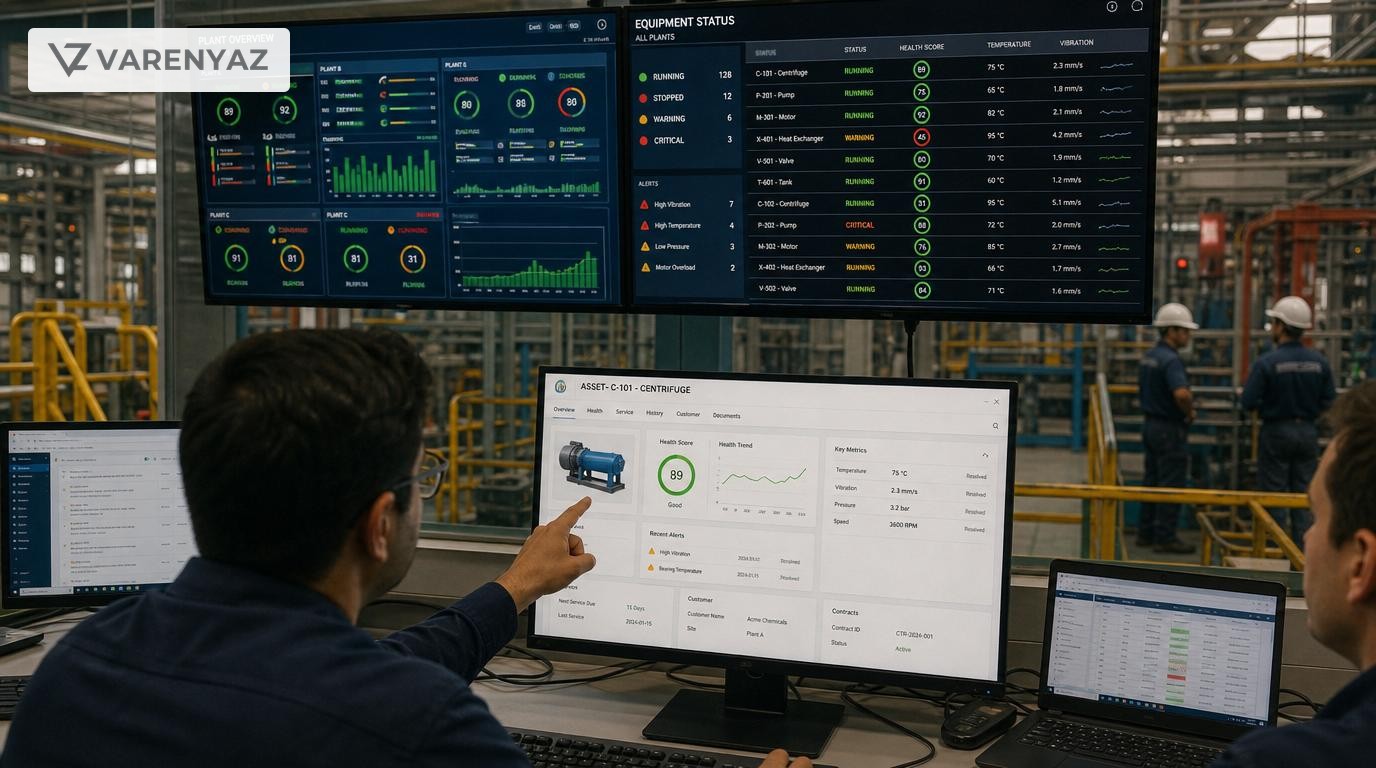
Why property CRM integrations are becoming a strategic lever in manufacturing
Manufacturing leaders are under pressure to do three things at once: keep plants running reliably, respond faster to customers, and unlock new service-led revenue. The problem is that the data needed to do all three usually lives in different places.
Operations teams stare at MES dashboards and IIoT platforms. Service teams juggle field service tools and spreadsheets. Sales and account teams live in CRM. Everyone sees a slice of reality, but no one sees the full picture of each asset and customer in real time.
This is where property CRM integrations come in. By treating every critical piece of equipment, line, or facility as a property (or asset) inside your CRM and integrating that with your manufacturing systems, you turn CRM into the live control panel for your installed base and customer relationships.
The result is real-time insight: a 360° view that connects asset health, service history, contracts, and customer context in one place, accessible to everyone who needs it.
Direct answer: how property CRM integrations deliver real-time insights
Property CRM integrations deliver real-time manufacturing insights by synchronizing each physical asset or site as a property record in CRM and streaming operational data into it.
- IIoT platforms and MES publish equipment events, alarms, and status changes.
- Integration services push these events into CRM against the correct property record.
- Service, sales, and operations teams see live asset health, uptime, and service actions in CRM.
- Workflows trigger automatically, creating cases, maintenance tasks, and notifications in real time.
Instead of static records, property objects become living profiles of each machine or facility, turning CRM into a decision hub for uptime, quality, and customer satisfaction.
What is a property CRM in the manufacturing context?
Most manufacturers are familiar with CRM as a tool for tracking accounts, contacts, and opportunities. A property CRM adds another first-class citizen: the asset or property.
In this context, a property can be:
- An individual machine or robot.
- A production line or cell.
- A customer facility or plant where your equipment is installed.
- A complex system, such as a turbine, HVAC system, or packaging line.
Each property record in CRM holds:
- Master data: model, serial number, configuration, commissioning date.
- Location: plant, line, country, site coordinates.
- Ownership and contracts: customer, warranty status, SLAs, service agreements.
- Service history: work orders, technician visits, parts replaced.
- Operational data: key KPIs (uptime, throughput, alarms) via integrations.
When this object is integrated across systems, it becomes the anchor for real-time insights and decision-making.
Why property CRM integrations are key for real-time manufacturing insights
1. Turning asset data into shared business insight
Manufacturing has made huge strides in connecting machines with IIoT and SCADA systems. But often, those insights stay on the plant floor. Property CRM integrations bring that data into the business layer.
With integrated property CRM, you can answer questions that require both operational and commercial context:
- Which high-revenue customers have assets trending towards failure?
- Where will we likely miss uptime commitments under current conditions?
- Which plants or lines generate the most unplanned downtime by asset family?
- How does asset reliability correlate with service contract profitability?
Industry research shows that many Industry 4.0 programs stall because insights don't reach the right decision-makers or are not tied into workflows. Integrating property CRM provides the connective tissue between IIoT insights and business action.
2. 360° view of each installed asset – not just the customer
A traditional CRM gives you a 360° view of the customer. A property CRM integration gives you a 360° view of every installed asset, linked to customers and contracts.
For each property, teams can see at a glance:
- Current status and health indicators.
- Open incidents, maintenance tasks, and upcoming service windows.
- Asset lifetime performance trends and recurring issues.
- Associated opportunities, renewals, and service contract value.
This asset-centric view is essential for modern business models like outcome-based contracts, where you sell availability, uptime, or throughput rather than just equipment.
3. Enabling predictive, not reactive, operations
Predictive maintenance and quality initiatives rely on the ability to detect weak signals in operational data and act before failure. But if that signal doesn't reach the people who can schedule maintenance, adjust inventory, or communicate with customers, its value evaporates.
With property CRM integrations, predictive algorithms running in IIoT platforms or data lakes can raise risk scores and alerts directly on property records in CRM:
- AI models identify patterns suggesting a component is likely to fail soon.
- The risk score is written back to the property record.
- CRM workflows create pre-emptive work orders or cases with recommended actions.
- Account teams get notified if a high-value customer's critical assets are at risk.
This closes the loop between prediction and action, reducing downtime and emergency callouts while improving customer trust.
4. Aligning operations, service, and commercial teams
Real-time insight is only powerful if it is shared across functions. Property CRM integrations provide a shared language: the property record. Everyone can anchor discussions around concrete, current asset status.
For example:
- Operations teams see which customer assets are driving the most plant disruptions.
- Service teams see upcoming production demands when planning maintenance windows.
- Sales sees which assets are underutilized and may benefit from optimization projects.
- Product teams get structured feedback about recurring issues by model or configuration.
This breaks down silos and helps align incentives around common KPIs like uptime, first-time-fix rate, and contract renewal rates.
Core integration architecture: how the pieces fit together
To deliver real-time insights, property CRM integrations need a clear architecture. At a high level, this usually involves:
- CRM and property data model – the structure of property, asset, and site records.
- Operational systems – MES, SCADA, IIoT, and historian platforms.
- Enterprise systems – ERP, PLM, field service, and order management.
- Integration layer – APIs, event brokers, and middleware connecting systems.
- Analytics layer – data lake or warehouse with BI and AI workloads.
1. Designing the property object
The property object (often called Asset, Equipment, or Installed Base) is the backbone of the integration. Key design considerations include:
- Granularity: do you model each component, the whole machine, or the line?
- Hierarchy: how do you represent plants, lines, machines, and subassemblies?
- Identifiers: which IDs (serial number, asset tag, customer tag) are authoritative?
- Lifecycle states: commissioned, active, under maintenance, decommissioned, etc.
Getting this model right makes it far easier to match records from MES, IIoT, and ERP and to generate reliable analytics later.
2. Connecting IIoT and MES to CRM
IIoT and MES systems generate the events that give your CRM its real-time pulse. Typical integration patterns include:
- Event streaming: sensors and controllers send telemetry via protocols like MQTT or OPC UA into an IIoT platform, which publishes relevant events to an event bus.
- API updates: a middleware service listens to events, matches them to the correct property, and calls CRM APIs to update status fields or create timeline entries.
- Threshold alerts: when conditions are breached (temperature, vibration, quality metrics), an event is generated that triggers CRM workflows.
Because raw telemetry can be high-volume, you typically filter and aggregate at the IIoT platform or integration layer before pushing only decision-relevant events into CRM.
3. Integrating ERP, service, and commercial systems
To turn operational signals into business outcomes, CRM must also be connected to:
- ERP: for contracts, warranties, spare parts availability, and billing.
- Field service management: for technician scheduling, routing, and parts logistics.
- Order management and CPQ: for quoting retrofits, upgrades, or service packages.
These integrations ensure that when a property enters a risk state, the system knows:
- What obligations exist (SLAs, uptime guarantees).
- What resources are available (technicians, parts inventory).
- What commercial opportunities or threats are in play (renewals, expansions).
Again, APIs and event-driven patterns are preferred over batch file transfers to keep the picture current.
4. Building a data and analytics layer on top
While CRM is ideal for real-time workflows and human interaction, long-term trend analysis and AI models require consolidated datasets. Many manufacturers use a data lake or cloud warehouse for this purpose.
In this architecture:
- Data from CRM, MES, IIoT, and ERP is ingested into the lake.
- Asset and customer IDs are standardized to create a unified asset-customer graph.
- BI tools and AI models run on this layer, producing dashboards and predictions.
- Key insights (risk scores, recommended actions) are written back to CRM properties.
This turns your property CRM into the operational front-end for analytics, while heavy lifting happens behind the scenes in scalable data platforms.
Business value: where property CRM integrations move the needle
1. Reduced downtime and faster response
The most immediate value is operational:
- Real-time visibility into asset health reduces diagnosis time.
- Automated case creation from equipment alarms shrinks response time.
- Predictive alerts enable maintenance during planned windows, not after failures.
Even modest improvements in uptime on critical assets can translate into substantial productivity and revenue gains, especially in continuous or high-volume operations.
2. Higher first-time-fix and lower service cost
Service technicians and support teams benefit from having full asset context in CRM:
- Telemetry and event history help pinpoint the root cause before dispatch.
- Integrated parts and BOM data support better preparation and parts ordering.
- Knowledge articles linked to similar properties speed up resolution.
Higher first-time-fix rates reduce truck rolls, labor costs, and customer disruption. Over time, this also improves technician morale and customer satisfaction.
3. Stronger customer experience and transparency
Customers expect more than a helpline. They want real-time visibility into their own assets and clear communication when issues arise.
Property CRM integrations enable:
- Customer portals that show live asset status and upcoming maintenance.
- Proactive alerts when KPI thresholds are breached.
- Data-backed discussions about performance, optimization, or upgrades.
This level of transparency strengthens trust and makes your company a strategic partner rather than a reactive supplier.
4. New service-led and outcome-based revenue models
As more manufacturers explore service-led business models, integrated property CRM becomes essential. When you offer uptime guarantees, pay-per-use, or outcome-based contracts, you need:
- Reliable measurement of performance indicators in near real time.
- Clear attribution of events and downtime to specific assets and causes.
- Integrated billing and contract management based on asset data.
With property-centric CRM integrations, you can design and scale such models, confident that you have the data backbone to measure and monetize value delivered.
Implementation considerations and tradeoffs
1. Choosing your integration patterns: batch vs. real time
Not all data needs to flow in real time. A pragmatic approach balances:
- Real-time or near real-time for alarms, status changes, and events that trigger workflows.
- Frequent syncs (hourly/daily) for metrics and counters used for dashboards.
- Batch loads for historical data, large logs, and archived records.
Overloading CRM with high-frequency telemetry can degrade performance. Filtering and summarizing at the integration layer helps maintain responsiveness while preserving actionable insight.
2. Data model and master data management
One of the toughest challenges is creating consistent asset and customer identifiers across systems. If a single machine appears under different IDs in IIoT, MES, and ERP, your integrations will be brittle.
Mitigation steps include:
- Defining a canonical asset ID and enforcing it at commissioning.
- Using master data management (MDM) tools where complexity is high.
- Implementing data quality checks and reconciliation processes.
Investing in this foundation pays off as integrations scale.
3. Security, access control, and compliance
Connecting plant data to CRM expands the audience who can see operational information. That's powerful, but it also introduces risk.
Key safeguards include:
- Role-based access control: limit which users can see which properties and fields.
- Segmentation: separate sensitive production parameters from high-level KPIs when not needed.
- Audit trails: log data changes and access to meet regulatory and internal requirements.
- Secure integration: use encrypted channels, strong authentication, and least-privilege principles for APIs and event brokers.
Security design should be part of the initial architecture, not an afterthought.
4. Change management and user adoption
Even the best integration will fail if people don't trust or use it. Common obstacles include:
- Frontline teams skeptical of new tools.
- Confusion about who owns data and workflows.
- Overly complex interfaces that bury key signals.
Practical steps to drive adoption:
- Co-design property layouts and dashboards with end users.
- Start with clear, narrow use cases and measure tangible improvements.
- Provide training focused on day-to-day decisions, not only on features.
- Continuously refine alerts and workflows to reduce noise.
Step-by-step roadmap for rolling out property CRM integrations
Step 1: Define your high-value use cases
Instead of "integrate everything," identify 2–3 high-impact scenarios, such as:
- Reducing unplanned downtime on a critical asset family.
- Improving first-time-fix rate for a specific product line.
- Supporting uptime-based contracts for strategic customers.
Attach clear metrics to each use case (e.g., downtime hours, mean time to repair, contract renewal rate) so you can track success.
Step 2: Design your property model and identifiers
Clarify how you'll represent properties in CRM:
- Define asset hierarchies and relationships (plant, line, machine, component).
- Standardize identifiers and naming conventions.
- Capture necessary fields for matching with MES, IIoT, and ERP.
It's worth piloting this model with a subset of assets and adjusting before scaling.
Step 3: Set up your integration layer
Choose and configure tools for:
- API management to connect CRM, IIoT, MES, and ERP.
- Event streaming or messaging (such as Kafka or cloud equivalents) for real-time events.
- Data transformation and validation to ensure consistent formats.
If you're using major cloud providers or enterprise suites, leverage their native connectors where appropriate, but still design with long-term flexibility in mind.
Step 4: Integrate IIoT and key operational signals into CRM
Start by mapping a small set of critical events into CRM, such as:
- Fault codes for mission-critical assets.
- Threshold breaches for key process variables.
- Production stops and unplanned downtime events.
For each event type, define:
- How it updates the property record (fields, status, timelines).
- What workflows it triggers (cases, tasks, notifications).
- Who needs to be notified and through which channels.
Step 5: Connect service and commercial workflows
Next, integrate field service and ERP so that real-time asset events can:
- Create or update work orders with relevant context.
- Check contract terms and SLAs before committing responses.
- Update billing or contract consumption based on service delivered.
This is where real-time insight begins to show up as tangible business outcomes in service performance and customer experience.
Step 6: Add analytics and AI on top
Once integrations are producing consistent data, you can:
- Build dashboards for uptime, failure patterns, and service performance by asset type.
- Train models to predict failures, recommend maintenance windows, or score risk across the installed base.
- Write AI outputs (such as risk scores or recommended actions) back into CRM properties.
The key is not to rush into AI before your data and integration foundations are stable. AI multiplies value, but it also multiplies any underlying data problems.
Risks, tradeoffs, and how to manage them
1. Integration complexity vs. agility
Deep integrations can become complex and fragile, especially when linking legacy systems. To manage this:
- Use modular, API-first architectures that minimize hard coupling.
- Introduce an integration platform or service layer, so CRM and upstream systems don't depend on each other's internal details.
- Document integration contracts and version them carefully.
2. Signal vs. noise in real-time data
When you first open the firehose from IIoT systems, CRM users can quickly be overwhelmed by alerts.
Mitigation approaches include:
- Implementing alert thresholds, aggregates, and debounce logic.
- Grouping related events into a single incident in CRM.
- Allowing users to subscribe only to properties and event types they care about.
3. Vendor lock-in vs. ecosystem flexibility
Many platforms offer end-to-end stacks for CRM, IIoT, and ERP. They are tempting, but it's important to preserve optionality:
- Prefer open standards like REST APIs, OPC UA, and MQTT.
- Avoid proprietary data formats where possible.
- Design your integration layer so components can be swapped if needed.
4. Data privacy and customer agreements
In some sectors, customers may have concerns about how their operational data is used. Clear communication and contractual alignment are critical:
- Define what data will be collected, how long it will be stored, and for what purposes.
- Offer value in return, such as benchmarking, optimization advice, or improved uptime guarantees.
- Ensure compliance with applicable regulations and industry standards in each geography.
Practical examples of property CRM insights in action
Scenario 1: Proactive maintenance on high-speed packaging lines
A manufacturer integrates its packaging line sensors with CRM via an IIoT platform. Each line is modeled as a property, with machines as child properties.
- Vibration and temperature data stream into the IIoT layer.
- Models detect unusual patterns suggesting bearing wear.
- A risk score is written back to the line's property record.
- CRM automatically creates a maintenance task scheduled during a low-production window.
- Service teams prepare parts based on BOM data linked to the property.
Downtime is avoided, and the event becomes part of the asset's lifelong record in CRM, informing future decisions and model training.
Scenario 2: Uptime-based contracts for industrial chillers
An equipment OEM offers uptime guarantees on chillers installed at customer facilities. Each chiller is a property in CRM, integrated with on-premise IoT gateways.
- SLA terms are attached to the property along with financial penalties.
- Real-time status and utilization metrics sync into CRM.
- If uptime for a period looks at risk, CRM alerts account managers and service planners.
- Any downtime automatically logs against the property and contract for transparent reporting.
This level of integration makes the OEM confident enough in its data to stand behind aggressive uptime commitments while managing risk.
Scenario 3: Coordinated incident response across plants and customers
A component defect affects a specific series of machines across multiple customers. Without integrated data, identifying all affected assets is painful.
With property CRM integrations in place:
- Product teams identify affected models and serial ranges.
- A query in CRM surfaces all matching properties globally, with associated customers and locations.
- Bulk workflows create proactive service cases and communicate mitigation steps.
- Operational data helps prioritize interventions based on current load and risk.
What would have been a chaotic, manual recall becomes an orchestrated, data-driven response.
How VarenyaZ helps build real-time property CRM integrations
Designing and implementing property CRM integrations that genuinely deliver real-time insights is not a plug-and-play project. It requires careful strategy, strong engineering, and thoughtful UX design.
VarenyaZ works with manufacturers to:
- Shape an integration strategy aligned with business goals, not just system checklists.
- Design property and asset data models that harmonize CRM, MES, IIoT, and ERP.
- Build API-first, event-driven architectures that scale as more plants and assets come online.
- Develop intuitive web and portal experiences for internal teams and customers to see real-time asset insights.
- Layer AI and advanced analytics on unified data to drive predictive maintenance, quality, and service innovation.
If you're exploring how to connect your CRM, operational systems, and AI to unlock real-time insights, reach out to VarenyaZ at https://varenyaz.com/contact/.
Conclusion: property CRM as the real-time brain of modern manufacturing
Manufacturing is moving from periodic reporting to continuous awareness. Property CRM integrations are a cornerstone of that shift, giving you a live, shared understanding of how each asset is performing and how that performance ties back to customers and contracts.
By connecting CRM with IIoT, MES, ERP, and service systems around a well-designed property object, you turn operational data into decision-ready insight. That insight helps you reduce downtime, serve customers proactively, and build new revenue models anchored in outcomes rather than transactions.
VarenyaZ combines web design, web development, and AI development expertise to help you architect these integrations end to end: from clean, usable interfaces in CRM and portals, through robust backend services and data pipelines, to intelligent models that learn from every asset event. With the right foundation, your property CRM becomes more than a database—it becomes the real-time brain of your manufacturing business.
Editorial Perspective
Expert Review Notes
"When you treat every installed machine or facility as a property inside CRM, with live telemetry and service history attached, the CRM stops being a sales database and becomes a real-time operating console for the whole business."
"The most successful manufacturers are not just connecting plants; they are connecting assets to customers and commercial models through CRM, which is where real-time insights turn into revenue and differentiated service."
"You will not get value from predictive maintenance models if your integration fabric is weak. Clean, timely property CRM integrations are what let AI see the full life of every asset, not just fragments."
Frequently Asked Questions
What is a property CRM integration in manufacturing?
A property CRM integration connects your CRM platform to manufacturing systems such as MES, ERP, IIoT platforms, and field service tools, with each physical asset or site represented as a "property" or asset record. Telemetry, service history, contracts, and usage data are synchronized so teams get a real-time, asset-centric view inside CRM.
How do property CRM integrations deliver real-time insights?
They stream equipment telemetry and event data into CRM timelines using APIs, webhooks, or event buses. When sensors detect a threshold breach, a process change, or a fault code, the event is published and CRM updates the property record or triggers workflows, alerts, and service tickets in near real time.
Which systems should manufacturers integrate with CRM first?
Most manufacturers start with their IIoT or asset monitoring platform, field service management system, and core ERP or order management. This combination links live equipment health, service execution, and commercial data, delivering fast wins in uptime, response time, and contract profitability before integrating deeper MES and quality systems.
What are the main risks of integrating CRM with plant and asset data?
Key risks include exposing sensitive operational data to too many users, performance bottlenecks from streaming high-volume telemetry into CRM, inconsistent asset identifiers across systems, and change-management challenges as teams adapt to new, more transparent workflows. Strong governance, access controls, and a clear data model mitigate these risks.
How can smaller manufacturers adopt property CRM integrations cost-effectively?
Smaller manufacturers can start with cloud CRM and IIoT platforms that offer native connectors, focus on one high-value asset category, and use low-code integration tools. Instead of trying to integrate every system at once, they prioritize a few critical events that drive maintenance, service, or quality decisions and expand gradually.
Where does AI fit into property CRM integrations for manufacturing?
Once data from assets, plants, and customers is unified, AI can predict failures, recommend maintenance windows, score risk across the installed base, and surface next-best actions for service or sales teams. AI models rely on consistent, well-structured integration so they learn from real outcomes and deliver explainable, trusted insights.
Selected References
Further Reading
Related perspectives
Future-Proofing Your Business with AI
AI solutions for small business are now accessible, affordable, and essential for staying competitive. Startups and SMBs can use AI to automate routine work, personalize customer experiences, improve decisions, and test new products faster. This article explains where AI creates real value, how to choose the right use cases, assess your data, decide between off‑the‑shelf and custom AI, manage risks, and roll out a phased roadmap that fits limited budgets and teams.
How AI Drives Revenue Growth in Transport & Logistics
AI solutions help transportation and logistics companies grow revenue by improving asset utilization, optimizing prices and routes, reducing delays, and enabling new digital services for shippers. This article explains the main AI use cases, how they translate into measurable revenue, and the data, technology, and change-management foundations required. It also covers risks like biased pricing, operational disruption, and integration complexity, and offers a practical roadmap to move from pilots to production. The article closes with how VarenyaZ supports web, product, and AI development for logistics players.
Predictive Analytics for Startup & SMB Growth
Predictive analytics helps startups and SMBs use historical and real-time data to forecast revenue, demand, churn, and risk, so they can act before problems and opportunities surface. This article explains business value, essential data foundations, model options, tooling choices, governance, and change management. It outlines a phased roadmap, from quick-win use cases to integrated AI workflows, and highlights key risks such as bias, overfitting, and poor data quality. You will also learn how to measure ROI and how a partner like VarenyaZ can help architect and implement predictive analytics solutions.