

What Happened In Brief
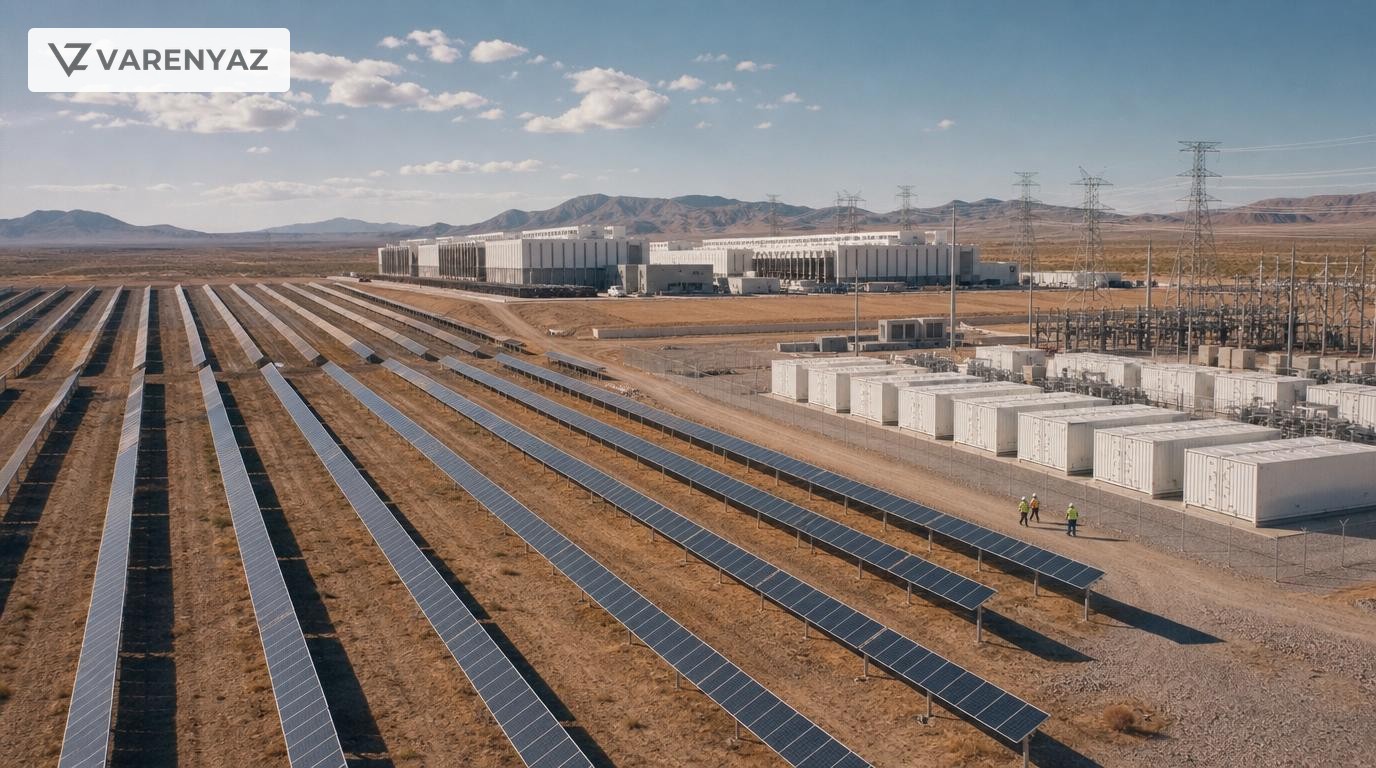
Two former SpaceX executives have launched Ambrosia Energy, a solar and battery startup designed to power AI data centers and high-performance compute. Ambrosia plans to deliver utility-scale projects in under a year, undercut natural gas on cost, and deploy gigawatts of capacity by 2030. For AI, cloud, and data-center leaders, this represents a fast, renewable alternative to traditional grid and gas-fired power, with implications for siting, reliability strategy, and long-term energy contracts.
News Desk
LiveEditorial Review
VarenyaZ Editorial Desk, Managing Editor
Global
In This Story
Coverage Signals
Key Takeaways
- Ambrosia Energy is a new solar-plus-storage startup founded by two SpaceX alumni to serve AI and data center power demand.
- The company claims it can build utility-scale solar and battery plants in under 12 months, faster than typical gas or grid upgrades.
- Ambrosia’s goal is to undercut the cost of natural gas power while delivering low-carbon electricity tailored to AI workloads.
- The startup is targeting gigawatts of capacity by 2030, aligning with the rapid expansion of AI and hyperscale data centers.
- For CTOs and infrastructure teams, this model enables power procurement strategies that align AI growth with decarbonization goals.
- Key risks include permitting delays, supply-chain bottlenecks, grid interconnection queues, and long-term battery economics.
- Enterprises should monitor how clean energy developers, cloud providers, and AI companies co-locate compute with dedicated renewables.
- VarenyaZ can help organizations architect AI-ready, energy-aware software and data platforms that match these new infrastructure models.
Two SpaceX alumni want to solve AI’s power problem with solar and batteries
AI may be limited less by chips than by electricity. As hyperscalers and enterprises rush to deploy GPU clusters and AI-native data centers, power demand is exploding in locations where the grid is already strained. Into this gap steps Ambrosia Energy, a new startup founded by two SpaceX alumni that wants to build solar-plus-battery power plants specifically to feed the AI boom.
The company’s pitch is direct: build utility-scale solar and storage projects in under 12 months, deliver firm power at a lower cost than natural gas, and deploy gigawatts of capacity by 2030. If Ambrosia can execute, it could become one of the pivotal, behind-the-scenes enablers of large-scale AI infrastructure.
What Ambrosia Energy is building
Ambrosia Energy is positioning itself as a vertically focused clean energy developer for AI, cloud, and data center customers. Rather than just adding renewables to the grid, it aims to develop solar farms tightly integrated with battery storage and long-term offtake agreements tailored to compute-heavy workloads.
Fast-build solar-plus-storage plants
According to early reporting, the company wants to achieve three key milestones:
- Sub-12-month deployment cycles: From site control to commercial operation, Ambrosia targets build schedules that outpace traditional gas plants and grid upgrades.
- Solar-plus-battery at scale: Combining large photovoltaic arrays with utility-scale batteries to deliver firm, schedulable power rather than intermittent renewables.
- Gigawatt ambitions by 2030: The startup is aiming for multi-gigawatt capacity as AI data-center demand accelerates
This model shifts from generic renewable projects toward application-specific power infrastructure, purpose-built for AI and high-performance computing clusters.
From rocketry to electrons
The SpaceX pedigree matters less for branding than for execution style. Alumni from the company tend to favor aggressive timelines, vertical integration, and an engineering-led operating model. Applying that approach to power projects means reducing soft costs, standardizing plant designs, and tightly managing construction and supply chains to hit ambitious schedules.
Why this matters for AI and data center leaders
AI workloads are becoming an energy story. The International Energy Agency (IEA) projects electricity demand from data centers, AI and cryptocurrencies could double by 2026, with AI a rapidly growing share. Grid planners in the U.S., Europe, and Asia are already warning that power constraints will dictate where the next generation of data centers can be built.
AI capacity is colliding with grid constraints
In markets like Northern Virginia, Dublin, and key Indian metros, data-center clusters are hitting the limits of local transmission and distribution networks. Upgrading that infrastructure can take many years, often longer than AI product cycles.
For CTOs, CIOs, and infrastructure heads, this creates a stark choice:
- Wait for utilities and regulators to unlock more capacity, or
- Co-locate compute with dedicated, contracted clean energy projects that sit where power is easier and faster to build
Ambrosia Energy is betting that hyperscalers, AI cloud providers, and large enterprises will increasingly choose the latter.
Cost, carbon, and corporate commitments
Solar and batteries are no longer just about sustainability messaging. In many regions, utility-scale solar is already among the cheapest sources of new power. As battery costs fall and market designs mature, firmed renewable power can compete economically with natural gas, especially when carbon pricing, volatility in fuel prices, and reputational risk are factored in.
For listed companies and global brands deploying AI aggressively, this matters in three ways:
- Cost visibility: Long-term contracts with solar-plus-storage developers can stabilize power costs over a decade or more.
- Carbon accounting: Dedicated renewable capacity simplifies ESG reporting and alignment with science-based net-zero targets.
- License to operate: Regulators and communities are increasingly scrutinizing the footprint of data centers; clean power projects make approvals easier to win and defend.
Business impact: From power as constraint to design variable
Ambrosia’s model, if proven, reframes power as a design variable for AI infrastructure, not just a constraint. For technology and business leaders, several changes follow.
Rethinking where to build AI infrastructure
Instead of defaulting to traditional hubs, organizations can:
- Site new AI data centers near high-quality solar resources and available land.
- Use dedicated battery-backed capacity to achieve high uptime without relying solely on local grid resilience.
- Pair long-term power contracts with modular data-center builds that can scale in phases.
This opens up new geographies for AI infrastructure, including sun-rich regions in India, the U.S. Southwest, and parts of the Middle East and Africa, where grid capacity historically limited large builds.
New procurement and partnership models
Power procurement becomes more strategic and complex. Instead of just negotiating colocation and cloud contracts, enterprises will increasingly be asked to sign:
- Virtual or physical power purchase agreements (PPAs) with dedicated renewable developers.
- Long-duration, compute-linked contracts where GPU capacity and megawatts are planned together.
- Tri-lateral structures involving cloud providers, energy developers, and large enterprise tenants.
Leaders in finance, legal, and operations will need to align around these structures early, as they directly affect AI roadmaps and rollout velocity.
Risks and open questions
Ambrosia Energy’s vision is compelling, but execution risk is real. Decision-makers should weigh several uncertainties.
Permitting, interconnection, and local politics
Even with standardized designs and aggressive timelines, large solar-and-battery projects can face:
- Lengthy environmental and planning approvals.
- Grid interconnection queues that stretch for years.
- Local opposition around land use, visual impact, or water concerns.
These are not challenges unique to Ambrosia—but they can undermine any promise of sub-12-month delivery if not anticipated and managed.
Battery supply, cost curves, and technology bets
Utility-scale batteries rely on complex global supply chains. Competition from EVs, stationary storage, and grid projects could affect pricing and availability. There are also open questions around:
- Degradation over time and replacement cycles.
- Choice of chemistry (e.g., lithium iron phosphate vs. alternatives) and its impact on safety and lifetime costs.
- Revenue stacking strategies in markets where batteries can also participate in grid services.
For AI customers, understanding how these variables are priced into long-term contracts will be crucial.
Will AI power demand forecasts hold?
Forecasts for AI-driven power demand vary widely. If adoption slows, or if new chip architectures dramatically improve efficiency, some contracted capacity could be underutilized. On the other hand, underestimating demand could lead to stranded AI projects due to lack of power.
Resilient strategies will likely combine conservative baseline planning with options to ramp capacity up or down as utilization trends become clearer.
What leaders should watch next
For founders, CTOs, and infrastructure leaders, several signals will show whether Ambrosia Energy’s model is scaling:
- First announced sites and their locations relative to existing or planned AI data centers.
- Publicly disclosed partnerships or power purchase agreements with major cloud or AI providers.
- Evidence that projects are hitting sub-12-month build timelines in practice, not just in pitch decks.
- Regulatory and community responses in early markets, especially in the U.S., U.K., and India.
In parallel, watch how hyperscalers talk about “clean firm power” and “energy-aligned regions” in their own roadmaps. Ambrosia is part of a broader pattern where compute strategy and energy strategy are converging.
Implications for digital, AI, and product teams
The power story behind AI has direct implications for software, data, and product planning.
- Energy-aware AI architectures: As power availability varies by region, teams may need to design workloads to shift between locations or prioritize training in energy-rich sites.
- Latency vs. energy trade-offs: Some applications can tolerate a few extra milliseconds to run in a cleaner, cheaper region; others cannot. Architecture choices will reflect that.
- Resilience planning: Battery-backed clean power can improve resilience, but systems must still be designed for multi-site failover and graceful degradation.
Aligning infrastructure realities with product roadmaps will be a differentiator as AI moves from pilot to production at scale.
How VarenyaZ fits into the evolving AI–energy landscape
As companies confront this new world where megawatts and models are intertwined, technology strategy cannot be separated from infrastructure constraints. That’s where partners like VarenyaZ become relevant.
VarenyaZ helps businesses design and build web platforms, custom applications, and AI-driven systems that are infrastructure-aware from day one. From multi-region architectures and intelligent workload routing to automation that responds dynamically to cost and capacity signals, the right software design can turn energy constraints into competitive advantage.
If you are planning large-scale AI, data, or cloud-native initiatives and need to align product, infrastructure, and sustainability strategies, you can start a conversation with our team here: https://varenyaz.com/contact/
Conclusion: AI’s next bottleneck is the grid—and Ambrosia is a preview
Ambrosia Energy’s bet on fast, solar-plus-storage plants for AI data centers crystallizes a deeper structural shift: the AI race is becoming an energy race. Leaders who treat power as a first-class design input—alongside latency, security, and user experience—will make better decisions about where and how to build.
For organizations navigating this transition, VarenyaZ can help translate infrastructure and energy realities into resilient digital products, scalable web architectures, automation, and AI systems that are ready for the next decade of compute growth.
Editorial Perspective
"Ambrosia Energy is a clear signal that the AI era will be constrained less by GPU supply and more by clean, reliable megawatts; whoever solves that bottleneck at scale will quietly shape the trajectory of the entire AI ecosystem."
"For CTOs and CIOs, the rise of solar-plus-storage providers like Ambrosia turns power from a fixed constraint into a strategic design parameter for where to build, deploy, and scale AI workloads."
Frequently Asked Questions
What is Ambrosia Energy and who founded it?
Ambrosia Energy is a solar-plus-battery power developer founded by two alumni from SpaceX. The startup focuses on building utility-scale renewable plants designed to serve AI data centers and high-performance compute workloads, combining fast deployment timelines with long-duration battery storage.
How does Ambrosia Energy plan to power AI data centers?
Ambrosia Energy plans to build large solar farms paired with utility-scale battery storage near AI and cloud data centers. The batteries smooth solar variability and provide firm, predictable electricity that can be contracted directly by operators, reducing reliance on volatile grid mix and fossil-fuel peaker plants.
Why is solar-plus-storage attractive for AI workloads?
AI workloads consume vast, growing amounts of power and require high uptime. Solar-plus-storage offers low operating costs, emissions reductions, and the ability to deliver contracted, time-shifted power. When engineered correctly, it can match or beat natural gas on cost while aligning with corporate net-zero strategies.
What is Ambrosia Energy’s timeline and scale ambition?
Ambrosia Energy aims to deliver full solar-plus-storage power plants in under 12 months, a significantly faster cycle than many conventional projects. The company is targeting gigawatt-scale deployments by 2030, positioning itself as a major independent provider of clean power to AI and hyperscale data-center customers.
What should technology and business leaders watch next?
Leaders should watch how Ambrosia secures land, permits, grid connections, and long-term power purchase agreements with AI and cloud providers. They should also track whether this model drives a broader shift toward co-locating compute with dedicated renewables, reshaping where and how future AI infrastructure is built.
Selected References
Stay Ahead
Get concise, actionable insights on AI, digital strategy, and innovation. No spam, just value.
More Coverage
Related News
Jul 25, 2026
Anduril Targets $100B Valuation in New Defense AI Funding Round
Anduril is reportedly in talks to raise a new funding round that would value the defense-tech and AI company at about $100 billion, more than tripling its valuation from the prior year. This would make Anduril one of the world’s most valuable private defense and dual-use AI companies, highlighting how investors view autonomous systems, sensors, and AI-powered command platforms as core national infrastructure. For founders, CTOs, and public sector-focused vendors, this is a signal that AI-native defense and security stacks are entering a new phase of capital intensity and strategic relevance.
Jul 24, 2026
Corgi’s $4B valuation shows how hot AI insurance has become
AI-first insurance startup Corgi has reportedly raised its third funding round in just eight weeks, at a valuation of around $4 billion. This pace places Corgi among the most aggressively funded insurtechs in the current AI wave. For insurers, founders, and CTOs, the deal signals strong investor conviction in AI-native underwriting, risk scoring, and automated policy operations, but also raises questions about sustainability, regulatory scrutiny, and the pressure to convert rapid capital inflows into robust, compliant insurance products and reliable enterprise-grade platforms.
Jul 23, 2026
Travis Kalanick’s Atoms Raises $1.7B to Build Industrial AI Robots
Travis Kalanick’s robotics and industrial AI startup Atoms has raised $1.7 billion in funding led by Andreessen Horowitz, with Uber participating. Atoms says it will use robotics, computer vision, and AI to modernize physical operations such as warehouses, fulfillment centers, and logistics hubs. For enterprises, the round signals intensifying investment in end-to-end automation platforms, with potential impacts on supply-chain resilience, labor models, and how software products integrate with real-world, robot-enabled infrastructure.