

What Happened In Brief
Critical Energy, founded by a former SpaceX engineer, has secured a major funding round to repurpose rocket engines for ultra-deep geothermal drilling. By reaching hotter rock layers, the startup aims to provide firm, low-carbon baseload power that can compete with fossil fuel plants. The approach could be attractive for utilities, data centers, and heavy industry seeking 24/7 clean energy. Key questions now are drilling costs, regulatory paths, and how fast power purchase agreements and pilot plants can scale from demonstration to commercial deployment.
News Desk
LiveEditorial Review
VarenyaZ Editorial Desk, Managing Editor
Global
In This Story
Coverage Signals
Key Takeaways
- Critical Energy, founded by a former SpaceX engineer, has raised a substantial round to bring rocket-engine technology into geothermal drilling.
- The company aims to tap ultra-deep, high-temperature rock to deliver firm, low-carbon baseload power competitive with fossil fuels.
- If drilling economics work, utilities, hyperscale data centers, and industrial loads could gain a new 24/7 clean energy option beyond solar, wind, and batteries.
- The approach relies on adapting high-thrust, high-temperature rocket engines into controllable, long-duration geothermal drilling systems.
- Regulatory approvals, subsurface risk, and long project cycles remain major uncertainties for investors and infrastructure planners.
- Enterprise leaders should track pilot projects, levelized cost of energy (LCOE) data, and early power purchase agreements as signals of commercial viability.
- Digital twins, advanced simulation, and AI-driven control systems will be critical to safely optimizing drilling performance and plant operations.
- VarenyaZ can help climate-tech and energy innovators build the web platforms, data systems, and AI tooling needed to commercialize similar deep-tech solutions.
SpaceX alum’s Critical Energy aims rocket engines at the grid
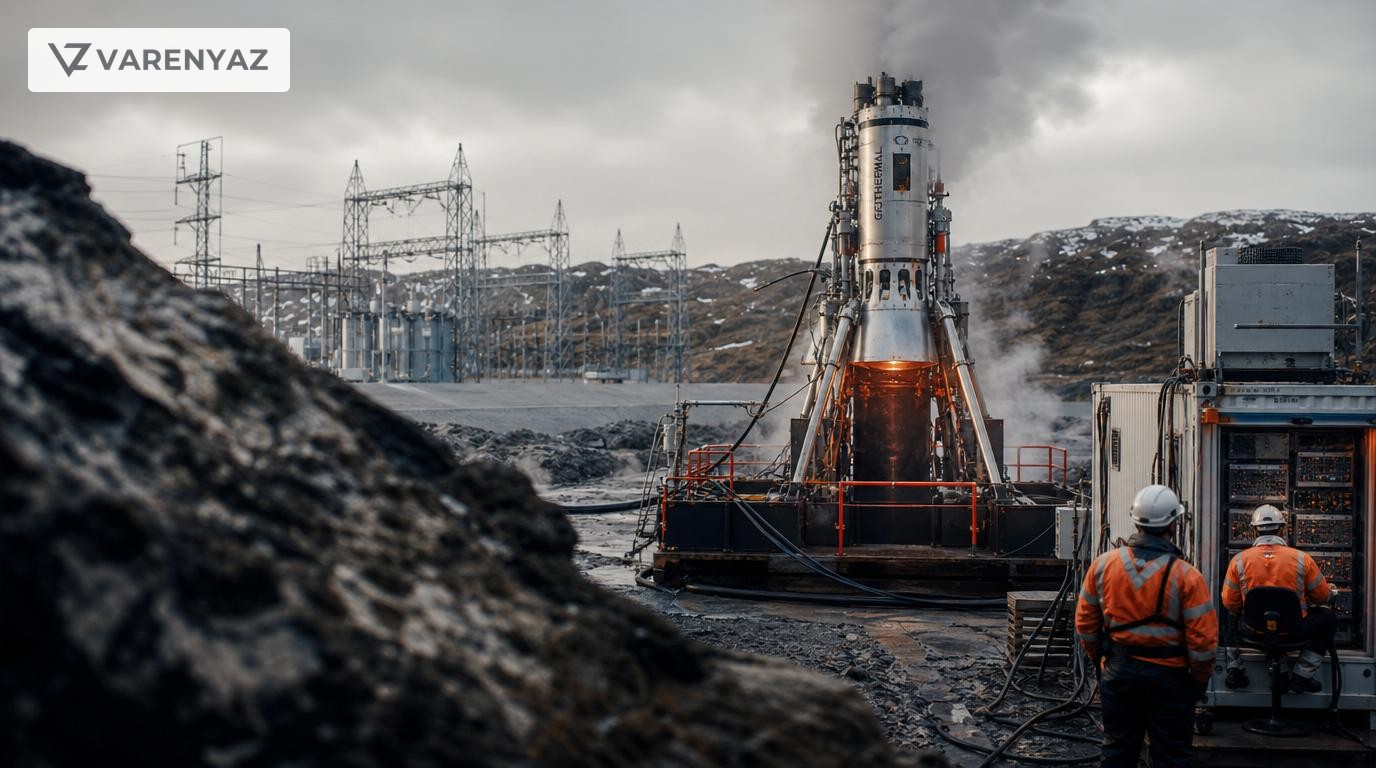
A former SpaceX engineer is taking rocket engines from orbit to the underground. Critical Energy, a geothermal startup led by a SpaceX alumnus, has raised a fresh round of funding to adapt high-performance rocket engine technology for ultra-deep geothermal drilling, with ambitions to ultimately deploy hundreds of gigawatts of clean baseload capacity.
Instead of lifting payloads to space, these engines will drive high-energy drilling systems designed to chew through hard rock faster and deeper than conventional rigs. The goal: unlock heat reservoirs miles below the surface that are hot, stable, and capable of producing 24/7 renewable power.
What happened: venture-backed bet on rocket-powered geothermal
Critical Energy’s new funding—reported in TechCrunch’s coverage of the deal—positions the company among a small but growing cohort of geothermal innovators trying to reinvent drilling, economics, and scale.
The company’s core idea is simple but radical: use modified rocket engines as ultra-high-temperature, high-thrust drilling tools. Where conventional drills struggle with deep, high-strength rock, rocket-derived systems promise higher penetration rates and access to hotter formations that produce more energy per well.
Critical Energy is targeting multi-decade, utility-scale operations rather than small pilot wells. Its long-term vision is to deliver hundreds of gigawatts per year of new geothermal capacity if the technology can be replicated across diverse geologies and markets.
Direct answer: why this matters for business and the grid
Rocket-powered geothermal matters because it could provide firm, 24/7, low-carbon power at a cost that competes with fossil fuel plants—without depending on sun or wind. For utilities, data centers, and heavy industry, this offers a potential way to meet aggressive decarbonization targets while maintaining reliability and cost control.
Key strategic implications
- Utilities gain a new baseload resource to complement solar, wind, and storage.
- Data centers and AI workloads could locate near future geothermal hubs for predictable, clean power.
- Industrial players might tap geothermal heat directly for process heat, not just electricity.
- Investors get a high-risk, high-upside climate-tech category with deep-tech defensibility.
How rocket engines change geothermal economics
Geothermal has long been constrained by geology and cost. Conventional projects are viable only in select locations where heat, permeability, and water all align. Enhanced geothermal systems (EGS) and next-generation concepts aim to break those limits through deeper drilling, stimulation, or closed-loop systems.
Rocket-derived drilling can influence three critical levers:
1. Depth and temperature
By reaching deeper strata, Critical Energy targets rock temperatures high enough to deliver more energy per unit of flow. That can translate into higher capacity factors and better levelized cost of electricity (LCOE) if drilling costs do not explode.
2. Speed and cost of drilling
Drilling is typically the most expensive and uncertain part of geothermal projects. Faster penetration through hard rock, fewer bit changes, and better control in hostile environments could materially lower project costs and timelines. That, in turn, improves bankability and makes financing large-scale deployments more realistic.
3. Geographic flexibility
Ultra-deep wells open the possibility of “geothermal almost anywhere,” where depth substitutes for natural hydrothermal resources. For businesses, that means decarbonized baseload power need not be limited to traditional geothermal hotspots.
Who should care: utilities, AI infrastructure, and policymakers
Utilities and grid operators
As grids absorb more variable renewables, balancing gets harder and more expensive. Geothermal is attractive because it is dispatchable and predictable. If rocket-powered drilling can scale, utilities will gain:
- New options for retiring coal and gas plants without compromising reliability.
- Better tools to meet regulatory pressure for clean energy portfolios.
- Localized baseload near demand centers, reducing transmission bottlenecks.
AI, cloud, and data center leaders
Hyperscalers and AI infrastructure providers are facing acute power constraints. Training large models, running inference at scale, and cooling dense racks are pushing data center energy demand sharply upward.
Ultra-deep geothermal could be attractive because it offers:
- 24/7 clean power that aligns with corporate net-zero commitments.
- Location flexibility for siting data centers in cooler climates or near users, not just near cheap gas.
- Predictable long-term prices via long-term power purchase agreements (PPAs).
Public sector and regulators
Governments running geothermal and enhanced geothermal initiatives—such as the U.S. Department of Energy’s Enhanced Geothermal Shot—will see companies like Critical Energy as proof points for the viability of deep-tech approaches. Regulators will need to adapt permitting frameworks to emerging drilling methods, environmental impacts, and induced seismicity concerns.
Risks, unknowns, and what to watch
Technical and operational risks
- Reliability at depth: Rocket-derived systems are optimized for short, intense launch cycles, not continuous industrial duty. Adapting them for long-term drilling and minimizing failures will be critical.
- Subsurface uncertainty: As with any geothermal project, resource quality, permeability, and induced seismicity remain key risks.
- Thermal management and safety: Controlling extreme heat and pressure safely will require advanced engineering and software.
Economic and financing risks
- High upfront capex: Deep wells are capital-intensive. Until there is a track record, many financiers will remain cautious.
- LCOE validation: Claims of competitive costs must be proven with actual production data and independent verification.
- Long development cycles: Multi-year project timelines challenge traditional venture models and require patient infrastructure capital.
Signals for business leaders
Executives and investors should track:
- Pilot and demonstration results: drilling depth, time, costs, and sustained output.
- Early PPAs with utilities or hyperscalers, which signal market confidence.
- Policy support via tax credits, grants, or regulatory fast lanes for geothermal.
- Partnerships with major EPCs, oil and gas service companies, or grid operators.
Software, data, and AI: the hidden backbone of deep geothermal
While the hardware story is dramatic, software will quietly determine whether rocket-powered geothermal scales.
- Subsurface modeling and digital twins to simulate drilling paths, predict rock behavior, and optimize heat extraction.
- AI-driven control systems to adjust drilling parameters in real time and prevent equipment failures.
- Operational dashboards and automation to orchestrate fleets of wells, manage maintenance, and integrate with grid markets.
- Customer-facing platforms for PPAs, performance reporting, and ESG disclosures.
Climate-tech founders and energy companies will need reliable web platforms, robust data pipelines, and specialized AI tooling to commercialize these projects, communicate with stakeholders, and manage complex infrastructure over decades.
What this means for digital strategy and product roadmaps
For enterprise leaders, the emergence of rocket-powered geothermal is not just an energy story; it is a planning story.
- Site selection: Future power hubs may emerge around geothermal resources, influencing where factories, campuses, and data centers are built.
- Decarbonization roadmaps: 24/7 clean power options change the trajectory and credibility of net-zero strategies.
- Product design: Software and devices increasingly need to account for energy availability, carbon intensity, and grid interaction as core constraints.
- Resilience planning: Diversified baseload resources reduce exposure to fuel price shocks and grid stress.
Organizations that anticipate these shifts can secure advantageous PPAs, co-development opportunities, and reputational gains well before geothermal matures into a mainstream asset class.
How VarenyaZ fits into the next wave of climate-tech infrastructure
As companies like Critical Energy push the boundaries of geothermal, they will need robust digital and AI foundations as much as advanced hardware. That includes modern web platforms, secure data systems, and intelligent automation to translate engineering breakthroughs into bankable projects and scalable businesses.
VarenyaZ partners with energy innovators, climate-tech startups, and infrastructure operators to design and build:
- High-performance web platforms for investor relations, project marketing, and regulatory communication.
- Custom web applications for asset monitoring, drilling analytics, and real-time dashboards.
- AI-driven automation that turns telemetry into actionable insights, from predictive maintenance to operational optimization.
- Integrated data architectures that connect field systems with cloud analytics and business workflows.
If you are exploring how to digitally enable next-generation energy projects or need a trusted partner for web, automation, or AI development, talk to the VarenyaZ team at https://varenyaz.com/contact/.
Conclusion: from rockets to reliable clean power
Rocket engines powering geothermal wells might sound like science fiction, but for Critical Energy and its backers, it is a calculated bet on the future of baseload power. As grids strain under AI-era loads and decarbonization mandates tighten, deep geothermal could evolve from niche to necessity.
For business leaders, the opportunity lies in preparing now—aligning digital infrastructure, data strategies, and AI capabilities with an energy landscape where breakthroughs in subsurface engineering and software intelligence redefine what reliable, clean power looks like. VarenyaZ stands ready to help organizations build the web, automation, and AI foundations that will thrive in that future.
Editorial Perspective
"Rocket-engine geothermal is one of the clearest examples of space-tech know-how colliding with the energy transition, compressing decades of drilling innovation into a few funding cycles."
"If companies like Critical Energy can consistently hit deep, hot rock at acceptable costs, baseload geothermal could become the quiet backbone of AI-era power systems."
"The real differentiator will not just be the hardware but the software stack—data, automation, and AI that orchestrate drilling and operations with aerospace-level precision."
Frequently Asked Questions
What is rocket-powered geothermal and how does it work?
Rocket-powered geothermal uses modified rocket engine technology to drill ultra-deep wells into very hot rock formations. Instead of combustion for launch, the engines are adapted to deliver focused, high-energy drilling that can cut through hard rock faster than conventional rigs. Once wells are completed, water is circulated to capture heat and generate electricity from steam or supercritical fluids.
Why is Critical Energy’s approach significant for the clean energy transition?
Most renewable energy today is variable, depending on sun or wind. Critical Energy’s approach targets firm, 24/7 geothermal heat deep underground that can act like a clean baseload power plant. If it can be deployed at scale and at competitive cost, it would give utilities and large energy users a stable, low-carbon alternative to coal and gas plants.
Who should be paying attention to this rocket-enabled geothermal technology?
Utility planners, hyperscale cloud and AI data center operators, industrial manufacturers, and climate-tech investors should watch this closely. For these groups, long-term access to reliable, low-carbon power is becoming a board-level risk issue, and technologies like ultra-deep geothermal could materially change site-selection, grid-interconnection, and decarbonization strategies.
What are the main risks and unknowns with rocket-engine geothermal drilling?
Key risks include drilling economics at extreme depths, subsurface uncertainty, long permitting and regulatory processes, and the durability of rocket-derived systems when run continuously rather than in short launch cycles. There are also financing challenges: each project can require large up-front capital with long payback timelines, which limits early adopters until performance data is robust.
How soon could businesses expect commercially viable rocket-powered geothermal projects?
Timelines depend on how quickly successful pilot wells and demonstration plants are proven. If early projects validate drilling speed, reliability, and competitive levelized cost of electricity, limited commercial deployments could emerge within several years, with broader adoption following as regulatory frameworks adapt and financing models mature.
How does this innovation intersect with software, AI, and digital infrastructure?
Geothermal projects rely heavily on subsurface modeling, real-time telemetry, and control systems. AI and advanced software can optimize drilling trajectories, predict equipment failures, and maximize heat extraction. On the commercial side, digital platforms are needed for project monitoring, stakeholder reporting, and integration with power markets and corporate decarbonization tools.
Selected References
Stay Ahead
Get concise, actionable insights on AI, digital strategy, and innovation. No spam, just value.
More Coverage
Related News
Jun 27, 2026
OpenAI’s Jalapeño AI chip turns up heat on Nvidia’s dominance
OpenAI is developing Jalapeño, a custom AI inference chip built with Broadcom, as part of a broader effort to reduce its dependence on Nvidia GPUs. The move aligns OpenAI with Google, Apple, Amazon, Meta, and Tesla, all investing in in‑house silicon. For businesses, Jalapeño highlights a shift toward vertically integrated AI stacks that optimize for cost, latency, and energy efficiency. Leaders should not expect to buy Jalapeño directly soon, but its existence will influence cloud pricing, AI performance baselines, and long‑term hardware strategy.
Jun 26, 2026
General Intuition Bets $2.3B That Games Can Train Real-World AI
General Intuition is making a multibillion-dollar bet that video games are the best simulation layer for training real-world AI agents. After raising hundreds of millions to scale, the company uses millions of hours of gameplay as action data for reinforcement learning, aiming to build agents that generalize to logistics, robotics, and enterprise automation. For leaders, the move signals that synthetic, game-like environments are becoming strategic infrastructure for decision-making AI, with implications for product design, operations, and AI-driven software.
Jun 25, 2026
HaloBraid raises $7M to reinvent salon braiding workflows
HaloBraid has raised $7 million in funding, led by Alexis Ohanian’s Seven Seven Six, to launch a braiding-assistant device for professional salons. The hardware-plus-software tool is designed to reduce multi-hour braiding appointments into more efficient sessions, helping salons increase chair turnover, reduce stylist burnout, and expand textured-hair services. For founders and CTOs, HaloBraid highlights how specialized hardware and workflow automation can unlock value in overlooked, service-heavy verticals like beauty and personal care.