

What Happened In Brief
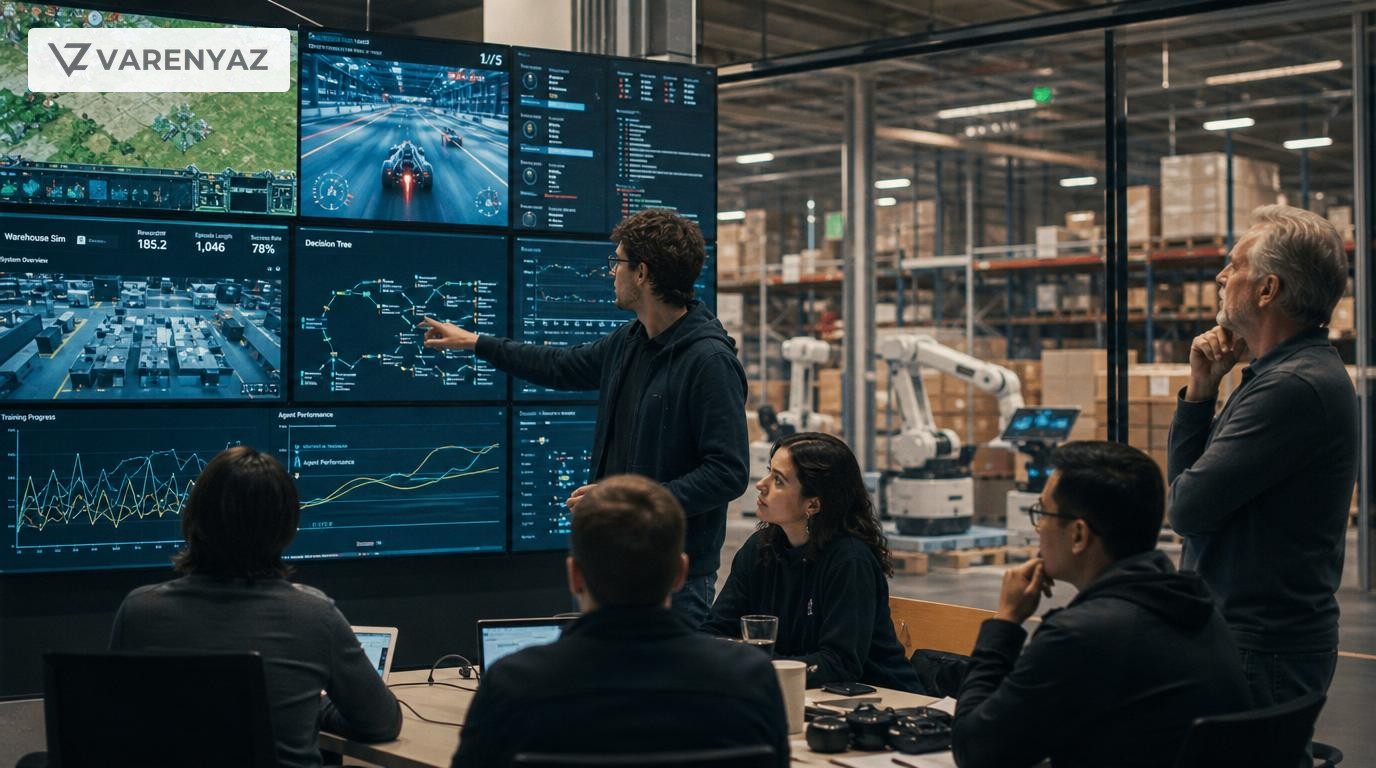
General Intuition is making a multibillion-dollar bet that video games are the best simulation layer for training real-world AI agents. After raising hundreds of millions to scale, the company uses millions of hours of gameplay as action data for reinforcement learning, aiming to build agents that generalize to logistics, robotics, and enterprise automation. For leaders, the move signals that synthetic, game-like environments are becoming strategic infrastructure for decision-making AI, with implications for product design, operations, and AI-driven software.
News Desk
LiveEditorial Review
VarenyaZ Editorial Desk, Managing Editor
Global
In This Story
Coverage Signals
Key Takeaways
- General Intuition is betting that video game environments are powerful training grounds for AI agents that must operate in complex, dynamic real-world settings.
- The company is scaling AI trained on millions of hours of gameplay, using action-rich data instead of static text or image corpora.
- This approach could accelerate AI for logistics, robotics, autonomous systems, and operations-heavy businesses that need better decision-making at the edge.
- For enterprises, simulation-first AI offers a way to test and tune agents safely before deploying them into live operations and customer environments.
- The strategy depends on how well behaviors learned in synthetic game worlds transfer to noisy, constrained real-world conditions.
- Leaders should evaluate where game-like simulation layers could de-risk AI initiatives, from warehouse flows to financial decision engines.
- Partnering with specialized AI and software teams will be critical to integrate agent-based intelligence into web apps, internal tools, and operational systems.
- VarenyaZ can help organizations design, build, and integrate AI-driven products that leverage simulation, automation, and custom web applications.
General Intuition’s $2.3B bet on game-trained AI agents
General Intuition is making one of the boldest bets in applied AI: that video games, not text or images, are the best training ground for real-world AI agents.
The company has reportedly secured a funding package that values the business at around $2.3 billion, including a fresh $320 million raise dedicated to scaling its approach. Its core thesis is simple but radical: millions of hours of human and AI gameplay can teach agents a kind of operational intuition that static datasets cannot.
Where foundation models have been built on trillions of words and pixels, General Intuition is training on decisions—what players do, in sequence, under pressure, in complex environments with clear objectives and constraints.
What happened: from gameplay to general decision-making
General Intuition is building AI agents trained mostly within video game environments, rather than on open web data. These agents learn through reinforcement learning and imitation learning from millions of gameplay episodes, absorbing patterns of strategy, adaptation, and resource management.
The new capital is intended to expand both sides of the equation:
- More diverse and complex game-like environments to train in
- More scalable infrastructure to run massive agent training runs
- More commercialization efforts to take these agents into real-world use cases
Unlike traditional game AI, which is typically narrow and hand-tuned, these agents are designed to generalize. They are trained across multiple games and scenarios, with the goal of creating policies that can transfer to logistics, robotics, operations management, and other dynamic decision domains.
Why games matter for AI: action data vs. static data
Foundational AI waves have been driven by different data regimes:
- Language models learned from text corpora.
- Vision models learned from labeled images and videos.
- Multimodal models blend these with audio and more.
General Intuition is pushing a fourth regime: action data.
Video games are almost perfect laboratories for this kind of learning:
- They encode clear rules, goals, and feedback loops.
- They generate dense action sequences (every click, move, and strategy choice).
- They naturally reward planning, adaptation, and teamwork.
That makes them uniquely attractive for reinforcement learning and multi-agent systems. If text teaches an AI to predict the next word, game environments teach it to pick the next action—under uncertainty, with consequences.
Enterprise impact: from play to operations, logistics, and robotics
For business leaders, the path from games to the warehouse floor might seem distant. But the underlying capabilities map closely to real operational challenges.
Game-trained agents can be applied to:
- Logistics and routing – optimized paths, dynamic reprioritization, and resource allocation resemble real-time strategy game mechanics.
- Warehouse and fulfillment – coordinating bots, workers, and inventory shares patterns with multi-agent team games.
- Manufacturing and robotics – navigation, collision avoidance, and task sequencing are close cousins to in-game movement and planning.
- Financial and operational decision engines – running “what-if” scenarios via simulation before committing to costly real-world actions.
Crucially, these agents can be stress-tested in simulation before they ever touch live systems. Enterprises can spin up game-like replicas of their environments—digital twins—for agents to learn and be evaluated safely.
For CTOs, product leaders, and operations chiefs, this shifts AI from static analytics toward continuous, simulation-driven decision support.
AI, software, and the new simulation stack
The technical strategy hints at a new “simulation stack” for AI-driven businesses:
- Simulation layer – game-like or physics-based environments that approximate real systems (warehouses, traffic, production lines).
- Agent training layer – reinforcement learning and multi-agent systems that learn strategies and policies in those environments.
- Application layer – custom web apps, internal tools, dashboards, and APIs where agents are embedded as decision engines.
- Monitoring and governance layer – observability, overrides, logging, and compliance tooling that keep agents accountable.
General Intuition is focusing on the first two. But for enterprises, value is only realized when these agents are integrated into reliable software products—your planning tools, customer platforms, and internal systems.
That is where software architecture, cloud design, and thoughtful UX become as important as the underlying AI models.
Key risks and open questions for decision-makers
Despite the excitement, this approach comes with non-trivial risks and unknowns that leaders must weigh carefully.
1. Simulation-to-reality transfer
The central technical question is: how much of what an agent learns in a game transfers to messy reality?
Real-world environments have noisy sensors, incomplete information, physical constraints, and human factors. If the simulation is too simplified, agents may learn brittle shortcuts rather than robust strategies.
Mitigation will require:
- Progressively narrowing the gap between simulation and reality.
- Hybrid training on both synthetic and real operational data.
- Rigorous evaluation frameworks and red-teaming.
2. Safety, governance, and explainability
Game-trained agents may optimize for objectives in ways that don’t align with human expectations or regulations. For regulated sectors—finance, healthcare, public infrastructure—opaque agent behavior is a material risk.
Enterprises should demand:
- Clear control knobs and override mechanisms.
- Transparent logs of agent decisions and rationales where possible.
- Governance frameworks that define allowed and disallowed behaviors.
3. Integration complexity
Most organizations run on legacy systems, ERPs, and fragmented data. Dropping a smart agent into that reality is not plug-and-play.
Success depends on thoughtful integration across:
- APIs and data pipelines from core systems.
- Operational dashboards and alerting.
- Workflows that define how humans and agents collaborate.
What leaders should watch next
For now, General Intuition’s funding is a signal, not a guarantee. But it points to a broader trend: simulation and synthetic data are becoming strategic infrastructure for AI-native companies.
Business and technology leaders should track:
- Early reference customers – which industries see real ROI first (e.g., logistics, manufacturing, e-commerce, mobility).
- Benchmarking vs. traditional optimization – whether agents outperform conventional heuristics or human planners.
- Tooling around observability – how vendors expose agent performance, bias, and error patterns to customers.
- Regulatory response – how safety and accountability are addressed as agents take on higher-stakes roles.
At a strategic level, organizations that already invest in simulation (e.g., digital twins, forecasting engines) will be well-positioned to experiment with game-trained agents. Those that do not should at least begin mapping where a simulation layer might create value.
How this connects to web, app, and AI product strategy
Even if you never deploy General Intuition’s technology directly, the pattern it represents is critical: AI is moving from passive models embedded in narrow features to active agents woven through products and operations.
For digital product and technology teams, this means:
- Designing web apps and internal tools that can host, monitor, and collaborate with AI agents.
- Building APIs and event-driven architectures that let agents observe and act safely.
- Creating UX patterns for human-in-the-loop control over automated suggestions and actions.
- Planning data strategies that support both real-world logs and simulation data.
If you are exploring how agent-based AI, simulation, or automation could reshape your product or operations, you can start a conversation with the VarenyaZ team at https://varenyaz.com/contact/.
Where VarenyaZ fits: from concept to deployed agents
Transforming ideas like “game-trained AI agents” into real business value is a multidisciplinary challenge. It demands strong software engineering, thoughtful product design, and careful AI integration.
VarenyaZ can help by:
- Designing custom web and internal applications where AI agents can be deployed, supervised, and measured.
- Building data and integration layers that connect simulations, real-world logs, and existing systems (ERP, WMS, CRM).
- Implementing automation workflows that balance agent autonomy with human oversight.
- Prototyping AI-driven experiences that combine LLMs, agents, and domain-specific logic for your sector.
As ventures like General Intuition redefine how AI is trained, enterprises will need partners who understand both the AI frontier and the realities of production systems. That is where VarenyaZ focuses: turning emerging AI capabilities into reliable, usable, and well-governed digital products.
Whether you are considering simulation-driven decision tools, AI-powered dashboards, or fully automated workflows, VarenyaZ can help you architect, design, and build the web platforms and custom applications that will make the next generation of AI agents truly useful in the real world.
Editorial Perspective
"General Intuition’s wager is that games are not a distraction from reality but an accelerated sandbox for it, compressing years of decision-making experience into hours of agent training."
"For enterprises, the real story behind game-trained AI agents is not entertainment—it’s the emergence of simulation layers as core infrastructure for operations, automation, and product intelligence."
Frequently Asked Questions
What is General Intuition’s core idea with video game AI training?
General Intuition’s core idea is that rich, interactive video game environments provide better training data for AI agents than static text or image datasets. By learning from millions of hours of gameplay, agents can develop decision-making patterns and a form of “intuition” that may transfer to real-world tasks like logistics, robotics, and operations automation.
Why are video games useful for training real-world AI agents?
Video games offer complex rules, dynamic environments, clear objectives, and constant feedback loops, which are ideal for reinforcement learning. Games generate large volumes of structured, action-focused data. This helps AI agents learn sequencing, strategy, resource allocation, and adaptation—skills that are difficult to acquire from purely static data.
How could game-trained AI agents impact enterprises and operations teams?
Game-trained AI agents could support decision-making in areas like route optimization, warehouse flows, inventory allocation, scheduling, and robotics control. Because these agents can be tested in simulations before deployment, enterprises can iterate on strategies and policies safely, then integrate the best-performing agents into their internal tools and operational software.
What are the main risks or open questions with using gameplay to train AI?
The biggest risks are transferability and bias. Behaviors that work well in stylized game worlds may not map directly to noisy, constrained real-world environments. Game rules can also encode assumptions that don’t hold in practice. Enterprises need strong evaluation frameworks, guardrails, and monitoring to ensure agents behave safely, transparently, and within regulatory guidelines.
How should CTOs and product leaders respond to this trend now?
CTOs and product leaders should start by identifying decision-heavy workflows that could benefit from simulation and agent-based optimization. From there, they can pilot small-scale simulations, explore vendors building game-trained AI, and work with partners like VarenyaZ to design web apps, dashboards, and automation layers that can host and monitor these agents responsibly.
Selected References
Stay Ahead
Get concise, actionable insights on AI, digital strategy, and innovation. No spam, just value.
More Coverage
Related News
Jun 25, 2026
HaloBraid raises $7M to reinvent salon braiding workflows
HaloBraid has raised $7 million in funding, led by Alexis Ohanian’s Seven Seven Six, to launch a braiding-assistant device for professional salons. The hardware-plus-software tool is designed to reduce multi-hour braiding appointments into more efficient sessions, helping salons increase chair turnover, reduce stylist burnout, and expand textured-hair services. For founders and CTOs, HaloBraid highlights how specialized hardware and workflow automation can unlock value in overlooked, service-heavy verticals like beauty and personal care.
Jun 24, 2026
Menlo Ventures’ $3B AI Fund Raises the Stakes for Anthropic Bet
Menlo Ventures has raised a new $3 billion fund, heavily oriented around artificial intelligence, following the strong paper gains from its high-conviction $750 million investment in Anthropic in 2024. The raise underscores a shift toward larger, concentrated AI bets by top-tier VCs. For founders and enterprise leaders, this signals fiercer competition for AI talent and capital, a premium on defensible infrastructure and workflow products built on foundation models, and a rapid acceleration of AI-first roadmaps in software, cloud, and automation.
Jun 23, 2026
Fika Jobs Raises $4M to Build AI Video-First Hiring Platform
Fika Jobs has raised $4 million to build an AI video-first hiring platform where AI agents conduct initial interviews with candidates. Instead of screening CVs, employers receive structured, asynchronous video responses and AI-generated insights. For business and HR leaders, this signals a move toward conversational, always-on recruitment with potential gains in speed and consistency, but it also raises questions around bias, explainability, data privacy, and how to re-architect hiring workflows in an AI-mediated funnel.