

What Happened In Brief
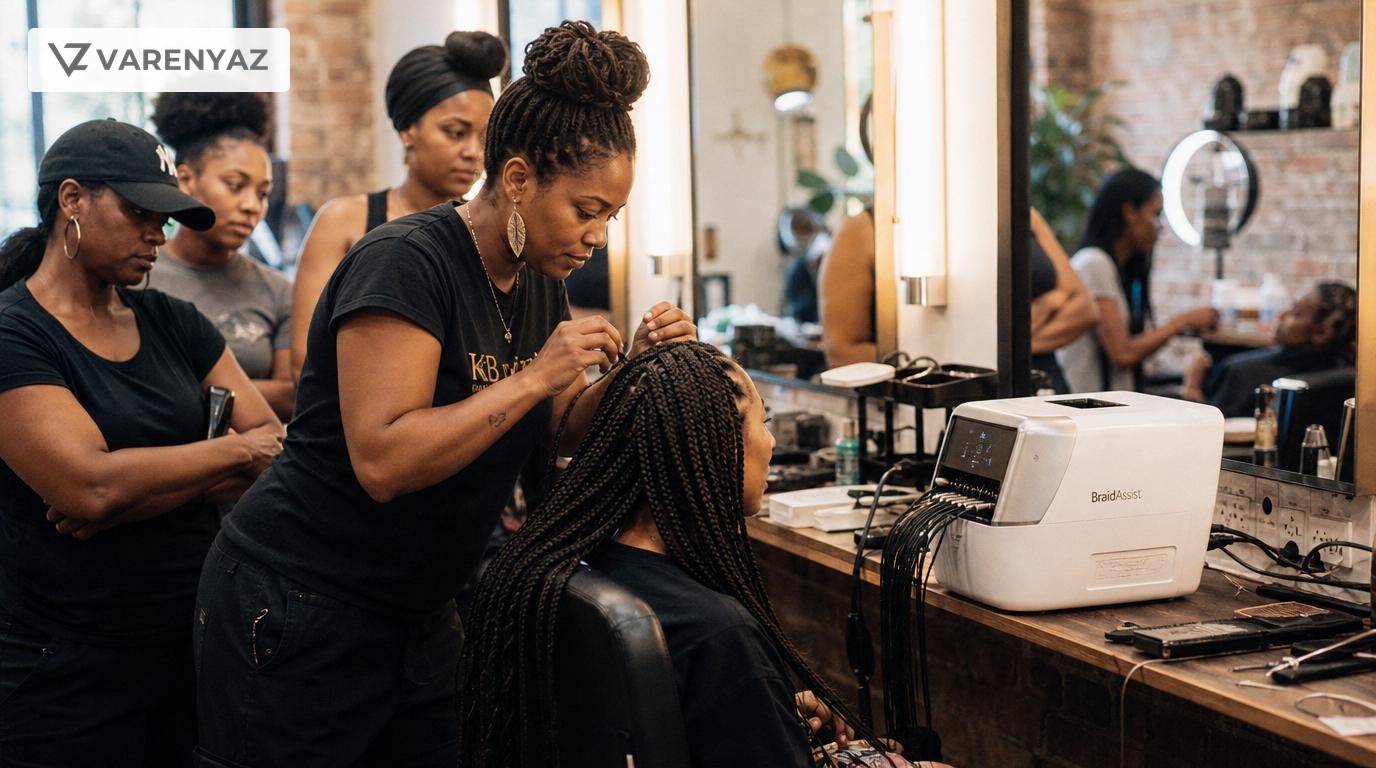
HaloBraid has raised $7 million in funding, led by Alexis Ohanian’s Seven Seven Six, to launch a braiding-assistant device for professional salons. The hardware-plus-software tool is designed to reduce multi-hour braiding appointments into more efficient sessions, helping salons increase chair turnover, reduce stylist burnout, and expand textured-hair services. For founders and CTOs, HaloBraid highlights how specialized hardware and workflow automation can unlock value in overlooked, service-heavy verticals like beauty and personal care.
News Desk
LiveEditorial Review
VarenyaZ Editorial Desk, Managing Editor
Global
In This Story
Coverage Signals
Key Takeaways
- HaloBraid has raised $7 million in funding, led by Seven Seven Six, to commercialize a braiding-assistant device for professional salons.
- The startup targets the six-hour-plus appointments common for box braids and other protective styles, aiming to radically shorten service time.
- For salon owners, the device could increase chair utilization, enable new pricing models, and ease staffing constraints in textured-hair services.
- For investors and product leaders, HaloBraid is a case study in hardware-plus-software innovation for an underserved, high-friction service vertical.
- Adoption will depend on reliability, stylist trust, ergonomics, and how well the device integrates into existing salon workflows and training.
- The move highlights a broader trend of automation and assistive tools entering beauty and personal-care categories traditionally seen as purely manual.
- Data generated from usage patterns could inform future AI features, from style presets to workflow optimization for salons and multi-location chains.
HaloBraid raises $7M to compress six-hour braiding appointments
HaloBraid, a beauty-tech startup focused on textured-hair services, has raised $7 million in funding led by Alexis Ohanian’s venture firm Seven Seven Six. The company is building a braiding-assistant device for professional stylists that aims to cut the time it takes to complete popular protective styles, often measured in half-day appointments, into significantly shorter sessions.
The funding will support refinement, manufacturing, and rollout of HaloBraid’s first commercial device, which is expected to launch later this year. While technical specifications remain limited publicly, the company positions the product as a hardware-plus-software assistant rather than a fully autonomous robot, designed to integrate into existing salon workflows.
Why this funding round matters
HaloBraid is tackling a problem that is both obvious to customers and historically overlooked by technology: the extremely long duration of professional braiding services. Box braids, knotless braids, twists, and other protective styles can easily take four to six hours or more per client.
For clients, that means lost productivity and difficulty finding appointment slots. For stylists and salon owners, it means constrained chair capacity, revenue ceilings, and intense physical labor. The fact that a mainstream venture firm like Seven Seven Six is leading a round in such a focused, culturally specific problem area is a signal of several broader trends:
- Venture capital is increasingly comfortable funding vertical, hardware-enabled workflows rather than only pure software.
- Beauty and personal-care services are being reimagined as high-value, automatable operations, not just artisanal labor.
- There is growing recognition of the economic weight of textured-hair services, long underserved by product and technology innovation.
What HaloBraid is building: a braiding assistant, not a replacement
Based on public information, HaloBraid’s device is intended to assist professional stylists by handling repetitive, precision sections of the braiding process, while humans maintain control over consultation, parting, styling decisions, and finishing.
In practice, that could manifest as:
- Stylists using the device to braid standardized sections while they focus on overall pattern, neat parting, and client comfort.
- Salons building new workflows where assistants set up the device and senior stylists supervise, check quality, and handle complex details.
- Hybrid appointments where the device is used for bulk work and stylists handle edges, hairline, and customizations.
Crucially, this framing matters for adoption. Beauty professionals have understandable concerns about robotics and automation. Positioning HaloBraid as a tool that amplifies stylist capacity, rather than a replacement, is strategically important for market entry.
Business impact: new levers for salons and chains
If HaloBraid delivers credible time savings without compromising quality, it could fundamentally shift economics in salons that specialize in braids and protective styles.
1. Capacity and revenue per chair
With appointments that run five or six hours, a stylist may only serve one or two braiding clients per day. Cutting appointment time by even 30–40% can unlock additional daily slots, higher revenue per chair, and more flexible scheduling—especially for working clients who cannot commit to an entire day in the salon.
2. Labor models and training
Salons often struggle to hire experienced braiders, and training new talent is time-consuming. A repeatable device-assisted workflow could:
- Allow less-experienced stylists or assistants to handle parts of the process under supervision.
- Standardize certain patterns and techniques into repeatable “recipes.”
- Shorten training curves by embedding best practices into tooling and visual guidance.
3. Pricing and productization of services
With more predictability in duration, salons could experiment with:
- Tiered pricing based on speed, complexity, or device-assisted vs. fully manual work.
- Subscription or membership models for clients who routinely maintain protective styles.
- Premium time slots where the device is dedicated to high-value, time-sensitive bookings.
For multi-location chains and franchise concepts, a standardized device and workflow could become a differentiator—delivering consistent braiding experiences with reduced variance between stylists and branches.
Where AI, software, and data fit in
HaloBraid is first and foremost a hardware story, but the most durable value is likely to come from the software and data layer wrapped around the device.
Over time, a connected braiding platform could capture:
- Average time per style, per stylist, and per hair type.
- Utilization metrics that inform staffing, opening hours, and capacity planning.
- Popular style combinations and customization requests across regions.
These signals could then enable AI-augmented features such as:
- Time estimates for specific styles during online booking.
- Recommendation engines for clients based on hair profile and maintenance goals.
- Workflow optimization suggestions for salon owners—such as ideal staff mix or slot lengths.
For platforms like VarenyaZ, which build web, AI, and automation systems for service businesses, this is a compelling blueprint: specialized devices integrated into digital booking, CRM, analytics, and marketing stacks to create end-to-end, data-rich experiences.
Risks, unknowns, and adoption barriers
Despite the promise, several critical questions will determine whether HaloBraid becomes a category-defining tool or a niche curiosity.
1. Trust and cultural fit with stylists
Braiding is not just a technical workflow; it is a cultural, aesthetic, and deeply personal practice. If stylists feel the device flattens creativity or threatens their livelihood, adoption will be slow. HaloBraid will need to invest in education, co-creation with professionals, and community-building around the tool.
2. Reliability in high-usage environments
Salons are punishing contexts for hardware: long operating days, continuous use, varied hair textures, and tight schedules. Device reliability, maintenance routines, and responsive support will be non-negotiable for owners betting their daily revenue on a new tool.
3. Upfront cost and ROI clarity
Beauty businesses often operate with thin margins. HaloBraid will have to calibrate pricing, financing, or leasing models so that salons can clearly see payback—whether through more appointments per day, reduced overtime, or expanded service menus.
Transparent ROI stories and case studies will likely be as important as the technical innovation itself.
Signals for investors, founders, and product leaders
Beyond the beauty industry, HaloBraid’s round underscores several larger patterns:
- Vertical hardware-plus-software is back: Investors are backing tightly scoped devices that solve painful, repetitive workflows in services, from restaurants to salons to clinics.
- Culture-specific problems can be global markets: Textured-hair services may be hyperlocal in expression, but the underlying pain point—long, manual appointments—is global, spanning cities from Lagos to London to Los Angeles.
- Service businesses are ready for automation: As labor constraints bite across geographies, owners are becoming more open to assistive robotics and AI, provided they enhance, not erase, human expertise.
What happens next
In the near term, watch for:
- HaloBraid’s first commercial deployments and early salon feedback.
- How the company handles training, certification, and community-building around stylists.
- Partnerships with salon software providers, marketplaces, or beauty schools.
- Emerging competitors exploring similar assistive devices for braiding, extensions, or other intricate services.
If HaloBraid can cross the trust gap with stylists and prove consistent time savings, it has a path to becoming core infrastructure for textured-hair services, much like point-of-sale systems or booking platforms today.
How VarenyaZ fits into the future of beauty and service automation
For salon chains, beauty platforms, and service marketplaces, hardware innovation like HaloBraid is only half of the story. Real transformation comes when devices are woven into digital experiences—online booking that reflects real device capacity, dashboards that surface time savings, AI-driven recommendations that personalize services, and marketing sites that communicate those benefits clearly.
VarenyaZ helps companies design and build that connective tissue: custom web platforms, service portals, automation workflows, AI assistants, and data layers that make specialized hardware commercially powerful. If you are exploring how to integrate new devices, AI, or workflow automation into your beauty, wellness, or service business, contact our team at https://varenyaz.com/contact/.
Conclusion: from six-hour braids to instrumented workflows
HaloBraid’s $7 million round is a reminder that some of the most interesting frontiers for technology lie in places that have been effectively analog for decades—like the braiding chair. As automation quietly enters beauty and personal care, salons and platforms that pair physical innovation with robust digital infrastructure will be best positioned to capture the upside.
From modern web design and booking journeys to salon dashboards, AI-driven scheduling, and custom workflow tools, VarenyaZ partners with teams to turn emerging hardware and automation into scalable, human-centered experiences.
Editorial Perspective
"HaloBraid’s funding underscores how much value still sits locked inside manual, culture-specific services that have been underserved by software and automation for decades."
"For beauty-tech and workflow founders, the real story is less about hardware alone and more about owning the data, training, and platform layer that sits on top of the device."
"If HaloBraid can win the trust of stylists and prove tangible time savings without compromising quality, it could become infrastructure for textured-hair services worldwide."
Frequently Asked Questions
What is HaloBraid and what did it announce?
HaloBraid is a beauty-tech startup building a braiding-assistant device for professional stylists. The company announced a $7 million funding round, led by venture firm Seven Seven Six, to bring its first hardware product to market and help salons dramatically reduce the time required for braided and protective hairstyles.
How does HaloBraid aim to change salon braiding appointments?
HaloBraid’s device is designed to function as a braiding assistant for trained professionals, automating repetitive portions of the braiding process while leaving creativity and final detailing to stylists. The goal is to cut multi-hour appointments—often five to six hours for complex braids—into significantly shorter sessions, increasing throughput and reducing stylist fatigue.
Why is HaloBraid’s funding important for salon owners and operators?
Salon owners, especially those focused on textured-hair and protective styles, face long appointment times, limited chair capacity, and difficulty hiring experienced braiders. HaloBraid’s funding signals that investors believe hardware-assisted workflows can address these bottlenecks, potentially enabling higher revenue per stylist, more flexible scheduling, and less burnout for braiding professionals.
Is HaloBraid replacing stylists with robots?
No. Based on available information, HaloBraid is framing its product as an assistive tool rather than a full replacement for stylists. The device is meant to augment human skills by handling repetitive, precision-driven steps while professionals retain control of consultation, design, sectioning, finishing, and customer experience. Adoption will hinge on whether stylists see the tool as empowering rather than threatening.
When will HaloBraid’s braiding-assistant device be available?
HaloBraid has indicated that its first device is slated to launch later this year for professional salon use. Exact timelines, pricing, and regions have not been fully detailed publicly, so salon owners should monitor the company’s announcements for updates on preorders, training, and distribution plans.
What should tech and product leaders learn from HaloBraid’s approach?
HaloBraid illustrates how founders can apply hardware-plus-software thinking to high-friction, overlooked service workflows. By targeting a specific vertical (textured-hair braiding), solving a time and labor bottleneck, and pairing physical devices with data and software layers, the company showcases a path for building defensible products in niche but global markets.
Selected References
Stay Ahead
Get concise, actionable insights on AI, digital strategy, and innovation. No spam, just value.
More Coverage
Related News
Jun 24, 2026
Menlo Ventures’ $3B AI Fund Raises the Stakes for Anthropic Bet
Menlo Ventures has raised a new $3 billion fund, heavily oriented around artificial intelligence, following the strong paper gains from its high-conviction $750 million investment in Anthropic in 2024. The raise underscores a shift toward larger, concentrated AI bets by top-tier VCs. For founders and enterprise leaders, this signals fiercer competition for AI talent and capital, a premium on defensible infrastructure and workflow products built on foundation models, and a rapid acceleration of AI-first roadmaps in software, cloud, and automation.
Jun 23, 2026
Fika Jobs Raises $4M to Build AI Video-First Hiring Platform
Fika Jobs has raised $4 million to build an AI video-first hiring platform where AI agents conduct initial interviews with candidates. Instead of screening CVs, employers receive structured, asynchronous video responses and AI-generated insights. For business and HR leaders, this signals a move toward conversational, always-on recruitment with potential gains in speed and consistency, but it also raises questions around bias, explainability, data privacy, and how to re-architect hiring workflows in an AI-mediated funnel.
Jun 22, 2026
Stanford-Backed Clair Health Raises $11M for Noninvasive Hormone Wearable
Clair Health, founded by two Stanford graduates, has raised $11 million to develop a noninvasive hormone-tracking wearable focused on women’s health. The device aims to monitor inflammation, bloating, energy levels and cycle phases to detect irregularities, perimenopause, and hormonal fluctuations earlier and more precisely. For healthtech leaders and investors, this signals an emerging data infrastructure layer in femtech, where continuous hormone and cycle analytics can power new digital health services, clinical decision support tools, and personalized care experiences across apps, telehealth, and enterprise healthcare platforms.