

What Happened In Brief
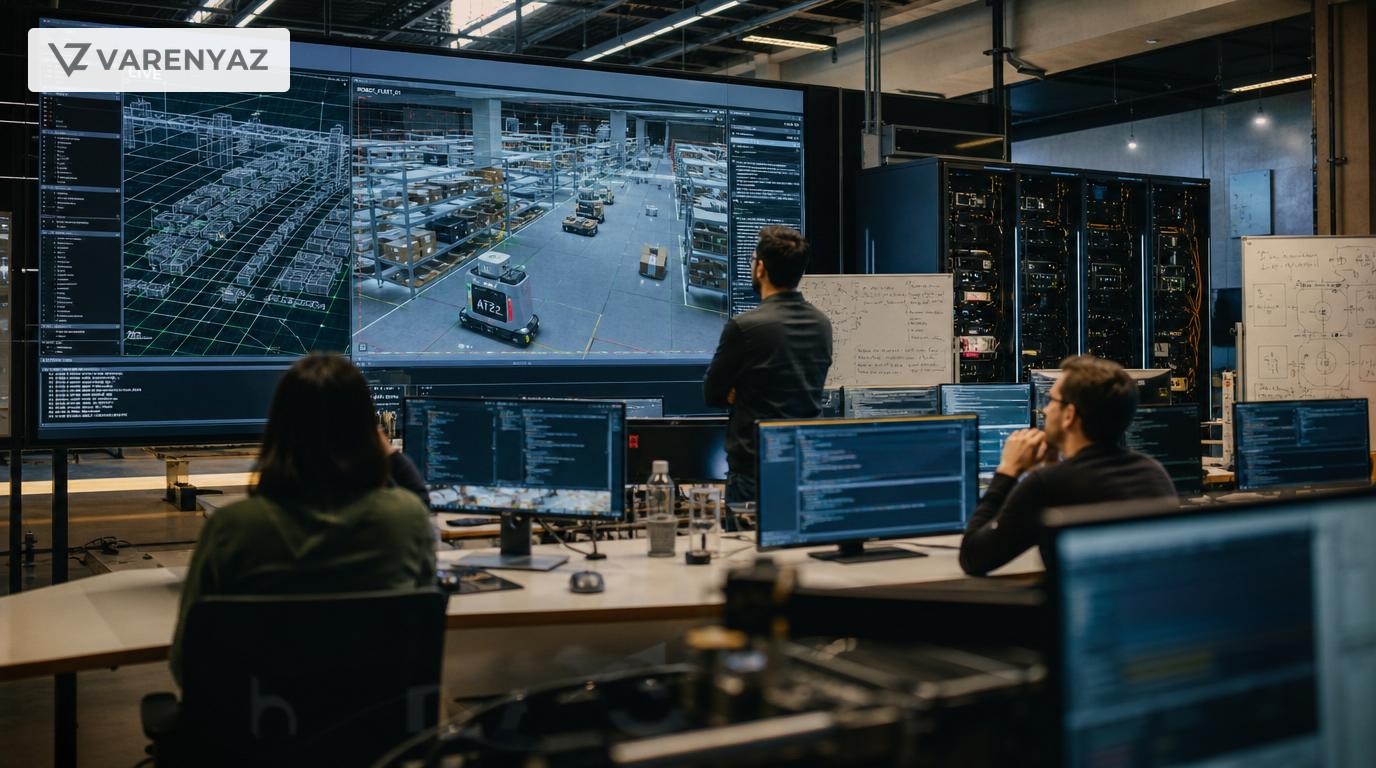
Odyssey, a startup building AI world models, has reached a $1.45 billion valuation in a funding round backed by Amazon and other major investors. World models simulate real environments so AI agents can plan, act, and learn in virtual space before deployment. This shift moves AI beyond text-focused LLMs toward simulation-native platforms for robotics, logistics, digital twins, and autonomous systems. For enterprises, it signals a new competitive phase where operations, infrastructure, and product teams should explore how world models can de-risk automation, optimize physical processes, and integrate with cloud and edge architectures.
News Desk
LiveEditorial Review
VarenyaZ Editorial Desk, Managing Editor
Global
In This Story
Coverage Signals
Key Takeaways
- Odyssey has reached a $1.45 billion valuation, positioning it as a leading startup in AI world models.
- World models extend AI beyond language, enabling systems to simulate, plan, and act in complex physical environments.
- Amazon’s backing signals that world models will be deeply tied to cloud infrastructure, edge computing, and data services.
- Enterprises in logistics, manufacturing, mobility, and robotics should treat world models as a core component of future automation strategies.
- World models can reduce risk and cost by testing policies and workflows in simulation before deployment to real-world operations.
- Key challenges remain around data acquisition, safety, standardization, and integrating world models into existing software stacks.
- Leaders should start with pilot projects that connect operational data, digital twins, and AI planning agents in constrained domains.
- Partners like VarenyaZ can help design and build web, data, and AI layers that make world models usable in real enterprise workflows.
Odyssey’s $1.45B world model bet: a new chapter for post-LLM AI
AI world model startup Odyssey has secured a funding round that pushes its valuation to around $1.45 billion, with Amazon and other major investors backing the company’s push into simulation-native intelligence. The deal places Odyssey among the most closely watched players in what many see as the next major layer of AI beyond large language models (LLMs).
While LLMs like GPT-4 and Claude excel at language, world models focus on learning how environments behave over time—how objects move, how agents interact, and how complex systems respond to decisions. Odyssey’s core bet is that enterprises will need these capabilities to safely automate warehouses, fleets, factories, and smart infrastructure.
What exactly are AI world models?
AI world models are systems that build an internal representation of the world and its dynamics, often from sensor data, simulations, and historical behavior. Where LLMs predict the next word, world models predict the next state of the environment.
In practice, that means a world model can answer questions such as:
- What happens to throughput if I change my warehouse layout?
- How will traffic flows shift if I reroute part of my delivery fleet?
- What is the safest and fastest path for a robot navigating a dynamic shop floor?
Instead of relying solely on static analytics or human intuition, world models allow AI agents to plan, simulate, and test actions millions of times in virtual space before touching a real robot, truck, or conveyor belt.
Why Odyssey’s raise matters now
Odyssey’s new valuation is significant for three reasons.
1. It validates world models as a commercial, not just research, priority
For years, world models were a research topic at labs like OpenAI, DeepMind, and universities. Odyssey’s funding shows large investors now expect real revenue from applying these ideas to logistics, manufacturing, mobility, and autonomy. It marks a turning point from prototypes to production platforms.
2. Amazon’s involvement ties world models to cloud strategy
Amazon’s backing strongly suggests that world models will be tightly integrated with cloud infrastructure. Training high-fidelity simulations, orchestrating agents, and streaming operational data all depend on scalable compute and storage.
For AWS and rival clouds, world models are a natural extension of existing offerings in robotics, IoT, and digital twins. Expect deeper integrations between simulation services, AI toolchains, and real-time data platforms.
3. It raises the bar for enterprise AI expectations
Enterprises have already seen what LLMs can do for content, support, and coding. Odyssey’s trajectory will set new expectations: AI that doesn’t just write and summarize, but plans, coordinates, and optimizes in the physical world.
That’s a step-change for sectors like logistics, construction, manufacturing, and mobility, where the value of AI is measured not in tokens generated but in packages delivered, defects reduced, and downtime avoided.
Business impact: from dashboards to decision-making agents
For business and technology leaders, Odyssey’s rise is less about one startup and more about a broader shift in how AI interacts with operations.
From analytics to simulation-native decisions
Most enterprises still rely on dashboards and historical analytics. World models pave the way for a different pattern:
- Digital twins mirror plants, warehouses, or networks in software.
- World models learn how these systems evolve under different conditions.
- Planning agents test thousands of strategies in simulation, then recommend or execute the best ones in the real world.
This can transform fields like:
- Logistics: routing, dock scheduling, and workforce planning.
- Manufacturing: line balancing, changeover planning, and predictive maintenance.
- Mobility: fleet repositioning, charging strategies, and traffic-aware routing.
- Robotics: navigation, task assignment, and coordination across robot fleets.
Cloud, edge, and infrastructure implications
World models are compute-intensive. Training and running them typically involves:
- High-performance compute on cloud for simulation and training.
- Edge runtimes for low-latency decision-making on robots, vehicles, or controllers.
- Streaming data pipelines from sensors, ERP, WMS, and IoT systems.
Amazon’s participation suggests that cloud providers see world models as a source of new workloads and higher-value services. For CTOs and architects, that means aligning AI, OT (operational technology), and cloud strategies, rather than treating them as separate tracks.
Strategic questions for CTOs and product leaders
With Odyssey and others pushing aggressively into this space, technology leaders should consider three immediate questions.
1. Where are your “world model ready” domains?
Look for domains with:
- Clear physical processes or flows (goods, vehicles, energy, people).
- Existing operational data (sensors, logs, ERP, WMS, MES).
- High cost or risk of experimentation in the real world.
Typical starting points include warehouses, production lines, distribution networks, or field operations.
2. How will simulation connect to your existing software stack?
World models are only useful if their insights reach decision-makers and systems. That means integrating with:
- Web dashboards and internal apps used by operations teams.
- Workflow tools and automation platforms that execute policies.
- Monitoring and alerting systems that track performance and safety.
This is where robust web development, API design, and UX matter as much as the underlying AI.
3. What’s your data and safety posture?
World models will depend on sensitive operational data and may recommend actions that carry real risk. Leaders should establish:
- Clear governance for what data is used and how it’s secured.
- Safety review processes for AI-driven policies, especially in robotics and mobility.
- Human-in-the-loop mechanisms and “kill switches” for critical systems.
Risks, unknowns, and what could go wrong
Despite the excitement, world models—Odyssey’s included—bring real challenges.
Simulation gaps and blind spots
No model perfectly captures reality. If a world model misses rare but critical events (equipment failures, edge-case behaviors, extreme weather), its recommendations can be brittle. Over-reliance without proper monitoring could introduce new systemic risks.
Vendor lock-in and ecosystem fragility
Enterprises may find themselves anchored to specific world model vendors or cloud providers. Migrating between platforms—or combining multiple simulation stacks—could become costly if standards don’t emerge.
Organizational readiness
World models aren’t just a new API; they shift how operations, IT, and data teams collaborate. Many organizations will need new skills in simulation engineering, MLOps, and human–AI decision-making to unlock full value.
What happens next: a roadmap for early adopters
For enterprises watching Odyssey and this broader trend, a practical near-term roadmap looks like:
- Assess readiness: Map processes where small improvements unlock major savings in throughput, safety, or cost.
- Build or refine digital twins: Start with a single facility, fleet, or line, capturing layout, assets, and key constraints.
- Run constrained pilots: Use simulated scenarios to evaluate routing, scheduling, or robotic behaviors in a narrow domain.
- Integrate with apps and workflows: Surface insights via internal portals, dashboards, and APIs for operations teams.
- Iterate on safety and governance: Treat world models as tools that augment human decision-makers, not replace them overnight.
If you are planning to explore world models, digital twins, or AI-enabled automation, you can reach out to the VarenyaZ team at https://varenyaz.com/contact/.
Where VarenyaZ fits: making world models usable in real workflows
Odyssey’s funding highlights a key reality: the most powerful AI is only as valuable as the systems it connects to. Many organizations will not build their own world models from scratch, but they will need to:
- Design data flows from ERP, WMS, IoT, and edge devices into simulation platforms.
- Expose world model insights through intuitive web interfaces and APIs.
- Automate safe, auditable actions across operations software and robotics stacks.
VarenyaZ helps teams close this gap by combining:
- Custom web and app development to build operational portals and AI-native interfaces.
- Backend and data architecture that integrates cloud services, digital twins, and AI agents.
- Automation and AI workflows that connect planning outputs to real-world actions in a controlled manner.
Conclusion: from LLM hype to world model execution
Odyssey’s $1.45 billion valuation, with Amazon as a key backer, marks an inflection point: world models are moving from labs to the center of enterprise AI strategy. Over the next few years, competitive advantage will come from how effectively organizations combine world models, data infrastructure, and user-facing software.
As you design your next generation of web platforms, operations tools, and AI-driven automation, VarenyaZ can help you architect systems that bridge simulation, decision-making, and execution—turning world model innovation into measurable business impact.
Editorial Perspective
"Odyssey’s valuation is not just about one startup; it’s a clear market signal that the center of gravity in AI is shifting from static text models to simulation-native systems that can reason about the physical world."
"For enterprises, world models will be most powerful where they connect directly to operational data and existing software—turning dashboards, digital twins, and workflow tools into decision-making systems that can test scenarios before committing in real life."
"Amazon’s backing of Odyssey suggests that world models will become first-class citizens in cloud ecosystems, making it easier for teams to deploy advanced planning and control without assembling all the infrastructure themselves."
Frequently Asked Questions
What are AI world models and how do they differ from large language models?
AI world models are systems that learn a structured representation of how the world behaves, often through simulation, spatial reasoning, and temporal dynamics. Unlike large language models, which mainly process and generate text, world models allow AI agents to plan, predict outcomes, and act inside simulated or real environments such as warehouses, factories, or road networks.
Why is Odyssey’s $1.45 billion valuation important for enterprises?
Odyssey’s $1.45 billion valuation, backed by Amazon and other major investors, is a signal that world models are moving from research to commercialization. For enterprises, it means that simulation-native AI for robotics, logistics, and digital twins is likely to become a mainstream capability, affecting automation roadmaps, cloud infrastructure decisions, and data strategy.
What industries are likely to benefit most from Odyssey’s world model technology?
Industries with complex physical operations stand to gain the most: logistics and warehousing, manufacturing, automotive and mobility, robotics, energy and utilities, and smart infrastructure. These sectors can use world models to test new layouts, routing strategies, and autonomous behaviors in simulation before making costly real-world changes.
How should CTOs and product leaders respond to the rise of world models?
CTOs and product leaders should first map where physical operations, spatial data, and real-time decision-making are bottlenecks. Then, they can run controlled pilots combining digital twins, sensor data, and AI agents trained in simulated environments. Partnering with experienced AI and product teams to integrate these capabilities into existing platforms will be critical for adoption.
What role do cloud providers like Amazon play in the world model ecosystem?
Cloud providers offer the compute, storage, simulation infrastructure, and data pipelines needed to train and run world models at scale. Amazon’s involvement suggests that world models will be tightly integrated with cloud-native tooling, managed services, and edge runtimes, making it easier for enterprises to deploy simulation-heavy AI without building everything in-house.
How can companies get started with world models and simulation-native AI?
Companies can start small by identifying a single high-value process—such as warehouse routing, robotic task allocation, or fleet scheduling—and building a digital twin plus a basic world model around it. From there, they can iterate with planning agents and reinforcement learning, gradually plugging the resulting intelligence into existing web apps, dashboards, or automation workflows.
Selected References
Stay Ahead
Get concise, actionable insights on AI, digital strategy, and innovation. No spam, just value.
More Coverage
Related News
Jun 17, 2026
Flutterwave hits $3.2B valuation with new Ripple-backed deal
Flutterwave, one of Africa’s leading payments infrastructure companies, has reached a $3.2 billion valuation following a new funding and strategic partnership with Ripple. The deal strengthens Flutterwave’s position in cross-border payments, combining its pan-African rails with Ripple’s blockchain-based settlement network. For banks, fintechs, and global merchants, this signals faster, cheaper, and more programmable payment options into and out of African markets, while reinforcing Africa’s role as a testbed for next-generation financial infrastructure.
Jun 12, 2026
Equal AI Raises $30M to Tackle India’s Spam Call Crisis
Equal AI has raised $30 million to expand its AI-powered call assistant, which already serves over one million monthly active users in India. The platform screens and handles calls on behalf of users, promising relief from pervasive spam, scams, and telemarketing. For businesses, Equal AI’s technology points to a broader shift toward AI-driven contact centers, automated lead qualification, and intelligent voice workflows across sales and customer support in high-volume markets.
Jun 11, 2026
Niteshift Challenges Big AI Lock-In With Open Coding Agents
Niteshift, an AI coding agent startup founded by former Datadog engineers, has raised a $7 million seed round to build model-agnostic tools for software teams. Instead of locking customers into a single large language model, Niteshift aims to orchestrate multiple models while integrating deeply with existing developer workflows, observability, and security. For CTOs and product leaders, the launch signals a maturing market where portability, governance, and cost control across AI providers become strategic priorities rather than afterthoughts.