

What Happened In Brief
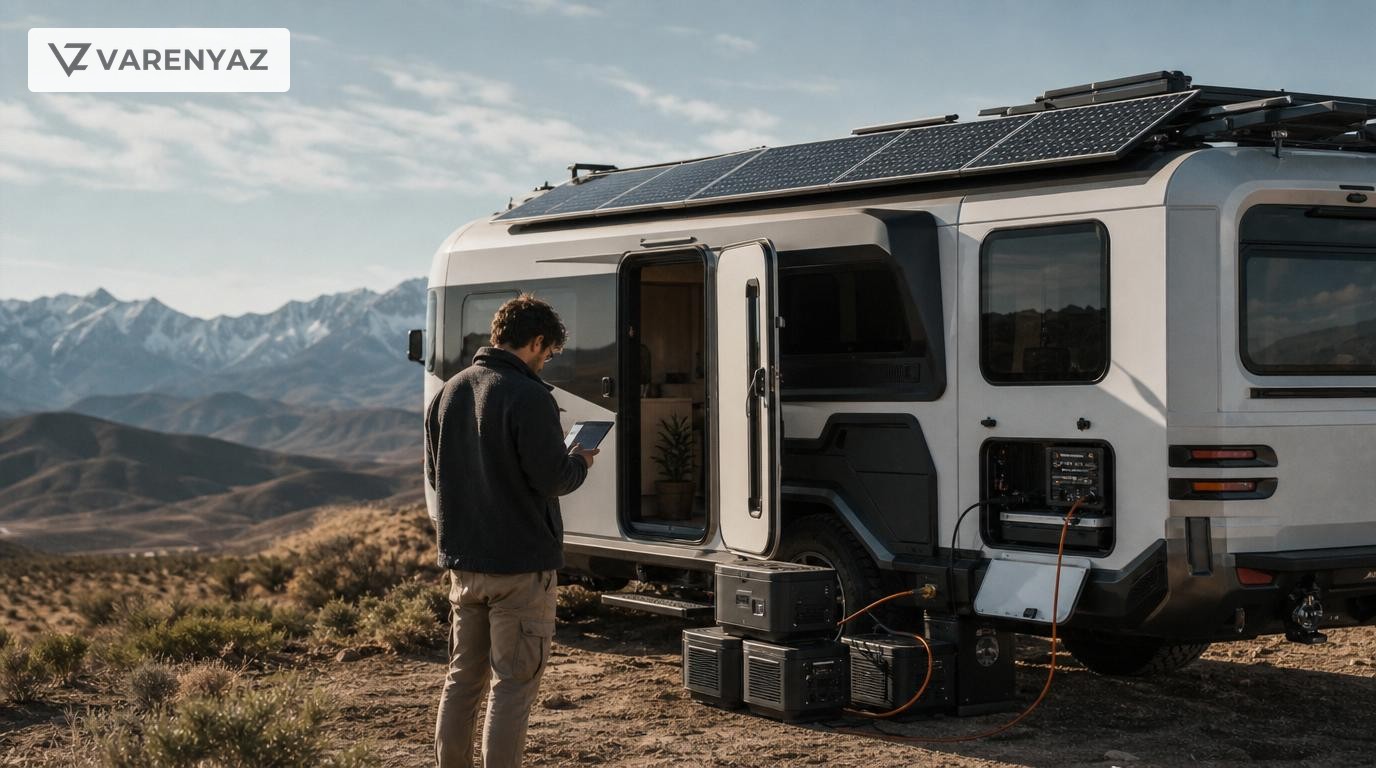
Evotrex, backed by Anker, has raised $30 million to build an off-grid electric RV that can operate with limited reliance on fixed charging stations and traditional RV campsites. The startup is betting on a hybrid power architecture combining batteries, solar generation and intelligent power management. For mobility operators, investors and infrastructure planners, this marks a shift toward distributed, software-defined energy systems embedded directly in vehicles, with new opportunities in connected services, fleet use cases and remote work-travel experiences.
News Desk
LiveEditorial Review
VarenyaZ Editorial Desk, Managing Editor
Global
In This Story
Coverage Signals
Key Takeaways
- Evotrex has raised $30 million to develop an off-grid electric RV platform backed by power accessory giant Anker.
- The company is betting on a hybrid power system that blends batteries, solar and intelligent power management to reduce reliance on charging stations.
- Off-grid electric RVs could unlock new business models for rental fleets, overland tourism, remote work travel and energy-as-a-service offerings.
- For infrastructure planners, Evotrex’s approach highlights a complementary path to fixed fast-charging networks, centered on distributed onboard generation.
- Software, telemetry and AI-driven energy optimization will be critical differentiators in the off-grid mobility segment.
- Risks include regulatory uncertainty, safety certification, real-world range performance and the complexity of maintaining hybrid systems.
- Investors should watch how Evotrex scales manufacturing, partnerships with campgrounds and utilities, and recurring revenue from connected services.
- Brands building digital experiences around travel and mobility will need robust web, app and AI layers to integrate with such connected RV platforms.
Evotrex raises $30M to build an off-grid electric RV that skips charging stations
Evotrex, a young electric RV startup backed by mobile power giant Anker, has raised $30 million to develop an off-grid recreational vehicle platform designed to rely far less on traditional charging stations and RV campsites.
The funding, reported on June 9, 2026, positions Evotrex in a crowded but fast-evolving RV market where electrification, solar and energy management software are converging. While several players are experimenting with electric motorhomes and camper vans, Evotrex is betting that the future of road travel looks more like a self-contained microgrid than a vehicle tethered to sparse charging infrastructure.
What Evotrex is building: an RV as a rolling microgrid
According to early details, Evotrex’s platform centers on a hybrid power system that combines:
- High-capacity batteries for propulsion and onboard systems
- Extensive rooftop solar arrays to trickle-charge and extend range
- Power electronics and inverters akin to advanced home energy setups
- Software intelligence to prioritize and balance loads in real time
The startup’s pitch is straightforward: today’s public fast-charging networks are patchy away from major highways and cities, and many remote destinations don’t offer reliable RV hookups. By elevating solar and smart energy management to first-class citizens in the design, Evotrex wants its RVs to roam further from the grid, stay longer in remote locations and provide a more predictable power experience than opportunistic charging can offer.
This is not about ignoring charging networks altogether—Evotrex vehicles are still expected to plug in when convenient—but about making that network optional rather than mandatory for every long trip.
Why this matters: beyond range anxiety to infrastructure anxiety
For many EV buyers, range anxiety is slowly being replaced by “infrastructure anxiety”: will chargers be working, available and conveniently located when needed?
That concern is amplified for RV owners, who often travel into rural areas, forests, deserts and mountains—precisely where charging investment tends to lag. Evotrex’s off-grid emphasis directly addresses this tension. By shifting more of the energy problem into the vehicle itself, it reduces dependence on public infrastructure that will take years to fully mature.
For policymakers and utilities, this is an important signal: the future of electrified travel will likely be a mix of high-power corridors, destination charging and increasingly capable onboard energy systems, not any single silver bullet.
Strategic role of Anker: hardware maturity meets vehicle ambition
Anker’s involvement is more than a logo on a cap table. The company has spent years building portable batteries, inverters and solar accessories, plus the supply chains and quality processes needed to ship power hardware at scale.
That experience could accelerate Evotrex’s path in several ways:
- Component reliability: Leveraging proven cells, inverters and BMS designs instead of starting from scratch.
- Cost optimization: Tapping existing manufacturing relationships to keep bill-of-materials costs under control.
- Brand halo: Borrowing trust from a consumer brand already associated with reliable power gear.
For Anker, the partnership extends its brand from portable accessories into integrated, high-value mobility systems—an attractive adjacency as the line between home, office and vehicle power continues to blur.
Business impact: new models for fleets, hospitality and travel platforms
Off-grid electric RVs are more than a lifestyle upgrade. They can reshape how businesses think about mobility, tourism and energy.
Rental fleets and subscription mobility
For RV rental platforms and fleet operators, an off-grid vehicle reduces friction and uncertainty for customers. It can also support:
- Longer booking durations without campsite constraints
- Premium pricing for autonomous, off-grid experiences
- Lower dependency on destination infrastructure investment
Fleet operators may layer subscription services on top—such as energy analytics, route optimization or remote diagnostics—to create ongoing revenue beyond the rental itself.
Outdoor hospitality and tourism
Off-grid units give campgrounds, eco-lodges and tourism providers new flexibility. Sites that lack heavy electrical infrastructure can still host high-end electric RV experiences, especially if the vehicle brings its own power safety net.
For regions with growing domestic tourism but underdeveloped grids—parts of India, remote US states, Scottish Highlands and more—this could expand the map of viable destinations without massive upfront utility spend.
Energy-as-a-service and remote work
As RVs turn into mobile microgrids, they also become mobile offices and studios. Stable onboard power, satellite or 5G connectivity, and smart climate control can turn an Evotrex unit into a high-end remote work pod.
That opens the door to energy-as-a-service bundles tailored to digital nomads and remote teams, where power, connectivity and workspace are sold as a unified subscription product.
Software, data and AI: the real differentiators
Underneath the hardware, software will determine whether Evotrex’s concept delivers practical value or remains a niche novelty.
Energy and route intelligence
Evotrex will need robust software for:
- Predicting energy use based on terrain, driving style and weather
- Forecasting solar yield along planned routes
- Recommending itineraries that balance scenery, charging and comfort
- Managing loads automatically—air conditioning, cooking, devices—without user micromanagement
AI and telemetry can help refine these models over time, learning from fleets of vehicles and thousands of trips.
Connected platforms and partner integrations
For travel platforms, marketplaces and B2B partners, the opportunity lies in integration: booking, navigation, campground management, payments and local experiences all need to tie into the vehicle.
That requires well-designed APIs, secure data flows and thoughtfully crafted digital interfaces. Companies that can orchestrate these layers—web, mobile, back-end and AI—will be the ones that capture value as connected RV ecosystems emerge.
If your organization is exploring connected mobility, digital travel services or energy-aware applications, you can start the conversation with VarenyaZ at https://varenyaz.com/contact/.
Risks and open questions
Despite the funding momentum, several unresolved issues will determine how far Evotrex’s vision can scale.
- Real-world performance: Marketing claims about off-grid autonomy must withstand hot summers, cold winters, shaded campsites and heavy energy use.
- Cost and weight: Combining large batteries with meaningful solar capacity and inverters risks pushing vehicles into high price brackets and challenging weight limits.
- Regulation and safety: RVs carry sleeping passengers, gas appliances and complex electrical systems; regulators will scrutinize safety, fire risk and repairability.
- Competition: Incumbent RV makers and mainstream EV companies are experimenting with similar ideas and can leverage existing dealer networks.
How Evotrex handles transparency—publishing realistic specs, clear maintenance plans and lifecycle impact data—will be critical to winning both regulators and early adopters.
What leaders should watch next
For founders, CTOs, investors and product leaders, a few signals will reveal whether Evotrex’s approach is indicative of a broader shift or a niche experiment:
- Pilot deployments: Early fleets with rental partners and travel platforms, and the data that emerges from them.
- Software roadmap: Whether Evotrex positions itself as a hardware seller or as a platform company with APIs, analytics and subscription services.
- Partnerships: Collaborations with campgrounds, telcos, utilities and mapping/navigation players.
- Customer profiles: Whether demand skews toward high-end overlanding enthusiasts, digital nomads, or mainstream families seeking low-stress road trips.
How VarenyaZ can help brands ride the off-grid mobility wave
As vehicles like Evotrex’s off-grid RVs evolve into connected platforms, every serious player in travel, energy and mobility will need robust digital infrastructure:
- Custom web and app experiences that integrate bookings, route planning and energy dashboards.
- APIs and middleware to connect RV telemetry with partner systems and marketplaces.
- AI-driven optimization for route suggestions, solar and battery forecasting, and personalized travel recommendations.
- Automation across operations, from fleet management to customer communications and billing.
VarenyaZ specializes in stitching together these layers—web, AI, design and custom application development—so businesses can focus on strategy rather than plumbing. As off-grid mobility and energy-aware travel gain momentum, a thoughtful digital architecture will be as important as the vehicles themselves.
Evotrex’s $30 million raise underscores an important reality: the future of mobility is not just electric, but intelligent, connected and increasingly self-reliant. Organizations that invest now in flexible, data-centric digital platforms will be best positioned to partner with, compete against or build on top of innovators like Evotrex.
Editorial Perspective
"Evotrex’s funding round signals a pivot in EV thinking—from assuming dense charging coverage to designing vehicles that bring more of the energy ecosystem onboard."
"For software and AI teams, off-grid electric RVs are less about hardware novelty and more about orchestrating power, routes and experiences through data-rich, connected platforms."
Frequently Asked Questions
What is Evotrex and what did it announce?
Evotrex is an electric RV startup focused on off-grid mobility. It announced a $30 million funding round, backed in part by mobile power company Anker, to build an RV platform that can operate with reduced dependence on fixed charging stations and traditional RV hookup infrastructure.
How is Evotrex’s off-grid electric RV different from other electric RVs?
Evotrex’s concept centers on a hybrid power system that layers high-capacity batteries with solar generation and advanced energy management. Rather than assuming frequent use of public DC fast chargers or full-service campsites, its design aims to sustain longer periods of off-grid operation with intelligent load balancing and energy optimization.
Why does an off-grid electric RV matter for businesses and investors?
Off-grid electric RVs open new revenue models for rental fleets, travel platforms, outdoor hospitality, remote work services and energy providers. They reduce dependence on uneven charging infrastructure and create opportunities for subscription-based services, data-driven route planning, and integrated digital experiences around mobility, content and commerce.
What role does Anker play in Evotrex’s strategy?
Anker brings deep experience in batteries, inverters, portable power stations and consumer energy products. That expertise can help Evotrex design robust electrical architectures, leverage proven components and tap into an existing supply chain for power electronics, which is crucial for scaling a reliable off-grid RV platform.
What are the main risks for Evotrex’s off-grid RV model?
Key risks include validating real-world range and autonomy under varied climates, meeting safety and RV certification standards, managing the cost and weight of combined battery-solar systems, and delivering intuitive software that makes complex energy management simple for non-technical users, all while keeping the product price-competitive.
How can digital and AI solutions enhance an off-grid RV platform like Evotrex’s?
Digital and AI solutions can optimize route planning based on energy use, forecast solar yield, manage loads in real time, and power predictive maintenance. They can also enable companion apps, OTA updates, smart campground integrations, and personalized travel experiences, turning the RV into a software-defined, connected product.
Selected References
Stay Ahead
Get concise, actionable insights on AI, digital strategy, and innovation. No spam, just value.
More Coverage
Related News
Jul 24, 2026
Corgi’s $4B valuation shows how hot AI insurance has become
AI-first insurance startup Corgi has reportedly raised its third funding round in just eight weeks, at a valuation of around $4 billion. This pace places Corgi among the most aggressively funded insurtechs in the current AI wave. For insurers, founders, and CTOs, the deal signals strong investor conviction in AI-native underwriting, risk scoring, and automated policy operations, but also raises questions about sustainability, regulatory scrutiny, and the pressure to convert rapid capital inflows into robust, compliant insurance products and reliable enterprise-grade platforms.
Jul 23, 2026
Travis Kalanick’s Atoms Raises $1.7B to Build Industrial AI Robots
Travis Kalanick’s robotics and industrial AI startup Atoms has raised $1.7 billion in funding led by Andreessen Horowitz, with Uber participating. Atoms says it will use robotics, computer vision, and AI to modernize physical operations such as warehouses, fulfillment centers, and logistics hubs. For enterprises, the round signals intensifying investment in end-to-end automation platforms, with potential impacts on supply-chain resilience, labor models, and how software products integrate with real-world, robot-enabled infrastructure.
Jul 22, 2026
Passionfroot Raises $15M to Scale B2B Creator Marketplace in US
Passionfroot, a German startup building a B2B creator marketplace, has raised $15M in Series A funding led by Insight Partners to drive its expansion into the US market. The platform focuses on professional creators and brands, streamlining sponsorships and campaign workflows. For marketing leaders and product teams, this signals a maturing creator economy where workflow, data, and integrations matter as much as reach. The move also creates opportunities for martech, CRM, and AI-powered tooling to plug into a rapidly formalizing brand-creator collaboration stack.