

What Happened In Brief
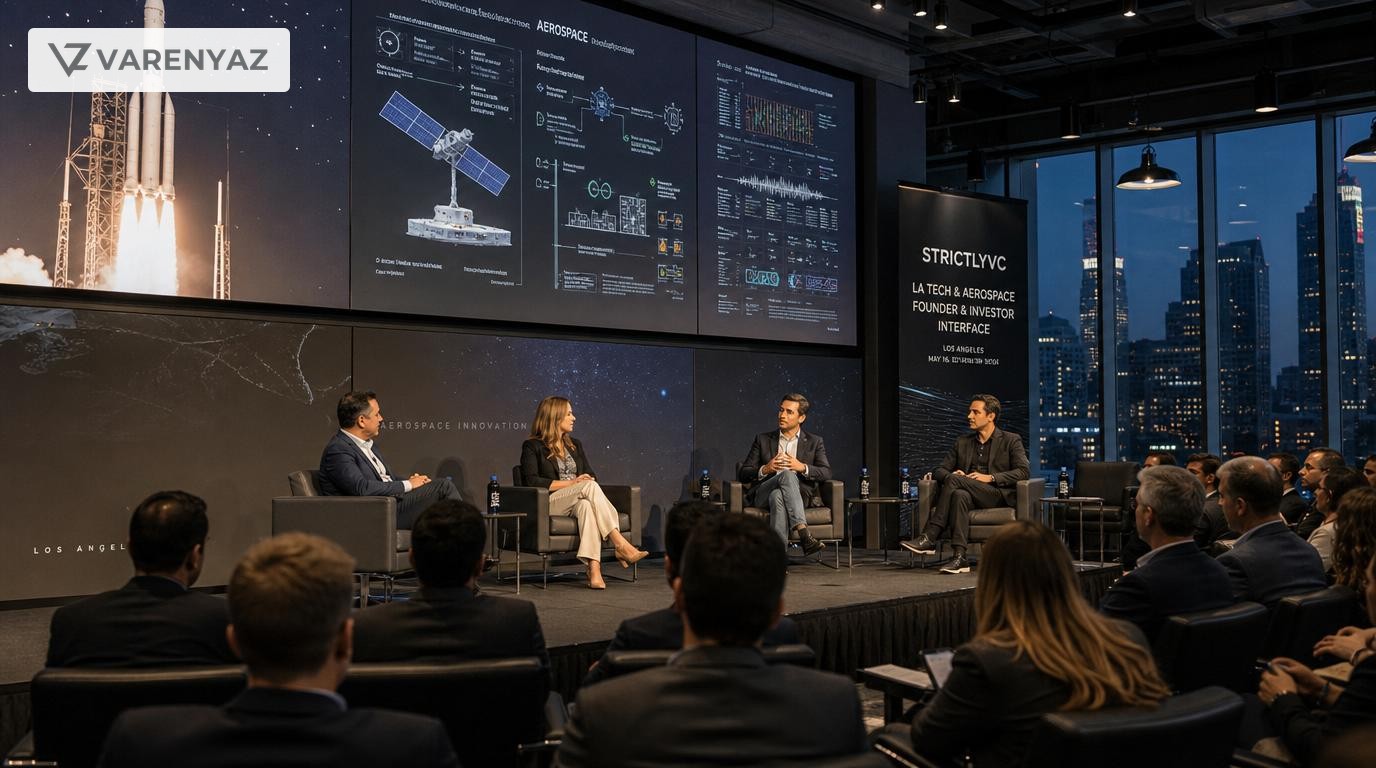
StrictlyVC Los Angeles, held June 18 at The Aerospace Corporation Campus, will bring investors, founders, and operators together to focus on defense technology, AI, and startup fundraising. The event highlights how venture capital is moving toward dual-use and national security innovation, with an emphasis on AI infrastructure, aerospace, and advanced industry. For founders and CTOs, the agenda signals capital flows, partnership models, and compliance expectations that will shape product roadmaps and go-to-market strategies over the next funding cycle.
News Desk
LiveEditorial Review
VarenyaZ Editorial Desk, Managing Editor
Global
In This Story
Coverage Signals
Key Takeaways
- StrictlyVC Los Angeles on June 18 will spotlight defense tech, AI, and venture fundraising at The Aerospace Corporation Campus.
- The event underscores a structural shift toward dual-use and national security technology in venture capital portfolios.
- AI is moving from generic tooling to mission-critical infrastructure for defense, aerospace, and advanced industry.
- Founders will need to navigate export controls, security clearances, and procurement complexity alongside product-market fit.
- Investors are seeking startups that blend software leverage with capital-intensive hardware in space and defense.
- Corporate and government buyers are emerging as key anchors for AI and defense-tech revenue, not just pilots.
- The conversations in Los Angeles will shape how startups design architectures, security models, and GTM for regulated markets.
- VarenyaZ can help teams translate these signals into robust web platforms, automation, and AI-first product experiences.
StrictlyVC Los Angeles: Defense Tech, AI, and Fundraising Converge on June 18
On June 18, investors, founders, and technology leaders will gather at The Aerospace Corporation Campus in Los Angeles for StrictlyVC Los Angeles, an evening event centered on three themes that are reshaping venture capital: defense technology, artificial intelligence, and startup fundraising.
Hosted on a working aerospace and national security campus, the event underscores how quickly dual-use and defense-adjacent startups have moved from the industry fringe to the center of mainstream VC conversation.
What Is Happening at StrictlyVC Los Angeles?
StrictlyVC, known for its candid investor-founder conversations, is using its Los Angeles stop to put defense tech and AI at the top of the agenda. The program is expected to feature venture capitalists, defense operators, AI practitioners, and founders building in space, autonomy, and advanced industry.
While full session details remain fluid, the event’s framing around "defense technology, artificial intelligence, and fundraising" makes three signals clear:
- Defense and dual-use innovation are no longer niche; they are core to how investors think about long-term returns.
- AI has shifted from generic productivity tooling to hardened infrastructure for aerospace, defense, and critical systems.
- Fundraising narratives must now connect technology depth with regulatory readiness and credible go-to-market paths into complex buyer ecosystems.
The Aerospace Corporation Campus setting is itself a message: venture-backed startups are now expected to coexist with primes, government labs, and mission operators in a shared innovation stack.
Why This Event Matters for Tech and Business Leaders
StrictlyVC Los Angeles is not just another AI meetup. It is a barometer of how capital, policy, and technology are aligning around national security and resilient infrastructure.
For founders, CTOs, and investors, several strategic questions are on the table:
- Where will the next decade of outsized venture returns come from? Signals point toward dual-use software, autonomy, sensing, and space infrastructure that unlock new capabilities for government and industry.
- How will AI be deployed in regulated, safety-critical contexts? Beyond chatbots, the focus is on mission planning, logistics optimization, threat detection, and human-machine teaming.
- What will LPs demand from funds exposed to defense tech? Expect deeper diligence on ethics, export risks, and the durability of government budgets.
LA has become a crossroads for these forces, combining aerospace heritage, a growing startup ecosystem, and increasing federal attention on space and autonomy. An event like StrictlyVC effectively acts as a strategy session for the ecosystem.
Defense Tech and Dual-Use: From Fringe to Front Row
For years, many generalist VCs kept defense at arm’s length, worried about ethical debates, long sales cycles, and dependence on government contracts. That stance is changing.
Geopolitical tension, renewed public-sector modernization efforts, and visible success stories in space and autonomy have led to a shift in posture. Instead of avoiding government, many funds now explicitly seek:
- Dual-use models that sell to both government and commercial customers.
- Software-first defense tech that can scale faster than hardware-only systems.
- AI-native products that use models, simulation, and data pipelines to deliver asymmetric capabilities.
The StrictlyVC Los Angeles program reflects that shift. Instead of framing defense tech as a caveat, it is presented as a primary lens for understanding the next wave of AI and infrastructure startups.
AI as Critical Infrastructure, Not Just a Feature
The AI conversation at StrictlyVC is expected to go beyond model benchmarks and into how AI is embedded into real-world systems.
In aerospace and defense contexts, AI is increasingly used to:
- Fuse satellite, sensor, and open-source data into actionable intelligence.
- Simulate complex environments for training and mission rehearsal.
- Automate routine tasks while keeping humans in the loop for critical decisions.
That shift has direct implications for technical leaders:
- Architectures must be secure by default. Sensitive data, model provenance, and access controls become non-negotiable.
- Reliability matters more than novelty. AI systems must degrade gracefully and expose clear failure modes.
- Integration beats isolation. AI modules have to plug into legacy defense systems, industrial software, and web-based control interfaces.
These are not purely research problems. They are software engineering, product, and infrastructure challenges that will shape which startups can cross the chasm from cool demo to dependable deployment.
Fundraising in a Defense-Heavy, AI-First Market
Fundraising is the third pillar of the StrictlyVC Los Angeles agenda, and it is tightly coupled to defense and AI themes.
Compared with the 2021-era growth-at-all-costs environment, today’s fundraising climate rewards:
- Clear strategic alignment with national security or critical infrastructure priorities.
- Evidence of serious customers—not just pilots, but real programs of record or long-term commercial contracts.
- Operational maturity in security, compliance, and data governance.
Founders pitching into this market need to be ready for a different kind of diligence discussion. Instead of only asking about burn and CAC, investors increasingly probe:
- How export controls or sanctions might affect market expansion.
- Whether the software stack can be operated in air-gapped or classified environments.
- How the company handles model updates, monitoring, and auditability over time.
This creates a premium on teams that can combine deep technical capability with disciplined engineering, documentation, and process.
Implications for CTOs, Product Leaders, and Operations Teams
The conversations in Los Angeles will reverberate far beyond the room. For leaders running product, engineering, or operations, several implications stand out:
- Roadmaps will be pulled toward mission-critical use cases. Even commercial-first startups will feel pressure to harden their systems for high-stakes environments.
- Data and integration strategies become competitive advantages. Winning in defense and advanced industry often means ingesting messy, heterogeneous data from field systems and legacy tools into cohesive, secure platforms.
- UX and reliability are now part of the safety case. In complex operations, interfaces and workflows are not cosmetic; they shape operator error rates and mission outcomes.
These shifts favor organizations that can design robust digital experiences and automation layers around their core AI and analytics capabilities.
Risks, Constraints, and Open Questions
Alongside opportunity, the StrictlyVC Los Angeles agenda surfaces important tensions:
- Ethical constraints: How should startups and investors weigh the ethics of AI in defense, particularly around autonomy and lethal decision-making?
- Regulatory volatility: Export controls, data localization, and AI regulation are evolving quickly and may reshape viable markets.
- Budget and dependency risk: Over-reliance on a small number of government programs can expose startups to procurement delays and policy swings.
The event is likely to surface more questions than answers here, but the discussions themselves are a sign of a maturing ecosystem where ethics, compliance, and business strategy must be considered together.
What Leaders Should Watch Next
For executives and investors following from outside Los Angeles, the output of StrictlyVC LA can be read as an early indicator of broader trends. In particular, watch for:
- Which categories get the most attention: space infrastructure, autonomy, cyber, logistics, or simulation.
- How investors talk about time horizons: near-term SaaS-style returns vs. longer defense-program timelines.
- Emerging partnership models: co-development between primes, startups, and research institutions; or new public-private accelerators.
The themes most amplified during and after the event are likely to inform where capital, hiring, and M&A activity concentrate over the next 12–24 months.
How VarenyaZ Fits: From Signal to Execution
For founders and leaders who want to act on these signals, the challenge is execution: turning a compelling defense or AI thesis into reliable software, interfaces, and automation that stand up in demanding environments.
VarenyaZ works with teams across web, AI, design, and custom web app development to:
- Architect secure, scalable platforms for AI-driven products and data-heavy workflows.
- Design interfaces that help operators understand and trust AI recommendations in high-stakes contexts.
- Automate integrations between field systems, internal tools, and customer-facing portals.
- Build investor-ready web experiences that clearly communicate complex dual-use value propositions.
If your organization is planning to raise capital, expand into defense or aerospace, or harden your AI infrastructure in line with these emerging expectations, you can start a focused conversation with our team at https://varenyaz.com/contact/.
Conclusion: Los Angeles as a Lens on the Next Wave of AI and Defense Innovation
StrictlyVC Los Angeles is more than a single evening on an aerospace campus; it is a snapshot of where venture capital, AI, and national security are converging. For founders, CTOs, and investors, the message is consistent: the next generation of high-impact companies will blend deep AI capability with secure, reliable software and thoughtful engagement with regulated markets.
VarenyaZ helps teams build that foundation—through rigorous web design, resilient development, automation, and AI-driven product architectures—so that when the conversation shifts from theory to deployment, your technology is ready.
Editorial Perspective
"StrictlyVC Los Angeles is a milestone in the normalization of defense tech inside mainstream venture portfolios, not a niche siding but a core thesis around AI and national resilience."
"For founders, the message is clear: mastering secure AI, data pipelines, and dual-use-friendly architectures is now as important as pitching a bold market narrative."
Frequently Asked Questions
What is StrictlyVC Los Angeles focusing on this year?
StrictlyVC Los Angeles is focusing on defense technology, artificial intelligence, and startup fundraising. The program highlights how dual-use and national security innovation are reshaping venture capital, with particular attention to aerospace, AI infrastructure, and the changing expectations on founders building in these regulated markets.
Why is defense tech and AI such a priority for venture capital now?
Defense tech and AI are priorities because governments and enterprises are racing to modernize national security, space, and critical infrastructure. Big public-sector budgets, renewed geopolitical tension, and rapid advances in AI models and sensors mean investors see large, durable markets for dual-use startups that can ship faster than legacy contractors.
What does StrictlyVC Los Angeles mean for startup founders and CTOs?
For founders and CTOs, StrictlyVC Los Angeles is a signal that capital, talent, and customers are converging around dual-use tech. The themes suggest that successful teams will pair strong AI and software engineering with compliance, secure architectures, and realistic go-to-market plans aimed at defense, aerospace, and industrial buyers, not just consumer or SMB segments.
How should startups preparing for fundraising respond to these trends?
Startups should clarify their dual-use story, demonstrate defensible technology, and show traction with strategic customers such as defense agencies or aerospace primes. They should be ready to discuss security posture, data governance, and export-control considerations, while presenting a realistic roadmap for scaling AI and automation within sensitive environments.
What role can a partner like VarenyaZ play in defense and AI-focused ventures?
VarenyaZ can help teams translate complex defense and AI ideas into secure, performant digital products and workflows. This includes building investor-ready web platforms, integrating AI into custom web apps, automating data flows across secure environments, and aligning UX, reliability, and compliance so founders can move from concept to deployment faster.
Selected References
Stay Ahead
Get concise, actionable insights on AI, digital strategy, and innovation. No spam, just value.
More Coverage
Related News
Jul 20, 2026
Applied Computing Targets Whole-Plant AI Model for Oil & Gas
Applied Computing has raised a $20M Series A round to build a foundation AI model tailored to oil, gas and petrochemical plants. Instead of point solutions for individual assets, the startup aims to model the entire plant, integrating sensor data, engineering diagrams and operational histories. The goal is to improve uptime, reduce energy use, enhance safety and support more accurate decision-making. For operators, this signals a shift toward plant-scale digital twins and unified AI layers that sit on top of existing OT and IT systems, with implications for data strategy and vendor selection.
Jul 19, 2026
Sheryl Sandberg Backs $10M AI Vehicle Inspection Startup
Sheryl Sandberg is leading a $10 million investment in a 2021-founded startup that uses AI and computer vision to detect vehicle damage from smartphone photos. Targeting insurers, fleet operators, rental firms, and mobility marketplaces, the platform aims to cut claims costs, reduce fraud, and standardize inspections without special hardware. For business leaders, it signals rapid adoption of AI-driven, mobile-first inspection workflows across automotive and insurance operations.
Jul 18, 2026
Databricks Soars to $188B as Open AI Stack Bets Pay Off
Databricks has surged to a $188 billion valuation, extending its transformation from data lakehouse vendor to full-stack enterprise AI platform. The company is leaning hard into open-weight AI models, publishing research on cost savings for AI-assisted coding compared with closed APIs. For enterprises, this signals a major shift: AI strategy is moving from one-off pilots to platform decisions where data, governance, and model choice converge. Leaders should reassess where to run AI workloads, how to manage costs, and how open models fit into their software delivery and analytics roadmaps.