
Property CRM Integrations for Modern Retail
Learn how to modernize legacy property CRM systems in e-commerce and retail with real-time, API-first integrations that improve CX and operational efficiency.

Quick Answer
Property CRM integrations connect legacy store, location, and asset systems with modern e-commerce, marketing, and analytics platforms. In 2026, brands need API-first, event-driven architectures that unify property and customer data into a shared “source of truth”, powering real-time inventory, booking, and hyper-personalised experiences. This article explains the business value, key architectural choices, migration patterns, and risks, and offers a step-by-step modernization roadmap. It closes with how a specialist partner like VarenyaZ can help design, build, and maintain integrated web, CRM, and AI solutions.
In this article
Coverage signals
14 min
Jun 11, 2026
VarenyaZ Editorial Desk, Technical Content Review
Updated Jun 11, 2026
Key Takeaways
- Property CRM integrations are about unifying store, location, and asset data with customer and order data across all channels.
- In 2026, API-first and event-driven architectures are the most resilient way to modernize legacy retail CRM systems.
- Start with a clear business value stack: inventory accuracy, booking and allocation, personalization, and store-network optimization.
- A central data platform or customer data platform can act as the backbone between legacy property CRM and modern SaaS tools.
- Risk management should focus on data quality, identity resolution, security, and operational ownership of integrations.
- Incremental modernization—using strangler patterns and facades—reduces disruption and de-risks large CRM projects.
- AI becomes effective only after you stabilise data flows; clean, unified property and customer data is the foundation.
- Partners like VarenyaZ can design and implement end-to-end CRM, web, and AI solutions tailored to retail realities.
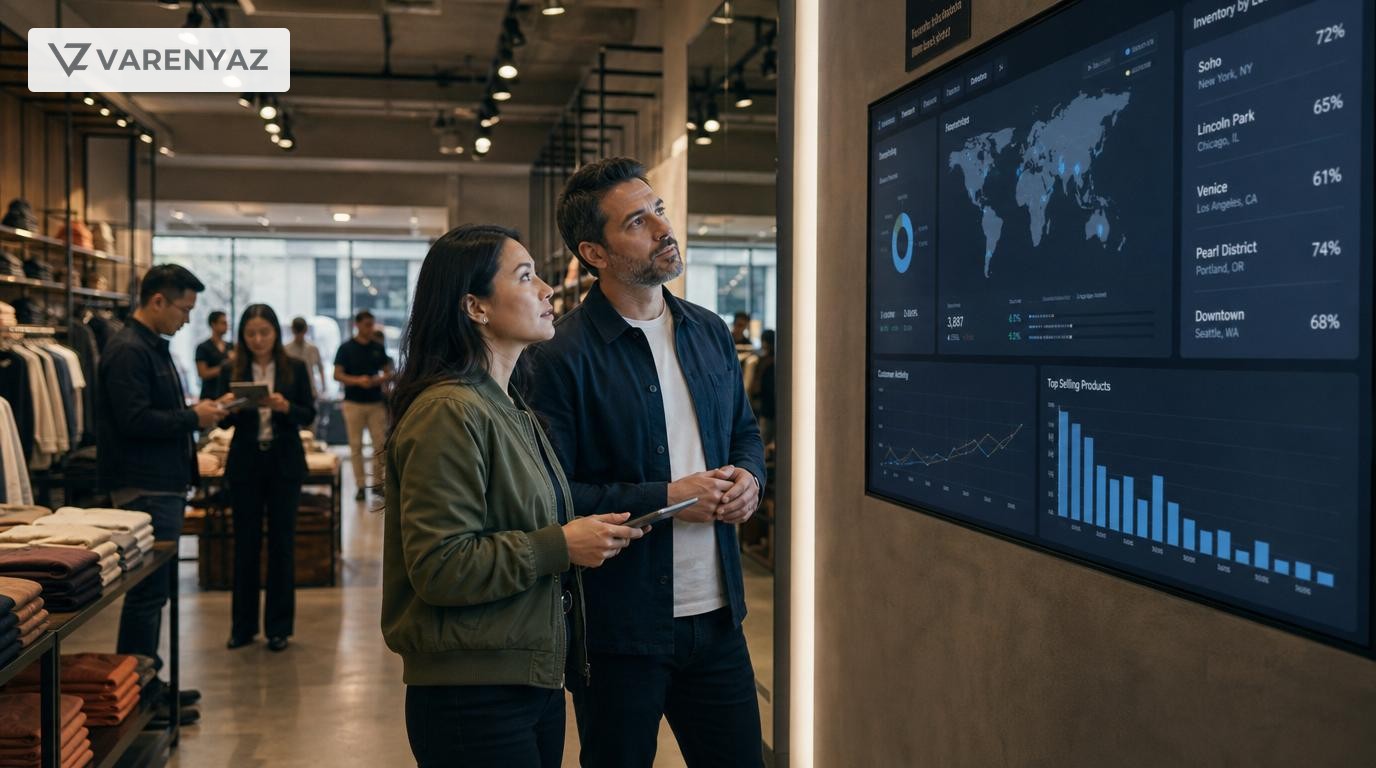
Property CRM Integrations in E-commerce & Retail: How to Modernize Legacy Systems in 2026
Why property CRM integrations suddenly matter so much
Retailers and e-commerce brands have quietly become property businesses. Stores, dark stores, pickup points, partner locations, micro-warehouses, showrooms, and even in-store fixtures like fitting rooms or demo zones are all "properties" that need to be modelled, booked, staffed, and fully visible across channels.
Yet the systems that manage these properties are often the oldest in your stack: on-premise CRMs, store operations tools, or homegrown databases built a decade ago. They hold critical data but were never designed for real-time e-commerce, AI, or omnichannel customer journeys.
This is where property CRM integrations come in. Instead of another big-bang replatform, they let you modernize by connecting legacy property systems to your web, mobile, CRM, marketing, and analytics stack in a structured, API-first way.
Quick definition: What is a property CRM integration?
A property CRM integration is the set of APIs, data flows, and workflows that connect systems managing your locations and assets (stores, warehouses, pickup points, bookable spaces, concessions) with systems that manage customers, orders, and marketing (e-commerce, POS, CRM, CDP, analytics).
In practice, that means:
- Exposing accurate, near real-time store and inventory data to your website, apps, and marketplaces.
- Linking property data (which store, which shelf, which slot) to customer behaviours and orders.
- Enabling central teams to analyse the performance of properties, not just products.
- Creating AI-ready data for forecasting, personalization, and network optimisation.
Direct answer: How to modernize legacy property CRM systems in 2026
To modernize legacy property CRM systems in 2026, retailers should:
- Map the current landscape of property, customer, and order systems and identify data owners.
- Design a target data model that unifies properties (stores, warehouses, pickup points) with customers and orders.
- Introduce an API and event layer that exposes legacy CRM data via REST/GraphQL and streams key changes.
- Use a central data or customer data platform to build a single source of truth for property and customer 360 data.
- Apply a strangler pattern to gradually route new features through the new integration layer while retiring legacy modules step by step.
This approach de-risks modernization, enables real-time omnichannel use cases, and creates an AI-ready foundation without pausing the business.
The business value: Why invest in property CRM integrations now?
1. Real-time inventory and availability across every channel
The most immediate win from integrating property CRMs is accurate, channel-wide inventory and availability. When your legacy store system, WMS, and web store finally speak the same language, you can:
- Show real-time stock by store for each product on the web and app.
- Offer reliable "click-and-collect" and "reserve in store" options.
- Expose delivery SLA and slot availability that actually reflects capacity.
- Reduce cancellations and customer service escalations due to phantom stock.
Platforms like Salesforce and Microsoft Dynamics 365 emphasise the importance of consolidating operational and customer data into a customer 360 to support these experiences, even when multiple back-end systems are involved.
2. Hyper-personalised experiences tied to real locations
Integrations also unlock new personalization layers. When your marketing stack understands where a customer shops, their preferred locations, and local stock conditions, you can:
- Recommend products available now at their nearest store.
- Personalise promotions based on local events or store openings.
- Prioritise offers that use underutilised store capacity.
- Design journeys that blend digital and physical, like inviting high-value customers to store-only experiences.
Property data turns generic personalization into contextual personalization. Instead of just “people like you also bought…”, you can offer “ready to pick up in 30 minutes at your usual store”.
3. Smarter network and operations decisions
At the operations and finance level, a unified view of properties and customers enables more rigorous decisions:
- Which stores act as mini fulfilment centres for online orders?
- Where should you add or remove pickup points?
- Which regions need more inventory or different assortments?
- Where does footfall plus online behaviour suggest a new store should open?
Event-driven architectures, such as those built on Apache Kafka, are increasingly used by retailers for real-time store and inventory signals, supporting these decisions through streaming analytics rather than periodic batch reports.
4. AI and automation that actually work
AI initiatives in retail often stall because underlying data is scattered and inconsistent. Once you have reliable, integrated property and customer data, AI starts to perform:
- Demand forecasting tailored to specific stores or regions.
- Dynamic pricing and markdowns driven by local stock and demand.
- Intelligent routing of orders to the best fulfilment location.
- Natural-language interfaces where staff can ask, “Show me stock of Item X in Delhi for the next 7 days.”
Cloud providers like Google Cloud now promote patterns that combine APIs, streaming data, and AI platforms for exactly these types of retail use cases.
What data actually lives in a property CRM?
Property CRMs in retail are usually a messy combination of official master data and tribal knowledge. As you integrate, you should aim to clarify and standardise the following areas:
Core property model
- Property types: store, showroom, outlet, warehouse, dark store, pickup point, partner concession, kiosk, event pop-up.
- Identifiers: global property ID, external IDs (e.g., POS, ERP, marketplace), geocodes.
- Attributes: address, opening hours, size, capabilities (e.g., alterations, click-and-collect, returns).
- Operational data: staffing levels, capacity constraints, service SLAs.
Inventory and capacity
- Stock levels: on-hand, reserved, in-transit, damaged.
- Capacity: booking slots, fitting rooms, event capacity, delivery capacity.
- Lead times: replenishment cycles, transfer time between properties.
Customer and behavioural links
- Preferred store: where a customer usually shops or picks up.
- Visit history: check-ins, appointments, events attended.
- Order linkage: orders by fulfilment location, returns by store, services consumed.
Your integration project should start by deciding which of these data elements are authoritative in which system, and how conflicts are resolved.
Modern architecture patterns for property CRM integrations
1. API-first as the foundation
API-first is now the default design pattern for CRM modernization. Instead of connecting systems directly to the legacy database, you build a stable layer of REST or GraphQL APIs that:
- Expose property, inventory, and booking data in a consistent format.
- Enforce security and access control.
- Translate between old schemas and new domain models.
- Provide a single contract to web, mobile, and partner channels.
Modern CRM and integration blueprints from providers like Salesforce and Microsoft explicitly recommend API-led, modular integration to achieve a unified customer 360 while keeping systems loosely coupled.
2. Event-driven and streaming architectures
Batch integrations cannot keep up with 2026 expectations. Event-driven architectures add a streaming backbone (often Kafka or a managed equivalent) so that when something important happens—stock changes, store status updated, booking created—it is immediately published as an event.
Downstream consumers (web store, mobile app, CDP, analytics) subscribe to these events and update their views in near real time. This enables:
- Live inventory on product detail pages.
- Immediate alerts when store capacity or status changes.
- Real-time dashboards for operations teams.
- Streaming features for ML models, reducing forecast lag.
3. Central data platform or customer data platform
An integration layer alone is not enough. You also need somewhere to store and reconcile data over time. Retailers typically add:
- A central data warehouse or lakehouse to model property, inventory, and customer data with history.
- Optionally, a customer data platform (CDP) that focuses on unifying customer and engagement data and connecting it back to properties.
Salesforce’s Customer 360 and similar blueprints stress that this consolidated view is key to cross-selling, upselling, and service excellence, even when underlying systems remain heterogeneous.
4. Integration platforms and iPaaS
Many organisations adopt integration platforms (iPaaS) to orchestrate flows, handle transformations, and connect SaaS systems. For property CRM integrations, this might include:
- Syncing store master data with e-commerce and POS.
- Mapping order and fulfilment events between OMS, WMS, and CRM.
- Enriching CRM records with behavioural and location data from the data platform.
This is often where operational teams build and monitor workflows, with IT providing the underlying patterns and governance.
Modernization strategies: From legacy to 2026-ready
1. Strangler pattern: Replace capabilities, not whole systems
Instead of replacing your property CRM in one risky move, the strangler pattern lets you replace it piece by piece:
- Place an API gateway or façade in front of the legacy system.
- Route all new consumers (web, app, new tools) through that façade.
- Build new microservices or modules that handle specific capabilities (e.g., store hours, booking) and plug them behind the façade.
- Gradually switch traffic for each capability from legacy to modern components.
This keeps the business moving while you modernize.
2. Data-first modernization
Another path is to focus first on data:
- Replicate property and inventory data from the legacy CRM into a modern data platform.
- Establish master data management (MDM) rules for properties and customers.
- Expose this cleaned, unified data to downstream systems via APIs.
Once data foundations are stable, you can decide whether the legacy CRM still needs to exist as a system of record, or if it can be retired.
3. Parallel-run for critical operations
For mission-critical flows—like inventory reservations or high-volume booking—consider a parallel-run phase:
- Run the new and legacy integration paths side by side.
- Compare events and outcomes for discrepancies.
- Only cut over once metrics show acceptable variance and stability.
This approach is slower but dramatically reduces operational risk.
Key risks and trade-offs to manage
1. Data quality and identity resolution
Property CRM integrations frequently surface deep data-quality issues:
- Duplicate property records with minor spelling differences.
- Inconsistent IDs between POS, WMS, and CRM.
- Different definitions of “on-hand” or “available”.
You will need clear governance: which system is the source of truth for each field, and how conflicts are automatically or manually resolved.
2. Latency vs. complexity
Real-time everything is expensive. Some data needs millisecond latency (inventory reservations); other data is fine updated hourly (store footfall). Over-optimising for real time everywhere leads to complex architectures and higher costs.
Decide explicitly:
- Which use cases require streaming.
- Which can run on scheduled batches.
- Where an API call-on-demand is sufficient.
3. Security and access control
Property data might seem harmless, but combined with staffing, sales, and operational metrics, it becomes sensitive. Consider:
- Role-based access control for store performance dashboards.
- Separate scopes for internal staff apps vs. partner or marketplace APIs.
- Audit logs on all property and inventory updates.
Modern patterns use OAuth 2.0 and standard API security practices enforced centrally.
4. Integration ownership and support
Once integrations are live, who owns them?
- Does IT own the API gateway and event streaming platform?
- Do digital or e-commerce teams own the mapping to web and app experiences?
- How do store operations teams request changes to integration-driven workflows?
Without clear ownership, integration issues quickly become everyone’s problem and no one’s priority.
Practical modernization roadmap for 2024–2026
Step 1: Align the business case
Start by aligning leaders across technology, operations, and marketing around a clear business case:
- Reduce stock-related cancellations by X%.
- Increase click-and-collect or BOPIS adoption by Y%.
- Improve store utilisation and event bookings.
- Increase cross-channel customer retention.
These become the yardstick for your integration roadmap.
Step 2: Map systems and data flows
Create a simple but accurate map of:
- All systems that store property and inventory data.
- All systems that store customer and order data.
- Current integrations: APIs, batch jobs, file drops, manual exports.
This reveals duplication, single points of failure, and opportunities for consolidation.
Step 3: Design the target architecture
With the map in hand, design your 2026 target architecture:
- Define the canonical property and inventory model.
- Decide on your API strategy (REST, GraphQL, API gateway).
- Choose your streaming or messaging platform.
- Confirm where your long-term source of truth will live (data platform, CDP, CRM).
This is where working with an experienced integration and product partner can accelerate decisions and avoid dead ends.
Step 4: Deliver a thin slice end-to-end
Instead of starting with back-end plumbing alone, ship a visible end-to-end slice:
- Pick a region or a subset of stores.
- Integrate property and inventory data for a focus product category.
- Expose real-time availability on the website and app for that slice.
- Monitor conversion, cancellations, and operational metrics.
This validates the architecture and builds trust internally.
Step 5: Scale and harden
Once the slice works, scale systematically:
- Add more stores, product categories, and channels.
- Introduce event streaming for more event types (returns, cancellations, capacity changes).
- Automate data quality checks and alerts.
- Document and standardise integration patterns for new teams to re-use.
Step 6: Layer on AI and advanced automation
Only when data flows are stable should you invest heavily in AI use cases:
- Demand forecasting by property with ML models.
- AI-powered recommendations that combine customer, product, and store context.
- Intelligent routing of orders and returns to optimise cost and experience.
- Natural-language tools for store staff to query property and inventory data.
This layering ensures that AI sits on solid data foundations.
Geo considerations: India, US, and UK retail realities
India
In India, modern trade and e-commerce coexist with highly fragmented physical networks and cash-heavy operations. Property CRM integrations need to handle:
- Uneven connectivity and offline modes for stores.
- Rapidly changing partner and franchise networks.
- Regional assortment and language differences.
Retailers here often leapfrog directly to cloud-native architectures, skipping some legacy stages seen in mature markets.
United States
US retailers typically deal with large store networks, multiple legacy systems from past mergers, and strong marketplace presence. Key integration priorities include:
- Consolidating data from multiple historical CRMs and ERPs.
- Integrating with major marketplaces and last-mile partners.
- Supporting advanced use cases like ship-from-store and curbside pickup.
Here, the complexity lies in scale and technical debt more than basic connectivity.
United Kingdom
UK brands often operate in dense geographies with a focus on customer experience and sustainability. Property CRM integrations are used to:
- Optimise store footprints in urban centres.
- Support sustainable last-mile options and local fulfilment.
- Power premium services like appointments and in-store events.
Integration strategies emphasise fine-grained property data and customer-centric services.
How VarenyaZ can help you modernize property CRM integrations
Modernizing property CRM integrations isn’t just a back-end project; it’s a full-stack transformation that touches web, mobile, operations, and AI. You need clear architecture, focused execution, and design that keeps the customer at the centre.
VarenyaZ brings together web design, web development, and AI-focused engineering to help retailers and e-commerce brands:
- Audit existing property, CRM, and e-commerce systems and define a pragmatic modernization roadmap.
- Design API-first and event-driven architectures that integrate legacy property CRMs with modern platforms.
- Build high-performing web and app experiences that surface real-time property and inventory data.
- Implement AI search, recommendations, and forecasting on top of your new data foundation.
If you’re planning to modernize property CRM integrations and want a partner who can bridge strategy, engineering, and design, reach out at https://varenyaz.com/contact/.
Done well, property CRM integrations turn your entire physical and digital footprint into a single, intelligent network. With the right architecture and an experienced partner like VarenyaZ, you can move from legacy constraints to a 2026-ready retail platform that’s faster, smarter, and truly customer-first.
Editorial Perspective
Expert Review Notes
"In 2026, the competitive edge in retail no longer comes from owning more systems, but from how cleanly and quickly you can integrate property, inventory, and customer data into one real-time backbone."
"The smartest retailers treat property CRM integration as infrastructure, not a project—an ongoing capability that continuously feeds web, mobile, and AI experiences with reliable data."
"Legacy CRMs rarely need to be ripped out on day one; a well-designed API and event layer lets you modernize property data flows while the business keeps running at full speed."
Frequently Asked Questions
What is a property CRM in retail and e-commerce?
A property CRM in retail and e-commerce is a system that manages data about physical or digital properties that underpin your business—stores, showrooms, warehouses, concessions, pickup points, or even bookable spaces within a store—while linking that property data to customers, orders, and operational workflows.
Why are property CRM integrations critical in 2026?
By 2026, customers expect real-time inventory, accurate store availability, and seamless cross-channel journeys. Property CRM integrations connect legacy store and asset systems with e-commerce, marketing, and analytics platforms so you can expose accurate data everywhere, personalize experiences, and optimise store networks without replacing every legacy system at once.
How do I modernize a legacy property CRM without a big-bang replacement?
You can modernize incrementally by exposing the legacy CRM via APIs, creating an integration or data platform as a backbone, and then using a strangler pattern: route new use cases through the new layer while gradually decomposing or replacing legacy modules. This reduces risk and downtime while delivering value step by step.
What technologies are commonly used for modern property CRM integrations?
Common technologies include REST or GraphQL APIs, event streaming platforms like Apache Kafka, integration platforms or iPaaS, cloud-based CRM like Salesforce or Dynamics 365, and data platforms such as cloud data warehouses or lakehouses. Together, they provide near real-time data flows and a unified source of truth for property and customer data.
How does AI fit into property CRM modernization for retailers?
AI becomes powerful once you unify and clean property and customer data. Retailers can then apply AI for demand forecasting, dynamic pricing, store-specific recommendations, appointment optimization, and network planning. LLMs and AI search can also power natural-language access to property data for store staff and support teams.
When should we work with an external partner on CRM integrations?
Bring in an external partner when you face complex legacy systems, limited internal integration capacity, or cross-functional scope involving web, CRM, and AI. A partner like VarenyaZ can help design the target architecture, implement integrations, and build the web and AI experiences that actually use your new data foundation.
Selected References
Further Reading
Related perspectives
Digital Transformation Roadmaps for Education
A digital transformation roadmap in education is a structured plan that aligns technology investments with learning, operational, and revenue outcomes. This article explains how to assess digital maturity, prioritize initiatives, and phase implementation across strategy, platforms, data, and change management. It covers governance, budgeting, risks, and practical steps for schools, universities, and edtech providers. You’ll learn how to blend web platforms, cloud, and AI responsibly, and where specialist partners like VarenyaZ can help design student experiences, build scalable systems, and implement data-driven, AI-powered solutions.
Future-Proofing Manufacturing with UI/UX
Future-proofing manufacturing now depends as much on UI/UX design as on machinery. UI UX design in manufacturing reduces errors, speeds training, and makes complex Industry 4.0 systems usable on the shop floor. By mapping critical workflows, simplifying interfaces, and designing data-rich dashboards for real operators, manufacturers can unlock value from MES, IoT, and AI. This article outlines best practices for industrial HMI, mobile apps, and AI copilots, the risks of poor UX, and a practical roadmap. It ends with how VarenyaZ can help design, build, and scale these experiences.
Predictive Analytics for Real Estate Efficiency
Predictive analytics in real estate uses historical and real-time data to forecast demand, pricing, maintenance issues, and operational risks so teams can act before problems arise. It increases operational efficiency by reducing downtime, optimizing occupancy and rental yields, and targeting capital where it matters most. This article outlines core use cases, data and technology requirements, implementation steps, governance and risk considerations, and how leaders can practically start with pilots and scale to portfolio-wide predictive capabilities, often with support from specialized web, data, and AI partners like VarenyaZ.