
Digital Transformation Roadmaps for Education
Learn how a structured digital transformation roadmap helps education leaders modernize operations, improve learning outcomes, and unlock new revenue.

Quick Answer
A digital transformation roadmap in education is a structured plan that aligns technology investments with learning, operational, and revenue outcomes. This article explains how to assess digital maturity, prioritize initiatives, and phase implementation across strategy, platforms, data, and change management. It covers governance, budgeting, risks, and practical steps for schools, universities, and edtech providers. You’ll learn how to blend web platforms, cloud, and AI responsibly, and where specialist partners like VarenyaZ can help design student experiences, build scalable systems, and implement data-driven, AI-powered solutions.
In this article
Coverage signals
14 min
Jul 26, 2026
VarenyaZ Editorial Desk, Technical Content Review
Updated Jul 26, 2026
Key Takeaways
- A digital transformation roadmap in education must start from clear learning, operational, and revenue goals, not from tools.
- Successful initiatives align three layers: student experience, educator workflows, and back-office operations.
- Cloud-first, interoperable platforms and shared data models reduce long-term integration and maintenance costs.
- AI and automation should be introduced as assistive co-pilots with strong governance, not as opaque black boxes.
- Change management and digital skills training are as important as any platform you choose.
- Governance structures and a lean portfolio of prioritized projects help avoid fragmentation and "app sprawl".
- Data privacy, security, and ethical use of analytics must be built into the roadmap from day one.
- Specialist partners like VarenyaZ can accelerate roadmap execution with web, product, and AI development expertise.
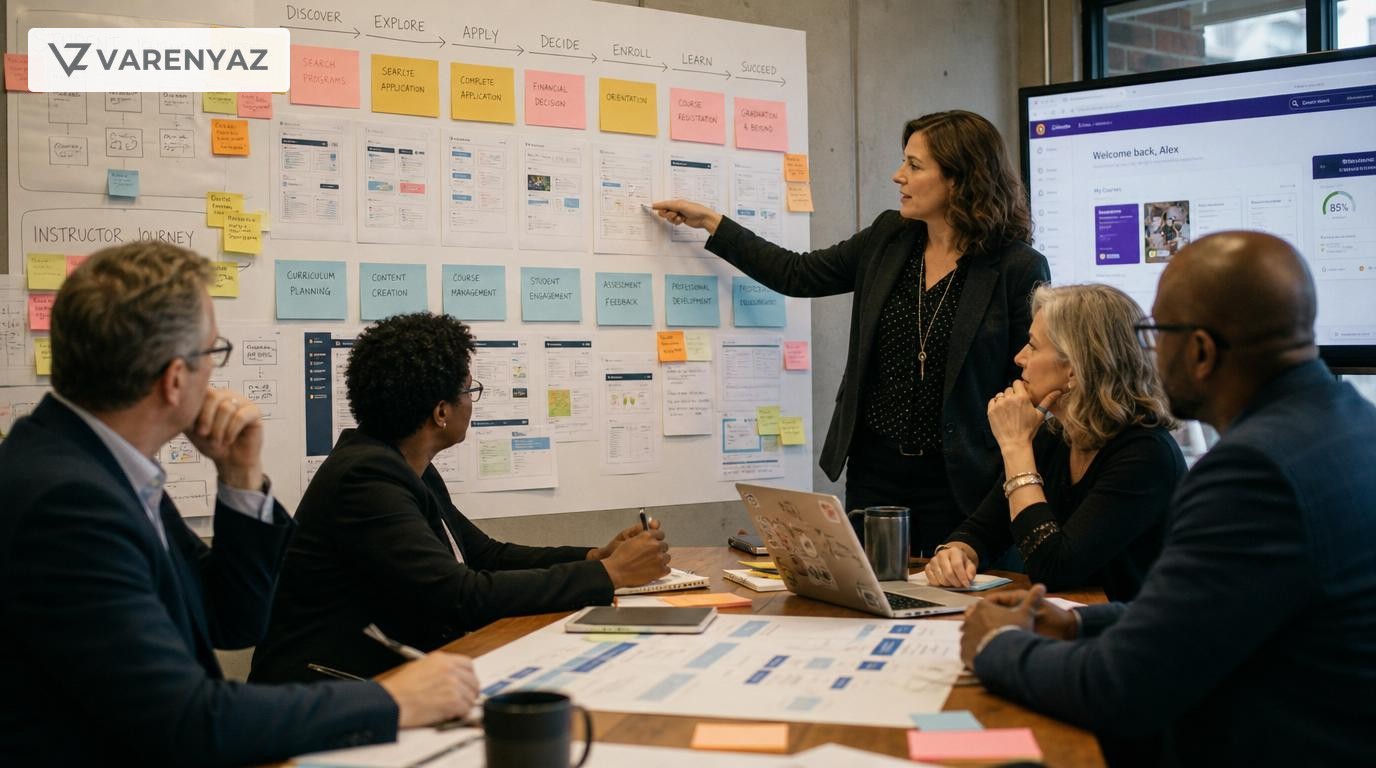
Why education needs a digital transformation roadmap now
Education has been under pressure for years, but the last few have pushed it to a breaking point. Learner expectations have shifted, funding models are strained, and technology options are overwhelming. What many schools, universities, and training providers lack isn’t more tools—it’s a clear digital transformation roadmap in education.
A roadmap turns reactive decisions into a coherent strategy. Instead of buying another app to plug a gap, you design a connected ecosystem that improves learning outcomes, operational efficiency, and long-term sustainability.
This article walks you through how to build that roadmap: what to prioritize, how to sequence projects, where AI fits, and how partners like VarenyaZ can help you execute with modern web, product, and AI development.
Direct answer: What is a digital transformation roadmap in education?
A digital transformation roadmap in education is a phased, outcome-focused plan that describes how a school, university, or education business will use technology, data, and process changes to modernize teaching, learning, and operations over a defined period, typically 18–36 months.
It connects your vision—better access, higher completion rates, improved learner satisfaction, stronger financial resilience—to clear initiatives, timelines, owners, and metrics across areas like web presence, learning platforms, student information systems, analytics, and AI.
The business case: From point solutions to an education ecosystem
Most institutions already use technology: LMS, SIS, video platforms, messaging tools, maybe an analytics dashboard. The problem is fragmentation.
Signs you need a proper roadmap:
- Students and staff juggle multiple logins and interfaces that don’t talk to each other.
- Leadership can’t answer simple questions like “Which students are at risk?” or “Which programs have the strongest digital engagement?”
- New initiatives stall because the underlying systems can’t support them.
- Budgets get eaten by maintenance instead of innovation.
A roadmap shifts you from a patchwork of tools to a deliberate digital learning ecosystem. The business value typically shows up in four dimensions:
1. Learning and student outcomes
- Personalization: Use data to tailor learning paths, support, and communications.
- Access and flexibility: Blended and online models that match learners’ lives and geographies.
- Early support: Analytics that flag disengagement early so staff can intervene.
Global work shows that effective digital learning strategies can support efforts to tackle learning loss and improve continuity when disruptions occur, provided they’re backed by strong planning and teacher support.[3]
2. Operational efficiency
- Automated admissions, fee management, attendance, grading, and reporting.
- Less time lost to duplicate data entry across systems.
- Streamlined coordination across academic, IT, and administrative teams.
For leaders, this translates into lower administrative overhead and the ability to redirect staff energy toward high-value student engagement.
3. Revenue resilience and growth
- Launch online and hybrid programs for new markets and working professionals.
- Bundle micro-credentials and short courses around industry needs.
- Develop B2B offerings for corporate training or government partnerships.
A modern digital stack lets you test and scale new business models faster without rebuilding everything for each new offering.
4. Trust, compliance, and reputation
- Robust data protection and ethical use of analytics.
- Transparent use of AI in teaching and assessment, aligned with emerging guidance.[1][2]
- Consistent, accessible digital experiences that reflect your institutional values.
Stakeholders—from parents to regulators—are increasingly sensitive to how technology is used. A roadmap helps you show that you’re intentional and responsible, not just experimental.
Core pillars of an education digital transformation roadmap
A useful roadmap is more than an IT plan. It weaves together six pillars:
- Strategy and outcomes
- Student and stakeholder experience
- Platforms and architecture
- Data, analytics, and AI
- People, skills, and change management
- Governance, risk, and ethics
1) Strategy and outcomes: Start with the “why”
Before tools, define the business and academic outcomes you care about in the next 3–5 years. Examples:
- Increase program completion rates by 10%.
- Double enrollment in online and blended offerings.
- Reduce administrative workload for faculty by 20%.
- Strengthen data and AI governance to meet new regulations.
Translate these into specific, measurable indicators—digital adoption, satisfaction scores, time-to-enroll, time-to-grade, etc. These become your north star for prioritizing projects.
2) Student and stakeholder experience: Design journeys, not screens
Education is a network of journeys: prospect to applicant, applicant to enrolled learner, learner to alumni, and similar arcs for faculty and staff. Your roadmap should map how digital touches each stage.
Key questions:
- How do prospective students discover, research, and apply to you?
- What does a typical learning week feel like on your platforms?
- How do students get help—academic, tech, financial—and how quickly?
- How do staff and faculty access data and systems to do their jobs?
From here, prioritize a few high-impact transformations, such as:
- A unified, responsive web presence that clearly explains programs and outcomes.
- A consistent portal or app that gives learners one place for courses, grades, communication, and support.
- Self-service capabilities for common tasks (letters, certificates, timetable changes).
This is where VarenyaZ’s web design and web development capabilities can help you create coherent digital front doors for students, parents, and partners.
3) Platforms and architecture: Build a flexible spine
Your technology stack should be modular, interoperable, and cloud-friendly. The goal is not to own every tool, but to integrate a small set of core platforms well.
Typical core components:
- Public web and content platform (for discovery, marketing, and general information).
- Student Information System (SIS) (for enrolment, records, fees, and compliance data).
- Learning Management System (LMS) or VLE (for content, assessments, interaction).
- Identity and access management (for single sign-on and security).
- Integration layer and APIs (to link all of the above).
Your roadmap should specify:
- Which legacy systems to keep, modernize, or retire.
- What to buy as SaaS vs. build as custom applications.
- Architecture principles (e.g., cloud-first, API-first, security-by-design).
For custom workflows—like unique admission flows, research portals, or partner dashboards—you may need product-grade web and application development. VarenyaZ can design and build these around your core systems so they scale cleanly.
4) Data, analytics, and AI: From reports to insight to action
Education data is rich but often scattered across systems. Without a plan, you get static reports instead of actionable insights.
Your roadmap should:
- Define a central data layer (data warehouse or lakehouse) that aggregates from LMS, SIS, finance, and other tools.
- Standardize key definitions (enrolled, active, at-risk, completed, etc.).
- Build initial dashboards and alerting for key roles: leadership, program heads, student support, marketing.
- Plan for learning analytics that support improvement without over-surveillance.[4]
Once you have solid data foundations, you can introduce AI in targeted ways:
- Assistive tutors and study aids that are transparent and aligned with pedagogical goals.
- Early-warning models for drop-out risk that prompt human intervention.
- Workflow automations (summarizing forms, routing tickets, drafting communications).
International guidance stresses that AI in education should support human decision-making, protect privacy, and be governed by clear ethics frameworks.[1][2] Your roadmap should reflect those principles in both design and governance.
5) People, skills, and change management: Technology adoption is human
You can buy platforms; you have to build adoption. Teachers, administrators, and students all need support to change habits.
Include in your roadmap:
- Stakeholder analysis: Who is most affected by each initiative, and what do they need?
- Training programs for digital competencies, targeted by role.
- Change champions—faculty and staff who pilot tools and advocate for peers.
- Feedback loops: Simple mechanisms to capture what’s working and what isn’t.
Education systems worldwide are learning that technology investments only pay off when accompanied by strong support for teachers and institutional capacity-building.[3]
6) Governance, risk, and ethics: Guardrails, not handcuffs
Digital transformation touches sensitive data, future reputations, and public trust. Governance gives you guardrails.
Your roadmap should outline:
- Decision structures: Who approves new tools, data integrations, and AI use cases?
- Policies on data privacy, retention, access, and sharing.
- Ethical guidelines for analytics and AI, aligned with local regulations and international norms.[1][2]
- Risk and incident response plans (for outages, breaches, or tool misuse).
Good governance doesn’t slow you down; it prevents expensive missteps and course corrections later.
Step-by-step: How to build your digital transformation roadmap
Here is a practical sequence you can follow, whether you’re a university, K–12 group, training provider, or edtech business.
Step 1: Assess your digital maturity
Start with brutally honest answers to four questions:
- Strategy: Do we have clear, digital-related goals for learning, operations, and revenue?
- Experience: How consistent and usable are our digital touchpoints for students and staff?
- Technology: Are our core systems integrated, secure, and cloud-ready?
- People and governance: Do we have the skills, roles, and policies to manage digital initiatives?
Simple tools like maturity scorecards, stakeholder interviews, and quick UX audits of your web and portal experiences can reveal gaps. This is often where an external partner like VarenyaZ can provide an objective view.
Step 2: Clarify your priorities and constraints
No institution can transform everything at once. You need to choose.
Consider:
- Strategic anchors: For example, “improve student progression,” “expand online programs,” or “standardize operations across campuses.”
- Constraints: Budget, staff capacity, regulatory deadlines, existing vendor contracts.
- Non-negotiables: Compliance dates, security risks that must be fixed, platforms at end-of-life.
Map initiatives against impact and feasibility. Focus the first 12–18 months on high-impact, feasible projects that unlock capacity for later waves.
Step 3: Map your initiative portfolio
Now list and categorize potential initiatives. Examples:
- Web and experience: Redesign institutional website, unify program pages, build student portal.
- Core platforms: LMS upgrade, SIS consolidation, identity and access management.
- Data and analytics: Central data store, core dashboards, student risk indicators.
- AI and automation: Pilots for AI tutoring, assignment support tools, service desk assistants.
- Operations and process: Digitize admissions, automate document workflows, integrate finance and enrollment data.
For each initiative, define:
- Problem it solves and which outcome it supports.
- Dependencies (data, systems, teams).
- Rough cost, effort, and timeline.
- Risks and mitigation measures.
Limit your initial portfolio to a realistic number of concurrent projects. Fragmentation kills momentum.
Step 4: Sequence into waves
Turn the portfolio into a time-based roadmap, usually in three waves:
- Wave 1 (0–12 months): Stabilize and simplify. Modernize the website, fix critical integration gaps, consolidate logins, and implement foundational data pipelines and dashboards.
- Wave 2 (12–24 months): Enhance experiences. Launch unified student portal, expand self-service, deepen analytics, start targeted AI pilots with clear guardrails.
- Wave 3 (24–36 months): Innovate and scale. Embed AI in more workflows, launch new digital-first programs, refine personalization, and extend partnerships.
Each wave should have 3–5 major deliverables, with interim checkpoints to assess adoption and adjust priorities.
Step 5: Design your operating model and governance
Decide how you will manage and sustain transformation work:
- Ownership: Create a cross-functional digital steering committee spanning academics, operations, IT, and student services.
- Roles: Clarify who owns product decisions for the website, learning platforms, and data tools.
- Processes: Agree on how initiatives are proposed, evaluated, approved, and reviewed.
Education reports consistently highlight the importance of coherent governance for digital initiatives, especially when AI is in play.[1][2][4]
Step 6: Commit to measurement and continuous learning
Finally, connect the roadmap back to outcomes with metrics:
- Adoption: Portal logins, course engagement, completion of self-service workflows.
- Efficiency: Time saved per process, reduced errors, faster turnaround.
- Outcomes: Completion rates, satisfaction, application-to-enrolment conversion, lifetime learner value.
Build these into your dashboards and review cycles, and treat your roadmap as a living document. Adjust based on evidence, not just intuition.
AI in your education roadmap: Promise, risks, and practical use cases
AI is reshaping expectations about what digital learning can do—but it also raises complex questions. International organizations emphasize that AI should enhance human capacities, protect rights, and be used transparently in education.[1][2]
Where AI can add value
- Personalized learning support: AI-powered study companions that help explain concepts, suggest practice questions, or generate multiple representations of content.
- Educator productivity: Drafting lesson outlines, generating quiz items, or summarizing discussion threads, always under human review.
- Student support services: Chat-based triage for FAQs, routing complex queries to human advisors with context.
- Operational automation: Sorting applications, categorizing support tickets, or extracting key data from documents.
Key risks and mitigation strategies
- Bias and fairness: AI systems can reflect data biases. Mitigate with diverse datasets, human oversight, and clear appeals processes.
- Privacy and security: Student data must be protected and used minimally. Anonymize where possible, and avoid training models directly on identifiable data.
- Over-reliance: Ensure AI is framed as a support tool, not a replacement for teaching, guidance, or critical thinking.
- Transparency: Communicate where AI is used, what it does, and its limitations.
Your roadmap should treat AI not as a single project, but as a capability you build responsibly over time, anchored by governance, data quality, and staff readiness.
Regional and global considerations for your roadmap
While the principles are universal, your roadmap will vary based on geography and context.
India
Many Indian institutions operate in rapidly growing markets with diverse learners, constrained resources, and intense competition. Priorities often include:
- Mobile-first experiences for students with uneven device and connectivity access.
- Scalable cloud platforms to support large cohorts and multiple campuses.
- Blended models that combine in-person teaching with flexible digital content.
United States
In the US, institutions balance innovation with compliance, legacy systems, and a saturated market:
- Deep integrations between LMS, SIS, and analytics for detailed reporting.
- Experimentation with AI and adaptive learning, under strong governance and privacy rules.
- Competitive differentiation through superior digital experience and student support.
United Kingdom
UK institutions often focus on:
- Data-driven quality assurance and student success metrics.
- Integrating research, teaching, and outreach portals into coherent experiences.
- Scaling flexible provision for lifelong learning and international students.
Across all regions, the common thread is moving from tactical digitization to strategic transformation with clear roadmaps and governance.
Practical next steps for education leaders
If you’re a founder, CTO, academic leader, or operations head, here’s how to move from theory to action over the next 90 days:
1. Convene a cross-functional digital taskforce
Include leadership, IT, academic reps, student services, and at least one student voice. Give them a clear mandate: articulate a 2–3 year digital vision and a draft roadmap by a specific date.
2. Run a quick discovery and maturity assessment
In 4–6 weeks, you can:
- Audit your public web presence and key portals.
- Map your core systems and integrations.
- Interview representative users: prospective students, current learners, faculty, and staff.
- Document pain points and quick wins.
3. Define your top 3–5 transformation goals
Align leadership on the outcomes that matter most. Disagreement here will derail the roadmap later, so spend time getting this right.
4. Draft waves and identify critical enablers
Outline Wave 1–3, assign owners, and highlight cross-cutting enablers like identity, data, and governance. Use this to inform budgeting and capacity planning.
5. Decide where to partner
You don’t need to build everything in-house. Consider partnering for:
- Web and experience design: To create coherent, accessible, and conversion-optimized sites and portals.
- Custom development: For workflows, dashboards, or integrations your off-the-shelf platforms can’t handle.
- AI and analytics: To design use cases, architect data pipelines, and implement responsible AI capabilities.
If you’re ready to explore how a partner can accelerate this work, reach out via https://varenyaz.com/contact/.
How VarenyaZ can support your education digital roadmap
VarenyaZ works at the intersection of web, product, and AI development. For education leaders, that translates into practical support across your roadmap:
Strategic discovery and roadmap design
We collaborate with your leadership and academic teams to understand your context, assess your current digital estate, and translate your ambitions into a clear, prioritized roadmap. Our background in education and technology allows us to bridge executive vision with implementation detail.
Web design and student experience
Your website and portals are the front door to your institution. VarenyaZ’s design team creates:
- Modern, mobile-first education websites with clear navigation and compelling storytelling.
- Information architectures that make it easy to explore programs, costs, and outcomes.
- Student and staff portals that unify services and reduce friction across the learner journey.
We focus on usability, accessibility, and performance so your digital presence matches the quality of your teaching.
Web and product development for education workflows
Many institutions struggle to make generic platforms fit their unique processes. Our development team builds custom web and application solutions that sit on top of, or alongside, your LMS and SIS, such as:
- Admissions and onboarding flows that reduce dropout between offer and enrolment.
- Program, cohort, and mentor management tools.
- Dashboards for leadership, program heads, and support teams.
We architect for scalability, integration, and maintainability so your ecosystem can evolve with your roadmap, not against it.
AI development and learning analytics
VarenyaZ helps you move from ideas about AI to concrete, ethics-aware implementations. We can support you to:
- Scope and validate AI use cases that genuinely support teaching and learning.
- Design and build data pipelines and analytics layers that respect privacy and consent.
- Prototype and deploy AI assistants for learning support, student services, or internal operations.
Our approach is grounded in international guidance on responsible AI in education, making sure that your innovations align with emerging expectations around transparency, fairness, and human oversight.[1][2]
Ongoing partnership and evolution
A roadmap is not a one-off document. We work with clients as long-term partners, helping them:
- Review and update their roadmap based on results and changing conditions.
- Iterate on digital experiences with user research and analytics.
- Expand AI capabilities carefully as data and governance mature.
Conclusion: Turn intention into a living roadmap
Digital transformation in education is less about chasing the latest technology and more about deliberately reshaping how you deliver learning, support people, and sustain your mission. A clear, realistic digital transformation roadmap in education helps you align stakeholders, prioritize investments, manage risks, and build trust with learners and partners.
VarenyaZ can help you turn that roadmap into reality—designing the web experiences your students expect, developing the platforms and integrations your operations need, and building AI-powered capabilities that are responsible, transparent, and genuinely useful. When technology, data, and design pull in the same direction, your institution can unlock its full potential in a digital-first world.
Editorial Perspective
Expert Review Notes
"In education, digital transformation isn’t about having more tools; it’s about orchestrating a small ecosystem of platforms, data, and workflows so students and educators experience one coherent journey."
"The most successful digital roadmaps in education start with a brutally honest maturity assessment, then ruthlessly prioritize the minimum projects that can unlock visible value in the first year."
"AI will only be as effective as the institutional data, processes, and trust you build beforehand, which is why it should be a pillar of the roadmap, not a bolt-on experiment."
Frequently Asked Questions
What is a digital transformation roadmap in education?
A digital transformation roadmap in education is a structured, time-bound plan that connects technology investments to specific learning, operational, and financial outcomes. It maps how a school, university, or edtech provider will evolve student experiences, educator workflows, data, and infrastructure over phases, typically 18–36 months, with clear milestones, risks, and owners.
Why do education institutions need a digital transformation roadmap?
Education institutions need a digital transformation roadmap to avoid fragmented technology decisions, duplicate tools, and wasted budgets. A roadmap aligns leadership around priorities, sets realistic timelines, and clarifies dependencies across web platforms, student information systems, learning management, analytics, and AI. It also helps manage risks related to data privacy, security, and change fatigue among staff and students.
What should be included in an education digital roadmap?
An education digital roadmap should include current-state and maturity assessments, target outcomes, prioritized initiatives, architecture principles, data and integration strategy, change management plans, risk and compliance considerations, and success metrics. It should span student experience, academic and administrative workflows, infrastructure, and enabling capabilities like analytics and AI.
How long does digital transformation in education usually take?
Digital transformation in education is an ongoing journey, but a practical roadmap typically spans 18–36 months. Within that period, organizations break the work into waves or quarters, focusing first on high-impact, low-dependency initiatives such as web experience modernization, core platform upgrades, or foundational data and integration layers, and then layering more advanced capabilities like AI-based analytics.
How can smaller institutions or training providers afford digital transformation?
Smaller institutions can focus on a few high-value platforms, use cloud and SaaS solutions to avoid heavy upfront investments, and prioritize interoperability over owning everything in-house. Starting with a modest, well-structured roadmap helps them negotiate better with vendors, avoid unnecessary tools, and phase investments over time while still improving student experience and operational efficiency.
Where does AI fit into an education digital transformation roadmap?
AI should be introduced once your core data, systems, and processes are reasonably stable. In a roadmap, AI often appears in the second or third wave as assistive tools for personalized learning, early risk detection, or workflow automation. It must be backed by clear governance, transparency requirements, and strict data privacy protections.
Selected References
Further Reading
Related perspectives
Future-Proofing Manufacturing with UI/UX
Future-proofing manufacturing now depends as much on UI/UX design as on machinery. UI UX design in manufacturing reduces errors, speeds training, and makes complex Industry 4.0 systems usable on the shop floor. By mapping critical workflows, simplifying interfaces, and designing data-rich dashboards for real operators, manufacturers can unlock value from MES, IoT, and AI. This article outlines best practices for industrial HMI, mobile apps, and AI copilots, the risks of poor UX, and a practical roadmap. It ends with how VarenyaZ can help design, build, and scale these experiences.
Predictive Analytics for Real Estate Efficiency
Predictive analytics in real estate uses historical and real-time data to forecast demand, pricing, maintenance issues, and operational risks so teams can act before problems arise. It increases operational efficiency by reducing downtime, optimizing occupancy and rental yields, and targeting capital where it matters most. This article outlines core use cases, data and technology requirements, implementation steps, governance and risk considerations, and how leaders can practically start with pilots and scale to portfolio-wide predictive capabilities, often with support from specialized web, data, and AI partners like VarenyaZ.
Legacy Modernization for Real Estate Growth
Legacy modernization in real estate means upgrading core property, leasing, and finance systems so they can support today’s digital, data-driven operations. It involves replacing or refactoring old software, consolidating data, and building a modern, API-first architecture. Done well, it improves decision-making, reduces manual work, and enables AI-driven use cases like dynamic pricing or predictive maintenance. This guide explains the business case, modernization options, risk controls, and practical steps real estate leaders can follow, and how a partner like VarenyaZ helps design and implement modern web, data, and AI solutions.