
Predictive Analytics for Smarter E-commerce
Learn how predictive analytics transforms e-commerce and retail with demand forecasting, personalization, pricing, and fraud prevention.

Quick Answer
Predictive analytics in e-commerce and retail uses historical and real-time data to forecast customer behavior, demand, and risk so teams can take smarter actions before events happen. It powers better merchandising, personalized journeys, dynamic pricing, and fraud detection. This guide explains the core concepts, value levers, data foundations, technology options, and governance needed to deploy predictive models that actually move revenue and margin, while avoiding common pitfalls like biased data, fragile models, and black-box decisioning.
In this article
Coverage signals
14 min
Jun 17, 2026
VarenyaZ Editorial Desk, Technical Content Review
Updated Jun 17, 2026
Key Takeaways
- Predictive analytics in e-commerce translates historical and real-time data into forward-looking signals that guide merchandising, marketing, and operations.
- The fastest ROI use cases are demand forecasting, personalized recommendations, churn and CLV prediction, dynamic pricing, and fraud detection.
- Data quality, governance, and clear business ownership matter more than fancy algorithms for achieving consistent commercial impact.
- Start with a narrow, high-value use case, prove ROI, and then scale to a portfolio of predictive models integrated into daily workflows.
- Balance automation and human oversight: let models recommend and rank, while humans set constraints, ethics, and business rules.
- Monitor models continuously for drift, bias, and performance degradation, especially when consumer behavior or the macro environment changes.
- Composable data and ML architectures—data warehouses, feature stores, and real-time pipelines—make predictive analytics sustainable at scale.
- Partnering with experienced teams like VarenyaZ can accelerate implementation from data foundation to production-grade AI services.
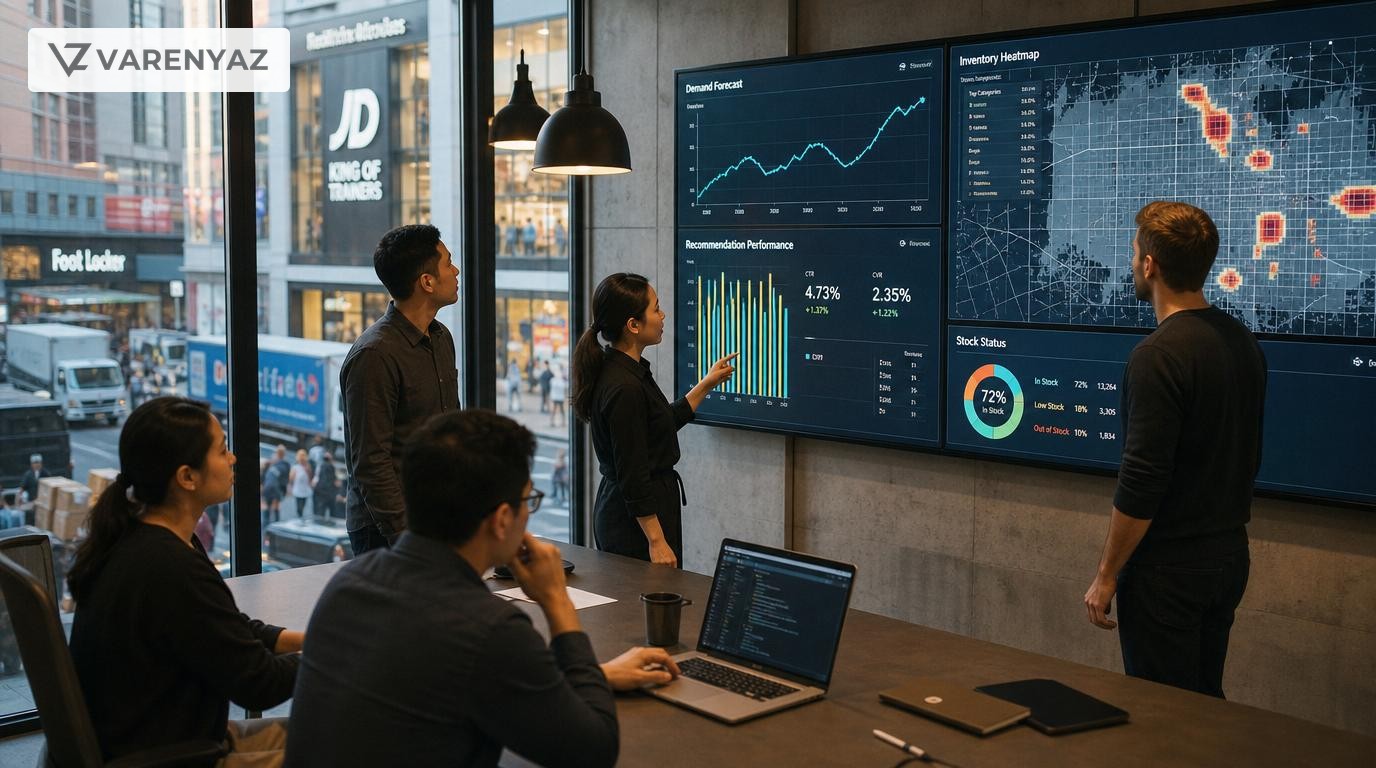
Exploring Predictive Analytics: A Pathway to Enhanced E-commerce & Retail
Every e-commerce and retail leader is now asking the same question: how do we make better decisions before problems show up in our dashboards? Predictive analytics is one of the most practical answers.
Instead of only reporting what happened, predictive analytics helps you anticipate what is likely to happen next: which products will sell, which customers might churn, which orders look risky, and which prices will protect margin without killing conversion.
In this article, we will unpack how predictive analytics in e-commerce and retail actually works, where it drives the most value, what it takes to implement, and how to avoid common pitfalls—so you can move from “interesting AI experiment” to consistent commercial impact.
What Is Predictive Analytics in E-commerce and Retail?
Predictive analytics is the use of statistical models and machine learning to analyze historical and real-time data and forecast future outcomes. In e-commerce and retail, that typically means predicting demand, customer behavior, and risk so you can act before events occur.
Think of it as turning your data into a continuous stream of forward-looking signals that power daily decisions in merchandising, marketing, operations, and finance.
How Predictive Analytics Differs from Traditional Reporting
Most retailers already use descriptive analytics: dashboards that show revenue, conversion, stock levels, and campaign performance. These answer “what happened?”
Predictive analytics pushes you into “what is likely to happen next?” and “what should we do about it?”
- Descriptive: Last week’s sales by category.
- Diagnostic: Why did sales drop in electronics?
- Predictive: What will electronics demand look like next month by channel?
- Prescriptive: How should we adjust inventory, pricing, and marketing to capture that demand profitably?
The biggest shift is that predictive analytics is designed to drive actions, not just generate charts.
Typical Predictive Models in Retail
While model types vary, most retail use cases fall into a few patterns:
- Forecasting models: Time-series models (and their variants) to forecast demand, traffic, or returns.
- Classification models: Predict the probability of a customer churning, an order being fraudulent, or a lead converting.
- Regression models: Estimate continuous outcomes like expected order value or revenue impact.
- Ranking and recommendation models: Suggest products, content, or offers in an optimized order for each customer or segment.
The technical sophistication of these models can vary, but from a business perspective the crucial question is: What decision will this prediction change, and how will we measure that change?
Why Predictive Analytics Matters for E-commerce & Retail Leaders
For business decision-makers, predictive analytics is not just an IT initiative. It is a strategic capability with direct impact on growth, margin, and working capital.
Core Business Benefits
- Revenue growth: Better targeting, recommendations, and timing increase conversion, basket size, and repeat purchases.
- Margin protection: Smarter promotions and dynamic pricing prevent unnecessary discounting and protect profitability.
- Inventory efficiency: More accurate demand forecasts reduce stockouts and overstock, freeing up cash.
- Operational resilience: Early signals of demand shifts help you respond faster to macro changes, seasonality, or competitor moves.
- Risk reduction: Fraud detection and credit risk scoring lower chargebacks, returns abuse, and write-offs.
Global analyses from major consultancies consistently show that data-driven retailers outperform peers on revenue growth and EBIT margins when they operationalize AI and analytics across core decisions. The emphasis is on operationalize—not just build one-off pilots.
Examples of Predictive Analytics in Action
- An e-commerce marketplace forecasts demand by category and region, then adjusts procurement and warehouse allocation before peak season.
- A D2C brand builds a churn model to identify at-risk subscribers and automatically triggers save-offers or personalized outreach.
- An omnichannel retailer uses propensity models to decide which customers should receive high-cost direct mail versus cheaper digital campaigns.
- A fashion retailer uses size and returns prediction to surface better fit recommendations, reducing return rates and shipping costs.
The common pattern: every prediction is tied to a measurable business lever—units sold, margin, inventory days, or cost of service.
High-Impact Predictive Analytics Use Cases
Not all use cases are equal. Some are experimental, while others consistently deliver quick, tangible ROI. Here are the most impactful starting points for e-commerce and retail.
1. Demand Forecasting and Inventory Optimization
Accurately predicting demand is the foundation of profitable retail. Modern forecasting models can ingest historical sales, price, promotions, seasonality, events, and macro indicators to generate granular forecasts—by SKU, store, region, or channel.
Core benefits include:
- Fewer stockouts: Maintain availability on fast-moving products without overbuffering.
- Lower overstock: Reduce excess inventory on slow movers, limiting markdowns and storage costs.
- Smarter allocation: Distribute inventory across warehouses and stores based on predicted local demand.
For omnichannel retailers, this also feeds ship-from-store and click-and-collect strategies, aligning online promises with physical stock.
2. Personalized Recommendations and Merchandising
Recommendation systems are one of the most visible forms of predictive analytics in e-commerce. They power:
- Product recommendations: “You may also like”, “Frequently bought together”, “Similar items”.
- Content personalization: Homepage layouts, category ordering, and editorial curation based on customer behavior.
- Marketing personalization: Email and push campaigns tailored to predicted interests and lifecycle stage.
Effective recommendation models blend customer behavior (views, clicks, baskets, purchases), product attributes (category, price, style), and contextual signals (device, time, channel) to predict what each shopper is most likely to engage with next.
3. Churn and Customer Lifetime Value (CLV) Prediction
Customer acquisition costs continue to rise across major markets. That shifts the focus from “more customers” to “more value per customer”.
Predictive models can estimate:
- Churn probability: Which customers are likely to stop buying or unsubscribe.
- Customer lifetime value: The expected revenue or margin a customer will generate over a defined future period.
With these scores, you can:
- Design tiered retention programs based on predicted value and risk.
- Prioritize service and outreach for high-CLV customers showing early churn signals.
- Optimize acquisition bids and channels by focusing on high-CLV cohorts, not just cheap first orders.
4. Dynamic Pricing and Promotion Optimization
Traditional pricing relies heavily on fixed rules, broad competitor checks, and manual overrides. Predictive analytics brings a more granular view of price elasticity—how demand reacts to price changes for specific products, segments, and times.
With this, retailers can:
- Adjust prices or discounts dynamically within defined floors and ceilings.
- Design personalized offers based on propensity to buy without excessive discounting.
- Optimize promotions to hit sell-through and revenue targets while preserving margin.
Importantly, dynamic pricing in retail is rarely a free-for-all. Governance, transparency, and fairness are essential, especially in regulated markets or categories like essentials.
5. Fraud Detection and Risk Scoring
As digital transactions grow, so does fraud—from payment fraud and account takeovers to promotion abuse and returns manipulation.
Predictive models can analyze patterns across devices, locations, behavior, and historical cases to flag suspicious activity in real time. A typical approach blends:
- Rules: Clear thresholds and business logic (e.g., velocity checks, blacklist matches).
- Machine learning: Models that learn subtle, evolving fraud patterns that rules might miss.
The goal is to reduce fraudulent losses and operational overhead without frustrating genuine customers with false positives.
6. Operations and Supply Chain Optimization
Beyond front-end experiences, predictive analytics can streamline operations:
- Forecast returns volume to plan staffing and reverse logistics capacity.
- Predict delivery delays or service outages and proactively communicate with customers.
- Model warehouse workloads to balance picking, packing, and dispatch across sites.
For large and mid-sized retailers, these operational use cases often deliver quieter but substantial gains in cost-to-serve and customer satisfaction.
Data Foundations: What You Need Before Advanced Models
It is tempting to jump straight into advanced algorithms. In practice, the winners in predictive analytics for retail invest first in data foundations.
Essential Data Sources
Most e-commerce and retail predictive projects rely on a familiar set of datasets:
- Transactional data: Orders, items, quantities, prices, discounts, timestamps, payment methods.
- Product and catalog data: SKUs, categories, attributes, availability, cost, and margin.
- Customer data: Profiles, segments, lifecycle stage, consent preferences, loyalty tiers.
- Behavioral data: Web and app events—views, clicks, search queries, carts, wishlists.
- Operational data: Inventory levels, warehouse locations, lead times, returns, logistics carriers.
- Marketing data: Campaigns, channels, spend, impressions, and attribution signals.
You can start small, but you must ensure that identifiers and keys allow you to join these datasets reliably. Mismatched IDs and inconsistent timestamps are common failure points.
Qualities of “Good Enough” Data
You do not need perfect data, but you do need data that is:
- Consistent: The same metrics and dimensions mean the same thing across systems.
- Complete enough: Key fields (IDs, dates, quantities, prices) are rarely missing.
- Timely: Data arrives in time to influence decisions (e.g., hourly for fraud, daily for forecasting).
- Ethically sourced: Customer data aligns with consent, privacy, and regional regulations such as GDPR or CCPA.
Sometimes, simplifying your data pipeline—fewer sources, clearer definitions—unlocks more value than adding yet another dataset.
How Predictive Analytics Fits into Your Technology Stack
Modern predictive analytics does not need to be monolithic. Composable architectures let you plug models into your existing e-commerce, CRM, ERP, and marketing systems.
Typical Architecture for Retail Predictive Analytics
While every business is unique, a common reference architecture looks like this:
- Data ingestion: Batch pipelines for historical data (e.g., orders) and streaming/event pipelines for real-time signals (e.g., clicks, transactions).
- Data warehouse or lakehouse: A central store (e.g., in the cloud) where cleaned, modeled data lives for analytics and ML.
- Feature store: A curated layer of machine learning features—such as “30-day order count” or “average basket value”—reused across multiple models.
- Model training environment: ML frameworks and tools where data scientists and engineers build, train, and evaluate models.
- Model serving: APIs or embedded services that deliver predictions in real time (for recommendations, fraud checks) or in batches (for forecasts, CLV scores).
- Activation layers: E-commerce platform, CRM, CDP, marketing tools, pricing systems, and warehouse management systems that consume predictions and trigger actions.
The crucial piece is not any single technology, but the smooth flow from data to prediction to action.
Build vs Buy vs Partner
Leaders often face a strategic choice:
- Buy: Off-the-shelf tools (e.g., for recommendations or fraud) get you started quickly, with limited flexibility.
- Build: Custom models and pipelines tuned to your business offer more control and differentiation, but require deeper talent and infrastructure.
- Partner: Working with a specialist like VarenyaZ lets you combine tailored solutions with proven implementation experience across web, data, and AI.
Many retailers choose a hybrid approach: start with commercial tools where differentiation is low and invest in custom models where your business has unique data or strategy.
Governance, Risk, and Ethics: Doing Predictive Analytics Responsibly
As predictive analytics influences pricing, offers, and risk decisions, governance becomes critical—both to avoid harm and to maintain customer trust.
Key Risks to Manage
- Model drift: Customer behavior changes (for example, during macro shocks or rapid channel shifts), and models trained on old patterns start to underperform.
- Bias and fairness: Models trained on biased data can disadvantage certain geographies, demographics, or income levels, especially in pricing or credit-like decisions.
- Over-automation: Fully automated systems can amplify errors at scale—such as misclassifying many legitimate orders as fraud or overreacting to short-term demand spikes.
- Privacy and compliance: Use of personal data must meet legal and ethical standards across jurisdictions, with transparent customer communication.
Practical Governance Moves
To keep predictive analytics aligned with your brand and regulations:
- Define clear business ownership for each model—who is accountable for its objectives and behavior.
- Set guardrails for automated decisions, including price ranges, discount caps, and human review thresholds.
- Monitor model performance and retrain schedules, especially after major assortment, pricing, or channel changes.
- Regularly audit segment-level impacts for pricing, promotions, and risk models to spot unintended unfairness.
- Align feature usage with privacy policies and ensure easy processes for data access and deletion requests where required.
Retailers that design governance into their AI stack often find it easier to scale predictive analytics, because stakeholders trust the system and understand its limits.
From Pilot to Production: How to Implement Predictive Analytics That Sticks
Many organizations have run predictive pilots that never left the slide deck. The challenge is not ideation; it is operationalization.
Step 1: Start with Clear Business Questions
Anchor each initiative in a focused question, such as:
- “Can we reduce out-of-stock events for our top 500 SKUs by at least 15%?”
- “Can we increase email-driven revenue per send by 10% using predictive targeting?”
- “Can we cut promotion spend by 8% while keeping sales flat by targeting offers better?”
These questions drive model selection, data requirements, and measurement design.
Step 2: Choose a Narrow, High-Value Use Case
Pick a use case that:
- Touches a core KPI (revenue, margin, inventory, fraud).
- Has access to reasonably clean and available data.
- Can be integrated into existing workflows without a multi-year transformation.
Common candidates include a first recommendation engine, a basic churn model, or demand forecasting for a limited set of SKUs or categories.
Step 3: Design the End-to-End Workflow Before Building
Before any modeling, answer:
- Where will the prediction be used? (e.g., PDP, cart, email, warehouse planning).
- Who owns decisions driven by this prediction? (e-commerce, marketing, supply chain).
- How will we measure impact? (A/B test, holdout groups, or historical baselines).
This lets you design your models around activation, not just accuracy metrics.
Step 4: Build Simple, Transparent Models First
In many retail environments, simpler models win because they are easier to explain, maintain, and integrate. For example:
- Baseline demand forecasting models as a starting point before highly complex architectures.
- Gradient boosting or logistic regression for churn and propensity models with clear feature importance.
- Hybrid recommenders that combine collaborative filtering with rule-based merchandising constraints.
You can add complexity later if the business case justifies it.
Step 5: Integrate, Test, and Iterate
Once models are ready, embed them into real-world flows:
- Expose predictions via APIs or scheduled exports to your e-commerce platform, CRM, or marketing tools.
- Run A/B tests or regional rollouts to isolate uplift—for example, increased revenue per visitor, reduced stockouts, or lower fraud loss.
- Collect business feedback and refine both features and user experience around the predictions.
The goal is to move from a one-off project mindset to an iterative product mindset around predictive capabilities.
Global and Local Considerations: India, US, UK and Beyond
While predictive analytics principles are global, market context matters.
United States
In the United States, retailers often face highly competitive markets and sophisticated digital consumers. Use cases like dynamic pricing, advanced personalization, and same-day delivery forecasting can be differentiators, but they must navigate consumer expectations on fairness and privacy.
United Kingdom
In the UK, regulatory expectations around data protection and transparency are particularly important. Retailers need robust consent management and explainability, especially when models influence pricing, offers, or credit-like decisions such as buy-now-pay-later eligibility.
India
In India, rapid e-commerce adoption, tier-2 and tier-3 city growth, and price sensitivity drive a slightly different focus: demand forecasting across diverse regions, cash-on-delivery risk prediction, and personalized promotions for value-conscious shoppers become critical.
In all three markets, omnichannel behavior—research online, purchase offline, return via yet another channel—demands integrated data and consistent predictive logic across touchpoints.
Metrics That Matter: How to Measure Predictive Analytics Success
It is easy to get lost in model metrics like accuracy and AUC. For executives, the key is to tie predictive analytics to business outcomes.
Commercial Metrics
- Revenue lift: Additional sales driven by recommendations, targeting, or pricing.
- Margin improvement: Reduced blanket discounting, fewer forced markdowns.
- Inventory efficiency: Lower days of inventory on hand, fewer stockouts on key SKUs.
- Customer metrics: Higher repeat purchase rates, CLV, and engagement.
- Risk metrics: Reduced fraud and chargeback rates at constant or improved customer experience.
Operational Metrics
- Forecast accuracy improvements by category or region.
- Time-to-decision: faster pricing updates, quicker detection of anomalies.
- Manual workload reduction in merchandising, pricing, or fraud review teams.
Design your analytics program so that both technical and business teams share a common scorecard, aligning technical performance with commercial goals.
What Decision-Makers Should Do Next
If you are a founder, CTO, or retail leader planning your next phase of growth, here is a practical roadmap for predictive analytics.
1. Assess Your Data and Decision Landscape
Map out:
- Your most critical decisions (buying, pricing, promotions, inventory, targeting).
- Where decisions are currently manual, rule-based, or guesswork-driven.
- What data you already collect that could inform better predictions.
This exercise reveals “low-hanging fruit” for predictive projects.
2. Prioritize 2–3 Predictive Use Cases
Rank potential use cases by:
- Business impact (revenue, margin, cost, risk).
- Data availability and quality.
- Integration complexity and change management needs.
Choose one flagship initiative and one or two smaller experiments.
3. Decide on Your Build-Partner Mix
Identify which capabilities you want to own internally and where a partner adds speed and depth. Many organizations:
- Build internal capability around data strategy, governance, and business ownership.
- Partner for data engineering, ML architecture, and integration with web and app platforms.
If you are evaluating partners, look for those who can connect web design, web development, and AI development—because predictive analytics only works if it shows up in the actual customer experience and operations.
4. Implement with Clear Milestones
For each use case, define:
- Data readiness milestones.
- Model development and validation checkpoints.
- Integration and rollout stages (pilot, A/B test, broader deployment).
- Governance reviews and retraining cycles.
This structure helps you manage expectations and track progress beyond generic “AI transformation” narratives.
5. Build a Culture of Data-Driven Decisions
Technology alone is not enough. Encourage teams to ask for evidence, challenge models, and suggest new use cases. Share wins and lessons learned. Over time, predictive analytics becomes part of how your organization thinks, not just a set of tools.
How VarenyaZ Helps E-commerce & Retail Teams Build Predictive Advantage
Predictive analytics sits at the intersection of data, AI, and digital experience. To unlock its value, you need these pieces to work together—from your website and mobile app to your data pipelines and AI services.
VarenyaZ brings a full-stack perspective across web design, web development, and AI development tailored for modern e-commerce and retail.
Data and AI Foundations
We help you design and implement data and AI foundations that are ready for predictive workloads:
- Retail-focused data modeling in modern warehouses or lakehouses.
- Event tracking strategies for web and app that support real-time recommendations and risk scoring.
- Feature pipelines and ML architectures for forecasting, propensity models, and recommendations.
Production-Grade Predictive Use Cases
Our team works with your business and technical stakeholders to deliver production-ready solutions such as:
- Personalized recommendation engines integrated into your product listing pages, carts, and emails.
- Demand forecasting models that inform buying, replenishment, and allocation decisions.
- Churn and CLV models that power targeted retention campaigns and smarter acquisition bidding.
- Fraud and risk scoring systems that blend rules with machine learning, connected to your checkout and order review flows.
Web and Product Integration
Because VarenyaZ also handles web design and development, we ensure predictive analytics is woven into your actual customer journeys:
- Designing UI components that make recommendations and dynamic pricing transparent and trustworthy.
- Building performant APIs and caching strategies so predictions load quickly, even under peak traffic.
- Embedding experimentation frameworks so you can measure uplift reliably.
Governance, Ethics, and Long-Term Maintainability
We work with you to design governance processes, monitoring dashboards, and retraining workflows so your models remain reliable, fair, and compliant over time. This includes documentation, playbooks, and knowledge transfer to your internal teams.
If you are ready to explore how predictive analytics can enhance your e-commerce or retail business, from data foundations to AI-powered experiences, get in touch with the VarenyaZ team at https://varenyaz.com/contact/.
Conclusion: Turning Prediction into Everyday Advantage
Predictive analytics is not about forecasting the distant future; it is about giving your teams a sharper view of the next decision—what to stock, what to show, what to price, and what to protect.
For e-commerce and retail leaders, the opportunity is clear: move from reactive reporting to proactive decisioning, anchored in robust data and responsible AI. With the right foundations and the right partner, predictive analytics becomes less of a buzzword and more of an operating advantage.
VarenyaZ helps you build that advantage end to end—designing digital experiences customers love, developing resilient web platforms, and engineering AI solutions that turn your data into real-time, revenue-driving predictions.
Editorial Perspective
Expert Review Notes
"The retailers winning with predictive analytics are not the ones with the most complex models, but the ones that can operationalize simple, reliable predictions into daily decisions at scale."
"Think of predictive analytics as a decision engine: if you cannot trace how a prediction changes pricing, inventory, or customer experience, you are not yet capturing real business value."
"A practical strategy is to start with customer-centric use cases—recommendations, churn, CLV—then move deeper into operations with forecasting and pricing as your data maturity grows."
Frequently Asked Questions
What is predictive analytics in e-commerce and retail?
Predictive analytics in e-commerce and retail uses statistical models and machine learning to analyze historical and real-time data, then forecast future outcomes such as demand, customer churn, product affinity, or likelihood of fraud. These predictions are embedded into systems like recommendation engines, inventory planning, pricing, and risk controls so teams can act before events occur.
Which predictive analytics use cases deliver the fastest ROI for retailers?
The fastest ROI typically comes from demand forecasting and inventory optimization, personalized product recommendations, cart-abandonment and churn prediction, customer lifetime value scoring for better acquisition and retention, dynamic pricing and promotion optimization, and rule-based plus ML-driven fraud detection. These use cases directly affect revenue, margin, and working capital, making value easier to measure.
How much data do we need to start with predictive analytics?
You do not need "big data" to start. Most retailers can begin with 12–24 months of transactional history, basic product catalog data, marketing campaign logs, and web or app analytics events. The priority is clean, consistent, and well-joined data rather than massive volume. Over time you can add richer data such as returns, support tickets, and third-party signals.
What are the main risks of predictive analytics in retail?
Key risks include poor data quality, which can produce misleading forecasts; model drift when customer behavior changes; overfitting to short-term patterns; bias that disadvantages certain customer segments; over-automation without human oversight; and privacy or compliance issues if sensitive data is used incorrectly. Clear governance and monitoring mitigate most of these risks.
Should we build predictive analytics in-house or use external partners?
It depends on your maturity, budgets, and timelines. Many retailers blend both: they rely on external partners to set up data infrastructure, ML pipelines, and initial models, while building an internal team to own strategy and day-to-day operations. Working with a partner like VarenyaZ can shorten the learning curve and reduce risk while you grow in-house capability.
How long does it take to see results from predictive analytics projects?
For focused use cases like recommendations or churn prediction, you can often see measurable lift within 8–12 weeks once the data is ready. Larger initiatives like end-to-end demand forecasting or dynamic pricing may take several months to design, test, and integrate into planning and pricing processes. The critical factor is scoping a narrowly defined pilot with clear success metrics.
Selected References
Further Reading
Related perspectives
Exploring Predictive Analytics in E-commerce
Predictive analytics in e-commerce and retail uses historical and real-time data to anticipate customer behavior, demand, and operational needs. It powers better demand forecasting, personalized recommendations, churn prediction, price optimization, and inventory planning. This article explains business value, key use cases, required data and tools, implementation phases, risks, and governance. It also outlines a practical roadmap for leaders to launch or scale predictive initiatives and shows how expert partners like VarenyaZ can help with data-ready web platforms, AI models, and integrated retail experiences.
Digital Transformation Roadmaps for Real Estate
A digital transformation roadmap in real estate is a structured plan that aligns technology investments with business goals such as faster leasing, higher occupancy, better owner reporting, and improved tenant experience. It maps current pain points, defines target capabilities, prioritizes initiatives like data platforms, AI tools, and self-service portals, and phases delivery over time. The roadmap should include governance, change management, vendor choices, cybersecurity, and ROI tracking. This article explains the key components, implementation phases, risks, tradeoffs, and outlines how partners like VarenyaZ support web, product, and AI execution.
Property CRM Integrations for Modern Retail
Property CRM integrations connect legacy store, location, and asset systems with modern e-commerce, marketing, and analytics platforms. In 2026, brands need API-first, event-driven architectures that unify property and customer data into a shared “source of truth”, powering real-time inventory, booking, and hyper-personalised experiences. This article explains the business value, key architectural choices, migration patterns, and risks, and offers a step-by-step modernization roadmap. It closes with how a specialist partner like VarenyaZ can help design, build, and maintain integrated web, CRM, and AI solutions.