
Exploring Predictive Analytics in E-commerce
Explore how predictive analytics improves forecasting, personalization, pricing, and operations in e-commerce and retail with clear steps to get started.

Quick Answer
Predictive analytics in e-commerce and retail uses historical and real-time data to anticipate customer behavior, demand, and operational needs. It powers better demand forecasting, personalized recommendations, churn prediction, price optimization, and inventory planning. This article explains business value, key use cases, required data and tools, implementation phases, risks, and governance. It also outlines a practical roadmap for leaders to launch or scale predictive initiatives and shows how expert partners like VarenyaZ can help with data-ready web platforms, AI models, and integrated retail experiences.
In this article
Coverage signals
14 min
Jun 17, 2026
VarenyaZ Editorial Desk, Technical Content Review
Updated Jun 17, 2026
Key Takeaways
- Predictive analytics in e-commerce turns historical and real-time data into forecasts of demand, behavior, and risk that directly impact revenue and margins.
- High-value use cases include demand forecasting, churn prediction, recommendation systems, price and promotion optimization, and fraud detection.
- Data quality, integration across channels, and clear business ownership matter more than choosing the "perfect" algorithm or toolset.
- Start with a narrow, measurable problem such as stockouts on top SKUs or churn in a key subscription segment, then expand to a broader roadmap.
- Model governance, bias monitoring, privacy compliance, and explainability are essential when predictions influence pricing, credit, or eligibility.
- Cloud analytics stacks, customer data platforms, and event-driven architectures form a strong foundation for scalable predictive analytics.
- Cross-functional collaboration between data teams, product, marketing, merchandising, and operations is critical to move from models to outcomes.
- Partnering with specialists like VarenyaZ accelerates implementation by aligning data infrastructure, web platforms, and AI models around clear commercial goals.
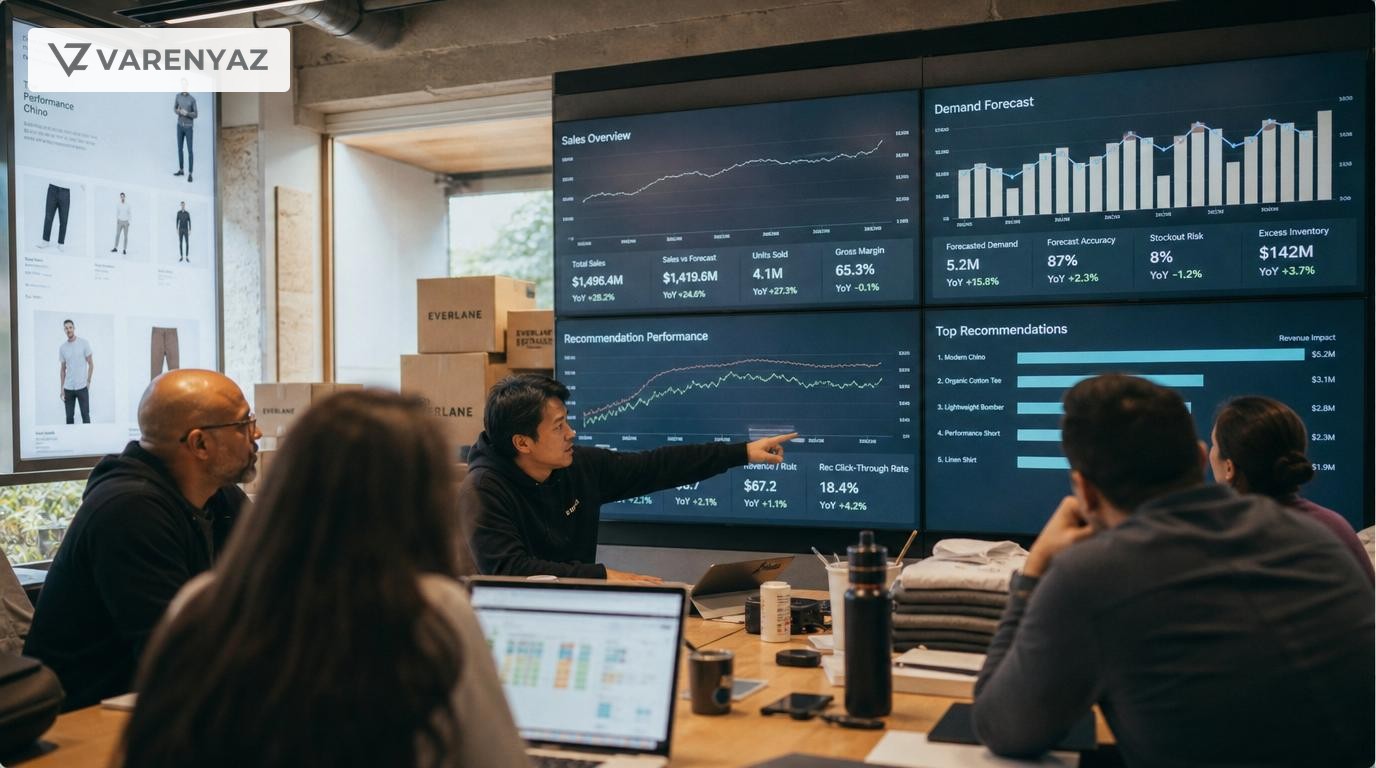
Exploring Predictive Analytics: A Pathway to Enhanced E-commerce & Retail
Why predictive analytics is no longer optional
The e-commerce and retail landscape has moved beyond simply collecting data. Every click, search, scan, and transaction generates signals. The challenge is turning those signals into timely, precise decisions. That is exactly where predictive analytics comes in.
Predictive analytics uses historical and real-time data to estimate what is likely to happen next: which products will sell, which customers might churn, how much inventory you will need, which promotion will resonate, and where fraud might appear. For retailers and e-commerce brands, these are not academic questions—they are the difference between profitable growth and razor-thin margins.
In this article, we will walk through what predictive analytics in e-commerce and retail really means, the business value, practical use cases, implementation steps, risks, and how to structure initiatives so they pay off in the real world—not just in dashboards.
Direct answer: What is predictive analytics in e-commerce and retail?
Predictive analytics in e-commerce and retail is the use of statistical and machine learning models on historical and real-time data to forecast future outcomes such as product demand, customer behavior, pricing response, and operational needs.
In practice, this means using your existing data—orders, traffic, inventory, customer engagement, returns, and more—to answer questions like:
- How much of each SKU should I stock by location next month?
- Which customers are likely to churn in the next 30 days?
- What price will maximize margin and conversion for this product?
- Which products should I recommend to this visitor right now?
- Is this transaction likely to be fraudulent?
The output is rarely just a yes/no answer. Models typically produce probabilities or forecasts that feed into merchandising, marketing, pricing, and operational decisions—sometimes through humans, sometimes automatically.
Why predictive analytics matters for modern retailers
From descriptive to predictive to prescriptive
Most retailers already use descriptive analytics—reports that explain what happened. Predictive analytics goes a step further by estimating what is likely to happen. When you add rules or optimization on top of that, you move toward prescriptive analytics—what you should do based on those predictions.
Example progression:
- Descriptive: Sales of Item A fell 15% last month.
- Predictive: Item A is likely to have low demand in the next four weeks.
- Prescriptive: Reduce purchase orders for Item A by 30% and shift budget to Item B, which is forecast to overperform.
Core business benefits
For decision-makers, the appeal of predictive analytics is straightforward:
- Better inventory decisions: Reduce lost sales from stockouts and capital locked in slow-moving inventory.
- More relevant customer experiences: Show the right product, offer, and content at the right time.
- Smarter pricing and promotions: Move beyond broad discounts to targeted, data-backed offers that preserve margin.
- Higher marketing efficiency: Focus spend on users and segments most likely to convert or grow in value.
- Lower risk and fraud: Spot abnormal patterns before they become costly problems.
McKinsey and others have documented that retailers who systematically apply advanced analytics across merchandising, pricing, and marketing outperform peers on revenue growth and margins. The gap is widening as leaders compound the advantage across more processes and channels.
Key predictive analytics use cases in e-commerce and retail
1. Demand forecasting and inventory optimization
Demand forecasting is often the most powerful and intuitive starting point for predictive analytics.
Instead of manual, spreadsheet-based forecasts, models analyze historical sales, seasonality, promotions, price changes, product lifecycle, and external factors (such as holidays or weather) to predict future demand at various levels—SKU, store, region, channel, or fulfillment node.
Business outcomes:
- Fewer stockouts on hero SKUs.
- Reduced overstock and markdowns.
- More accurate purchase orders and production planning.
- Better allocation between online and offline channels.
Advanced retailers feed these forecasts into automated replenishment, assortment decisions, and even supplier negotiations.
2. Product recommendation and personalization engines
Recommendation systems are one of the most visible and proven forms of predictive analytics in e-commerce. They predict what each user is likely to be interested in right now.
Models can be based on collaborative filtering (people similar to you bought X), content-based signals (you viewed products with certain attributes), or hybrid approaches that combine multiple signals and contextual data (device, time of day, traffic source).
Where recommendations appear:
- Home page and category pages ("recommended for you")
- Product detail pages ("customers also bought" or "frequently bought together")
- Cart and checkout flows ("complete your look" or add-ons)
- Emails, push notifications, and in-app messages
Used correctly, recommendations increase average order value, conversion rates, and customer satisfaction by reducing friction in product discovery.
3. Customer churn prediction and retention
Acquiring new customers is expensive; losing them quietly is even more costly. Churn prediction models estimate which customers are likely to stop buying or engaging within a given time frame.
They typically use signals like recency and frequency of purchases, browsing behavior, email and app engagement, customer service interactions, and changes in order value.
Churn predictions can power:
- Targeted win-back campaigns with tailored incentives.
- Personalized content to re-engage dormant customers.
- Prioritization for proactive customer service outreach.
- Input into customer lifetime value (CLV) models and budgeting.
Instead of sending generic discounts to everyone, you can reserve strong offers for high-value, high-risk customers and use lighter nudges for others.
4. Price and promotion optimization
Pricing in retail is a complex balance between competitiveness, brand positioning, and profitability. Predictive models help estimate how changes in price or promotions will affect demand and margin.
Common approaches include elasticity modeling (how demand changes with price), A/B testing combined with predictive uplift modeling, and more advanced reinforcement learning for dynamic pricing in large catalogs.
Use cases:
- Optimizing discount depth by product and segment, not just category.
- Testing and scaling promotional mechanics (e.g., bundles vs. percentage off).
- Dynamic pricing for fast-moving or perishable inventory.
- Localized pricing strategies across regions or channels.
The goal is not always to maximize short-term revenue; many retailers optimize for a balance of revenue, margin, and long-term customer value.
5. Fraud detection and risk scoring
As e-commerce scales, fraud attempts become both more frequent and more sophisticated. Predictive fraud detection models look for abnormal patterns across devices, locations, order values, payment methods, and historical behavior.
They produce a risk score, which can trigger actions like step-up verification, manual review, or blocking. Over time, models learn new patterns of fraud, improving protection while minimizing friction for legitimate customers.
6. Operations and supply chain analytics
Predictive analytics is also highly valuable behind the scenes:
- Warehouse operations: Forecast order volumes and SKUs to optimize labor scheduling and picking strategies.
- Logistics: Predict delivery times and delays, reroute shipments, and optimize carrier mix.
- Returns: Estimate which products or orders are likely to be returned and adjust quality checks or content (e.g., sizing guidance) accordingly.
These operational improvements may be less visible to customers, but they have substantial impact on cost-to-serve and customer satisfaction.
What you need to enable predictive analytics
1. The right data foundation
Predictive analytics is only as strong as the data behind it. You do not need perfect data to start, but you do need a minimum viable foundation.
Key data sources:
- Transactional data: Orders, line items, payments, refunds, returns.
- Product and catalog data: SKUs, attributes, categories, hierarchies, availability.
- Customer and account data: Profiles, segments, lifecycle stage, preferences.
- Behavioral data: Website and app events, searches, clicks, journeys, cart activity.
- Operational data: Inventory, lead times, supplier performance, shipping times.
- Marketing data: Campaigns, channels, spend, impressions, clicks.
Data quality priorities:
- Consistent identifiers for customers, orders, and products.
- Accurate timestamps and time zones.
- Clean product hierarchies and attributes.
- Defined rules for handling cancellations, returns, and partial shipments.
2. Infrastructure and tools
You can build predictive capabilities using a mix of cloud and SaaS tools. Typical components include:
- Data warehouse or lakehouse: Central store for analytics-ready data (e.g., BigQuery, Snowflake, Redshift).
- ETL/ELT and integrations: Pipelines that bring data from e-commerce platforms, POS, marketing tools, and databases into the warehouse.
- Customer data platform (CDP) or event tracking: For unifying identities and capturing behavioral events across web, app, and offline.
- ML platforms and libraries: Tools for building, training, and deploying models (e.g., managed ML platforms, Python/R stacks).
- Business intelligence tools: Dashboards for stakeholders to consume predictions and monitor performance.
Many e-commerce platforms and cloud providers offer pre-built recommendation engines and forecasting services, which can be a pragmatic starting point. Custom models become more valuable when you have unique data, complex operations, or differentiated experiences to build.
3. Skills and operating model
Predictive analytics is a team sport. Core roles include:
- Business owners: Own outcomes (e.g., head of merchandising, CRM lead, supply chain leader).
- Data engineers: Build and maintain data pipelines and infrastructure.
- Data scientists / ML engineers: Design, train, and deploy models.
- Product managers: Integrate model outputs into user journeys and internal workflows.
- Analysts: Monitor impact, run experiments, and refine KPIs.
Smaller organizations often rely on hybrid roles or external partners to cover these capabilities. What matters most is that projects have clear owners, defined success metrics, and a path from prediction to action.
Implementation roadmap: From idea to impact
Step 1: Clarify the business problem
Instead of starting with "we need AI," start with a concrete, high-value question. Examples:
- "We want to reduce stockouts on our top 500 SKUs by 30% in the next 12 months."
- "We want to reduce churn among our subscription customers by 15%."
- "We want to increase average order value by 10% without broadly increasing discounts."
Translate that question into a measurable outcome and a time frame. Then identify who owns the outcome and which levers (pricing, assortment, communications, etc.) can be adjusted in response to predictions.
Step 2: Audit and prepare your data
For the chosen use case, list the data you already have and the gaps. For example, for demand forecasting:
- Do you have at least 12–24 months of historical sales?
- Are returns and cancellations properly recorded?
- Do you track promotions and price changes historically?
- Are products consistently categorized?
Prioritize fixes that directly affect model reliability: missing data, inconsistent IDs, or incorrect timestamps. Avoid waiting for perfect data; improve iteratively.
Step 3: Choose your approach and tools
Decide whether to:
- Use built-in predictive features in your e-commerce, marketing, or analytics platforms.
- Adopt a cloud-native AI service (for example, recommendations or forecasting APIs).
- Develop custom models with support from internal teams or partners.
For many retailers, a hybrid approach makes sense: start with managed services for recommendations or basic forecasting, and layer custom models for specialized cases like regional price optimization or complex supply chains.
Step 4: Build, validate, and benchmark models
During model development:
- Split data into training and validation sets to avoid overfitting.
- Choose evaluation metrics aligned with business goals (e.g., forecast accuracy, lift in conversion, reduction in churn).
- Compare models not just on technical metrics but on expected commercial value.
Run backtests where possible: simulate how the model would have performed historically compared with current processes. Use this to estimate potential impact before live deployment.
Step 5: Integrate predictions into workflows
A prediction without an action is just an interesting number. To realize value:
- Embed demand forecasts into replenishment systems and buying decisions.
- Connect recommendations to your CMS, website, and app components.
- Feed churn scores into CRM journeys and customer support tools.
- Use pricing predictions to trigger rule-based or algorithmic price changes.
Define clear rules for how teams should respond to predictions, including thresholds (e.g., "if churn probability is above 70%, trigger retention flow").
Step 6: Monitor, learn, and iterate
Once live, treat predictive models as products, not one-off projects.
- Track both model performance (accuracy, bias) and business KPIs (revenue, margin, stockout rate).
- Set up alerts for model drift—when patterns change and predictions degrade.
- Retrain models regularly using fresh data.
- Run controlled experiments (A/B tests) to quantify impact.
Continuous improvement ensures that your predictive capabilities stay aligned with evolving customer behavior, assortment, and market conditions.
Risks, tradeoffs, and governance considerations
1. Data privacy and compliance
Retailers often process personal data—names, contact details, behavioral logs, and sometimes payment-related information. When using this data for predictive analytics, you must respect privacy regulations such as GDPR and CCPA, along with your own privacy policy commitments.
Key considerations:
- Minimize data collection to what is necessary for the use case.
- Use consent and preference management for personalized experiences.
- Apply anonymization or pseudonymization where possible.
- Limit access to raw data and sensitive features.
2. Bias and fairness
Predictive models learn patterns from historical data, which may reflect biases (for example, geographical or demographic skew in past promotions or service levels). If left unchecked, this can reinforce unfair outcomes—for instance, systematically offering better deals to certain regions or segments without justification.
To mitigate this:
- Review which features are included in models and why.
- Monitor outcomes across key customer segments.
- Use fairness checks and constraints where appropriate.
- Blend automated decisions with human oversight in sensitive use cases.
3. Over-automation and customer trust
Automation can backfire if it leads to unpredictable, opaque behavior. Dynamic pricing, for example, can trigger customer backlash if similar customers see wildly different prices without clear logic.
Balance automation with transparency and guardrails:
- Set limits on price changes or frequency.
- Retain manual override options for key categories or events.
- Explain, in plain language, why customers see certain recommendations or offers when appropriate.
4. Organizational adoption and change management
Often, the biggest risk is that predictive analytics becomes a side project rather than a core capability. Merchandisers, marketers, and operations teams may hesitate to trust models that feel like "black boxes."
Address this by:
- Bringing end-users into the design process early.
- Sharing intuitive visualizations and explanations of predictions.
- Pilot-testing in limited scopes to build confidence.
- Aligning incentives and KPIs with analytics-informed decisions.
Geo and scale considerations: India, US, UK and beyond
While the principles of predictive analytics are consistent, practical implementation varies by market.
India
In India, rapidly growing digital adoption, cash-on-delivery preferences in some segments, infrastructure variability, and regional diversity shape data patterns. Retailers need models that account for:
- High mobile traffic and app-centric journeys.
- Dense festival-driven seasonality and local events.
- Urban versus non-urban logistics constraints.
Data collection from marketplaces, D2C websites, and offline outlets can be fragmented, making integration a priority.
United States
US retailers often operate mature omnichannel environments with multiple legacy systems and complex supply chains. Key themes include:
- Integrating stores, e-commerce, and third-party platforms.
- Using predictive analytics for advanced assortment optimization.
- Balancing algorithmic personalization with strong privacy expectations.
United Kingdom
In the UK, retailers face intense competition and high customer expectations for convenience and sustainability. Predictive analytics is often applied to:
- Fine-tuning local assortments and delivery promises.
- Reducing food waste and overstock in grocery and FMCG.
- Optimizing promotions under tight margin pressure.
Regulatory considerations (including UK GDPR) and data ethics are an important part of solution design.
Measuring success: What good looks like
To keep predictive analytics grounded in real outcomes, define clear metrics upfront. Examples include:
- Demand forecasting: Reduction in stockouts, improvement in forecast accuracy, decrease in excess inventory and markdowns.
- Recommendations: Uplift in conversion rate, average order value, and click-through rates; impact on repeat purchases.
- Churn prediction: Reduction in churn rate for targeted segments; increase in retained revenue and CLV.
- Pricing: Margin improvement, revenue growth at stable or improved margin, promotion ROI.
- Operations: Reduced fulfillment time, lower logistics costs per order, fewer returns.
For each project, identify a baseline, implement an experiment design (such as test vs. control groups), and agree on the timeframe for evaluation. This rigor builds trust and helps justify further investment.
Practical next steps for decision-makers
1. Choose one flagship use case
Instead of launching a dozen pilots, select one or two flagship use cases where predictive analytics can deliver visible impact in the next 6–12 months. Popular starting points include:
- Demand forecasting for a critical category or region.
- Product recommendations on high-traffic pages.
- Churn prediction for a subscription line or loyalty program.
2. Align teams and responsibilities
Nominate a senior sponsor and define cross-functional squads. Align on:
- Business objective and KPIs.
- Data ownership and access.
- Delivery timeline and milestones.
- Decision rights—who can change pricing, stock, or campaign rules based on predictions.
3. Close critical data gaps
Conduct a rapid data gap assessment for your chosen use case. Fix foundational issues like missing event tracking, inconsistent customer IDs, or catalog attributes that hinder analytics. Invest in instrumentation within your website, app, and POS so events are captured cleanly from day one.
4. Decide build vs. buy vs. partner
Evaluate whether you have the in-house skills and capacity to design, implement, and maintain predictive models at the required pace. Many teams choose a blended strategy:
- Use off-the-shelf capabilities where they are strong (e.g., generic recommendations or forecasting).
- Build custom models where differentiation matters.
- Bring in partners to accelerate architecture, integration, and model operationalization.
5. Design for extensibility
Think beyond the first project. Set up data models, tracking, APIs, and governance in a way that can support multiple predictive use cases in the future—marketing, merchandising, pricing, and operations. This avoids rebuilding foundations for each new initiative.
How VarenyaZ supports predictive analytics journeys
Real-world predictive analytics in e-commerce and retail is not just about models—it is about how your digital experience, data infrastructure, and AI capabilities work together.
VarenyaZ helps retailers and e-commerce brands by:
- Designing data-ready web and app experiences: Implementing tracking, event schemas, and architectures that capture the right behavioral signals for future predictive models.
- Building robust web and e-commerce platforms: Developing or modernizing storefronts, headless commerce, and back-office systems with clean integrations to analytics and data warehouses.
- Developing and integrating AI models: Creating custom recommendation engines, demand forecasting models, churn prediction systems, and pricing tools, then embedding them into journeys and dashboards.
- Ensuring governance and scalability: Setting up monitoring, retraining pipelines, and documentation so predictive analytics remains reliable as data and business needs evolve.
If you are exploring how predictive analytics can improve your e-commerce or retail performance and want a partner who can connect strategy, data, web platforms, and AI, talk to the VarenyaZ team at https://varenyaz.com/contact/.
By bringing together thoughtful web design, scalable web development, and practical AI development, VarenyaZ helps transform predictive analytics from a buzzword into a daily engine for better decisions, smoother operations, and more profitable growth.
Editorial Perspective
Expert Review Notes
"In retail and e-commerce, predictive analytics delivers outsized value when it is wired directly into pricing, merchandising, and marketing decisions instead of living as reports no one acts on."
"The real competitive edge is not the most complex model, but the cleanest data and the fastest path from prediction to an automated action in your customer journey or supply chain."
"Successful brands treat predictive analytics as a continuous capability—testing, retraining, and refining models as customer behavior and product assortments evolve."
Frequently Asked Questions
What is predictive analytics in e-commerce and retail?
Predictive analytics in e-commerce and retail uses historical and real-time data, combined with statistical and machine learning models, to estimate the likelihood of future events. Typical examples include forecasting product demand, predicting which customers are likely to churn, estimating the best price point for a product, and identifying which users are most likely to respond to a campaign.
Which predictive analytics use cases deliver the fastest ROI for retailers?
Fastest-ROI use cases usually focus on revenue and inventory. Demand forecasting reduces stockouts and overstock, churn prediction targets at-risk high-value customers, recommendation systems increase average order value, and price optimization improves margins. Starting with a single product category, region, or segment makes it easier to prove value and scale.
Do small and mid-sized e-commerce brands really need predictive analytics?
Yes, especially as customer acquisition costs rise and competition intensifies. You do not need a full data science team to benefit. Many cloud analytics platforms, recommendation engines, and marketing tools now expose built-in predictive capabilities. Smaller brands can start with lightweight models or vendor tools, focusing on one or two clear problems such as replenishment or cart abandonment.
What data is required to build reliable predictive models for retail?
Core inputs include transaction history, product catalog and attributes, inventory levels, website and app events, customer profiles and engagement data, and basic marketing data. For advanced use cases, retailers add signals like returns data, store traffic, regional events, and weather or macroeconomic indicators. Consistent IDs, clean timestamps, and standardized product attributes are often more important than sheer data volume.
How long does it take to see results from predictive analytics projects?
Timelines vary by scope and data readiness. Many retailers can deploy a first predictive model—such as demand forecasting for a limited set of SKUs or a simple churn model—in 8 to 12 weeks, assuming basic data access and infrastructure. Measurable impact typically appears within one to three business cycles, especially when teams are prepared to adjust merchandising, pricing, or marketing actions in response to model outputs.
How can VarenyaZ help my business adopt predictive analytics?
VarenyaZ helps align your digital platforms and data flows so they are ready for AI and predictive modeling. The team can design and build data-aware websites and e-commerce experiences, integrate tracking and data pipelines, develop and deploy custom predictive models, and embed insights into dashboards and workflows. This end-to-end approach keeps analytics grounded in commercial outcomes, not standalone experiments.
Selected References
Further Reading
Related perspectives
Predictive Analytics for Smarter E-commerce
Predictive analytics in e-commerce and retail uses historical and real-time data to forecast customer behavior, demand, and risk so teams can take smarter actions before events happen. It powers better merchandising, personalized journeys, dynamic pricing, and fraud detection. This guide explains the core concepts, value levers, data foundations, technology options, and governance needed to deploy predictive models that actually move revenue and margin, while avoiding common pitfalls like biased data, fragile models, and black-box decisioning.
Digital Transformation Roadmaps for Real Estate
A digital transformation roadmap in real estate is a structured plan that aligns technology investments with business goals such as faster leasing, higher occupancy, better owner reporting, and improved tenant experience. It maps current pain points, defines target capabilities, prioritizes initiatives like data platforms, AI tools, and self-service portals, and phases delivery over time. The roadmap should include governance, change management, vendor choices, cybersecurity, and ROI tracking. This article explains the key components, implementation phases, risks, tradeoffs, and outlines how partners like VarenyaZ support web, product, and AI execution.
Property CRM Integrations for Modern Retail
Property CRM integrations connect legacy store, location, and asset systems with modern e-commerce, marketing, and analytics platforms. In 2026, brands need API-first, event-driven architectures that unify property and customer data into a shared “source of truth”, powering real-time inventory, booking, and hyper-personalised experiences. This article explains the business value, key architectural choices, migration patterns, and risks, and offers a step-by-step modernization roadmap. It closes with how a specialist partner like VarenyaZ can help design, build, and maintain integrated web, CRM, and AI solutions.