
How AI Drives Revenue Growth in Transport & Logistics
Discover how AI solutions drive revenue growth in transportation and logistics through dynamic pricing, network optimization, automation, and new services.

Quick Answer
AI solutions help transportation and logistics companies grow revenue by improving asset utilization, optimizing prices and routes, reducing delays, and enabling new digital services for shippers. This article explains the main AI use cases, how they translate into measurable revenue, and the data, technology, and change-management foundations required. It also covers risks like biased pricing, operational disruption, and integration complexity, and offers a practical roadmap to move from pilots to production. The article closes with how VarenyaZ supports web, product, and AI development for logistics players.
In this article
Coverage signals
14 min
Jun 27, 2026
VarenyaZ Editorial Desk, Technical Content Review
Updated Jun 27, 2026
Key Takeaways
- AI solutions for transportation and logistics directly impact revenue by improving utilization, pricing, reliability, and customer retention.
- The strongest AI value comes from connecting demand forecasting, dynamic pricing, and network optimization in a single decision loop.
- Data quality, integration with TMS/WMS/ERP, and clear ownership between commercial and operations teams are more critical than model complexity.
- AI can enable new revenue streams such as capacity-as-a-service, premium SLAs, and embedded logistics services in partner platforms.
- Risks like biased pricing, black-box decisions, and operational disruption can be mitigated with governance, explainability, and staged rollouts.
- Start with a narrow, high-value use case, measure impact in terms leaders care about, then expand to more advanced optimization and automation.
- AI requires both technical foundations and change management, especially for dispatchers, planners, and sales teams who rely on new recommendations.
- Partners like VarenyaZ help logistics companies move from concepts to production-grade AI solutions that integrate with web platforms and core systems.
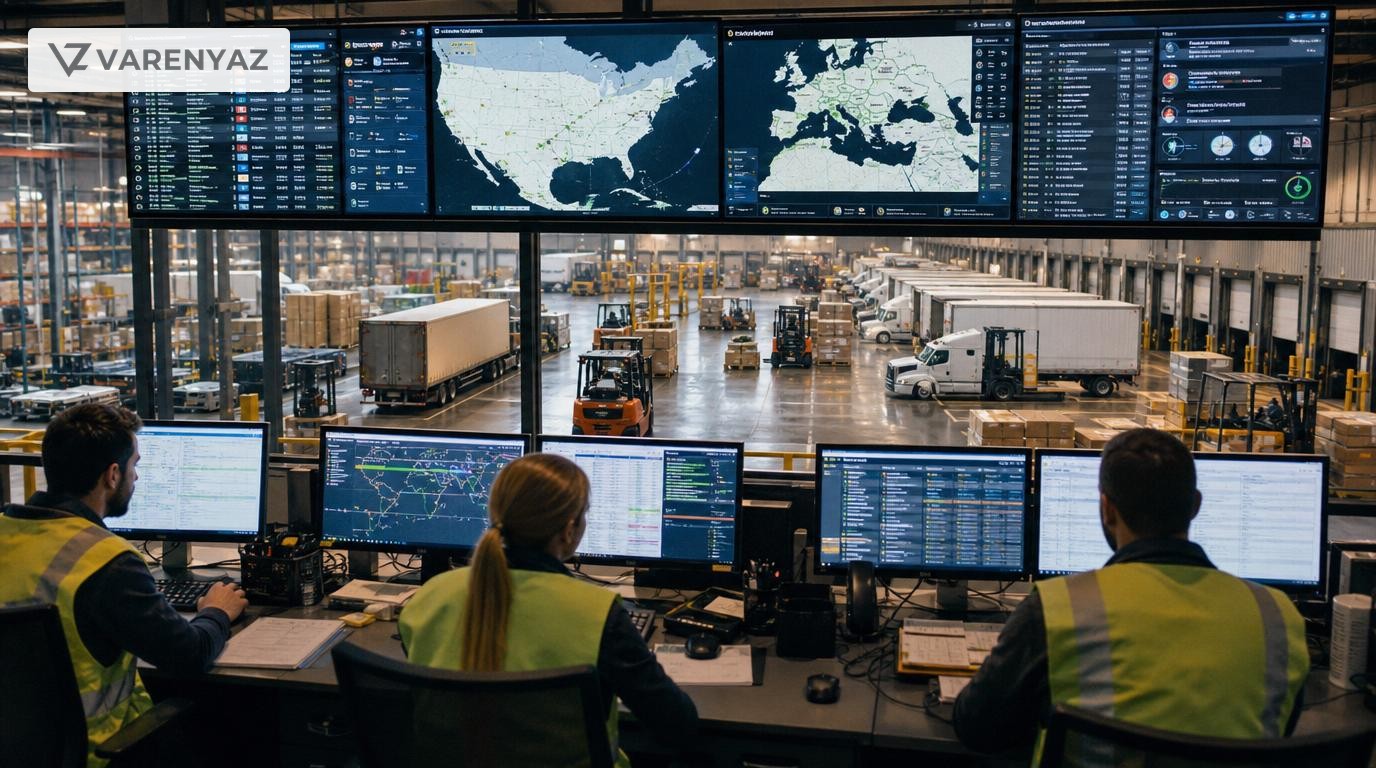
Why AI Solutions Are Now Central to Revenue Growth in Transportation & Logistics
Transportation and logistics used to grow revenue mostly by adding more trucks, more routes, more warehouses, and more people. That playbook is breaking down.
Margins are thin, demand is volatile, and customers expect Amazon-level visibility and speed at commodity prices. Simply adding more capacity no longer guarantees profitable growth.
This is where AI solutions for transportation and logistics have become a revenue engine rather than just a cost-savings tool. When properly implemented, AI helps you:
- Fill assets more efficiently and reduce empty miles
- Price capacity dynamically and profitably
- Predict and prevent service failures that erode revenue
- Launch new digital products and premium services that customers will pay for
In this article, we will unpack how AI translates into top-line growth, what it really takes to implement in live operations, and how to balance the opportunities and risks.
Direct Answer: How AI Drives Revenue in Transport & Logistics
AI drives revenue growth in transportation and logistics by improving yield on existing capacity, identifying the most profitable freight to move, and preventing failures that cause lost customers. It analyzes historical and real-time data to forecast demand, optimize prices, and match loads and routes so your trucks, containers, and delivery assets generate more revenue per kilometer, per hour, and per shipment. AI also enables premium and value-added services such as guaranteed ETAs, dynamic SLAs, and embedded logistics offerings that customers are willing to pay for.
The Pressure on Transportation & Logistics Revenue Models
Across road, ocean, air, and last mile, operators face a similar set of pressures:
- Demand volatility: Ecommerce peaks, seasonal spikes, and macro shocks make planning difficult.
- Rising operating costs: Fuel, driver wages, handling, warehousing, and regulatory compliance all eat into margins.
- Customer expectations: Shippers and consumers expect real-time visibility, narrow delivery windows, and flexible options.
- Price competition: Digital freight platforms make price comparison trivial, pushing rates down.
Most traditional levers—manually negotiated contracts, fixed rate cards, and rigid routes—were designed for more stable environments. Today, logistics organizations need to match demand and capacity much more dynamically to grow revenue without taking on unsustainable cost.
AI excels at exactly this kind of dynamic, data-heavy decision-making.
The Core Revenue Levers AI Unlocks
When you strip away the buzzwords, AI solutions in logistics affect four primary revenue levers:
1. Better Utilization of Assets
Every empty kilometer, half-full trailer, or idle vehicle is lost revenue. AI helps increase load factors and reduce wasted mileage by:
- Forecasting demand accurately by lane, day of week, and customer segment.
- Optimizing routes and schedules to pack more stops into the same time window without sacrificing service.
- Matching loads to capacity in real time, considering constraints like driver hours, vehicle type, and delivery windows.
Even modest improvements in utilization compound quickly. For a fleet that runs thousands of trips a week, more revenue per truck per day translates into significant top-line growth.
2. Smarter, Dynamic Pricing
Static tariffs and manual spot quotes miss opportunities on both sides: underpricing scarce capacity and overpricing when spare capacity is abundant.
AI-powered dynamic pricing analyzes historical rates, competitive benchmarks, demand forecasts, and real-time capacity to recommend the best price per shipment or lane. It can also segment customers by sensitivity and lifetime value, suggesting when to accept lower rates to keep strategic accounts and when to hold firm.
This allows you to:
- Capture more value during peak demand without losing key customers
- Fill backhaul and low-utilization lanes with targeted, profitable discounts
- Automate quote responses, resulting in faster deal closure and higher conversion
3. Higher Reliability and Customer Retention
On-time, damage-free, predictable delivery is a revenue strategy, not just an operations metric. Frequent delays, missed pickups, and poor communication directly lead to churn.
AI helps by:
- Predicting ETAs more accurately using real-time traffic, weather, and network conditions.
- Flagging at-risk shipments early so teams can intervene and recover service.
- Optimizing consolidation and cross-dock flows to avoid bottlenecks that cause cascading delays.
Customers will pay more—and stay longer—for reliable performance backed by transparent, AI-enhanced visibility.
4. New Digital and Premium Services
AI also opens doors to entirely new revenue streams, such as:
- Premium SLAs with guaranteed ETAs and priority handling, priced based on risk models.
- Self-service portals and APIs where customers can get instant quotes, bookings, and dynamic options.
- Embedded logistics services in partner platforms, like ecommerce checkout or B2B order systems.
By using AI to expose your capacity, service performance, and pricing as intelligent products, you move from a pure carrier or 3PL to a digital logistics partner.
Key AI Use Cases That Directly Impact Revenue
Let’s break down the most common logistics AI applications and link each to revenue outcomes.
1. Demand Forecasting and Network Planning
What it is: Machine learning models predict shipment volumes, product mix, and destination patterns by time, lane, and customer.
Why it matters for revenue:
- Reduces over- or under-booking, supporting higher fill rates.
- Improves allocation of vehicles, drivers, and warehouse resources to high-value lanes and customers.
- Enables more confident commitments to large customers and bids.
Studies and industry reports from organizations like DHL and IBM highlight that accurate forecasting is a foundational capability for more advanced optimization and automation across logistics networks.
2. Dynamic Pricing and Quotation Engines
What it is: Algorithms that calculate real-time prices and margins based on capacity, demand, competition, and service levels, supporting instant quotes and contract negotiations.
Revenue impact:
- Improves average yield per shipment while remaining competitive.
- Increases win rates on spot freight and short-term contracts.
- Reduces manual pricing time, letting sales focus on relationship-building and complex deals.
Implemented well, dynamic pricing helps balance volume and profitability lane by lane.
3. Route, Load, and Network Optimization
What it is: AI and optimization algorithms that design more efficient routes, load plans, and network flows (including hub-and-spoke vs. point-to-point decisions).
Revenue impact:
- Raises the number of stops or shipments per route while keeping service levels.
- Reduces empty miles and improves backhaul utilization.
- Supports differentiated service tiers (e.g., economy vs. premium) with distinct routing strategies.
Although optimization has been used in logistics for years, modern AI models can adapt plans in near real-time based on live conditions instead of static, overnight batch runs.
4. Predictive Maintenance for Vehicles and Equipment
What it is: AI models trained on telematics and sensor data predict when vehicles, trailers, or handling equipment are likely to fail or require service.
Revenue impact:
- Reduces unplanned downtime that would take capacity out of the network.
- Prevents disruptions that cause missed deliveries and penalties.
- Extends asset life, freeing up capital for growth investments.
Predictive maintenance is often framed as a cost-saving measure, but in high-utilization networks it also protects revenue by keeping capacity reliably available.
5. Real-Time Visibility, ETA Prediction, and Exception Management
What it is: AI combines GPS, IoT, traffic, and operational data to provide reliable ETAs and highlight shipments at risk of delay or damage.
Revenue impact:
- Shippers value accurate ETAs and may pay more for guaranteed delivery windows.
- Proactive exception handling preserves relationships when things go wrong.
- Real-time status becomes a differentiating feature in customer portals and APIs.
When your visibility platform is AI-augmented, it moves from “tracking” to “anticipating” issues, which is far more valuable to customers.
6. AI-Powered Customer Experience and Self-Service
What it is: Intelligent chatbots, guided workflows, and recommendation engines embedded in customer portals, apps, and websites.
Revenue impact:
- Increases conversion by answering questions and providing quotes 24/7.
- Boosts upsell and cross-sell by recommending service upgrades or consolidation options.
- Reduces churn through faster resolution and personalized experiences.
Combined with strong product design and web development, AI can transform your digital channels into always-on revenue drivers.
From Use Case to Business Case: Quantifying AI Revenue Impact
Business leaders often ask: How much revenue can we realistically gain from AI? The answer varies by starting point, but the method to calculate the opportunity is consistent.
Step 1: Define the Revenue Metric
Focus on concrete metrics such as:
- Revenue per truck per day or per route
- Revenue per container lift or per terminal slot
- Revenue per delivery zone or rider (for last mile)
- Yield per lane or per customer segment
Step 2: Link AI Use Case to Metric
For each AI use case, articulate the mechanism:
- Dynamic pricing: Increases average yield per shipment by X–Y%.
- Route optimization: Allows Z% more deliveries per route.
- Demand forecasting: Reduces forecast error, improving capacity allocation and reducing lost sales.
- Predictive maintenance: Decreases unplanned downtime, keeping more revenue-generating capacity available.
Step 3: Run Scenario Analysis
Use historical data to run “what-if” scenarios: What would last quarter’s revenue have been with 2%, 5%, or 10% higher utilization and improved pricing? This makes AI benefits tangible and helps prioritize investments.
Implementation Foundations: Data, Systems, and People
AI solutions rarely fail because the model is wrong. They fail because data, integration, or change management are not ready. For transportation and logistics, three foundations matter most.
1. Data Quality and Governance
You need consistent, reasonably clean data across:
- Orders, bookings, and shipments
- Routes, stops, lead times, and ETAs
- Capacity, fleet, and asset utilization
- Prices, discounts, and margins
Start with a data audit: Where does the data come from? How complete is it? How many gaps and inconsistencies exist? Clarify ownership (e.g., operations vs. finance vs. IT) and create simple processes for correction and improvement.
2. Integration with Core Systems (TMS, WMS, ERP)
AI must plug into the systems that run your business. Otherwise, it becomes a disconnected dashboard that no one uses.
Typical integration points include:
- TMS (Transportation Management System): for orders, routes, carriers, and execution.
- WMS (Warehouse Management System): for inventory, picking, and yard operations.
- ERP and billing: for prices, contracts, and financial performance.
- Telematics and IoT platforms: for vehicle and asset data.
Modern AI solutions use APIs, event streams, and cloud-based data platforms to connect these systems in near real time.
3. Change Management and Human-in-the-Loop
Dispatchers, route planners, and sales teams have deep practical knowledge. AI should enhance, not replace, their expertise.
Successful AI deployments:
- Start with decision support (recommendations) before moving to full automation.
- Explain why the model recommends a given price or route.
- Provide clear ways for users to override or adjust recommendations.
- Include feedback loops so the model learns from user corrections.
This builds trust and acceptance, making it more likely that AI outputs are actually used in day-to-day decisions.
Risks, Tradeoffs, and How to Manage Them
No serious AI strategy ignores risks. In transportation and logistics, several deserve specific attention.
Risk 1: Black-Box Decisions and Loss of Trust
If planners and sales teams cannot understand or challenge AI recommendations, they may ignore them—or worse, follow them blindly and create issues.
Mitigation: Use explainable models where possible, highlight key drivers of recommendations, and provide scenario tools so humans can see tradeoffs (e.g., revenue vs. on-time performance).
Risk 2: Biased or Unfair Pricing
Dynamic pricing models can inadvertently embed biases if trained on historical data that reflects unfair practices.
Mitigation: Implement fairness checks, monitor pricing patterns, and enforce business rules and constraints. Regularly review outputs for unintended bias, especially for consumer-facing services.
Risk 3: Operational Disruption
Overly aggressive optimization can push networks beyond what drivers, warehouses, or partners can actually sustain.
Mitigation: Include realistic constraints in models and run pilots in limited regions or fleets before full rollout. Keep a human-in-the-loop during early stages.
Risk 4: Overinvestment in Pilots That Never Scale
Many organizations get stuck in proof-of-concept mode: multiple pilots, few production deployments, and little measurable revenue impact.
Mitigation: Tie each AI project to a specific business outcome, define success metrics upfront, and plan integration and change management from day one—not as an afterthought.
Practical Roadmap: From Concept to Production
To move beyond experimentation and into revenue-generating AI, a structured roadmap helps.
Phase 1: Discovery and Prioritization
- Clarify your growth goals: revenue per asset, new services, or market expansion.
- Map your value chain from booking to delivery and invoicing.
- Identify friction points and opportunities where AI can influence revenue directly.
- Prioritize 1–2 use cases with strong business value and manageable data needs.
Phase 2: Data Readiness and Architecture
- Consolidate key data sources into a stable, accessible environment (often a cloud data platform).
- Define data models and governance suitable for AI and analytics.
- Set up secure integrations with TMS, WMS, ERP, and telematics systems.
Phase 3: Pilot and Measured Rollout
- Build an initial model and embed it into a limited operational scope—e.g., a set of lanes, a single warehouse, or a specific fleet.
- Track before-and-after KPIs such as utilization, revenue per trip, win rates, or on-time performance.
- Gather qualitative feedback from users and iterate on both model and UI.
Phase 4: Industrialization and Scale
- Harden models and pipelines for reliability, monitoring, and security.
- Expand scope across regions, business units, or service lines.
- Standardize AI-enabled workflows and training for operations and sales teams.
- Continuously refine models as new data and behaviors emerge.
Regional Nuances: India, the US, and the UK
While the AI principles are global, some nuances matter across regions such as India, the United States, and the United Kingdom.
India
In India, logistics networks often operate with fragmented fleets, diverse road conditions, and rapid ecommerce growth. AI can help by:
- Optimizing last-mile networks in dense urban areas.
- Balancing cost and service for tier-2 and tier-3 cities.
- Helping smaller carriers and 3PLs participate in digital freight platforms.
United States
In the US, the trucking and parcel sectors are highly competitive and data-rich. AI delivers value by:
- Fine-tuning yields on high-volume lanes and contracts.
- Optimizing intermodal flows across road, rail, and ocean.
- Enhancing premium services such as time-definite delivery and returns logistics.
United Kingdom
In the UK, dense networks, regulatory constraints, and cross-border trade with Europe create complexity. AI applications include:
- Optimizing urban deliveries under environmental and congestion regulations.
- Managing cross-border flows and customs-related delays more proactively.
- Designing flexible capacity strategies given space and infrastructure constraints.
Where Web, Product, and AI Come Together
AI alone does not create value. The value appears when AI is tightly integrated with customer-facing experiences and operational tools.
This means combining:
- AI development: models, data pipelines, decision engines.
- Web and product development: portals, apps, and APIs where shippers interact.
- Systems integration: TMS, WMS, ERP, CRM, and telematics.
For example:
- A dynamic pricing engine linked to your web booking portal can return instant quotes with smart upsell options.
- AI-driven routing can surface delivery window options in your ecommerce checkout, with price differences clearly visible.
- Predictive ETA models can drive automated notifications and exception workflows in your customer apps.
To explore how AI-infused digital products could drive revenue in your logistics business, you can reach out to the VarenyaZ team at https://varenyaz.com/contact/.
How VarenyaZ Helps Transportation & Logistics Companies
At VarenyaZ, we work with transportation and logistics organizations to turn AI from a buzzword into a measurable revenue driver.
1. Strategy and Use-Case Design
We help leaders clarify where AI will have the most impact on their P&L by:
- Assessing current digital maturity and data readiness.
- Identifying high-ROI use cases like dynamic pricing, forecasting, or route optimization.
- Building a roadmap that sequences quick wins with longer-term capabilities.
2. Data and AI Development
Our AI team designs and implements end-to-end solutions, including:
- Data integration from TMS, WMS, ERP, and telematics systems.
- Machine learning models for forecasting, optimization, and recommendations.
- Monitoring, evaluation, and retraining pipelines to keep models accurate and reliable.
3. Web, Product, and Platform Engineering
We also build the digital products and interfaces that make AI tangible for users and customers:
- Shipper portals and partner dashboards.
- Mobile apps for drivers, couriers, and warehouse teams.
- Public and partner APIs that expose pricing, capacity, tracking, and booking functionality.
Our focus is on user experience as much as technology, ensuring AI recommendations are easy to understand and act on.
4. Ongoing Optimization and Support
AI in logistics is not a one-off project; it’s an evolving capability. VarenyaZ supports clients with:
- Continuous improvement of models as new data becomes available.
- Feature enhancements to portals and apps based on customer feedback.
- Governance, documentation, and knowledge transfer to internal teams.
Conclusion: AI as a Revenue Engine, Not Just a Cost Lever
Transportation and logistics have always been about moving goods efficiently. AI takes that mission to a new level by aligning pricing, capacity, routes, and customer experience around real-time intelligence.
When AI is connected to your core systems and digital channels, it becomes a revenue engine—unlocking better utilization, more profitable pricing, reliable delivery, and new value-added services.
VarenyaZ helps transportation and logistics businesses make this shift by combining web design, web development, and AI development into cohesive, production-ready solutions. From data strategy to customer portals and AI decision engines, we work with you to turn your logistics network into a digitally enabled growth platform.
Editorial Perspective
Expert Review Notes
"The turning point for AI in transportation and logistics is when it stops being a dashboard and starts making operational decisions directly in your TMS, dispatch, and pricing workflows."
"For most logistics operators, the biggest AI opportunity is not a moonshot model, but the discipline to use accurate forecasts and optimization results every single day across the network."
"If you align AI projects to specific revenue metrics like yield per lane, on-time performance, and capacity utilization, it becomes far easier to secure sponsorship and prove ROI."
Frequently Asked Questions
How does AI actually increase revenue for transportation and logistics companies?
AI increases revenue by improving how effectively you use existing assets, how you price capacity, and how reliably you deliver. Concretely, AI can reduce empty miles, raise load factors, identify the most profitable freight to accept, and support dynamic pricing based on demand and capacity. It also helps improve on-time performance and customer experience, which boosts retention and upsell opportunities.
What are the most impactful AI use cases in logistics today?
High-impact AI use cases in logistics include demand forecasting, dynamic pricing of freight and last-mile deliveries, route and network optimization, ETA prediction, predictive maintenance of vehicles and equipment, intelligent dispatching, fraud and anomaly detection, and customer-facing tools like track-and-trace with proactive alerts. These use cases directly affect revenue, cost-to-serve, or both.
How much data do we need to start using AI in transportation and logistics?
You don’t need perfect data to start, but you do need consistent historical records on orders, shipments, routes, timings, capacity, and prices. Most companies can begin with 6–18 months of transactional and operational data. Over time, adding telematics, GPS, IoT and external data such as weather or traffic further improves the accuracy and business impact of AI models.
What are the main risks of deploying AI in logistics operations?
Key risks include black-box decisions that teams don’t trust, biased or unfair pricing recommendations, operational disruptions if AI changes plans too aggressively, and integration failures with TMS, WMS, or ERP systems. These can be mitigated through explainable models, clear guardrails, human-in-the-loop review during rollout, and robust testing in controlled pilots before scaling.
How do we get started with AI solutions without overcommitting budget and time?
Start with one focused use case that has clear revenue impact and a manageable scope, such as demand forecasting for a specific lane group or AI-assisted pricing for a product line. Run a 8–12 week pilot with defined metrics like revenue per truck per day or on-time delivery rate. Then, if the business case is proven, expand the solution across more regions, products, or fleets with a phased roadmap.
How can a partner like VarenyaZ help with AI in transportation and logistics?
VarenyaZ helps by assessing your data and systems, defining high-ROI AI use cases, and building production-ready models that integrate with your TMS/WMS and digital platforms. Our team combines web and product engineering with AI development, so we can deliver both the decision intelligence layer and the customer-facing applications that turn those insights into revenue.
Selected References
Further Reading
Related perspectives
Predictive Analytics for Startup & SMB Growth
Predictive analytics helps startups and SMBs use historical and real-time data to forecast revenue, demand, churn, and risk, so they can act before problems and opportunities surface. This article explains business value, essential data foundations, model options, tooling choices, governance, and change management. It outlines a phased roadmap, from quick-win use cases to integrated AI workflows, and highlights key risks such as bias, overfitting, and poor data quality. You will also learn how to measure ROI and how a partner like VarenyaZ can help architect and implement predictive analytics solutions.
Route Optimization Algorithms in Modern Logistics
Route optimization algorithms calculate the most efficient routes for fleets under real-world constraints like time windows, capacity, and traffic. They build on models such as the Vehicle Routing Problem and are increasingly enhanced by AI for real-time and predictive decisions. For logistics leaders, they can reduce mileage, fuel use, and late deliveries while enabling new services like time-definite delivery. Success depends on data quality, clear constraints, integrations with TMS/telematics, and careful change management—often supported by expert web, platform, and AI development partners.
Business Success with AI in Healthcare
AI solutions in healthcare can unlock business success by improving patient outcomes, reducing operational costs, and enabling new revenue models. This article explains key use cases like triage, decision support, predictive analytics, and automation—plus data, compliance, and integration requirements. It covers how to choose the right AI problems, measure ROI, manage clinical and regulatory risks, and scale from pilots to production. It ends with practical steps for leaders ready to build web, data, and AI foundations with a trusted partner.