

What Happened In Brief
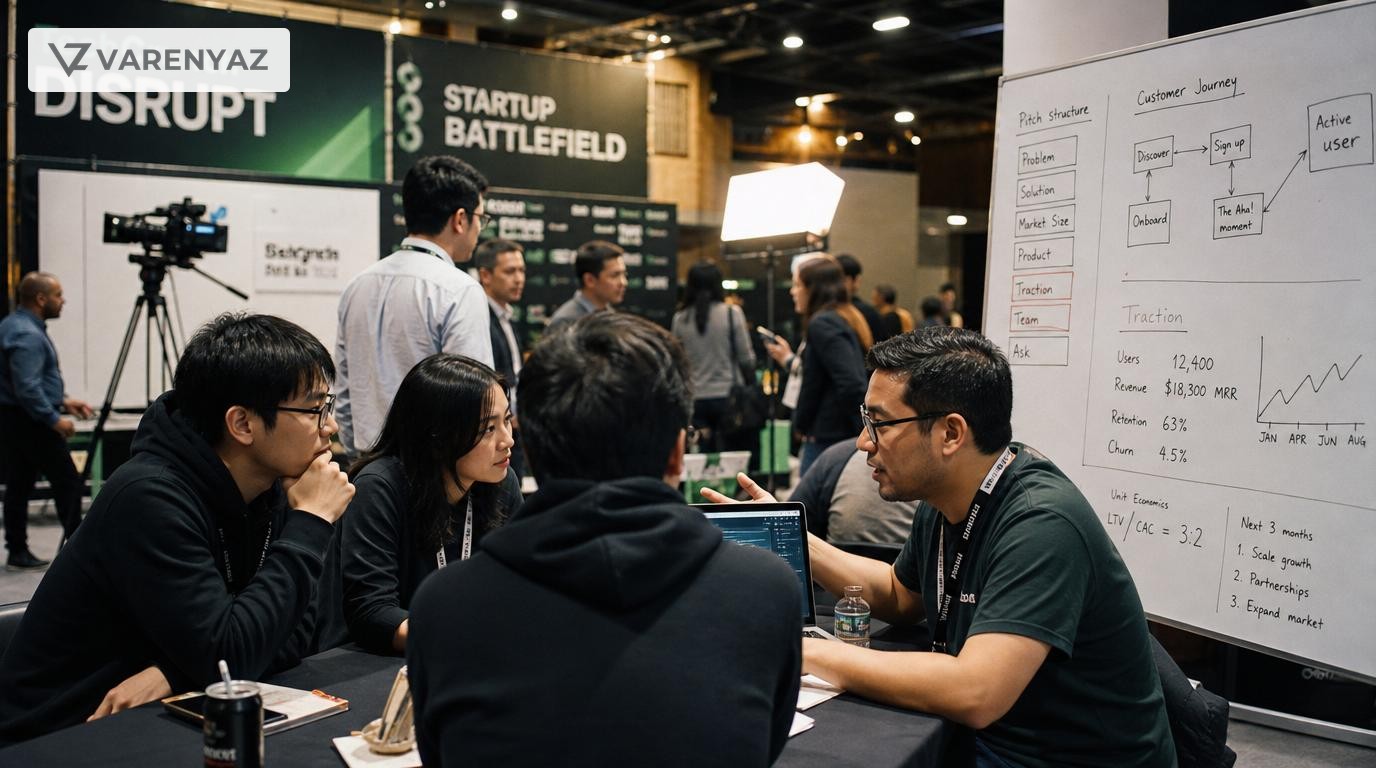
TechCrunch’s Startup Battlefield Top 20 has become a structured launchpad for early-stage startups rather than a single-shot pitch event. Selection now favours clear problem–solution fit, credible traction, and narrative discipline as much as raw innovation. Even teams that never reach the Disrupt main stage benefit from investor visibility, editorial feedback, and operational clarity. For founders and product leaders, the application itself is a forcing function to sharpen positioning, metrics, and roadmap, while the Top 20 cohort offers concentrated media exposure, warm intros, and weeks of coaching that can meaningfully move fundraising and go-to-market plans.
News Desk
LiveEditorial Review
VarenyaZ Editorial Desk, Managing Editor
Global
In This Story
Coverage Signals
Key Takeaways
- Startup Battlefield Top 20 has evolved into a curated acceleration funnel rather than a one-off pitch contest.
- Selection criteria emphasise clarity of problem, evidence of demand, and focused storytelling alongside technical innovation.
- Investors increasingly treat Top 20 inclusion as a de-risking signal for early-stage bets and future deal flow.
- Even applicants that never make the Top 20 gain narrative clarity and benchmarking from the application process.
- Founders that prepare data rooms, product demos, and crisp user stories outperform feature-heavy, unfocused pitches.
- The Battlefield program doubles as a media and distribution lab, not just a fundraising stage.
- Startup leaders should align product roadmaps and GTM milestones to leverage the visibility window around Disrupt.
- Partnering with product, design, and AI specialists can help translate complex tech into investor-ready Battlefield narratives.
Startup Battlefield Top 20: From Pitch Stage to Strategic Launchpad
TechCrunch’s Startup Battlefield has long been one of the highest-signal stages in tech. But the modern Battlefield is no longer just about a high-pressure six-minute pitch. With the emphasis on the Startup Battlefield Top 20, it increasingly acts as a tightly curated launchpad — and the value starts well before anyone steps onto the main stage.
For founders, especially in AI, SaaS, and developer tooling, understanding how this Top 20 selection works has become a strategic question: What does TechCrunch really look for, and what can you gain even if you never make it to the final lights and cameras?
What Actually Happens: Inside the Top 20 Funnel
TechCrunch reviews hundreds of applications globally for Battlefield. From that pool, it selects a Top 20 cohort to receive focused support, and a smaller subset will ultimately pitch on the Disrupt main stage.
While every year differs in details, the pattern is clear:
- Application stage: Founders submit structured information on the product, traction, market, team, and demo materials.
- Editorial review: TechCrunch editors and program leads shortlist startups based on clarity of problem, novelty, and execution signals.
- Top 20 cohort: Selected companies receive mentoring on pitch narrative, positioning, and demos in the weeks leading into Disrupt.
- Main stage selection: A subset is chosen for the headline Battlefield competition; others still benefit from coverage, investor attention, and on-site exposure.
The key shift: being in the Top 20 is now its own outcome, not just a stepping stone.
What TechCrunch Looks For: Beyond Buzzwords
Although criteria are not formally standardized, patterns have emerged from recent Battlefield cycles:
1. A painfully clear problem statement
Reviewers gravitate to startups that can state in one or two sentences who they serve, what breaks today, and why it matters. Vague claims about “redefining X with AI” rarely survive first pass without a concrete use case.
2. Evidence of demand, not just a demo
Battlefield is still early-stage, but teams that show any of the following tend to rise:
- Meaningful pilots or design partners
- Paying customers or strong waitlists
- Usage metrics that reflect recurring engagement
- Proof that someone outside the founding team cares enough to test or pay
3. Focused feature set and roadmap
Overstuffed products are a red flag. Top 20 teams usually present a narrow, sharp wedge into a bigger market — one core workflow or persona they dominate, with a believable path to expansion.
4. Storytelling that matches the product
TechCrunch is an editorial brand. Battlefield slots go to teams that combine strong products with stories that non-specialists can understand. This is particularly critical for AI infrastructure, data platforms, and deep-tech plays where differentiation is subtle.
Why It Matters: Battlefield as a Market Signal
For investors, corporates, and acquirers, the Top 20 list is effectively an externally curated watchlist. It compresses weeks of market scanning into a handful of companies that have already been pressure-tested by an editorial and product lens.
Practically, this means:
- Early validation: Inclusion is seen as a soft signal of quality and execution, especially in noisy categories like AI and fintech.
- Faster deal flow: Battlefield companies often find that first meetings move quickly to detailed product and data room discussions.
- Category shaping: Battlefield slots can crystallize emerging themes — for example, AI tooling for non-technical teams or privacy-preserving data infrastructure.
For founders, this translates into leverage: conversations that start from “why you?” shift toward “how big, how fast, and what does partnership or investment look like?”
The Hidden Upside: What Every Applicant Gains
Most applicants will never see the Disrupt stage — but the process itself is increasingly strategic if used well.
Application as a forcing function
Well-run teams treat the Battlefield application as a deadline to clean up their narrative:
- Sharpening ICP and use cases
- Aligning metrics and milestones internally
- Cleaning up demo flows for non-technical viewers
- Stress-testing market size and pricing assumptions
Many founders reuse Battlefield-ready positioning for:
- Seed and Series A fundraises
- Recruiting senior talent
- Enterprise sales decks
- Website and product marketing language
Soft visibility, even without winning
Even if a team doesn’t make Top 20, serious applications are often remembered. Reviewers, mentors, and investors track interesting teams over multiple cycles, especially when they can see clear progress between attempts.
This creates an iterative loop: apply, learn where you fall short, improve metrics and storytelling, then re-approach with a stronger product and narrative.
AI, Search, and Software Startups: The Battlefield Edge
For AI-first and software-driven startups, Battlefield offers something rare: a high-credibility space to prove you are not just another “LLM wrapper.”
To stand out, AI and software founders increasingly need to show:
- Embedded AI, not superficial features: Clear value beyond a chatbot veneer — automation, decision support, or measurable productivity gains.
- Responsible design: Transparency around data, evaluation, and failure modes.
- Real workflows: Demos that mirror how customers actually use the product in daily operations.
Search and discovery are also changing how Battlefield outcomes propagate. A strong Battlefield presence often turns into:
- Better brand queries and higher-intent traffic
- Richer coverage in AI overviews and answer engines
- Inclusion in “best of” roundups and analyst notes
That only compounds if your website, app, and documentation are ready to catch the interest spike — fast, clear, and technically robust.
Risks, Limits, and Open Questions
No program is a silver bullet. Battlefield comes with trade-offs founders should consider carefully:
- Over-pivoting to optics: Teams may be tempted to optimize for pitch theatre at the expense of product fundamentals.
- Competitive exposure: Going public early on a big stage can invite copycats or pressure from incumbents.
- Timeline distortion: Shipping features for Disrupt that aren’t ready for customers can create technical and trust debt.
There are also open questions around how Battlefield scales as application volume grows: will TechCrunch introduce more vertical tracks, regional cohorts, or hybrid digital programs to handle demand without diluting signal?
What Leaders Should Watch Next
For founders, CTOs, and product leaders in India, the US, the UK, and beyond, Battlefield is increasingly a barometer of where early-stage energy is going next. Watch for:
- Which categories dominate the Top 20: AI for operations, devtools, or vertical SaaS all signal different macro shifts.
- How quickly Top 20 companies raise follow-on rounds: That reveals how seriously investors treat Battlefield selection.
- How many Top 20 teams are non-US: A useful lens on globalization of startup capital and narratives.
Corporate innovation teams can also mine Top 20 lists for partnership opportunities, pilot programs, and acqui-hire candidates long before competitors do.
Turning Battlefield Standards into Your Operating System
Even if you never apply, you can borrow Battlefield’s implicit standards:
- Relentless clarity on problem and ICP
- Evidence-based traction narratives, not just roadmap promises
- Crisp demos that link features to concrete business outcomes
- Web, product, and AI experiences designed for fast comprehension
If your current product, website, and internal narrative would struggle under that scrutiny, that is a clear signal to invest in the foundations.
If you’re preparing for Battlefield, a major launch, or just want your product story to stand up to investor-level questions, talk to us at https://varenyaz.com/contact/.
Where VarenyaZ Fits: Building for the Spotlight, Not Just the Stage
At VarenyaZ, we work with founders and product leaders who need more than a pitch deck. We help teams:
- Translate complex AI and software into investor-friendly product stories
- Design and build launch-ready web experiences that convert conference and media traffic
- Develop custom web apps and prototypes that demo cleanly in Battlefield-style settings
- Automate workflows and data flows so metrics and storytelling stay in sync
Whether you’re targeting Startup Battlefield Top 20, planning a funding round, or orchestrating a major product launch, the same principles apply: clarity, credibility, and execution. VarenyaZ can help you align your web presence, product experience, and AI capabilities so that when opportunity arrives — on the Disrupt stage or elsewhere — your stack is ready to perform.
Editorial Perspective
"Startup Battlefield Top 20 functions like an ultra-condensed accelerator: weeks of narrative refinement, investor exposure, and market validation wrapped around a single media moment."
"For founders, the real leverage is using Battlefield preparation to harden your product story, tighten your metrics, and align your roadmap to a public launch window."
"Investors increasingly view Battlefield selection as a filter for teams that can both build and communicate, which is critical in crowded categories like AI and developer tooling."
Frequently Asked Questions
What is the Startup Battlefield Top 20 at TechCrunch Disrupt?
Startup Battlefield Top 20 is TechCrunch’s curated group of early-stage startups selected to compete for the main Disrupt stage. These companies receive intensive coaching, media exposure, and access to investors and partners, with a subset going on to pitch live on the Disrupt main stage.
How does a startup get selected for the Startup Battlefield Top 20?
Selection typically centers on a clear, important problem, differentiated solution, early signs of traction, and a team that can execute. Reviewers look for crisp explanations, believable market size, evidence of user demand, and a focused roadmap rather than just technical complexity or feature lists.
What do startups gain even if they don’t reach the Disrupt main stage?
Even non-finalists can benefit from the application process itself: forced clarity on their positioning, a structured way to present metrics and traction, and exposure to reviewers who track promising teams over time. Many founders reuse refined Battlefield narratives in future investor and customer pitches.
Why does Startup Battlefield matter for investors and corporate innovation teams?
Investors and corporate innovation leaders treat the Top 20 as a high-signal shortlist of teams with credible products and narratives. It compresses market scanning, highlights emerging categories, and surfaces startups that have already passed a demanding editorial and product scrutiny layer.
How can founders prepare their product and story for Battlefield-style scrutiny?
Founders should prioritize clarity over complexity: a tight problem statement, a simple demo, real user outcomes, and a measurable path to revenue. Partnering with product, UX, and AI experts can help translate deep technology into stories and interfaces that judges, media, and customers quickly grasp.
Stay Ahead
Get concise, actionable insights on AI, digital strategy, and innovation. No spam, just value.
More Coverage
Related News
Jul 17, 2026
AI Travel Agency Fora Hits Unicorn Status With $60M Round
Fora, an AI-powered travel agency platform, has raised a $60 million Series D round led by Forerunner and Tactile Ventures, valuing the company at $1 billion. The startup blends AI trip-planning tools with a distributed network of travel advisors, aiming to modernize how travel is sold and supported. For founders and operators, the deal highlights continued investor belief in vertical AI platforms, human-in-the-loop automation, and software that upgrades legacy, commission-based industries like travel.
Jul 16, 2026
Lululemon Backs Nylon Recycling Startup Syntetica in $30M Round
Lululemon has backed French startup Syntetica in a $30 million Series A round to scale a new chemical process for recycling nylon from textile and industrial waste. The deal highlights how performance apparel brands are racing to secure circular materials, reduce dependence on fossil-based nylon, and meet tightening sustainability regulations and customer expectations.
Jul 4, 2026
The New Browser Wars: Beyond Search, Toward Privacy and AI
The new browser wars are no longer just about which search engine is set by default. A wave of alternative browsers is competing on privacy, AI-native features, and workflow integration instead. For businesses, browser choice now affects security, analytics, and employee productivity. This article explains what’s changing, highlights key options beyond Chrome and Safari, and outlines what technology and product leaders should consider as they define their browser standards and design customer-facing web experiences for this fragmented ecosystem.