

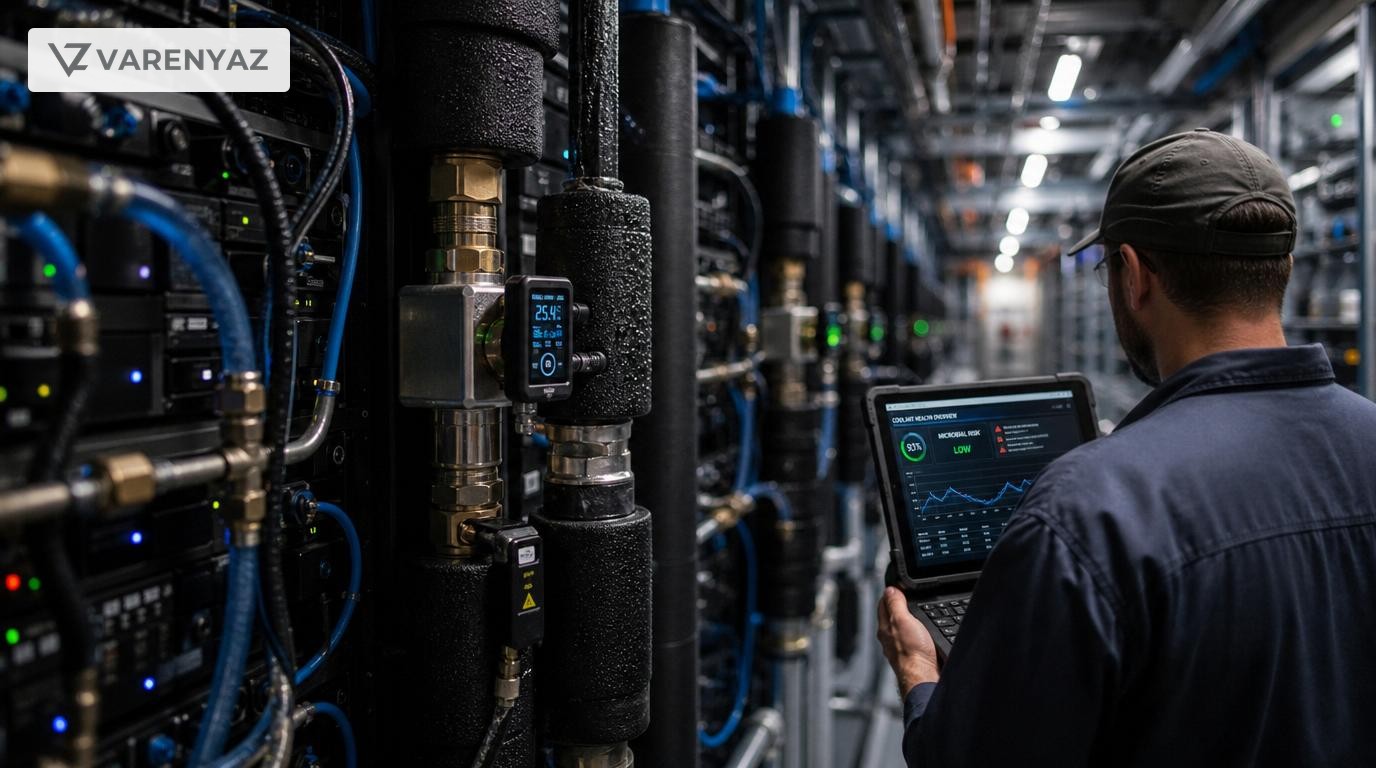
What Happened In Brief
Omen AI has raised a $31 million Series A round to build software that monitors liquid cooling systems in AI-heavy data centers. Its platform focuses on coolant quality, early detection of bacterial growth, and operational anomalies that can threaten high-density GPUs and CPUs. For cloud providers, AI infrastructure teams, and colocation operators, the move underscores how liquid cooling, once niche, is becoming mission-critical—and risky—without continuous monitoring, analytics, and automated alerts to protect uptime and hardware investments.
News Desk
LiveEditorial Review
VarenyaZ Editorial Desk, Managing Editor
Global
In This Story
Coverage Signals
Key Takeaways
- Omen AI raised a $31 million Series A round to monitor liquid cooling systems in AI data centers.
- The company focuses on coolant quality, bacterial growth risks, and operational anomalies that threaten uptime.
- Liquid cooling is moving from niche to mainstream as GPU-powered AI racks exceed the limits of traditional air cooling.
- For operators, coolant monitoring software could reduce outages, extend hardware life, and improve energy efficiency.
- Bacterial contamination and corrosion in closed-loop systems are emerging as new failure modes for AI infrastructure.
- Integrating cooling telemetry into broader observability stacks is becoming a priority for AI and DevOps teams.
- Investors see cooling intelligence as a critical layer in the AI infrastructure value chain, not just a facilities concern.
- Leaders should plan governance, data pipelines, and automation around cooling metrics as they scale AI footprints.
Omen AI raises $31M to monitor liquid-cooled data centers
Omen AI has secured a $31 million Series A round to tackle one of the least glamorous but fastest-growing risks in AI infrastructure: what happens when your data center coolant goes bad.
As hyperscalers, cloud providers, and enterprises race to deploy GPU-heavy clusters, traditional air cooling is hitting its limits. Liquid cooling—immersion and direct-to-chip—is moving from experimental to mainstream. But with that shift comes a new class of failure modes: bacterial growth, corrosion, leaks, and chemistry drift inside the very fluids that keep AI hardware alive.
Omen AI’s pitch is simple: treat coolant as a first-class data source, not a hidden mechanical detail. The company is building a monitoring and analytics platform that continuously tracks coolant health, microbial risk, and system behavior, aiming to catch issues before they take racks offline.
What Omen AI is actually building
While details remain high level, Omen AI sits at the intersection of sensors, data, and software. The emerging stack looks like this:
- Sensor integration: Collect readings from flow meters, temperature probes, pressure sensors, and inline sampling points embedded in liquid loops.
- Coolant health analytics: Track attributes such as pH, particulate levels, corrosion indicators, and signs of biofouling or bacterial growth.
- Anomaly detection: Use AI and pattern recognition to spot subtle deviations in flow, temperature differentials, or chemistry that precede leaks, clogs, or microbial blooms.
- Alerts and workflows: Surface issues to operators before they cascade into failures, tying into incident response tools and maintenance playbooks.
In short, Omen AI is trying to become the observability layer for data center liquids, in the same way existing tools already monitor networks, servers, and applications.
Why this matters for AI infrastructure
High-density AI racks can draw 80–100kW or more, making thermal management both expensive and existential. Liquid cooling is attractive because it moves heat more efficiently than air and can improve energy usage and rack density.
But water and specialty coolants introduce new challenges:
- Biofouling and bacterial growth: Warm, nutrient-exposed environments can support microbial communities, which in turn clog filters, foul surfaces, and reduce heat transfer efficiency.
- Corrosion risk: Poorly controlled chemistry or contamination over time can damage metal components and compromise loop integrity.
- Leak and condensation management: Any leak near high-value electronics is a major incident; even minor condensation can be a warning sign.
- Operational complexity: Facilities teams must now think in terms of fluid dynamics and microbiology, not just airflow and CRAC units.
For operators, Omen AI’s category of tools promises several outcomes: fewer thermal-related outages, extended hardware life, more predictable maintenance, and stronger justification for high-density AI deployments.
Business impact for data center and AI leaders
For CTOs, CIOs, and operations leaders, the funding round is a clear signal: cooling intelligence is graduating from a facilities afterthought to a board-level concern.
Key business implications:
- Risk and uptime: As more revenue-critical AI services run on GPU clusters, cooling failures turn directly into financial and reputational damage. Continuous coolant monitoring is emerging as a risk control, not a luxury.
- Capex protection: High-end GPUs, accelerators, and dense servers are expensive. Preventing coolant-related degradation or sudden failure protects multi-million-dollar capex investments.
- Energy and ESG: Inefficient or fouled cooling systems waste energy. In markets where regulators and customers are scrutinizing data center power and water usage, analytics on cooling performance feeds ESG reporting and optimization efforts.
- Contractual expectations: Colocation customers and cloud buyers will increasingly ask how liquid cooling risk is monitored and mitigated, potentially embedding such requirements into SLAs.
Direct answer: how will Omen AI change data center cooling?
Omen AI aims to change data center cooling by turning coolant health and liquid system behavior into always-on telemetry, analyzed by AI to identify bacterial growth, chemistry drift, or mechanical anomalies early. This helps operators prevent leaks, corrosion, and thermal failures, enabling safer deployment of high-density AI workloads and more efficient use of liquid-cooled infrastructure.
Cooling as a software and data problem
The most important shift here is conceptual: data center cooling is becoming a software and data problem as much as a mechanical one.
Traditionally, facilities and IT have lived in separate silos. With direct-to-chip cooling, immersion tanks, and manifolded loops running through racks, those lines blur. To operate safely at AI scale, leaders will need:
- Unified observability: Cooling metrics—flow, delta-T, coolant quality—exposed alongside CPU/GPU utilization, latency, and application health.
- Shared playbooks: DevOps and facilities teams aligned on what to do when cooling telemetry signals trouble, from throttling workloads to scheduling maintenance.
- Automation hooks: Triggering workload migration, throttling, or failover when coolant-related risk surpasses defined thresholds.
Omen AI and similar platforms fill the gap between raw sensor data and actionable decisions, making “liquid telemetry” consumable by both facilities engineers and SREs.
Risks, blind spots, and open questions
Despite the promise, there are important unknowns and risks that technology leaders should track:
- Sensor reliability and calibration: The accuracy of any coolant analytics stack depends on how well sensors are installed, maintained, and calibrated over time.
- Data volume and noise: Large facilities can generate massive streams of telemetry; separating signal from noise without overwhelming teams is a design challenge.
- Interoperability: Data centers run diverse cooling architectures and vendor ecosystems. How well Omen AI integrates with existing BMS, SCADA, and observability tools will be decisive.
- Security: Cooling control and telemetry systems are part of critical infrastructure. Any new monitoring platform must be built with strong security and access controls.
Leaders should push vendors to clarify how their tools sit within broader security models, data governance policies, and operational standards.
What leaders should do next
If you are planning or already operating AI clusters that lean on liquid cooling, several actions are worth immediate consideration:
- Map your cooling risk profile: Identify where liquid systems exist or are planned, what sensors are deployed, and how coolant health is currently tracked (if at all).
- Define key metrics: Agree on the coolant KPIs that matter—temperature deltas, flow rates, contamination indicators, microbiological risk scores—and how they connect to SLAs.
- Integrate with observability: Ensure cooling telemetry is not trapped in facilities-only systems. Surface it in the same dashboards your SRE and platform teams already use.
- Pilot new tooling: Consider small-scale pilots with cooling monitoring platforms, focusing on integration, alert quality, and operations impact rather than cosmetic dashboards.
As AI deployments accelerate across India, the United States, the United Kingdom, and beyond, the organizations that treat cooling as an end-to-end data and software discipline will be better positioned to scale safely.
Where VarenyaZ fits: architecture, automation, and AI on top of cooling data
Cooling monitoring alone is not enough; value emerges when that data flows into your digital backbone—dashboards, automation pipelines, incident response tools, and digital twins.
VarenyaZ works with enterprises and data center operators to:
- Design custom observability interfaces: Build web-based control panels that expose cooling and AI workload metrics side by side for faster, informed decisions.
- Integrate telemetry streams: Connect coolant data from platforms like Omen AI into data lakes, monitoring tools, and analytics stacks through robust APIs and microservices.
- Automate responses: Develop AI-driven automation that can trigger workload balancing, capacity throttling, or maintenance workflows based on cooling conditions.
- Create decision-support tools: Use AI and simulation to model how changes in cooling design or workload placement impact risk, cost, and sustainability.
If you’re planning next-generation AI infrastructure and need a partner to architect the digital layer around your physical cooling systems, you can start a conversation with our team here: https://varenyaz.com/contact/
Conclusion: cooling intelligence as a new AI-era stack layer
Omen AI’s $31 million funding round is more than a niche startup story—it’s a marker of how critical, and fragile, liquid-cooled AI data centers have become. As coolant loops weave deeper into our digital infrastructure, monitoring their health will be as important as tracking CPU temperature or network latency.
For business leaders, the message is clear: future-ready AI infrastructure demands end-to-end visibility—from chips and coolant to code and customers. VarenyaZ helps organizations close that loop with custom web platforms, integration, automation, and AI development that turn raw infrastructure telemetry into reliable, scalable digital experiences.
Editorial Perspective
"As AI racks cross 80–100kW, cooling stops being just a facilities concern and turns into a core reliability and data problem that CIOs and CTOs must own."
"Platforms like Omen AI signal a future where coolant chemistry, microbial risk, and thermal performance are all first-class metrics inside enterprise observability stacks."
Frequently Asked Questions
What does Omen AI do for data centers?
Omen AI develops software to continuously monitor liquid cooling systems in data centers, focusing on coolant quality, microbial growth, leaks, and other anomalies that can damage high-density GPUs and CPUs or cause costly outages in AI workloads.
Why is coolant monitoring important for AI data centers?
AI workloads concentrate massive power into a small space, pushing air cooling to its limits. Liquid cooling solves some of this but introduces new risks, including bacterial contamination, corrosion, and leaks. Monitoring helps detect these issues early, protecting uptime and expensive hardware.
Who should care about Omen AI’s $31 million funding round?
Cloud providers, hyperscalers, colocation operators, enterprise data center teams, and investors in AI infrastructure should pay attention. The raise signals that cooling telemetry and risk monitoring are becoming strategic capabilities, not just mechanical engineering details.
How does liquid cooling change data center operations?
Liquid cooling enables higher rack densities and better energy efficiency, but it adds fluid handling, chemistry, and biofouling management to the operational stack. Teams need new sensors, analytics, procedures, and incident playbooks to manage coolant loops alongside traditional IT monitoring.
Can coolant monitoring be integrated with existing observability tools?
Yes. Modern approaches collect sensor data from cooling systems and expose it via APIs or streams that can feed into existing observability platforms, data lakes, or AI-powered analytics, creating unified views of infrastructure health from chips and coolant to applications and SLAs.
What should CTOs and CIOs do as they adopt liquid cooling?
Technology leaders should treat liquid cooling as a data and automation challenge from day one: define metrics, deploy sensors, plan for monitoring platforms, update risk registers, and ensure DevOps and facilities teams share dashboards and incident response processes for coolant-related events.
Selected References
Stay Ahead
Get concise, actionable insights on AI, digital strategy, and innovation. No spam, just value.
More Coverage
Related News
Jun 30, 2026
Chamath Palihapitiya Backs AI Coding Startup With $135M Series A
Chamath Palihapitiya has raised a $135 million Series A and taken the CEO role at his own AI coding startup, signaling strong investor conviction in AI-assisted software development. The company aims to automate more of the software lifecycle, from code generation to maintenance. For CTOs and founders, this funding round is another sign that AI-native development workflows are quickly moving from experimentation to core infrastructure decisions, with implications for talent strategy, tooling budgets, and competitive product velocity.
Jun 29, 2026
Pocket Bets on AI Note-Taking Hardware With New $11M Round
Pocket, a startup building a $129 credit card-shaped AI note-taking device that sticks to the back of a smartphone, has raised $11 million to scale production and software. The puck offers continuous audio capture, unlimited recordings, transcription and task extraction, targeting professionals who live in meetings and conversations. The round underscores investor confidence in dedicated AI hardware and ambient computing, while raising new questions for IT leaders about privacy, compliance, device management and how such tools will integrate with existing SaaS stacks and custom applications.
Jun 28, 2026
SpaceX Veteran Turns Rocket Engines Into Geothermal Power
Critical Energy, founded by a former SpaceX engineer, has secured a major funding round to repurpose rocket engines for ultra-deep geothermal drilling. By reaching hotter rock layers, the startup aims to provide firm, low-carbon baseload power that can compete with fossil fuel plants. The approach could be attractive for utilities, data centers, and heavy industry seeking 24/7 clean energy. Key questions now are drilling costs, regulatory paths, and how fast power purchase agreements and pilot plants can scale from demonstration to commercial deployment.