

What Happened In Brief
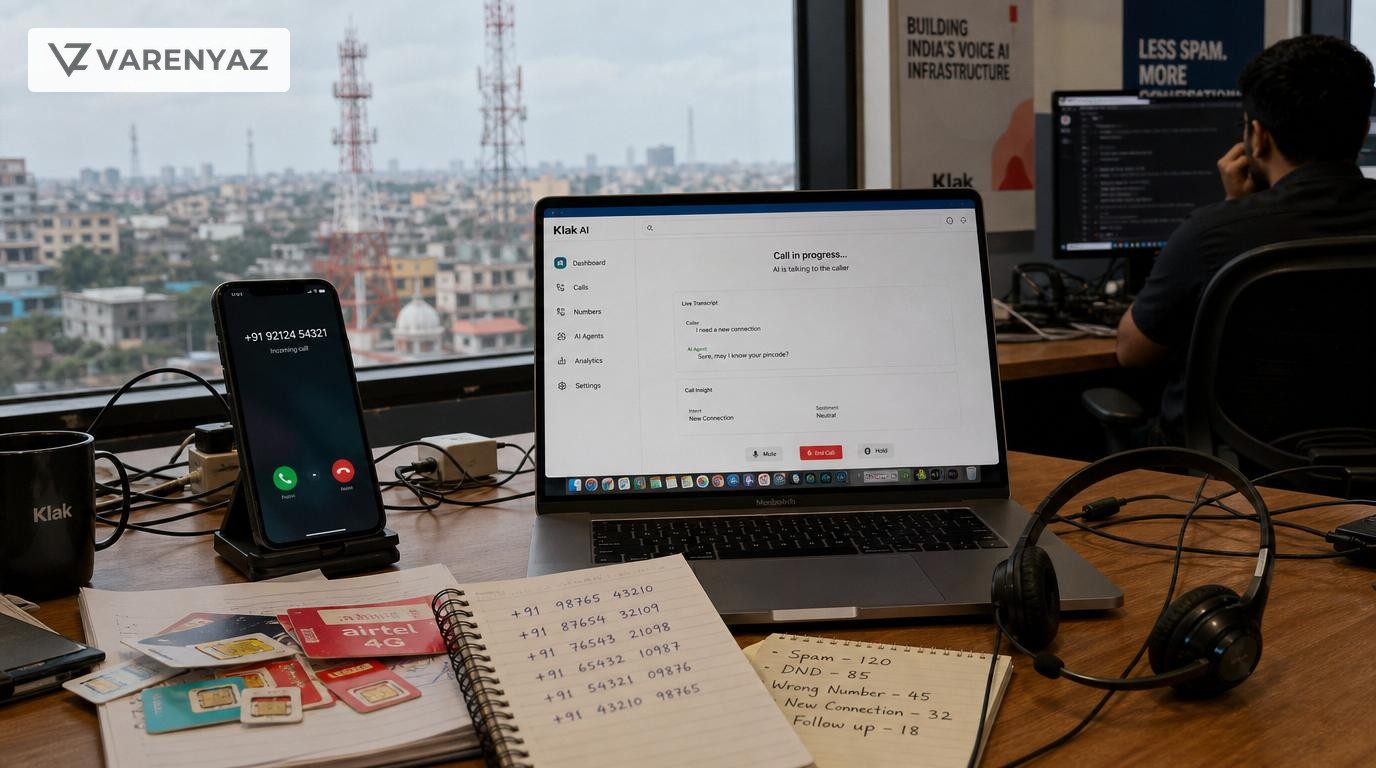
Equal AI has raised $30 million to expand its AI-powered call assistant, which already serves over one million monthly active users in India. The platform screens and handles calls on behalf of users, promising relief from pervasive spam, scams, and telemarketing. For businesses, Equal AI’s technology points to a broader shift toward AI-driven contact centers, automated lead qualification, and intelligent voice workflows across sales and customer support in high-volume markets.
News Desk
LiveEditorial Review
VarenyaZ Editorial Desk, Managing Editor
Global
In This Story
Coverage Signals
Key Takeaways
- Equal AI raised $30 million to scale its AI-powered call assistant in India.
- The platform has surpassed one million monthly active users, signaling strong early traction.
- India’s high volume of spam and scam calls creates a powerful product-market fit for AI call screening.
- For enterprises, Equal AI-like tools foreshadow AI-first contact centers and automated lead handling.
- Telecom regulations, consent, and call recording laws will be critical for sustainable growth.
- Voice AI performance in low-bandwidth, multilingual environments is a key technical differentiator.
- Investors are betting that AI voice agents will become a default layer between users and phone networks.
- Businesses should start piloting AI call flows now to avoid playing catch-up in CX and support.
Equal AI raises $30M to scale its AI call assistant for India’s spam-plagued phone networks
Equal AI, a fast-growing Indian startup building an AI-powered call assistant, has raised $30 million to expand its platform and tackle one of the country’s most frustrating digital problems: an unrelenting wave of spam, scam, and telemarketing calls.
The company says its AI call assistant already serves more than one million monthly active users, making it one of the most widely adopted consumer-facing voice AI products in the region. The fresh capital will be used to strengthen the underlying AI models, improve telephony infrastructure, and push deeper into both consumer and enterprise segments.
What Equal AI’s call assistant actually does
Equal AI’s core proposition is straightforward: let an AI answer your phone so you don’t have to. When a call comes in, the assistant can:
- Pick up the call and speak to the caller in natural language
- Identify whether the call is spam, a sales pitch, a service reminder, or something important
- Handle routine queries automatically, such as basic information requests
- Route critical or contextually relevant calls through to the user or a human agent
- Log call summaries and key details for later review
Unlike basic spam filters that rely mostly on number-based blocking or static lists, Equal AI’s approach is conversational. It listens, responds, and makes decisions based on what the caller says, their behavior during the call, and historical patterns.
For individual users, that means dramatically fewer interruptions and a layer of protection from fraud. For businesses, it means the ability to deploy AI agents at the front line of inbound calls, qualifying leads and triaging support without needing a human on every line.
Why this funding round matters for AI voice and telecom
The $30 million raise is a strong signal that voice AI is moving from experiments to infrastructure.
India is one of the toughest real-world environments for such technology. Networks are often congested, language use is highly multilingual, and spam levels are among the highest globally. If Equal AI’s assistant can function reliably at scale here, it becomes a compelling blueprint for other high-volume markets.
For investors and corporate leaders, this round underlines three trends:
- Voice as the next frontier for AI: After chat and email, live phone calls are the next major surface where AI is being embedded.
- AI-first contact centers: Contact center technology is rapidly shifting from human-only models to AI-augmented or AI-led operations.
- Infrastructure bets, not just apps: Call assistants require robust telephony, real-time speech recognition, low-latency inference, and monitoring – a full-stack problem, not a thin UI layer.
India’s spam crisis: perfect storm for AI call screening
India’s mobile boom has brought more than a billion connections online – and with them, a torrent of unwanted calls. Telemarketers, fraudulent loan offers, fake job calls, and phishing attempts are common complaints among smartphone users.
Regulators such as the Telecom Regulatory Authority of India (TRAI) have introduced rules to curb unsolicited commercial communication, but enforcement and evasion remain ongoing challenges. As spam tactics get more sophisticated, static blocking lists and simple network-level filters struggle to keep pace.
Equal AI’s pitch fits directly into this gap. By analyzing each call in real time and conversing with the caller, AI agents can detect patterns and intent that simple number-based systems miss, offering a dynamic defense that can adapt as fraudsters and aggressive marketers change tactics.
Business impact: from phone shield to AI contact center gateway
While consumer protection is the obvious story, the deeper business impact lies in contact center and customer experience (CX) transformation.
For enterprises and high-growth startups, AI call assistants open several possibilities:
- Lead qualification at the edge: AI agents can handle first-touch inbound calls, capture intent, verify basic details, and pass only qualified prospects to sales teams.
- Support triage: Routine support questions can be resolved or routed intelligently without waiting for a human agent, reducing queue times and agent burnout.
- After-hours coverage: AI can provide always-on answering services with consistent tone and escalation rules.
- Structured call data: Instead of unstructured call logs, businesses get summaries, tags, and analytics, which can flow into CRMs and ticketing tools.
As these systems mature, the line between a “spam shield” and a “voice-front contact center” will blur. Companies that adopt early will get better data, faster feedback loops, and more resilient CX operations.
Key risks and unanswered questions
Despite strong momentum, the model Equal AI is pursuing comes with non-trivial risks and open questions that leaders should track closely.
1. Privacy, consent, and regulation
AI assistants may record, transcribe, and analyze calls. That raises sensitive issues around:
- Informing callers that an AI is on the line
- Obtaining appropriate consent for recording and analysis
- Storing and securing voice and text data
- Complying with sector-specific rules (finance, healthcare, etc.)
India is iterating its digital and data protection regimes, and further guidance could shape what’s permissible in AI-based telephony. International deployments will also need to navigate GDPR-style consent frameworks in Europe and state-level rules in the US.
2. Accuracy and critical calls
If an AI mistakenly flags an important call as spam, or mishandles a high-stakes support interaction, the business impact can be significant. For critical sectors – banking, health, logistics – error tolerance is low.
Decision-makers will need clear visibility into:
- How models are trained and evaluated
- Fallback paths to human agents
- Latency and uptime SLAs
- Bias and language coverage, especially across Indian languages and accents
3. Customer trust and experience
Some callers may be uncomfortable speaking to an AI, particularly on sensitive topics such as debt, health, or personal finance. Poorly designed call flows can worsen frustration rather than reduce it.
This is fundamentally a product and experience design challenge, not just a modeling problem – one that demands close collaboration between AI engineers, CX teams, and compliance officers.
What leaders should watch next
For founders, CX leaders, and investors, several indicators will show how fast Equal AI’s category is maturing:
- Enterprise adoption: Case studies where large brands deploy AI call assistants across specific lines of business or regions.
- Regulatory updates: New rules or enforcement actions related to AI-led calling, recording, or spam control in India and beyond.
- Ecosystem integrations: Native integrations with CRMs, helpdesk platforms, marketing automation tools, and custom web apps.
- Quality benchmarks: Transparent metrics on call resolution, accuracy, user satisfaction, and fraud reduction over time.
As more players enter the AI voice space, leaders will need to evaluate partnerships not just on model performance, but also on integration flexibility, data governance, and long-term product roadmaps.
Strategic moves for businesses: from experiments to AI-first voice workflows
For most organizations, the best approach is to start small but strategic. Concrete next steps might include:
- Piloting AI answering for a single support or sales line during limited hours
- Automating after-hours reception or missed call handling with AI callbacks
- Integrating AI-generated call summaries into your CRM or custom dashboards
- Testing multilingual support for regions with diverse language use
The technical lift is non-trivial: it involves telephony integration (SIP, VoIP, or cloud telephony), API orchestration, secure data pipelines, and front-end interfaces for agents and managers. That is where specialized partners become critical.
If you are planning to embed AI voice workflows into your web platforms, custom dashboards, or internal tools, you can discuss a tailored approach with our team at https://varenyaz.com/contact/.
How this connects to web, AI, and custom app development
Equal AI’s trajectory highlights a broader shift: voice is becoming another programmable interface for your software stack. Calls are no longer just an offline channel – they are structured, analyzable events that can trigger workflows across your digital ecosystem.
For technology and product leaders, this creates opportunities to:
- Build custom dashboards that unify web, app, and call data into a single view
- Connect AI call agents with internal tools for ticketing, logistics, and field operations
- Design web experiences that adapt based on insights captured from phone conversations
- Implement automation pipelines that move from call to action – from lead capture to quote generation or appointment booking
Conclusion: Equal AI and the new AI layer on top of the phone network
Equal AI’s $30 million funding round is about more than just one startup: it signals that AI is becoming an active layer on top of the world’s phone networks, starting with India. The companies that win in this new era will be those that treat voice as programmable, data-rich, and tightly integrated into their digital infrastructure.
VarenyaZ helps organizations design and build that infrastructure – from AI-enabled web platforms and customer portals to automation-first backends and custom applications that can plug into voice AI tools like Equal AI. As AI voice agents move from novelty to necessity, aligning your web, data, and telephony strategy today will determine your competitive edge tomorrow.
Editorial Perspective
"Equal AI’s funding round underlines how phone calls are becoming the next major interface for generative AI, after chat and email. In markets like India, an AI layer that filters noise from signal is quickly turning from a convenience into an economic necessity for both individuals and enterprises."
"For CX and operations leaders, the real story is not just spam reduction – it’s the emergence of programmable voice workflows. AI call assistants will increasingly connect CRMs, ticketing tools, and analytics platforms into a single, live conversation layer."
Frequently Asked Questions
What is Equal AI and what does its call assistant do?
Equal AI is an Indian startup building an AI-powered call assistant that answers and screens phone calls on behalf of users. Its voice agent can pick up incoming calls, understand caller intent, filter spam and scams, and either resolve simple requests automatically or hand important calls through to the user or a human agent.
How much funding did Equal AI raise and why is it significant?
Equal AI raised $30 million in new funding, a sizable round for a voice AI startup focused on telephony in India. The round is significant because it validates AI call assistants as a standalone category, not just an add-on feature to chatbots, and highlights India as a key testbed for large-scale, real-time AI voice infrastructure.
How many users does Equal AI’s AI call assistant have?
Equal AI reports that its AI call assistant has crossed over one million monthly active users. That scale suggests ordinary consumers and small businesses are willing to let an AI sit between them and their phone number, especially in markets where spam, fraud, and telemarketing calls are relentless.
Why is India an important market for AI call screening?
India is one of the world’s largest mobile markets and also one of the most heavily targeted by spam and scam calls. High call volumes, price-sensitive users, and multilingual communication make it a demanding environment. If an AI call assistant can work reliably in India, it will likely generalize well to other regions and segments, from SMBs to global enterprises.
What are the business implications of Equal AI’s technology?
Equal AI’s technology signals a shift toward AI-first contact centers and telephony workflows. For businesses, voice agents can pre-qualify leads, triage support calls, route queries more intelligently, reduce agent load, and capture structured data from calls. This can cut costs and improve responsiveness, but it requires careful design, integration, and governance to avoid customer frustration or regulatory issues.
How can companies start using AI call assistants in their operations?
Companies can begin with focused pilots: automating after-hours answering, first-line triage, or lead capture for inbound sales calls. From there, they can expand into outbound confirmation calls, appointment reminders, and integrated CRM workflows. Partnering with experienced AI and web development teams, such as VarenyaZ, helps ensure the telephony stack, AI models, and business systems work together reliably and compliantly.
Selected References
Stay Ahead
Get concise, actionable insights on AI, digital strategy, and innovation. No spam, just value.
More Coverage
Related News
Jul 27, 2026
Yope bets on private social networking with $12.3M seed
Yope has raised $12.3 million in seed funding to build a private social network that rejects ads and algorithmic feeds. The app focuses on small, invite-only groups for friends and family, combining messaging, photo sharing, and AI features to strengthen offline relationships. For leaders and investors, Yope signals rising demand for privacy-first, low-noise social experiences and opens opportunities to rethink engagement, monetization, and AI in consumer and workplace communication products.
Jul 25, 2026
Anduril Targets $100B Valuation in New Defense AI Funding Round
Anduril is reportedly in talks to raise a new funding round that would value the defense-tech and AI company at about $100 billion, more than tripling its valuation from the prior year. This would make Anduril one of the world’s most valuable private defense and dual-use AI companies, highlighting how investors view autonomous systems, sensors, and AI-powered command platforms as core national infrastructure. For founders, CTOs, and public sector-focused vendors, this is a signal that AI-native defense and security stacks are entering a new phase of capital intensity and strategic relevance.
Jul 24, 2026
Corgi’s $4B valuation shows how hot AI insurance has become
AI-first insurance startup Corgi has reportedly raised its third funding round in just eight weeks, at a valuation of around $4 billion. This pace places Corgi among the most aggressively funded insurtechs in the current AI wave. For insurers, founders, and CTOs, the deal signals strong investor conviction in AI-native underwriting, risk scoring, and automated policy operations, but also raises questions about sustainability, regulatory scrutiny, and the pressure to convert rapid capital inflows into robust, compliant insurance products and reliable enterprise-grade platforms.