

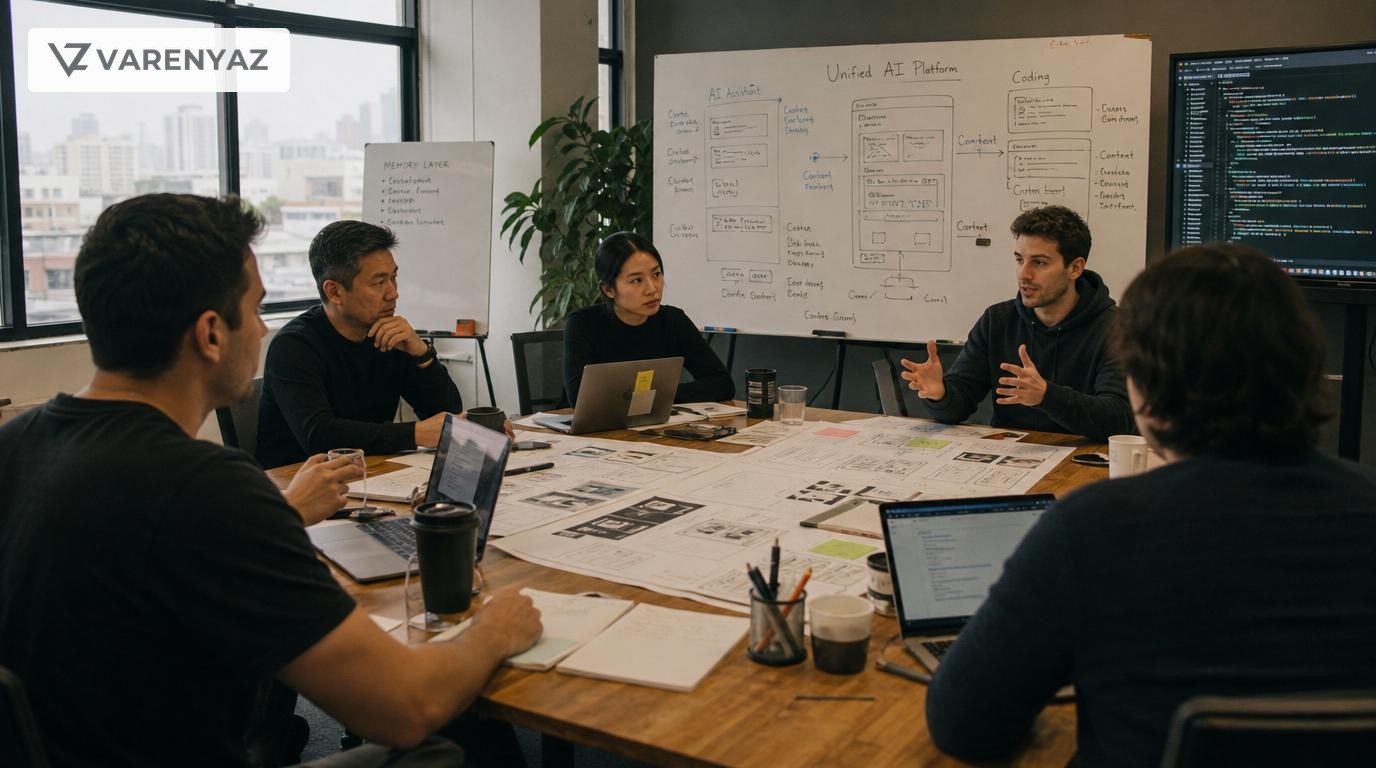
What Happened In Brief
OpenAI co-founder Greg Brockman has reportedly stepped in to lead product strategy as the company plans to more tightly combine ChatGPT with its coding assistant technology, Codex. For technology leaders, this signals a push toward a unified AI platform that serves both end users and developers. Expect deeper integration of natural language, code generation, and application workflows, with implications for software teams, cloud providers, and enterprises building on OpenAI’s stack.
News Desk
LiveEditorial Review
VarenyaZ Editorial Desk, Managing Editor
Global
In This Story
Coverage Signals
Key Takeaways
- OpenAI co-founder Greg Brockman is reportedly taking direct control of product strategy during a critical phase of the company’s evolution.
- The company is expected to more closely integrate ChatGPT with its Codex-based coding capabilities into a unified product experience.
- A combined ChatGPT–Codex stack advances OpenAI toward a single AI platform serving both end users and software developers.
- For CTOs and product leaders, the shift suggests future APIs and tools may center on integrated natural language and code workflows.
- Developer experience and enterprise readiness will likely become key battlegrounds with hyperscaler AI platforms and rival coding assistants.
- Risks include product concentration around a single provider, shifting pricing models, and compliance challenges for regulated industries.
- Teams should design AI strategies and architectures that can adapt to rapid changes in OpenAI’s product roadmap and integrations.
- Partnering with experienced AI and web engineering teams like VarenyaZ can help de-risk adoption of evolving AI platforms.
Greg Brockman reportedly steps in to steer OpenAI product strategy
OpenAI’s internal dynamics are shifting again. According to new reporting, co-founder Greg Brockman is now taking direct charge of the company’s product strategy at a moment when OpenAI is preparing a deeper integration of its flagship conversational assistant ChatGPT with its coding-focused technology, Codex.
This move signals that OpenAI is entering a new phase: less about showcasing discrete AI demos and more about solidifying a unified platform that can power both everyday user interactions and serious software development.
What happened: co-founder moves closer to the product wheel
Reports indicate that Greg Brockman, a founding executive and long-time technical leader at OpenAI, is stepping in to more directly guide the company’s product roadmap. The timing is notable: OpenAI is reportedly working to bring ChatGPT and its programming product Codex closer together.
ChatGPT has become the public face of OpenAI’s advances in natural language. Codex, the model family behind earlier code-generation tools such as GitHub Copilot, has been pivotal for developers looking to embed AI in their software workflows. Bringing them into tighter alignment under a co-founder’s leadership suggests OpenAI is planning a more opinionated, integrated product experience.
Instead of treating conversational AI and coding AI as separate tracks, OpenAI appears ready to present them as two sides of the same platform: one that understands language, code, and the workflows that connect them.
Why it matters: a platform-defining moment for OpenAI
For business decision-makers, this is not just an internal reshuffle. It is a signal about where OpenAI sees its competitive edge.
Over the past two years, the AI landscape has shifted from research-first to product-first. Enterprises no longer want just models; they want stable, secure, integrated solutions. For OpenAI, owning the product story means aligning research breakthroughs, developer tools, and enterprise demands into a coherent platform—and that requires strong, central product leadership.
With Brockman more visibly steering product strategy, OpenAI is likely aiming to:
- Reduce fragmentation between its consumer-facing and developer-facing offerings
- Define clear product surfaces that can scale from hobby projects to global enterprises
- Compete more directly with end-to-end AI platforms from cloud providers and major software vendors
ChatGPT + Codex: toward a unified AI workbench
One of the clearest implications of this shift is the reported plan to combine ChatGPT with Codex-based functionality. For engineering and product teams, this could reshape how AI is woven into day-to-day work.
From chat interface to full development environment
Today, many teams treat ChatGPT as a general-purpose assistant and use separate tools or APIs for code generation, refactoring, and documentation. A closer integration with Codex-style capabilities could turn ChatGPT into a more complete development cockpit where developers can:
- Discuss requirements in natural language
- Generate and refine code in multiple languages
- Create tests, documentation, and deployment scripts
- Iterate on bugs and performance issues in a single conversational thread
That kind of unified experience is more than a UX upgrade; it reframes how engineering time is spent and where automation sits in the lifecycle.
APIs that reflect integrated workflows
If the consumer and developer experiences converge, expect APIs and SDKs to follow. Rather than separate endpoints for generic text completion and code-specific tasks, OpenAI may design higher-level capabilities oriented around workflows:
- “Build and explain” functionality spanning specification, code, and documentation
- Integrated code review with natural language rationale
- Context-aware assistants that understand both product requirements and repository history
For teams designing new products or internal tools, this opens the door to AI-native workflows where chat, code, and orchestration live in the same layer.
Business impact: what founders, CTOs, and product leaders should expect
A stronger central product direction at OpenAI has practical implications across the stack—from budgets to team structures.
1. Consolidated AI spend and tooling choices
As ChatGPT and Codex unify, organizations may consolidate around a single OpenAI-based toolchain for both conversational interfaces and developer productivity. That can simplify vendor management and security review—but also intensify dependency on OpenAI’s roadmap, pricing, and uptime.
Technology leaders should revisit their AI budget assumptions, as more workflows aggregate on top of a smaller number of core services.
2. Shift in skills and workflows for engineering teams
A more capable, integrated assistant changes how teams structure work:
- Senior engineers may move further toward architecture, review, and system design while relying on AI to generate first-pass implementations.
- Junior developers may gain leverage but also face a steeper bar for understanding AI-assisted code at scale.
- Product managers could interact more directly with AI tools to translate requirements into structured tasks or even prototype logic.
Training, governance, and code-quality practices will need to adapt accordingly.
3. Competitive pressure on rival AI and cloud platforms
OpenAI’s push toward a unified platform under strong product leadership raises the bar for competitors, including hyperscale cloud providers and independent coding assistants. Expect moves such as:
- Deeper IDE integration from rivals
- Stronger enterprise offerings focused on data residency and compliance
- Verticalized AI experiences tailored to specific industries
For customers, this increased competition is likely to translate into faster feature releases—but also more frequent changes to pricing and packaging.
Risks and open questions for enterprises
While the reported leadership and product changes are promising for innovation, they also surface risks that CIOs and CTOs need to manage.
Vendor concentration and lock-in
The more capabilities are bundled into a single unified OpenAI experience, the harder it may become to swap components in and out. If critical workflows depend on ChatGPT–Codex style integration, moving to alternative providers later could be expensive in both time and technical debt.
Mitigation strategies include:
- Designing clear abstraction layers around AI calls
- Keeping core business logic and domain models portable
- Avoiding tight coupling between front-end UX and a single provider’s response formats
Governance, compliance, and IP management
As the boundary between “chatting with an AI” and “having the AI write production code” blurs, governance issues intensify:
- Who is accountable for AI-generated code in production?
- How are data and prompts stored, logged, and audited across tools?
- What are the IP and licensing implications in your jurisdiction?
Regulated industries in particular will need policies that treat AI as part of the formal software supply chain rather than an informal sidekick.
What leaders should watch next
In the coming months, business and technology leaders should track:
- Product announcements around the fusion of ChatGPT and coding features, including any rebranding or bundling.
- API evolution, especially new endpoints that encapsulate workflows rather than raw model calls.
- Enterprise and governance features, including audit logs, access control, and data-handling guarantees.
- Pricing and packaging changes that might affect ROI calculations for AI-heavy products.
These signals will shape whether OpenAI becomes a “default” AI platform for many organizations or one of several specialized providers in a multi-vendor strategy.
How to respond: practical steps for CTOs and digital leaders
In light of OpenAI’s reported shift in product leadership and direction, organizations can take several practical steps:
- Audit your AI footprint: Inventory where ChatGPT, Codex-style tools, or other LLMs are already embedded in workflows, from prototypes to production.
- Define target workflows: Identify the top 3–5 processes—such as feature development, QA, customer support, or internal knowledge retrieval—that could benefit most from a more unified AI experience.
- Architect for optionality: Design your AI integration layers so that core business logic is insulated from provider-specific quirks.
- Invest in enablement: Train engineers, product managers, and operations teams not just to “use AI,” but to understand how it interacts with your stack and your risk posture.
If you’re evaluating how to align your web platforms, internal tools, or custom applications with this changing AI landscape, you can start a focused discussion with the VarenyaZ team here: https://varenyaz.com/contact/.
Where VarenyaZ fits: building on a moving AI platform
For many organizations, the biggest challenge is not access to models but designing resilient products on top of fast-moving AI platforms.
VarenyaZ works with founders, product leaders, and CTOs to:
- Design and build AI-native web apps, portals, and internal tools that integrate conversational and coding capabilities
- Architect backends and APIs that can adapt as providers like OpenAI evolve their product surfaces
- Automate workflows across development, operations, and support using safe, governed AI patterns
- Develop custom interfaces and design systems that make AI assistance intuitive for both technical and non-technical users
As OpenAI’s product strategy consolidates under Greg Brockman’s reported leadership, the opportunity for ambitious digital products grows—but so does the need for careful technical and product planning.
Conclusion: strong signals from OpenAI, strategic decisions for you
Greg Brockman’s reported assumption of OpenAI product strategy, combined with plans to bring ChatGPT and Codex into tighter alignment, marks an inflection point. OpenAI is moving from a collection of powerful tools toward a more opinionated, unified platform for conversation and code.
For businesses, this is both an opportunity and a design constraint. Those who treat AI as a core architectural decision—not just an add-on—will be best placed to capture the benefits while managing risk.
VarenyaZ can help you navigate this shift by aligning web design, full-stack development, automation, and AI integration into a coherent roadmap that is ready for the next wave of OpenAI’s platform evolution.
Editorial Perspective
"Putting a co-founder back in the driver’s seat of product is a classic move when an AI company enters its platform-defining phase; it usually means fewer incremental features and more decisive bets on unified user and developer experiences."
"For engineering leaders, the real signal is the likely emergence of OpenAI as a consolidated application and developer platform, where conversation, coding, and orchestration are no longer separate tools but different views on the same AI core."
Frequently Asked Questions
What is changing in OpenAI’s product strategy with Greg Brockman reportedly in charge?
According to recent reporting, OpenAI co-founder Greg Brockman is taking a more direct role in steering product strategy as the company moves to consolidate its flagship offerings. This includes a deeper integration of ChatGPT with Codex-based coding capabilities, signaling a push toward a unified AI platform for both users and developers.
How does the integration of ChatGPT and Codex affect software teams?
A tighter ChatGPT–Codex integration could simplify how teams adopt AI, moving from separate chat and coding tools to a single experience that covers ideation, specification, code generation, and review. It may also change how teams design their APIs, internal tools, and developer workflows around OpenAI’s evolving stack.
What should CTOs and product leaders watch as OpenAI refines its roadmap?
Technology leaders should track changes in OpenAI’s API surface, pricing, rate limits, and enterprise features; the depth of integration between conversational and coding capabilities; and how the product differentiates from competing platforms. Governance, security controls, and data-handling policies will also be critical for regulated workloads.
Does a unified OpenAI platform increase vendor lock-in risk?
A more integrated platform can improve usability and performance but may also increase dependency on a single provider. To manage lock-in risk, teams should design modular architectures, keep business logic portable, and maintain optionality through abstraction layers or multi-vendor strategies where feasible.
How can businesses practically prepare for these OpenAI product changes?
Businesses can start by auditing where AI is already in use, mapping candidate workflows for automation, and prototyping with clear KPIs. Working with experienced partners like VarenyaZ can help teams design scalable, compliant architectures that can adapt as OpenAI’s product strategy and capabilities evolve.
Selected References
Stay Ahead
Get concise, actionable insights on AI, digital strategy, and innovation. No spam, just value.
More Coverage
Related News
Jun 30, 2026
Chamath Palihapitiya Backs AI Coding Startup With $135M Series A
Chamath Palihapitiya has raised a $135 million Series A and taken the CEO role at his own AI coding startup, signaling strong investor conviction in AI-assisted software development. The company aims to automate more of the software lifecycle, from code generation to maintenance. For CTOs and founders, this funding round is another sign that AI-native development workflows are quickly moving from experimentation to core infrastructure decisions, with implications for talent strategy, tooling budgets, and competitive product velocity.
Jun 29, 2026
Pocket Bets on AI Note-Taking Hardware With New $11M Round
Pocket, a startup building a $129 credit card-shaped AI note-taking device that sticks to the back of a smartphone, has raised $11 million to scale production and software. The puck offers continuous audio capture, unlimited recordings, transcription and task extraction, targeting professionals who live in meetings and conversations. The round underscores investor confidence in dedicated AI hardware and ambient computing, while raising new questions for IT leaders about privacy, compliance, device management and how such tools will integrate with existing SaaS stacks and custom applications.
Jun 28, 2026
SpaceX Veteran Turns Rocket Engines Into Geothermal Power
Critical Energy, founded by a former SpaceX engineer, has secured a major funding round to repurpose rocket engines for ultra-deep geothermal drilling. By reaching hotter rock layers, the startup aims to provide firm, low-carbon baseload power that can compete with fossil fuel plants. The approach could be attractive for utilities, data centers, and heavy industry seeking 24/7 clean energy. Key questions now are drilling costs, regulatory paths, and how fast power purchase agreements and pilot plants can scale from demonstration to commercial deployment.