
What to Ask Before Signing With an IT Vendor
A practical, question-led checklist to evaluate IT vendors before signing, covering strategy, delivery, security, financials, contracts, and governance for modern businesses.
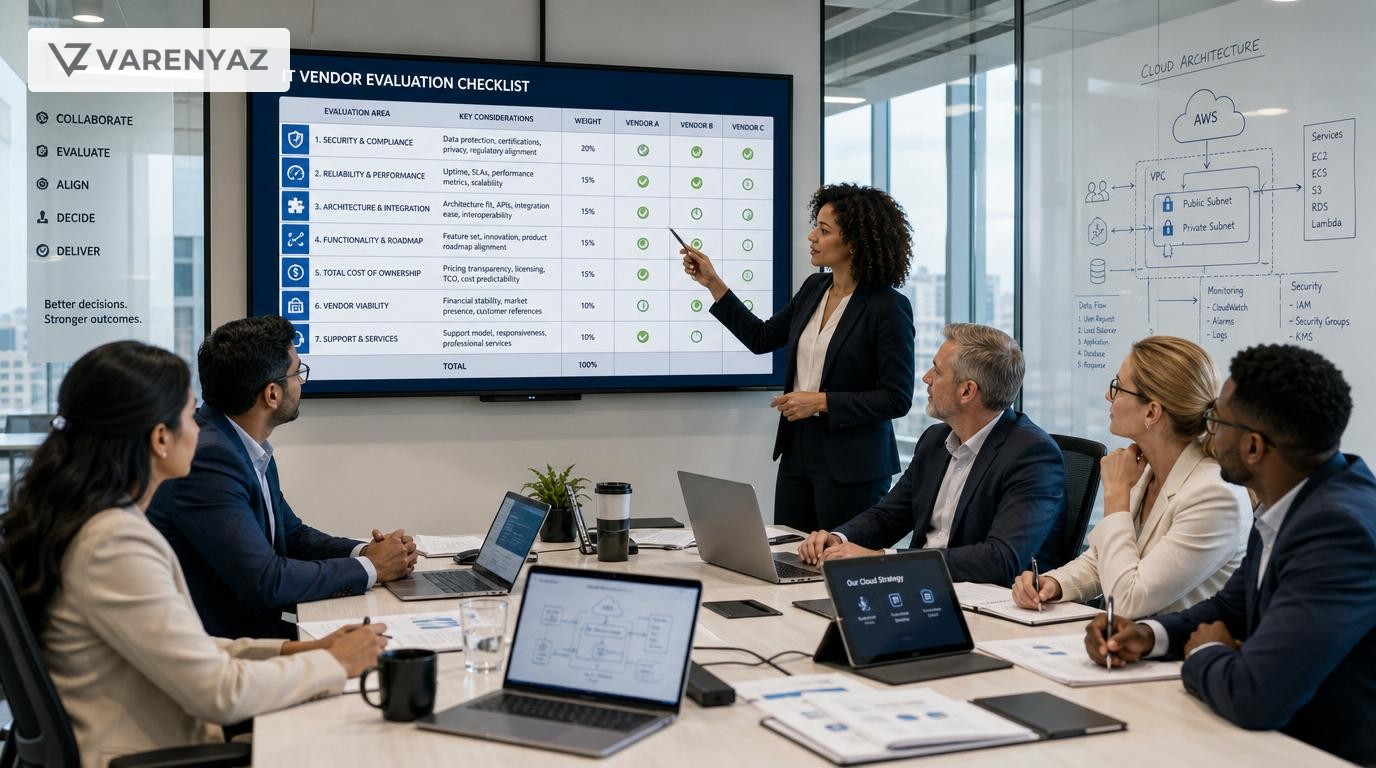
Guide details
- Type
- checklist
- Cluster
- Vendor selection
- Reviewed by
- VarenyaZ Editorial Desk
Direct answer
What you need to know
Before signing with an IT vendor, you should ask structured questions across seven areas: business fit, technical fit, delivery capability, security and compliance, financial and commercial terms, legal and risk, and ongoing support and governance. Clarify how the solution aligns with your strategy, integration landscape, and budget; how delivery and SLAs will be managed; what security, data protection, and continuity controls exist; and what exit options you have. Use these questions to compare vendors on evidence, not promises, and involve technical, finance, legal, and operations stakeholders for larger or higher‑risk contracts.
Key takeaways
- Evaluate IT vendors across business fit, technical fit, delivery, security, financials, legal risk, and governance, not just price.
- Turn vague promises into concrete commitments in contracts, SLAs, and security schedules before you sign.
- Ask for architecture details, integration plans, and data handling specifics to avoid lock-in and hidden costs later.
- Involve technical, legal, finance, and security stakeholders early for higher-value or higher-risk IT contracts.
- Define success metrics, service levels, and escalation paths up front so you can manage performance objectively.
- Check vendor financial health, subcontractor use, and exit terms to reduce continuity and lock-in risks.
- Use a repeatable checklist so you can compare IT vendors on evidence instead of sales narratives.
What You’re Really Deciding When You Sign With an IT Vendor
When you sign with an IT vendor, you are not just buying software, hardware, or a service. You are choosing a long-term partner that will touch your data, processes, and often your customers. The right questions before signature significantly reduce the risk of regret later.
This guide is a structured checklist of what to ask before signing with an IT vendor for modern businesses. It is designed for founders, business owners, CTOs, operations leaders, and marketing leaders who need practical due diligence questions, not just high-level advice.
Use it to:
- Clarify what you are trying to achieve and how to measure success.
- Compare multiple vendors on evidence, not just demos and personalities.
- Expose hidden risks around security, lock-in, and total cost of ownership.
- Decide when to involve technical, security, finance, and legal experts.
You can adapt the depth of questioning based on deal size and risk: light-touch for small SaaS tools, deeper for core platforms, and full due diligence for mission-critical or regulated systems.
1. Start With Strategy: Business Alignment Questions
1.1 Define what you are trying to achieve
Before you ask vendors anything, answer these questions internally:
- What business outcomes do we expect? (e.g., faster sales cycles, fewer manual tasks, better data visibility, lower operating cost)
- Which metrics will improve if this works? (e.g., lead-to-opportunity conversion rate, time to fulfill orders, NPS, incident resolution time)
- What is in scope now and what is explicitly out of scope?
- What is our time horizon? Is this a tactical 12-month solution or a 3–5 year strategic platform?
Vendors will naturally pitch whatever they have. A clear internal brief helps you stay grounded.
1.2 Questions to ask vendors about business fit
Once your goals are clear, ask vendors:
- Which of our goals is your solution best suited to support, and which are a stretch?
Ask them to rank your goals by how strong their support is, and where partners or custom work would be needed. - What similar customers have you helped, and what outcomes did they achieve?
You are looking for relevance (industry, size, complexity), not just a logo slide. - How does your product roadmap align with our likely future needs?
Ask for their high-level roadmap and how customer inputs influence it. - What is the smallest, most focused scope you recommend for phase 1?
This reveals whether they understand phased value delivery or just want a big initial sale.
Decision signal: Prefer vendors who can restate your goals in their own words and challenge unrealistic expectations, instead of promising everything without tradeoffs.
2. Technical Fit: Architecture, Integration, and Data
For modern businesses, the wrong technical fit creates hidden costs and lock-in. Even if you are not a technologist, structured questions can surface risks.
2.1 Architecture and deployment model
Ask:
- Is your solution cloud-based, on-premises, or hybrid?
Clarify where the system runs and who manages infrastructure. - Which cloud provider(s) and regions do you use?
This affects latency, data residency, and resilience. - How does your architecture scale as we grow users, data, or transactions?
Ask for examples of current customers at or above your expected scale. - What are our responsibilities versus yours in managing infrastructure and security?
This is especially important for IaaS, PaaS, and complex SaaS deployments.
For higher-risk systems, request a high-level architecture diagram and have a technical expert review it.
2.2 Integration and interoperability
Integration issues are one of the most common sources of overruns and frustration. Ask:
- What standard integrations do you already support? (e.g., CRM, ERP, marketing automation, payment gateways, identity providers)
- Do you provide documented APIs? Which standards do you support? (e.g., REST, GraphQL, webhooks, event streams)
- Which integrations are included in the base price, and which require custom work?
- Who is responsible for building and maintaining integrations? (you, the vendor, or a partner)
- How do you handle identity and access management? (e.g., SSO, SAML, OAuth, SCIM for user provisioning)
Decision signal: A credible vendor can show you real integration documentation, not just say “we integrate with everything.” Ask to see live or sandbox examples where possible.
2.3 Data model, access, and portability
Data is often your most valuable asset. Clarify:
- What data about our business and customers will your system store?
- How is our data logically separated from other customers?
- What self-service access do we have to our data? (e.g., exports, APIs, reporting)
- In what formats can we export data, and how often? (CSV, JSON, database dumps, APIs)
- What happens to our data if we terminate the contract?
Ask about how long they will retain it, how you can retrieve it, and any fees involved.
Avoid: Vendors who are vague about data formats or charge excessive “ransom” fees to export your own data.
3. Delivery Capability: Implementation, Resources, and SLAs
Many IT relationships fail not because of the product, but because of weak delivery and unclear expectations.
3.1 Implementation approach and responsibilities
Ask vendors to outline how implementation will work in practice:
- What are the major phases of implementation, and what is the typical timeline?
- Who will be on your implementation team? What profiles and seniority?
- What do you need from us to stay on track? (e.g., data, subject matter experts, decision-making cadence, internal project manager)
- What parts of implementation are fixed-fee versus time-and-materials?
- How do you manage scope changes?
Look for a clear change control process, not informal agreements.
Request a draft project plan or implementation proposal showing milestones, deliverables, and responsibilities.
3.2 Service levels and performance
Service level agreements (SLAs) are where promises become enforceable. Ask:
- What uptime do you commit to, and how is it measured? (monthly, per service, excluding planned maintenance)
- What are your response and resolution targets for incidents of different severities?
- What remedies are available if you miss SLAs? (service credits, termination rights)
- How do you communicate incidents and maintenance to customers?
- Can we see historical uptime and incident statistics?
Decision signal: Vendors who offer transparent, written SLAs and historical performance data typically have more mature operations than those who only give verbal assurances.
3.3 Support and training
Support quality heavily affects adoption and satisfaction:
- What support channels do you offer? (email, ticketing, chat, phone, dedicated account manager)
- What are your standard support hours and time zones?
- Is support tiered? What is included in the base price versus premium packages?
- What training do you provide for administrators and end users? (live training, documentation, videos, knowledge base)
- Do you offer a sandbox or test environment for safe experimentation?
Clarify any additional costs for premium support, training, or on-site assistance.
4. Security, Privacy, and Compliance Questions
Modern IT vendors inevitably impact your security posture and privacy obligations. Even if you operate in a non-regulated industry, security incidents can damage brand and trust.
4.1 Information security posture
Ask for concrete evidence of security practices, such as independent certifications or frameworks they follow:
- Do you maintain any security certifications or attestations?
Examples include ISO/IEC 27001 for information security management systems or independent audits like SOC 2 reports, which can demonstrate structured controls and oversight. - Can you share a summary of your information security policies?
Look for coverage of access control, change management, incident response, and vendor risk management. - How do you manage vulnerabilities and patches?
Ask about update frequency, testing, and how they communicate critical issues. - How is data encrypted in transit and at rest?
- What is your approach to identity and access management internally? (least privilege, multi-factor authentication, role-based access)
For higher-risk engagements, consider aligning your review with established security guidelines such as the NIST Cybersecurity Framework, which emphasizes identify, protect, detect, respond, and recover functions.
4.2 Data protection and privacy
If the vendor processes personal or sensitive data, your questions should go deeper:
- What categories of personal data will you process on our behalf?
- In which countries or regions is data stored and processed?
Data residency can affect regulatory obligations and customer expectations. - Do you act as a data controller, a data processor, or both for our data?
- How do you handle data subject requests and deletion?
- What mechanisms are in place for cross-border data transfers, where applicable?
Check that their privacy documentation aligns with your obligations and risk appetite, and that contracts include appropriate data protection clauses.
4.3 Incident response and business continuity
Incidents and outages will happen. The question is how prepared your vendor is. Ask:
- What is your incident response process?
Who is involved, and how do you notify customers and regulators when necessary? - What is your Recovery Time Objective (RTO) and Recovery Point Objective (RPO) for critical services?
RTO is how quickly services are restored, RPO is how much data loss (in time) you might experience. - Do you have documented business continuity and disaster recovery plans?
- How often do you test these plans, and what have you learned from past tests or events?
Decision signal: Vendors who can describe incident response and continuity in structured, non-defensive terms are typically better prepared than those who claim “it never happens.”
5. Commercials: Cost, Pricing Model, and Financial Health
Price is visible; total cost of ownership and vendor stability are often not. A few clear questions can save your budget later.
5.1 Pricing model and total cost of ownership
Clarify all components of cost:
- What are the main drivers of pricing? (users, usage volume, data volume, features, environments)
- What is included in the base subscription or license fee? (support, maintenance, upgrades, hosting)
- What additional costs might we incur? (implementation, integrations, premium support, training, storage, overages)
- How do prices change as we scale up or down?
Check for volume discounts, minimum commitments, or penalties. - What happens to pricing at renewal?
Clarify any caps on annual increases or market-alignment clauses.
Ask for an itemized 1-year and 3-year cost estimate under realistic usage assumptions, including one-time and recurring fees.
5.2 Vendor financial health and stability
You do not need full access to their financials, but you should assess risk:
- How long have you been in business, and in which markets?
- Roughly how many active customers use this product or service?
- What percentage of your revenue depends on this product line?
- What is your dependency on key subcontractors or third parties?
For cloud-based services, ask which third-party infrastructure, security, or service providers they rely on.
For large or mission-critical deals, your finance or procurement team may perform a deeper credit and risk review.
6. Contract and Legal: Protecting Your Position
Many of the questions you ask should flow into contractual protections. This is where vague promises become enforceable commitments.
6.1 Roles, responsibilities, and scope
Ensure contracts clearly answer:
- What exactly is the vendor obliged to deliver?
Reference statements of work, specifications, and SLAs. - What are our responsibilities?
E.g., providing data, timely approvals, infrastructure, or internal resources. - How are changes in scope handled?
Look for a documented change process and clarity on who can approve cost changes.
Avoid: Contracts that reference vague marketing brochures instead of specific deliverables and measurable outcomes.
6.2 Liability, indemnity, and insurance
Discuss with your legal and risk teams, but at minimum ask:
- What is the cap on your liability, and for which types of claims?
- Are there any areas where liability is uncapped or higher? (e.g., data breaches, intellectual property infringement)
- Do you maintain relevant insurance coverage? (e.g., professional indemnity, cyber risk)
- How do you handle third-party intellectual property claims related to your solution?
Align these terms with your risk appetite and the criticality of the service.
6.3 Data ownership and exit terms
Vendor lock-in is often contractual as much as technical. Ask:
- Who owns which data?
Your business data should remain yours; their analytics or aggregated data may be theirs. - Can you use our data for product development, AI models, or analytics?
If yes, in what form (e.g., anonymized, aggregated) and with what restrictions? - What is the process to retrieve our data when the contract ends? (timelines, formats, cost)
- Will you assist with migration to another provider if needed?
Clarify scope and pricing of any exit assistance.
Decision signal: Vendors willing to define fair data ownership and exit provisions are usually more confident in their long-term value.
7. Governance, Partnership, and Culture Fit
Even the best technology fails without clear governance and mutual trust.
7.1 Governance model and communication
Ask vendors:
- Who will be our main point of contact after go-live? (account manager, customer success manager, or support team)
- What governance structure do you recommend for a customer of our size?
For example, quarterly business reviews, monthly service reviews, steering committees. - What KPIs or metrics do you use to track account health?
- How do you gather and act on customer feedback?
Agree internally who will own the vendor relationship, and what oversight they need from leadership.
7.2 Cultural and working style fit
Cultural mismatch can cause friction during implementation and beyond. Consider:
- How transparent are they about risks, limitations, and tradeoffs?
- Do they push you into a single approach, or are they willing to adapt within reason?
- How do they behave when challenged on pricing, terms, or scope?
- Are they proactive in highlighting potential problems and mitigation options?
Talk to reference customers if possible and ask specifically about responsiveness, problem resolution, and escalation experiences.
8. Common Mistakes to Avoid in IT Vendor Selection
Even experienced organizations repeat the same avoidable mistakes. Use this section as a quick anti-pattern checklist.
8.1 Over-focusing on demos and under-focusing on operations
Demos are optimized to make everything look easy. Common pitfalls:
- Assuming demo workflows represent your real-world complexity.
- Ignoring how much configuration, customization, or integration is needed.
- Overlooking ongoing operational aspects like monitoring, support, and maintenance.
Counter this by asking for proof-of-concept scenarios and detailed implementation plans where appropriate.
8.2 Treating all IT vendors the same
A small marketing tool and a core payment gateway do not warrant the same level of scrutiny. Avoid:
- Over-engineering processes for low-risk, low-cost tools (slowing the business).
- Under-scrutinizing strategic platforms that impact revenue, compliance, or brand.
Classify vendors into risk tiers (e.g., low, medium, high) based on data sensitivity, business criticality, and spend, and adjust the depth of your questions accordingly.
8.3 Ignoring internal readiness
Even the best vendor cannot succeed if you are not ready. Mistakes include:
- No clear internal owner or sponsor for the solution.
- Underestimating the internal time required from subject matter experts.
- No plan for training, change management, or process updates.
Ask yourselves: Do we have the capacity and willingness to change how we work to realize the value of this solution?
8.4 Accepting vague answers and “we’ll work it out” promises
Vague responses can hide genuine uncertainty or lack of capability. Avoid signing until key aspects are:
- Written into contracts, SLAs, or statements of work.
- Acknowledged with clear assumptions and dependencies.
- Aligned with your governance and risk appetite.
If a vendor resists documenting commitments, consider what that implies about their willingness to be accountable.
9. When to Bring in Technical, Security, and Legal Help
Not every IT purchase requires a full cross-functional task force. But some clearly do. Use these guidelines to decide when to involve experts.
9.1 When to involve technical experts (CTO, architects, senior engineers)
Bring in technical help when:
- The system will integrate with core platforms like CRM, ERP, identity, or payment systems.
- The architecture is complex, or you expect significant customization.
- There are non-trivial performance, latency, or scalability requirements.
- You are depending on vendor APIs or event streams for automation or analytics.
Technical experts can validate architecture diagrams, integration feasibility, scalability claims, and feasibility of your future roadmap on the platform.
9.2 When to involve security and privacy experts
Security input is key when:
- The vendor processes personal data, financial data, health data, or other sensitive information.
- The solution is internet-facing or accessible to external users (customers, partners).
- The vendor gets extensive access to your internal systems (e.g., managed services, remote access).
- You operate in a regulated sector where security breaches or privacy violations carry heavy consequences.
Security professionals can align vendor practices with recognized approaches such as the NIST Cybersecurity Framework and your own policies, highlight gaps, and recommend mitigations.
9.3 When to involve legal and procurement
Legal review is strongly recommended when:
- The contract term is multi-year or contains auto-renewal with notice periods.
- There are significant liability implications (e.g., data breach, IP, service failure).
- The vendor uses heavily one-sided standard terms without room for negotiation.
- You are granting broad data usage rights to the vendor, particularly for AI or analytics.
Procurement and finance can help with vendor risk assessment, negotiation strategy, and ensuring alignment with internal purchasing policies.
10. A Practical Way to Use This Checklist
A checklist is only helpful if it is actually used. Here is a pragmatic approach you can adopt:
- Create a short, versioned questionnaire.
Distill the most important questions from this guide into a 2–4 page template with sections for business fit, technical fit, security, delivery, and commercials. - Tailor by risk tier.
Define a “light” version for low-risk tools, a “standard” version for most vendors, and a “full” version for strategic or high-risk engagements. - Share the questionnaire early.
Send it to vendors before advanced demos or negotiations so you get structured, comparable responses. - Score and compare vendors.
Create simple scoring for each section (e.g., 1–5) and discuss differences as a team, not just as individuals. - Convert answers into contractual commitments.
Where answers matter, ensure they are reflected in contracts, SLAs, and statements of work, not just emails. - Review periodically.
At least annually, revisit key vendors to ensure what you signed for is still what you are getting as your business evolves.
If you want a structured partner to help you design or run a robust vendor selection process tailored to your context, you can reach out to VarenyaZ at https://varenyaz.com/contact/.
11. Turning Questions Into Confident Vendor Decisions
Modern businesses rely on a growing ecosystem of IT vendors: SaaS platforms, cloud providers, integrators, and managed services. The complexity and risk will only increase as your technology footprint grows.
Using a structured set of questions about business alignment, technical fit, security, delivery, financials, contracts, and governance helps you:
- Spot misalignment before it becomes a costly project failure.
- Surface hidden operational and security risks while you still have negotiation leverage.
- Clarify mutual responsibilities and accountability from day one.
- Build more resilient, transparent partnerships with your most critical IT vendors.
The most effective technology leaders treat vendor selection as a deliberate capability, not an occasional ad-hoc task. With the right checklist and cross-functional involvement, you can move from reactive IT buying to strategic, data-informed vendor partnerships that actually move your business forward.
Practical checklist
- Clarify business goals, scope, and success metrics before engaging vendors.
- Confirm the solution aligns with your strategy and roadmap, not just current pain.
- Check the vendor’s understanding of your industry, regulatory context, and customer expectations.
- Assess architecture, integrations, and data flows for fit with your current stack and future plans.
- Evaluate how the vendor manages security, privacy, and compliance, including standards and attestations.
- Review service levels, support model, and escalation paths and ensure they are contractually documented.
- Understand implementation approach, responsibilities, and resource commitments on both sides.
- Confirm total cost of ownership, including implementation, integrations, training, and change fees.
- Evaluate the vendor’s financial stability, customer base, and reliance on subcontractors.
- Review data ownership, data access, and exit terms, including format and cost of data export.
- Align contract terms with your risk appetite, including liability caps, uptime commitments, and penalties.
- Ensure governance is defined: meeting cadence, reporting, KPIs, and who owns the relationship internally.
- Involve legal, security, and technical experts early for higher-risk or higher-value engagements.
Frequently asked questions
Why is a structured checklist important before signing with an IT vendor?
A structured checklist forces you to look beyond demos and price to the real risks and dependencies of an IT relationship. It helps you ask consistent questions across vendors, document answers, and compare options on evidence instead of sales narratives. This reduces the chances of surprises on integration, data security, performance, or total cost once the contract is signed.
What are the most critical questions to ask an IT vendor?
At minimum, ask how the solution aligns with your business goals, how it will integrate with existing systems, what specific service levels they commit to, how they protect and use your data, what happens if things go wrong, and how you can exit with your data if needed. These questions should be backed by written commitments in contracts, SLAs, and security documentation.
When should I involve legal and security experts in IT vendor selection?
Bring in legal review whenever there is long-term lock-in, access to sensitive data, or significant spend. Involve security and privacy experts whenever the vendor will process personal data, payment data, or critical operational data, or when systems are internet-facing. For many modern SaaS and cloud deals, involving legal and security before signature is now standard practice.
How do I assess an IT vendor’s security without being a security expert?
Ask the vendor to share their security certifications or attestations (such as ISO/IEC 27001 or SOC 2), their data protection approach, incident response process, and responsibilities in shared cloud models. You can use these documents to ask structured questions and, for higher-risk engagements, have an internal or external security professional review them.
What are common mistakes businesses make when signing with IT vendors?
Common mistakes include focusing only on price and features, assuming claimed capabilities exist without proof, accepting vague SLAs, overlooking data ownership and exit rights, underestimating integration and change costs, and not aligning contracts with internal governance and risk appetite. Many of these issues can be mitigated by using a repeatable set of questions and involving the right stakeholders before signing.
How can smaller businesses negotiate better terms with IT vendors?
Smaller businesses can negotiate better by preparing clearly, knowing must-haves versus nice-to-haves, and using competition between vendors. Asking precise questions, challenging vague clauses, and requesting reasonable changes on data ownership, exit assistance, and minimal security commitments can lead to more balanced contracts even when vendors are reluctant to customize extensively.
Sources
Related terms
Related guides
VarenyaZ support
Need help turning this guide into a working product, website, or AI system?
VarenyaZ helps teams plan, design, build, automate, and improve web apps, mobile apps, AI workflows, and digital growth systems.
Talk to VarenyaZ