
How to Compare Fixed Price vs Monthly Retainer Software Work
A practical checklist to compare fixed price projects versus monthly retainers for software work, so modern businesses can choose the right model, control risk, and align costs with outcomes.
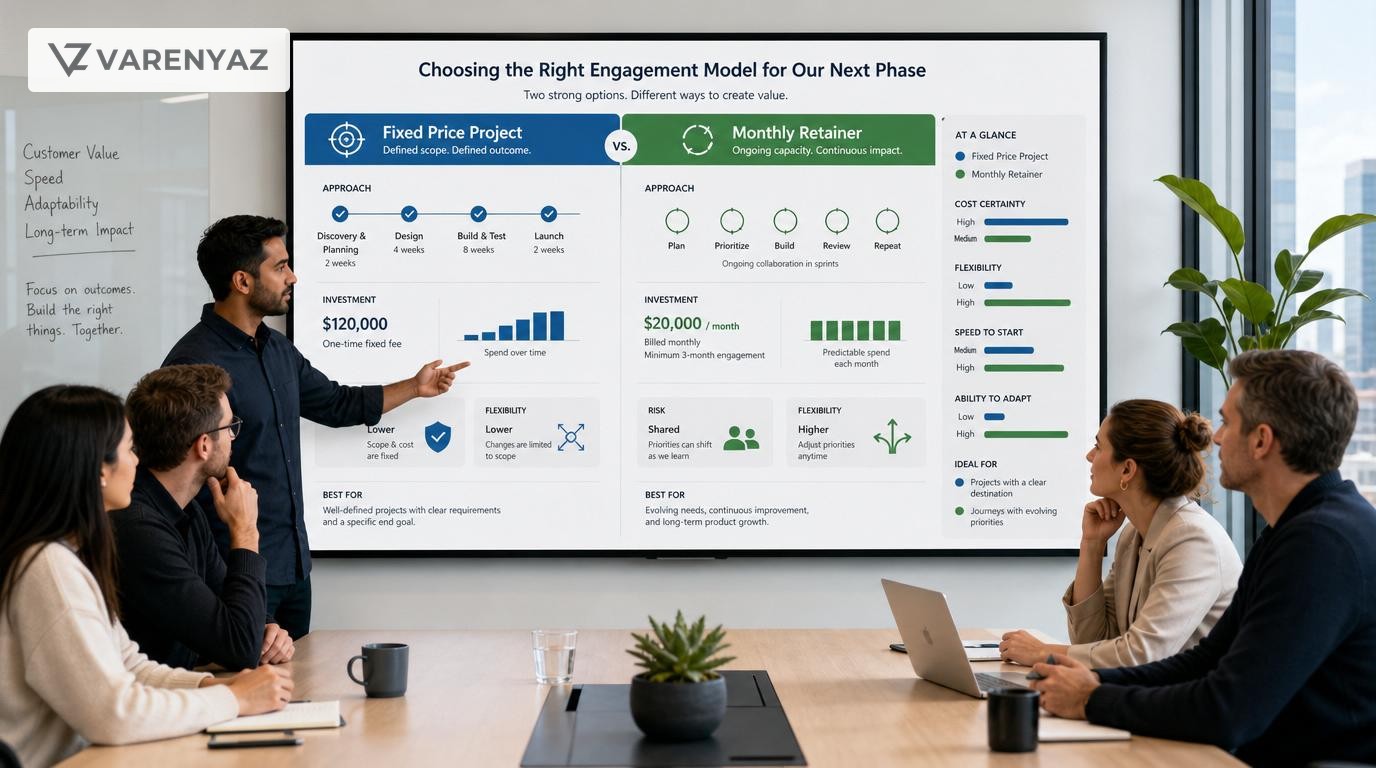
Guide details
- Type
- checklist
- Cluster
- Vendor selection
- Reviewed by
- VarenyaZ Editorial Desk
Direct answer
What you need to know
To compare fixed price and monthly retainer software work for modern businesses, start by clarifying your scope certainty, time horizon, internal capacity, and risk tolerance. Fixed price models work best for short, well-defined projects with minimal change, when your main priority is budget certainty. Monthly retainers suit ongoing product evolution, marketing tech, and operations automation, where priorities change and you need predictable capacity more than a fixed scope. Evaluate total cost of ownership, change control, governance, and vendor behaviour incentives before you choose. Use a structured checklist, run a simple 12–24 month TCO comparison, and involve finance and technical leaders to agree which model best aligns with your strategy and constraints.
Key takeaways
- Use fixed price mainly for short, well-defined software projects with low expected change.
- Use monthly retainers for ongoing product evolution, marketing tech, data work, and automation.
- Compare models over 12–24 months, not just upfront headline price, to understand total cost.
- Align the commercial model with incentives: fixed price optimizes for scope control; retainers for responsiveness.
- Decide based on scope certainty, time horizon, risk tolerance, and internal product ownership maturity.
- Define clear SLAs, governance, and exit options for both fixed price and retainers.
- Avoid under-scoping fixed price projects and under-sizing retainers that cannot deliver your roadmap.
- Involve technical, finance, and business leaders in the decision and run a small pilot before long commitments.
What You Are Really Choosing Between: Fixed Price vs Monthly Retainer
When you compare fixed price and monthly retainer software work for modern businesses, you are not just choosing a payment schedule. You are choosing:
- How risk is shared between you and the vendor.
- How easily you can change direction as your business evolves.
- How incentives shape vendor behaviour day to day.
- How predictable your costs are over 12–24 months.
Both models can work extremely well. Both can also fail badly if misused. The key is to match the model to the nature of the work, your internal maturity, and your risk appetite.
This guide gives you a practical, implementation-focused checklist to compare fixed price and monthly retainer software arrangements, so you can make a deliberate choice instead of defaulting to whatever a vendor proposes first.
Definitions: What Each Model Actually Means
Fixed Price Software Work
Fixed price means you and the vendor agree upfront on:
- A defined scope of work (deliverables, features, integrations).
- A fixed price (and often a payment milestone schedule).
- Timelines and acceptance criteria. >
The vendor carries more delivery risk (time and effort). You carry more scope risk (did you specify the right thing, and will the business needs change?).
Fixed price is usually used for:
- Implementing a well-understood feature set or app.
- Compliance or migration projects with clear endpoints.
- Proof-of-concept or pilot projects with narrow scope.
Monthly Retainer Software Work
Monthly retainer means you pay a recurring fee (usually monthly or quarterly) in exchange for:
- Access to a defined capacity (e.g., a dedicated or part-time team).
- Ongoing support, maintenance, and enhancements.
- Ability to prioritise and re-prioritise work within that capacity.
Scope is usually flexible within the agreed capacity and skills. You carry more capacity risk (will it be enough to achieve your roadmap?). The vendor carries less risk per unit of effort but more relationship risk (you can end the retainer if value is low).
Monthly retainers are usually used for:
- Continuous product development and experimentation.
- Marketing technology and website optimisation.
- Data analytics, automation, and internal tool evolution.
- Ongoing support and maintenance of business-critical systems.
Why This Decision Matters for Modern Businesses
Modern digital businesses rarely have static requirements. Markets shift, channels change, and your own teams discover new needs as they ship.
The commercial model you choose affects:
- Speed: Can you ship, learn, and adapt quickly?
- Cost: Are you optimising for lowest upfront cost or best multi-year ROI?
- Quality: Does the vendor have space to build robust, maintainable software?
- Governance: How visible and controllable is the work for you?
- Resilience: Can you absorb changes without constant renegotiation?
Many software projects struggle not because the technology is wrong, but because the commercial model is misaligned with how the work actually evolves in reality.
Research on software projects consistently highlights requirement volatility and unrealistic estimates as root causes of failure. Choosing the right commercial model is one of the most powerful levers you have to manage those risks.
What To Evaluate Before You Compare Models
Before you compare vendor proposals, step back and evaluate your own situation. This prevents you from being led purely by price tags and buzzwords.
1. Scope Clarity and Stability
Ask yourself:
- Can we write down, in plain language, what success looks like for this work?
- Do we have clear acceptance criteria for the main features?
- How likely are major changes in requirements within the next 6–12 months?
Stronger scope clarity increases the viability of fixed price. Higher uncertainty favours a retainer or hybrid model.
2. Time Horizon
Consider how long you realistically expect to work on this area:
- One-off project: e.g., a specific integration, data migration, or compliance reporting build.
- Ongoing initiative: e.g., product, website, data platform, automation program.
If the initiative is strategic and ongoing, you need a model that can support continuous evolution (usually a retainer or hybrid).
3. Internal Capacity and Maturity
Assess your internal capability:
- Do you have a product owner who can prioritise, make tradeoffs, and provide rapid feedback?
- Do you have a technical lead who can review designs and challenge estimates?
- Are your stakeholders used to iterative, agile delivery, or do they expect everything defined upfront?
If you lack strong product or tech leadership, vendors may push for fixed price to contain ambiguity. Alternatively, you might use a retainer with more strategic involvement from the vendor, but you must then govern outcomes very consciously.
4. Risk Appetite
Clarify what kind of risk is more acceptable for this initiative:
- Budget risk: Could costs grow beyond your initial expectations?
- Schedule risk: What happens if delivery is delayed?
- Scope risk: What if you discover halfway that what you asked for is not exactly what you need?
Fixed price tends to reduce budget risk (assuming good scope discipline) but can increase scope and change risk. Retainers may increase budget variability but can manage scope changes more gracefully.
5. Business Criticality
For core, revenue-driving or compliance-critical systems, your commercial model should:
- Support rapid response to issues and security concerns.
- Enable continuous improvement without painful renegotiation.
- Include clear service levels and escalation paths.
This often leads to a retainer or managed service model, even if part of the initial build is fixed price.
Checklist: Comparing Fixed Price vs Monthly Retainer
Use this section as a structured checklist while you evaluate proposals.
1. Alignment With Business Outcomes
- Have you expressed outcomes, not just features? For example, "reduce onboarding time by 30%" rather than just "build onboarding form".
- Does each model clearly connect work to outcomes?
- Fixed price: Are the deliverables the right ones to reach the outcome?
- Retainer: Is there a clear roadmap and prioritisation mechanism to pursue the outcome?
- Is there room to adjust if early results show a different path is better?
- Fixed price: Is there a structured change control process?
- Retainer: Is there a regular review cadence (e.g., monthly or quarterly roadmap reviews)?
2. Incentives and Behaviour
Look at how each model will shape vendor behaviour:
- Fixed price incentives:
- Vendor is incentivised to deliver scope with minimum effort.
- Can push for lower quality or technical shortcuts to preserve margin, if not managed carefully.
- May resist changes, even if those changes clearly improve business value.
- Retainer incentives:
- Vendor is incentivised to maintain a long-term relationship.
- Can be very responsive to changing priorities.
- However, without clear goals, a retainer can drift into low-impact busywork.
Ask vendors to explain how they measure success under each model and how they ensure they always prioritise high-value work.
3. Scope, Change, and Flexibility
Compare how each proposal handles change:
- Scope definition:
- Fixed price: Is there a detailed statement of work with acceptance criteria?
- Retainer: Is there a clear definition of what is in and out of scope (e.g., no new large products)?
- Change process:
- Fixed price: How are change requests estimated, approved, and priced?
- Retainer: How quickly can you re-prioritise the backlog within the same capacity?
- Impact on timelines:
- Fixed price: Do changes always extend timelines and cost?
- Retainer: Does changing priorities affect your ability to hit existing milestones?
4. Cost Over 12–24 Months
Rather than comparing only upfront quotes, build a simple multi-period view:
- Estimate realistic change volume.
- What new ideas are likely once users start using the system?
- What regulatory or business changes are probable?
- For fixed price:
- Initial project cost.
- Expected change requests (approximate percentage of initial scope).
- Maintenance and support costs.
- Potential follow-up projects or phases.
- For retainer:
- Monthly / quarterly fee multiplied by planned duration.
- Any onboarding or setup costs.
- Potential overage fees if you exceed capacity.
- Possible savings from catching issues earlier and reducing rework.
- Compare total cost and cost profile.
- Is one model front-loaded while the other is smoother over time?
- Which profile best matches your cash flow and risk appetite?
5. Governance and Transparency
Vendor models can fail simply because you cannot see what is happening.
- Visibility:
- Access to backlogs, boards, or work-in-progress reports.
- Regular demos, showcases, or stakeholder reviews.
- Clear metrics (velocity, defects, cycle time, satisfaction).
- Decision forums:
- How often will you meet to make tradeoffs and reset priorities?
- Who attends from your side and from the vendor?
- Escalation:
- If delivery slips or quality drops, how is that addressed?
- Do you have the right to change resources or reduce scope?
Retainers make transparency even more important, because you are funding capacity rather than a fixed output. Demand at least as much transparency from retainer vendors as you do from internal teams.
6. Vendor Fit and Working Style
Ask each vendor which model they prefer for this work and why. A vendor that is uncomfortable with a model may:
- Overprice risk.
- Deploy less experienced people.
- Be overly rigid in day-to-day collaboration.
Look for vendors who can articulate clearly:
- What they do differently under fixed price vs retainer.
- How they manage quality and risk under each model.
- Examples of engagements similar to yours (without breaching confidentiality).
When Fixed Price Makes the Most Sense
Fixed price can be the right choice when used in the right context.
Good Candidates for Fixed Price
- Short, well-defined projects:
- Single integration with a stable third-party API.
- Porting a small legacy app with minimal UX changes.
- Implementing a standard module of an existing platform.
- Proof-of-concept builds with narrow scope:
- A small prototype to validate technical feasibility or user interest.
- Initiatives with rigid deadlines where scope can be tightly controlled, such as certain compliance-related reporting modules.
Advantages of Fixed Price
- Budget predictability: You know the main cost upfront.
- Clear deliverables: Everyone knows what "done" means.
- Procurement simplicity: Easier to compare vendor quotes at surface level.
Risks and Common Mistakes with Fixed Price
- Under-scoped requirements: Critical details discovered mid-project become expensive change requests.
- Over-optimistic timelines: To win work, some vendors promise unrealistic schedules, leading to later compromises.
- Rigid contracts: Necessary learning and innovation are discouraged because every change hurts someone’s margin.
- Misaligned quality: Without clear non-functional requirements, vendors may optimise for speed over maintainability.
Mitigation steps:
- Invest in discovery and design before locking scope.
- Insist on clear acceptance criteria, including quality aspects.
- Include a structured but fair change control mechanism.
- Plan a follow-on phase (perhaps on a retainer) for post-launch iterations.
When Monthly Retainers Make the Most Sense
Retainers work best where the work is ongoing and inherently adaptive.
Good Candidates for Monthly Retainers
- Core product development:
- SaaS products, ecommerce platforms, mobile apps with continuous updates.
- Marketing technology and websites:
- Content sites, lead-gen funnels, CRO experiments, campaign integrations.
- Operations automation and data platforms:
- Workflow automations, analytics dashboards, data pipelines that evolve as teams mature.
- Support and maintenance for business-critical systems:
- Incident response, bug fixes, security updates, minor enhancements.
Advantages of Monthly Retainers
- Flexibility: You can adapt priorities as you learn from users and data.
- Continuous improvement: Encourages regular releases and incremental change.
- Predictable capacity: You know how much team you have month to month.
- Stronger partnership: The vendor becomes an extension of your team.
Risks and Common Mistakes with Retainers
- Vague scope: Without clear goals, retainers can become expensive support desks.
- Under-sized capacity: A tiny retainer may be unable to deliver your roadmap, leading to frustration.
- Weak governance: Without regular planning and review, important work may be deprioritised.
- Opaque reporting: If you cannot see how time is used, you cannot judge value.
Mitigation steps:
- Define capacity explicitly (e.g., hours per month, roles, or team size).
- Set clear quarterly objectives and key results for the retainer.
- Require regular demos, planning sessions, and usage reports.
- Include a trial period and regular review points to adjust the model.
Using a Hybrid Approach: The Best of Both Models
In practice, many modern businesses use hybrid models that combine fixed price and retainers.
Common Hybrid Patterns
- Fixed price for initial delivery, retainer for evolution:
- Define and deliver a minimum viable product (MVP) on fixed price.
- Switch to a retainer to iterate, add features, and support users.
- Fixed price for well-bounded components, retainer for the rest:
- For example, fixed price for a reporting module, retainer for ongoing core product work.
- Base retainer plus fixed-price add-ons:
- A stable retainer for continuous work, with separate fixed price contracts for large, one-off initiatives.
Hybrid models let you get budget certainty where scope is clear, and flexibility where learning and change are expected.
Key Considerations for Hybrid Models
- Define where the fixed scope ends and the retainer begins.
- Clarify handover responsibilities between project and ongoing team.
- Ensure there is continuity of knowledge (e.g., same lead engineer across phases).
- Align governance so that both parts still support a single product or business vision.
Implementation Checklist: Making the Decision
Use this condensed process to decide between fixed price and monthly retainer for your next software initiative.
Step 1: Clarify the Business Problem and Time Horizon
- Write one or two sentences describing the problem or opportunity.
- Decide whether this is a one-off build or part of a long-term capability.
- Outline a rough 12–24 month roadmap, even if only at a high level.
Step 2: Assess Scope Certainty
- Document current requirements and define which are fixed vs flexible.
- Rate requirement volatility: low, medium, or high.
- If medium or high, question any pure fixed price proposals that cover the full horizon.
Step 3: Map Risks to Each Model
- For each model, write down expected risks across budget, schedule, and scope.
- Consider the cost of slow changes vs the cost of possible overruns.
- Decide which risks you are more comfortable carrying.
Step 4: Build a Simple Cost Comparison
- For fixed price offers, add:
- Initial project cost.
- Rough change request allowance.
- Maintenance and support line items.
- For retainers, add:
- Monthly fee x planned duration.
- Onboarding cost.
- Optional scaling up or down after initial term.
- Compare not just totals, but how costs align with milestones and expected value.
Step 5: Validate Governance and Transparency
- Ensure there is a clear cadence for demos, planning, and retrospectives.
- Confirm access to progress dashboards or reports.
- Check whether you can redirect work quickly if priorities shift.
Step 6: Decide on Model and Pilot
- Choose a model (or hybrid) that best matches scope certainty, time horizon, and risk appetite.
- Run a time-boxed pilot (e.g., 8–12 weeks) under the chosen model with clear goals.
- Review the pilot and adjust the model if needed before long-term commitment.
Red Flags to Avoid in Vendor Proposals
Regardless of model, watch for these warning signs.
Fixed Price Red Flags
- Vague or incomplete specifications paired with a very precise price and timeline.
- Significantly lower price than other vendors without a clear explanation (e.g., smaller scope, lower quality expectations).
- No explicit change control process or claim that "small changes are always free" with no limits.
- Heavy penalties only on the vendor, which may drive defensive behaviour instead of collaboration.
Retainer Red Flags
- No clarity on capacity: You do not know how many hours, people, or skills you are actually buying.
- Lack of roadmap or prioritisation process: Work is managed ad hoc via email tickets.
- Long, rigid minimum terms without performance review or exit options.
- Limited transparency into where time is spent and what value is delivered.
When to Bring in Technical or Financial Help
Business leaders do not need to become contract or architecture experts, but you should know when to bring in deeper expertise.
Bring in Technical Help When:
- The system touches core architecture, security, or performance-sensitive areas.
- Multiple vendors propose very different technical approaches for the same outcome.
- You are unsure if the scope is realistic under the timelines and budget quoted.
- You cannot meaningfully assess the impact of cutting features to hit a fixed price.
A CTO, architect, or trusted external technical advisor can:
- Challenge assumptions in vendor estimates.
- Explain tradeoffs between short-term build cost and long-term maintenance.
- Help select which parts of work are suitable for fixed price vs retainer.
Bring in Finance / Procurement Help When:
- Contracts involve multi-year commitments or large budgets.
- You are evaluating several vendors with different commercial structures.
- You need to understand the impact on cash flow, capitalisation, or operating expenses.
- You want to standardise terms such as payment milestones, discounts, or inflation clauses.
Finance and procurement can help you:
- Compare total cost of ownership between models and vendors.
- Negotiate payment terms, caps, and review points.
- Ensure vendor financial health and viability.
Putting It All Together for Modern Businesses
To compare fixed price and monthly retainer software work effectively:
- Start with your business outcomes and time horizon, not with vendor price lists.
- Use fixed price for short, well-defined, low-volatility projects where budget certainty matters most.
- Use monthly retainers for ongoing product and operations work where learning, experimentation, and continuous improvement are expected.
- Where possible, design a hybrid approach that combines predictable milestones with flexible evolution.
- Look beyond the headline price and evaluate incentives, governance, and transparency for each model.
- Involve technical and financial expertise early for critical, high-impact initiatives.
If you want structured support designing the right mix of fixed price and monthly retainer software work for your roadmap, you can speak with the VarenyaZ team at https://varenyaz.com/contact/.
By deliberately choosing and tuning your commercial model, you create conditions where both your business and your vendors can do their best work—and where your software investments compound value rather than accumulate risk.
Practical checklist
- Clarify whether your main goal is budget certainty, speed, flexibility, or quality of outcome.
- Assess how clearly you can define scope, acceptance criteria, and constraints today.
- Estimate how much your requirements are likely to change over the next 6–18 months.
- Decide whether the work is a one-off project or ongoing product and operations support.
- Identify internal capacity: do you have a strong product owner and tech lead, or do you need the vendor to fill that gap?
- Map out a 12–24 month roadmap with must-haves, nice-to-haves, and experiments.
- For fixed price, write down the specific deliverables, milestones, and acceptance criteria.
- For retainers, define expected capacity per month (hours, story points, or similar).
- Create a simple total cost comparison over 12–24 months for each model.
- Evaluate how each model handles change requests, scope growth, and pivots.
- Review payment terms, minimum commitments, and exit clauses for each vendor offer.
- Check vendor transparency practices: reporting, demos, backlog access, and tooling.
- Define governance: how often you will review progress, reset priorities, and approve changes.
- Assess risk tolerance: schedule risk, budget risk, and quality risk for each model.
- Identify red flags in proposals: vague scope, unrealistic timelines, or very low prices.
- Decide where you might use a hybrid approach (fixed for launch, retainer for evolution).
- Validate the model choice with your technical lead, finance, and business owner.
- Start with a smaller pilot under the chosen model before committing long-term.
- Document your choice and the assumptions behind it so you can review after the first quarter.
- Plan a 3–6 month retrospective with the vendor to adjust the commercial model if needed.
Frequently asked questions
When is a fixed price software project better than a monthly retainer?
A fixed price project is usually better when your scope is stable and well-understood, the project is short to medium duration, and your main priority is budget certainty. Typical examples include building a small app or feature with clear requirements, implementing a specific integration with known APIs, or delivering a defined compliance or migration project. If you expect frequent changes, evolving requirements, or ongoing experimentation, a monthly retainer is usually a better fit.
How do I compare the total cost of fixed price vs monthly retainer?
Compare both models across a 12–24 month horizon. For fixed price, include change requests, maintenance, bug-fix arrangements, and any extension phases you realistically expect. For retainers, include the monthly fee, likely term, potential overage or usage fees, and the cost of onboarding or switching vendors. Then layer on the cost of delays and rework: for example, the impact on revenue or operations if a rigid fixed scope leads to slower changes versus a retainer that can adapt more easily.
Can I combine fixed price and monthly retainers with the same software vendor?
Yes, many modern businesses combine both models with one vendor. A common pattern is to use a fixed price contract for an initial implementation or a clearly defined milestone, and then switch to a monthly retainer for ongoing enhancements, support, and experimentation. This can give you budget certainty upfront and flexibility later, as long as the transition and responsibilities are clearly defined in the contracts and roadmap.
What risks should I watch for in a monthly software retainer agreement?
Key risks include vague scope and priorities, unrealistic expectations about how much can be delivered within the hours, lack of transparency on time usage, weak governance, and long minimum terms that are hard to exit. Mitigate these by defining capacity in hours or story points, setting a clear roadmap and prioritisation cadence, agreeing on service-level expectations, and including reasonable exit and review points every 3–6 months.
Who should be involved in choosing between fixed price and a retainer?
At minimum, involve a technical lead or CTO-equivalent, a business owner or product owner for the initiative, and someone from finance or procurement. The technical leader can judge delivery feasibility and risk, the business owner can articulate outcomes and roadmap flexibility, and finance can test affordability, commercial terms, and vendor viability. For critical systems, you may also involve security, data, or legal advisors.
Sources
Related terms
Related guides
VarenyaZ support
Need help turning this guide into a working product, website, or AI system?
VarenyaZ helps teams plan, design, build, automate, and improve web apps, mobile apps, AI workflows, and digital growth systems.
Talk to VarenyaZ