
What SEO Pages a Startup Should Create First
Learn which SEO pages a modern startup should build first, how to prioritize them by impact, and the practical steps and pitfalls when designing a lean, search-ready site.
Guide details
- Type
- seo presence
- Cluster
- SEO presence
- Reviewed by
- VarenyaZ Editorial Desk
Direct answer
What you need to know
A modern startup should first create a lean but high-impact set of SEO pages that map to its core customer journeys. This usually includes a focused home page, a primary product or service page for each offering, a clear pricing page, a credibility-focused About page, a conversion-oriented Contact page, and a small set of search-focused resources around top customer problems. These pages should be built with clear positioning, intent-driven keywords, fast performance, mobile responsiveness, and structured internal linking before expanding into more content-heavy SEO efforts.
Key takeaways
- Start with a small, focused set of pages that map directly to core customer journeys.
- Prioritize pages by business impact: acquisition, evaluation, and conversion.
- Design each page around a primary search intent and one main keyword theme.
- Home, product, pricing, About, Contact, and 3–5 resource pages form a strong SEO foundation.
- Avoid bloated blogs and keyword-stuffed content that do not match buyer intent.
- Plan internal links to guide visitors from discovery pages to conversion pages.
- Bring in technical help for performance, structured data, and analytics setup.
- Iterate based on real search data and user behavior rather than guesswork.
What SEO Pages a Startup Should Create First for Modern Businesses
If you are launching or rethinking a startup website, you face a familiar problem: you know you need "SEO" but you do not know which pages to build first. You have limited design, content, and engineering capacity. Every page you add increases cost and complexity.
This guide gives founders, CTOs, and marketing leaders a practical blueprint for what SEO pages a startup should create first for modern businesses. It focuses on impact, not volume: a minimum viable set of pages that can rank, explain, and convert.
What You Are Really Trying to Achieve With Your First SEO Pages
Your early SEO pages are not just "for Google". They are your minimum viable information architecture. Done right, they should help you:
- Get discovered by people already searching for problems you solve.
- Explain clearly what you do, for whom, and why you are different.
- Support evaluation by answering key buying questions.
- Convert interest into email signups, demo requests, trials, or purchases.
- Learn from data so you can improve your product and go-to-market strategy.
Instead of asking, "How many pages do we need for SEO?" ask, "Which pages best connect searchers to our product and help them decide?"
Why Your First SEO Pages Matter So Much
For modern businesses, organic search is often the most scalable and compounding acquisition channel. Your first set of pages strongly influences:
- How search engines understand your business – The topics and intents of your early content signal what queries your domain should be associated with.
- How users experience your brand – Initial visitors form opinions based on clarity, trust signals, and perceived quality.
- Your ability to measure and iterate – Clean page structure and analytics make it easier to see what works and adjust.
- Future SEO leverage – A solid foundation (navigation, internal linking, content themes) makes it cheaper to add new pages later.
Search engines themselves emphasize that helpful, people-first content and a good page experience matter more than tricks or excessive pages.1,2,3
How to Think About Page Types: Intent Over Templates
Before you decide which SEO pages to create first, step back and think in terms of search intent and buyer journey, not page templates.
Core search intents to design for
- Problem-aware / informational: "How do I reduce onboarding time for new hires?"
- Solution-aware / commercial investigation: "employee onboarding software"
- Product-aware / evaluation: "[your category] pricing", "[your brand] features"
- Action / transactional: "book demo", "start free trial", "contact support"
Your first SEO pages should map directly to these intents. A small set of focused pages will usually outperform a large, scattered blog that does not clearly support the buyer journey.
The Minimum Viable SEO Page Set for Most Startups
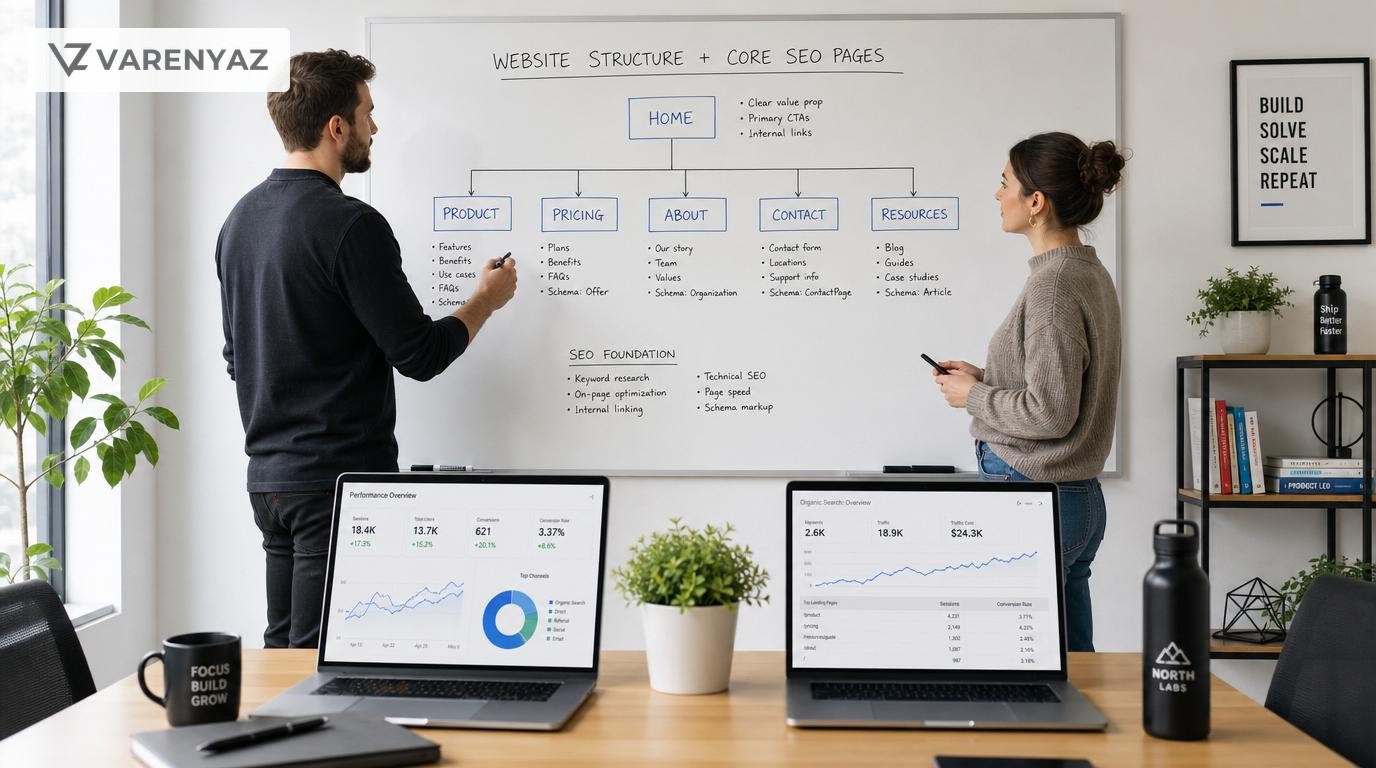
Across many modern B2B and B2C startups, a strong initial SEO presence usually includes 8–15 pages built around six core page types.
1. Home page: Positioning and clarity
Goal: Help new visitors quickly understand what you do, who it is for, and what to do next.
Primary intent: Mixed (navigational + informational + light commercial).
What to include:
- A clear, specific headline that states your value proposition (not just a slogan).
- A short explanation of who you serve and the main problem you solve.
- Top 2–4 product or solution highlights with benefits, not just features.
- Social proof (logos, testimonials, metrics if you have them).
- Primary calls-to-action (e.g., "Book demo", "Start free trial", "Talk to sales").
- Secondary navigation links to your most important child pages (Product, Pricing, Resources).
SEO considerations:
- Target a broad, brand-plus-category theme (e.g., "[Brand] – employee onboarding software").
- Ensure title and meta description clearly combine brand and main category.
- Make the page fast and mobile-friendly; core for page experience signals.3
2. Product or service pages: Your money pages
Goal: Convince qualified visitors that your offering can solve their specific problem.
Primary intent: Commercial investigation.
Most startups need one dedicated page per core product or service. If you sell one main thing, that is a single flagship page. If you have multiple use cases or tiers, you may have a main product page plus child pages (e.g., by role or industry).
What to include:
- Clear description of what the product is and how it works.
- Concrete, outcome-focused benefits (ideally tied to real use cases).
- Feature breakdown, but grouped by value themes (e.g., "Automate", "Measure").
- Screenshots or visuals to reduce abstraction (for SaaS).
- Use-case or role-specific sections (e.g., "For HR leaders", "For finance teams").
- Obvious pathways to Pricing, Demo, and Resources.
SEO considerations:
- Assign a primary keyword for each product or service page (e.g., "employee onboarding software" or "virtual CFO services").
- Include related phrases naturally (e.g., "onboarding process", "new hire checklist").
- Use internal links from resources and blog content to push authority to these pages.
3. Pricing page: Reducing friction and building trust
Goal: Help prospects answer, "Is this within my budget and worth exploring further?"
Primary intent: Evaluation / transactional.
Even if you cannot publish exact prices (enterprise, complex deals), a pricing page is still vital.
What to include:
- Clear pricing tiers, ranges, or at least how pricing is structured (per seat, per usage, per project).
- What each tier includes, in plain language.
- Common buying questions (billing cycles, contract terms, onboarding costs).
- FAQs addressing risk (cancellation, refunds, data ownership).
- Prominent calls-to-action: "Talk to sales", "Request quote", or "See ROI estimate".
SEO considerations:
- Optimize for queries like "[product type] pricing", "[category] cost", or "how much does [solution] cost".
- Link to this page from product pages, navigation, and relevant resources.
4. About page: Credibility and story
Goal: De-risk the decision by showing you are real, competent, and aligned with the customer’s world.
Primary intent: Informational / trust-building.
What to include:
- Concise origin story tied to the problem you solve.
- Founders and leadership with short bios that show relevant experience.
- Mission and values, but expressed concretely (e.g., how they influence product decisions).
- Milestones or traction if available (customers, regions, industries).
- Links to careers, press, and social channels if they strengthen trust.
SEO considerations:
- Support navigational and branded queries ("[brand] team", "about [brand]").
- Reinforce topical relevance by briefly referencing your category and audiences.
5. Contact / demo / signup page: Conversion engine
Goal: Turn interest into a concrete action – lead, booking, signup, or purchase.
Primary intent: Transactional.
What to include:
- Very short explanation of what will happen after the user submits (response time, what they can expect).
- Minimal form fields required to qualify leads while keeping friction low.
- Alternative contact options (email, phone, calendar link) depending on your model.
- Trust cues near the form (logos, privacy reassurance, data-handling statement as appropriate).
SEO considerations:
- Optimize for queries like "contact [brand]", "book demo [product]", or "start free trial [category]".
- Link to this page from every primary page via buttons and navigation.
6. Resource / guide pages: Targeted, evergreen SEO content
Goal: Capture informational and mid-intent searchers by answering their problems better than generic blogs.
Primary intent: Informational that naturally leads to commercial investigation.
Instead of a sprawling blog, most startups benefit from 3–5 focused, evergreen resource pages designed from day one for both people and search.
What to include:
- Step-by-step guides to core problems your product solves (e.g., "How to onboard new hires remotely").
- Checklists, templates, or frameworks that users can apply directly.
- Visuals or examples that make the content actionable.
- Contextual mentions of your solution, but with genuine educational value.
- Clear next-step CTAs (link to Product, Pricing, or a relevant demo).
SEO considerations:
- Each guide should target a specific question or topic cluster.
- Use descriptive, human-readable URLs (e.g., /resources/remote-onboarding-guide).
- Structure content clearly with subheadings to help users and search engines understand it.1,2
How to Prioritize: A Simple SEO Page Roadmap for Startups
You cannot build everything on day one. Use this three-phase roadmap to prioritize what SEO pages a startup should create first for modern businesses.
Phase 1: Launch-critical pages (Week 0–4)
These pages are non-negotiable for a credible, functional site:
- Home
- 1–3 Product/Service pages (depending on scope)
- Pricing
- About
- Contact / Demo / Signup
Decision criteria:
- Without this page, could a qualified lead understand enough to take the next step?
- Is this page required for sales conversations or investor diligence?
- Does this page support a critical search intent (e.g., [category] + pricing)?
Phase 2: Evergreen resources and FAQs (Week 4–10)
Next, add pages that attract earlier-stage searchers and reduce repetitive support or sales questions:
- 3–5 resource or guide pages addressing your most common questions or objections.
- A consolidated FAQ page if many recurring questions span multiple topics.
Decision criteria:
- Is this topic already coming up in customer calls, pilots, or support tickets?
- Would answering this via a public page shorten your sales cycle?
- Is the search intent aligned with your product (not just generically popular)?
Phase 3: Expansion and segmentation (Month 3+)
Once the core is live and you have some data, expand selectively:
- Role-specific pages (e.g., "For HR leaders", "For finance teams").
- Industry-specific pages (e.g., "Onboarding for healthcare" if you see traction there).
- Feature-deep-dive pages when certain capabilities become decision drivers.
- A more formal blog if you have a repeatable content engine.
By phasing your SEO presence this way, you avoid overbuilding early and can invest where real demand is emerging.
Mapping Keywords and Intent to Each Page
Effective SEO pages start from real user questions and needs, then layer keywords on top.
Step 1: Collect real questions
Gather input from:
- Sales and founder-led calls ("What do people ask first?").
- Customer support tickets or chat logs.
- Competitor FAQs and resource hubs (for gaps or patterns).
- Internal brainstorming about "how would I search for this?".
Step 2: Validate with lightweight keyword research
Use your preferred keyword tools to:
- Find search volume and difficulty for your core product terms.
- Discover long-tail variants that reflect actual language users employ.
- Group related terms into themes (e.g., "onboarding checklist", "onboarding process").
Step 3: Assign one primary keyword theme per page
For each page in your initial set, decide:
- Primary theme (e.g., "employee onboarding software").
- Supporting phrases (e.g., "new hire onboarding", "onboarding automation").
Design title tags, headings, and body copy to naturally reflect these themes without stuffing. Search engines emphasize that content should be written for people, not solely for rankings.2
Information Architecture and Internal Linking for Early SEO
Even with few pages, structure matters. A clean information architecture and internal links help both users and search engines understand your site.
Design a simple, shallow structure
For most startups, a two-level navigation is enough:
- Top level: Home, Product(s), Pricing, Resources, About, Contact.
- Second level: Separate product subpages, resource guides, or industry pages.
Too many levels or nested folders can confuse visitors and dilute authority.
Plan internal links intentionally
Use internal linking to guide users along a logical path:
- From Resource pages → Product pages → Pricing → Contact/Demo.
- From Product pages → Relevant resources that answer deeper questions.
- From About and Home → Your main money pages (Product, Pricing, Contact).
Every important page should be reachable from the main navigation and linked to from at least one other relevant page.
Technical Foundations: When to Bring in Technical Help
While you can draft and structure content internally, certain aspects of SEO foundations benefit from technical expertise, especially for growing startups.
Page experience and performance
Modern search emphasizes page experience, including loading performance, interactivity, and visual stability.3 Consider external help if:
- Your initial build is slow on mobile or fails Core Web Vitals tests.
- Your stack (e.g., heavy JavaScript frameworks) complicates server-side rendering.
- You lack in-house expertise on caching, image optimization, and code splitting.
Structured data and rich results
Structured data can help search engines better understand your business pages and may enable rich results in some cases.4 Bring in help if:
- You are unsure how to implement schema markup (e.g., Organization, Product, FAQ).
- You use a CMS that needs custom development for structured data.
- You want to connect structured data to internal systems (product catalogs, event data).
Analytics, events, and conversion tracking
To make data-driven SEO decisions, you need reliable tracking.
Consider specialist support when:
- Setting up analytics across multiple subdomains or environments.
- Defining custom events (demo booked, trial started, checklist downloaded).
- Linking marketing tools (CRM, email, ad platforms) and attribution.
Common Mistakes Startups Make With Their First SEO Pages
When deciding what SEO pages a startup should create first for modern businesses, avoid these high-cost, low-return pitfalls.
1. Launching a blog without a strategy
Publishing sporadic posts on random topics rarely builds a strong SEO presence. Focus on a small number of evergreen resources that directly support your product story.
2. Over-indexing on brand and under-explaining the problem
Founders often spend more copy on vision and less on practical, problem-focused explanations. Your early pages should speak your customer’s language first.
3. Targeting overly broad, competitive keywords
Trying to rank for "CRM" or "project management" from day one is unrealistic for most startups. Instead, go after specific, intent-rich phrases like "CRM for small property managers" or "project management for creative agencies".
4. Duplicating content across near-identical pages
Creating many thin, similar pages (e.g., a separate page for every city without meaningful differences) can dilute your site and confuse both users and search engines.
5. Ignoring conversion once someone lands on your page
Traffic without clear next steps is wasted. Every page should offer a logical action: learn more, calculate, download, book, or buy.
6. Treating the first version as final
Your first SEO pages are your best hypothesis. Plan to review and update copy, structure, and CTAs based on search queries, user behavior, and sales feedback at least quarterly.
Deciding What to Build In-House vs With External Support
For resource-constrained startups, deciding what to own internally versus outsource is a key strategic choice.
What you can often do in-house
- Problem and audience definition: No one knows your customers better than you.
- Core messaging and positioning: Founders and product leaders should lead this.
- Drafting outlines and raw content: Subject-matter expertise is internal.
Where external help adds leverage
- Information architecture and page prioritization: Experienced SEO strategists can turn business goals into a coherent site map.
- Keyword research and intent mapping: Specialists can validate your instincts with data.
- Content refinement for SEO: Editors can preserve your voice while improving structure, clarity, and on-page optimization.
- Technical SEO and performance: Developers and technical SEOs can ensure your site is crawlable, fast, and well-structured.
For many startups, a hybrid model works best: founders and internal teams provide the insight and draft content, while external partners translate that into a scalable, search-ready presence.
Practical Implementation Plan: From Blank Slate to SEO-Ready
Use this high-level process to go from idea to a prioritized, implementable SEO page plan.
1. Align on business goals and audiences
- Clarify what success looks like from organic search (e.g., 20 qualified demo requests per month).
- List your primary audience segments (e.g., HR leaders at firms with 50–500 employees, founders running remote teams).
- For each segment, list 5–10 questions they are likely to type into search.
2. Draft a minimum viable site map
- Start with the core six page types: Home, Product(s), Pricing, About, Contact, Resources.
- Add product and resource subpages necessary to cover your main questions and offerings.
- Keep the total count to a realistic number for the next 4–8 weeks of work.
3. Assign ownership and timelines
- Decide who owns each page: founder, PM, marketer, external partner.
- Set deadlines for outlines, drafts, design, development, and launch.
- Identify pages that are dependencies for others (e.g., Product page before Pricing details).
4. Outline every page before building
- Create a one-page outline per page: target audience, main question, primary keyword theme, core sections, and desired conversion action.
- Review all outlines together to ensure there are no big gaps or unnecessary overlaps.
5. Implement, test, and instrument
- Build pages in your CMS with clean URLs and descriptive titles.
- Check mobile responsiveness and page speed on key devices.
- Set up basic SEO hygiene: meta titles, meta descriptions, alt text, sitemaps, and robots configuration.
- Configure analytics, conversion events, and goal tracking for key actions.
6. Monitor and iterate
- Track impressions, clicks, and conversions per page.
- Review search queries in your analytics or search console to see what users actually type.
- Update copy, headings, internal links, and CTAs based on what is resonating.
Checklist: Are Your First SEO Pages Ready?
Before you launch or re-launch, use this quick checklist to validate your initial SEO presence.
- Your site has a clear Home page that states what you do, for whom, and why.
- Each core product or service has its own page with benefits, features, and CTAs.
- You have a Pricing page that answers cost questions and reduces friction.
- Your About page builds credibility with real people and milestones.
- A Contact/Demo/Signup page provides a simple, reassuring way to convert.
- You have at least 3–5 evergreen resource pages addressing top questions.
- Every page has a primary search intent and keyword theme defined.
- Navigation and internal links guide visitors toward conversion pages.
- Page performance, mobile usability, and basic technical SEO are in place.
- Analytics and conversion tracking are correctly configured and tested.
Next Steps: Turn This Blueprint Into a Real SEO Presence
Knowing what SEO pages a startup should create first for modern businesses is only the first step. The real leverage comes from executing a focused plan, then iterating based on data and customer feedback.
If you want expert help turning this framework into a concrete site map, content plan, and implementation roadmap tailored to your startup, you can speak with the VarenyaZ team at https://varenyaz.com/contact/.
Your early SEO presence does not need to be big; it needs to be clear, coherent, and connected to how your best customers actually search and decide.
Practical checklist
- We have a clear list of primary audiences and their top 5–10 questions.
- Our home page clearly communicates what we do, for whom, and why it matters.
- Each core product or service has its own dedicated, detailed landing page.
- We have a pricing page that removes friction and supports sales conversations.
- Our About page establishes credibility with real people, milestones, or proof.
- A Contact or demo page is easy to find and simple to complete.
- We have at least 3–5 evergreen resource pages targeting key search questions.
- Each page targets one primary keyword theme aligned with user intent.
- Navigation and internal links guide users toward conversion pages.
- Basic technical SEO, mobile responsiveness, and performance are in place.
- Analytics and conversion tracking are configured and tested.
- We have a simple quarterly plan to add or improve SEO pages based on data.
Frequently asked questions
What SEO pages should a startup create first?
Most modern startups should begin with a focused home page, one product or service page per core offering, a clear pricing page, an About page that builds trust, a conversion-optimized Contact or demo page, and a small set of resource pages answering top customer questions. This mix covers awareness, evaluation, and conversion while staying lean enough to launch quickly and iterate.
How many pages does a startup need for SEO at launch?
Many B2B and SaaS startups can launch effectively with 8 to 15 core pages. The exact number depends on your product complexity and audiences, but a compact site with well-structured, intent-driven pages usually outperforms a large but thin and unfocused site in the early stages.
Do we need a blog right away for SEO?
Not always. A blog is useful when you have a clear content strategy and capacity to publish quality posts. Early on, it is often smarter to ship 3–5 evergreen resource or guide pages that deeply answer top customer questions than to maintain an open-ended blog with sporadic, shallow posts.
How do we choose keywords for our first SEO pages?
Start from your customers, not from tools. List real questions buyers ask, describe what they search to find solutions like yours, and then use keyword tools to refine phrases and validate volume. Map one primary keyword theme and a few closely related variants to each page rather than targeting many unrelated terms on a single page.
When should a startup bring in an SEO or technical specialist?
Bring in expertise when you design your site architecture, implement tracking and analytics, handle performance optimization, or add structured data. These foundation decisions are difficult to fix later and can significantly affect crawlability, Core Web Vitals, and your ability to measure ROI from organic search.
How soon can we expect SEO results from our first pages?
SEO timelines vary by competition and domain strength, but many startups begin to see early impressions and clicks within 4–12 weeks after indexation, especially on less competitive, long-tail queries. Treat your first pages as a baseline to improve every month as data arrives, rather than a one-off launch.
Sources
Related terms
Related guides
VarenyaZ support
Need help turning this guide into a working product, website, or AI system?
VarenyaZ helps teams plan, design, build, automate, and improve web apps, mobile apps, AI workflows, and digital growth systems.
Talk to VarenyaZ