
Operational Risks to Review Before Launching Online in the US
A practical guide to reviewing critical operational risks before launching an online business in the United States, covering compliance, payments, logistics, security, and customer operations.
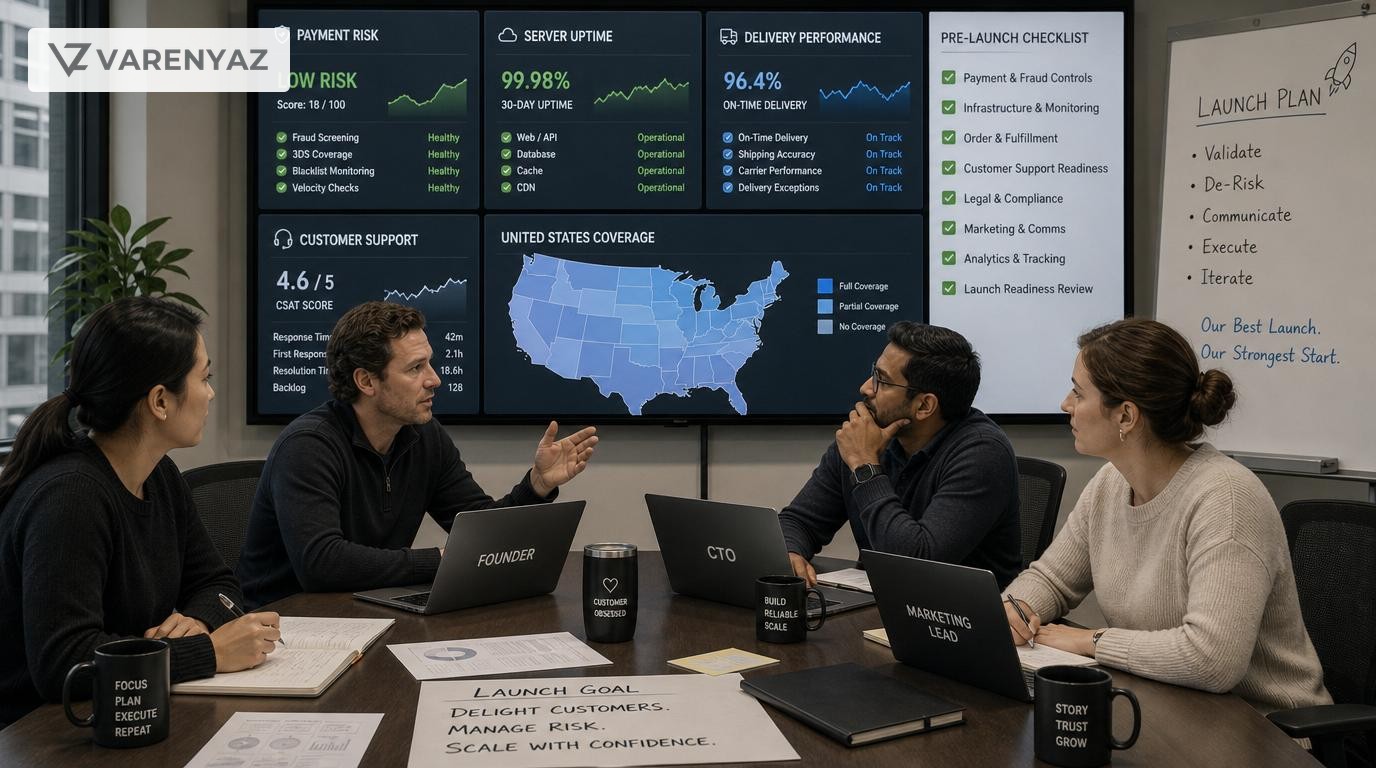
Guide details
- Type
- pillar
- Cluster
- Business planning
- Reviewed by
- VarenyaZ Editorial Desk
Direct answer
What you need to know
Before launching online in the United States, you should systematically review operational risks across compliance, payments and fraud, data privacy and security, logistics and fulfillment, technology reliability, customer service, brand and reputation, and financial resilience. This means confirming legal registrations and tax setup, choosing compliant payment processors, hardening your security posture, stress-testing your tech stack and supply chain, defining clear service levels, and building monitoring and incident response processes. Addressing these risks before launch reduces costly outages, chargebacks, regulatory issues, and negative customer experiences.
Key takeaways
- Operational risk planning should run in parallel with product and go-to-market planning for any US online launch.
- Regulatory, tax, and payments decisions create long-lasting constraints; validate them before growth marketing starts.
- Security, privacy, and uptime are not only IT issues; they directly impact revenue, customer trust, and regulatory exposure.
- Logistics, fulfillment, and returns policies determine real margins and customer satisfaction for US e-commerce.
- Clear service levels, support workflows, and incident playbooks reduce chaos during the early launch period.
- Monitor leading indicators such as fraud attempts, error rates, and delivery delays from day one.
- Bring in legal, security, and architecture experts when decisions have multi-year cost or compliance implications.
What You Are Really Trying to Achieve With an Online Launch in the United States
Launching online in the United States is not just about turning on a website. You are trying to build a reliable, compliant, and scalable operation that can accept orders, get paid, deliver value, resolve problems, and protect your brand. Operational risk is everything that can break in that chain.
When you ask what operational risks to review before launching online in United States, you are ultimately trying to answer three questions:
- Can we operate without major disruptions? (technology, logistics, staff)
- Can we operate without unacceptable losses? (fraud, chargebacks, penalties, wasted marketing spend)
- Can we operate without damaging trust? (customer, regulator, and partner trust)
Thinking this way helps you prioritize. You are not trying to eliminate all risk. You are deciding which risks you are willing to accept, mitigate, or avoid before you invite US customers in.
Why Operational Risk Matters So Much in the US Market
The United States is one of the largest, most competitive, and most litigious online markets. That creates specific reasons to take operational risk seriously:
- Customer expectations are high. US buyers are accustomed to fast shipping, easy returns, and responsive support. Falling short quickly creates negative reviews and churn.
- Regulatory and consumer protection enforcement is active. Agencies such as the Federal Trade Commission (FTC) take action on deceptive marketing, unfair practices, and data misuse, even for smaller businesses.
- Payment fraud and chargebacks are common. Online card-not-present transactions carry more risk. Poor fraud controls can erode margins and get your merchant account flagged.
- Operational issues scale with marketing. If your logistics or tech stack are fragile, growth campaigns simply amplify failures, raising costs and reputational risk.
For founders, CTOs, operations leaders, and marketing leaders, aligning around operational risk before launch prevents "fix it later" surprises that are expensive to repair.
Framing Your Risk Review: Domains and Tradeoffs
Before diving into details, organize your thinking into core operational domains. This gives you a checklist and helps you assign owners.
Core Operational Risk Domains
- Legal, regulatory, and tax readiness – Are we allowed to do what we plan, where and how we plan to do it?
- Payments, fraud, and financial flows – Can we get paid reliably without excessive losses or disputes?
- Data privacy and cybersecurity – Are we protecting customer data and our own systems to a reasonable standard?
- Logistics, fulfillment, and returns – Can we reliably deliver what we promise across the US?
- Technology reliability and scalability – Will our platform remain available, responsive, and secure as traffic grows?
- Customer support and service quality – Can we handle issues without creating more problems or costs?
- Brand, marketing, and reputation risk – Are our claims, content, and operations aligned and defensible?
- Financial resilience and continuity – Can we absorb shocks and maintain operations if something goes wrong?
Within each domain, consider:
- Impact – If this fails, how bad is it (revenue, trust, cost, legal exposure)?
- Likelihood – How likely is it, given your model, industry, and scale?
- Control – What can you directly change versus what you must manage via partners or contracts?
This helps you prioritize which issues to address before launch and which to monitor and improve over time.
Legal, Regulatory, and Tax Readiness
This guide does not provide legal or tax advice, but it can help you frame the questions you should address with qualified professionals before launch.
Key Questions to Evaluate
- Entity and jurisdiction
- Do you have (or need) a US legal entity for your planned operations?
- Where is your business legally established today, and how does that interact with US law?
- Licensing and industry-specific rules
- Are there federal or state licenses required for your product or service (for example, financial services, healthcare-related offerings, alcohol, or other regulated goods)?
- Do your products face age restrictions, labeling requirements, or shipping limitations?
- Consumer and advertising rules
- Are your marketing claims accurate, substantiated, and not deceptive as required by US consumer protection guidance?
- Are pricing, auto-renewal, and recurring billing terms clearly disclosed?
- Tax considerations
- How will you handle federal and state income tax obligations related to your activities?
- Does your business trigger sales tax obligations in particular US states, and how will you manage collection and remittance?
Practical Steps
- Draft straightforward Terms of Use, Privacy Notice, and Refund/Returns Policy and ensure they are accessible from every page.
- Review industry-specific requirements (if any) through official sources and industry associations.
- Engage a lawyer or tax professional with experience in US online business and your specific industry to review your planned structure and key policies.
- Keep a short written summary of your legal and tax assumptions (for example, which states you expect sales tax obligations in) and revisit as your footprint grows.
Common Mistakes to Avoid
- Copying policies from another website without legal review.
- Assuming that no physical presence in the US means no US obligations.
- Promising "no questions asked" returns without calculating the operational and financial impact.
Payments, Fraud, and Financial Flows
Payments are the lifeblood of your online business, and in the US market, payment risk can quickly turn profitable sales into losses.
What to Evaluate
- Payment methods
- Which payment instruments will you support at launch (credit/debit cards, digital wallets, Buy Now Pay Later, ACH)?
- Does your target audience have strong preferences that affect conversion (for example, specific wallets)?
- Payment processors and gateways
- Does your provider support US card networks, fraud screening, and chargeback management?
- What are the fees and settlement times, and how do they affect your cash flow?
- Fraud and chargeback controls
- What tools exist to screen suspicious transactions (for example, rule-based filters, risk scoring)?
- What is your process for manual review of high-risk orders?
- Refunds, disputes, and reconciliation
- Are systems in place to track refunds, credit notes, and chargebacks against orders?
- Can finance reconcile payments across channels and platforms without manual chaos?
Practical Steps
- Select a payment provider that:
- Has a strong presence supporting US merchants.
- Offers clear tools and dashboards for managing fraud and disputes.
- Integrates cleanly with your commerce or subscription platform.
- For launch, start with a limited, manageable set of payment methods and expand later based on customer demand and operational maturity.
- Configure conservative fraud rules at first, then tune based on real data (for example, flag unusually large orders, mismatched billing/shipping addresses, or high-risk geographies).
- Define who (by role) decides when to refund, when to contest a chargeback, and how to document those decisions.
- Ensure finance and operations leaders have shared visibility on payment performance metrics: approval rates, chargeback rates, refund volume, and settlement delays.
Mistakes to Avoid
- Choosing a payment provider solely on the lowest advertised fee without understanding dispute handling and support.
- Turning off or loosening fraud controls just to increase conversion during launch campaigns.
- Allowing marketing or customer service to create ad hoc refund practices without finance oversight.
Data Privacy and Cybersecurity
Accepting US customers means processing personal data. Cybersecurity and privacy are not only technical concerns; they are core business risks with reputational and regulatory consequences.
What to Evaluate
- Data inventory and minimization
- What personal data do you collect at each step (account creation, checkout, support)?
- Can you reduce the volume or sensitivity of data collected without hurting the customer experience?
- Storage and access
- Where is data stored (cloud region, providers, backups)?
- Who within your organization and which vendors can access it, and why?
- Security baseline
- Are basic protections implemented (for example, strong authentication, role-based access control, encryption in transit, patching process)?
- Do you rely on third-party platforms (for example, commerce platforms, CRM) that provide built-in security features you can configure properly?
- Incident readiness
- Do you know how you will respond to a security incident involving customer data?
- Who will lead communication with customers, partners, and (if needed) authorities?
Practical Steps
- Document a simple data flow diagram showing:
- What data is captured.
- Which systems store or process it.
- Which vendors are involved (for example, email providers, payment processors).
- Apply a recognized security framework as a reference for controls appropriate to your scale, such as the NIST Cybersecurity Framework.
- Use well-established platforms that already meet common security and payment standards (for example, providers that support PCI DSS compliance for card data, rather than building your own card storage logic).
- Implement basic but essential security measures:
- Multi-factor authentication for administration and cloud accounts.
- Least-privilege access controls.
- Encryption in transit for all web traffic (HTTPS) and encryption at rest where provided by your cloud or platform.
- Regular updates and patching for systems you manage.
- Write a short, practical incident response playbook that covers how you will detect, triage, contain, and communicate about suspected breaches.
When to Bring in Technical Help
- If you are storing or processing payment card data beyond what standard providers require.
- If you handle especially sensitive data (for example, health-related or financial account data beyond payment processing).
- If you operate your own infrastructure rather than using managed platforms.
Common Mistakes to Avoid
- Collecting more personal data than needed because "we might use it later" without clear security and retention plans.
- Leaving admin accounts with shared passwords or no multi-factor authentication.
- Assuming that cloud or SaaS providers alone cover all your security responsibilities.
Logistics, Fulfillment, and Returns
For any physical product sold online in the United States, logistics and returns strongly shape the real cost of each order and your customer satisfaction. Even digital and service businesses often have equivalent operational dependencies such as onboarding timelines or scheduling.
What to Evaluate
- Coverage and service levels
- Which US states and territories will you serve at launch?
- What delivery times can you reliably meet in each region?
- Partners and contracts
- Which couriers, fulfillment centers, or third-party logistics providers (3PLs) will you use?
- What are their service commitments, and how will you monitor their performance?
- Inventory and packaging
- How will you maintain stock accuracy, especially if you sell on multiple channels?
- Are packaging, labeling, and documentation compliant with shipping and product rules (for example, hazardous materials where applicable)?
- Returns and reverse logistics
- How will customers initiate returns (portal, email, phone)?
- How will you inspect returns, restock, refurbish, or dispose, and how will this affect margins?
Practical Steps
- Start with a constrained geography or shipping promise that you can confidently deliver, then expand as you understand real performance and costs.
- Run trial shipments to multiple US regions before launch to validate typical transit times and identify bottlenecks.
- Integrate your ecommerce platform with your logistics partners where possible, so tracking numbers and status updates flow automatically to customers.
- Define a clear and realistic returns policy with time limits, conditions, and any restocking fees, and ensure it is operationally feasible.
- Set internal targets for on-time delivery rate, return rate, and delivery-related support tickets, and review them weekly at launch.
Mistakes to Avoid
- Advertising aggressive delivery promises based solely on a courier’s "typical" estimates without real-world tests.
- Ignoring the cost of returns and replacements in your unit economics.
- Relying on a single logistics partner without a backup plan for disruptions.
Technology Reliability and Scalability
Your online presence is the visible tip of a larger stack of infrastructure, integrations, and workflows. Reliability failures during or after launch directly convert marketing spend into lost revenue and reputational damage.
What to Evaluate
- Platform choice
- Are you using a hosted ecommerce or subscription platform, a custom build, or a hybrid?
- What uptime and performance guarantees do your vendors provide?
- Architecture and integrations
- How many systems must work together to complete an order (for example, website, payments, inventory, shipping, CRM)?
- What happens if one of them fails or slows down?
- Performance and capacity
- How does the site behave under expected launch and peak loads?
- Are any processes (for example, reporting, exports) likely to degrade performance during busy periods?
- Monitoring and alerting
- Do you have live visibility into uptime, error rates, and key user flows (for example, homepage to checkout)?
- Who receives alerts and is authorized to act on them?
Practical Steps
- Map your critical paths, such as "browse to checkout" and "sign-up to first use", and test them thoroughly on multiple devices and networks.
- Implement synthetic monitoring or simple scripted checks that run key flows periodically and alert on failures.
- Conduct load testing before major marketing pushes to identify bottlenecks.
- Use staged rollouts or feature flags where possible to limit the blast radius of new features during launch.
- Document a short runbook for common issues (for example, payment gateway outage, inventory sync failure, site degraded performance) and who will respond.
When to Bring in Technical Help
- If you are building custom integrations between multiple systems that affect payments, inventory, or tax calculations.
- If you manage your own hosting infrastructure or complex microservices rather than a fully managed platform.
- If you are planning high-visibility campaigns that will drive traffic spikes beyond typical usage.
Mistakes to Avoid
- Leaving monitoring and alerting for "later" because they are not a visible feature.
- Deploying last-minute changes right before launch or major campaigns without rollback options.
- Underestimating how small configuration errors (for example, timeouts, rate limits) can cascade into outages.
Customer Service and Experience Risk
Operational risk is not limited to systems and suppliers. Customer experience failures at launch can be just as damaging, and they often result from unclear or incomplete internal processes.
What to Evaluate
- Channels and coverage
- Which support channels will you offer (email, chat, phone, social media)?
- What hours of coverage can you realistically maintain in US time zones?
- Service levels and expectations
- How quickly will you respond to customer inquiries?
- Which issues require same-day handling and which can be queued?
- Knowledge and training
- Do your support agents (internal or outsourced) understand your products, policies, and systems?
- Do they know when to escalate technical or sensitive issues?
- Feedback loops
- How do you capture recurring issues or complaints and feed them back into product, operations, or marketing decisions?
Practical Steps
- Start with a small number of channels you can manage well, rather than many channels that all perform poorly.
- Create concise internal guides or playbooks covering:
- Common issues and standard responses.
- Refund and return rules.
- Escalation criteria and contacts.
- Define and publish realistic response time targets, and train agents to set expectations clearly with customers.
- Set up basic tagging or categorization in your support tools so you can identify patterns (for example, payment issues, shipping issues, product confusion).
Mistakes to Avoid
- Routing all queries to a single founder or leader’s inbox with no backup.
- Letting support teams invent policy at the point of contact under pressure.
- Failing to adjust marketing promises based on real support and operations capacity.
Brand, Marketing, and Reputation Risk
Marketing decisions create operational obligations. If your launch campaigns set expectations your operations cannot meet, you create reputational risk and potential regulatory scrutiny.
What to Evaluate
- Claims and promises
- Are your claims about product performance, delivery times, discounts, and guarantees accurate and supportable?
- Are recurring billing, trial periods, and subscription terms clearly disclosed and easy to understand?
- Consistency with reality
- Do your operational teams agree that advertised promises are achievable at current capacity?
- Are there clear procedures to update marketing content if operations change?
- Crisis and communications
- Do you have a plan for responding if something goes wrong (for example, delayed shipments, stockouts, system outages)?
Practical Steps
- Run launch campaigns and key pages past operations and support leaders to confirm feasibility.
- Maintain a single, accessible inventory of "promises" you make to customers (for example, delivery times, guarantees, return windows) and connect it to operational planning.
- Prepare a few pre-approved messages for use during disruptions (for example, apologizing for delays and explaining remedies).
- Monitor social channels and major review sites closely in the first months after launch to detect issues early.
Mistakes to Avoid
- Allowing separate teams to own claims, operations, and support without a shared view.
- Using overly aggressive countdown timers or scarcity tactics that cannot be justified.
- Ignoring feedback signals like spikes in negative reviews or refund requests until they become a crisis.
Financial Resilience and Business Continuity
Operational risk has financial consequences: refunds, penalties, emergency fixes, and lost sales. Planning for resilience means assuming some things will go wrong and ensuring they do not threaten the business.
What to Evaluate
- Cash flow and buffers
- How many months of core operating expenses can you cover if revenue is slower than expected or if you must temporarily stop paid acquisition?
- What is your tolerance for chargebacks, refunds, or write-offs in the first year?
- Concentration risk
- How dependent are you on a single payment provider, logistics partner, or key platform?
- Do you have backup options or alternative workflows if one fails?
- Business continuity
- What events could materially disrupt your ability to fulfill orders or operate your platform (for example, data center issues, major supplier outages)?
- Do you have a simple plan for each high-impact scenario?
Practical Steps
- Model conservative revenue and cost scenarios for the first year and explicitly include contingencies for:
- Higher-than-expected refunds or chargebacks.
- Temporary marketing pauses.
- Increased logistics or supplier costs.
- Identify any "single points of failure" in your suppliers and platforms and document at least one fallback option for each.
- Ensure critical account access (for example, to payment, hosting, and domain providers) is not concentrated in a single individual.
- Schedule quarterly reviews of operational and financial assumptions and adjust as you observe real-world data.
Mistakes to Avoid
- Over-optimistic forecasting that assumes flawless operations and immediate traction.
- Locking into long-term contracts with key vendors before validating real-world performance.
- Neglecting how operational issues can impact investor confidence or lending terms.
When to Bring in External Experts
Not every risk requires a consultant or outside specialist. Use external expertise where decisions are complex, have long-term impact, or involve specialized knowledge.
Situations Where Expert Help Is Recommended
- Legal and tax structuring
- Deciding whether and how to form a US entity.
- Understanding sales tax exposure across states and how to manage it.
- Security and data protection
- Designing controls for sensitive data processing.
- Responding to suspected breaches or major security incidents.
- Architecture and scaling
- Designing custom architectures that must integrate multiple systems or support high projected traffic.
- Assessing whether your current stack can support growth plans.
- Financial modeling and risk
- Building scenarios that integrate operational metrics, unit economics, and cash flow.
When bringing in experts, make sure they work closely with your internal leaders so that knowledge and decision rationale stay inside the organization.
How to Sequence Your Operational Risk Review
To make this practical, sequence your review into stages that run in parallel with your product and marketing plans.
Stage 1: Concept and Feasibility (3–6 Months Before Launch)
- Clarify your business model, target segments, and value proposition for US customers.
- Identify regulatory, tax, or licensing constraints that could block or significantly change your approach.
- Choose core technology and payment platforms at a high level.
- Estimate logistics needs and potential partners.
Stage 2: Build and Integration (2–4 Months Before Launch)
- Implement your ecommerce or application platform and payment integration.
- Draft and review terms, privacy notices, and key customer policies.
- Set up initial security controls, access management, and monitoring basics.
- Define fulfillment, returns, and support processes and test with internal users.
Stage 3: Test and Soft Launch (4–8 Weeks Before Full Launch)
- Conduct load and user testing of all critical journeys.
- Run trial shipments or service deliveries to sample US locations or pilot customers.
- Validate fraud rules, refund processes, and reconciliation workflows with small volumes.
- Train support teams and rehearse incident response scenarios.
Stage 4: Full Launch and Stabilization (0–90 Days After Launch)
- Monitor key metrics daily: uptime, error rates, payment approvals, chargebacks, delivery performance, and support volumes.
- Hold short cross-functional reviews weekly to prioritize fixes and improvements.
- Adjust marketing promises, policies, and processes based on real-world performance.
- Capture lessons learned and convert them into checklists and runbooks.
Operational Readiness Checklist Before Going Live
Use this distilled checklist to confirm you have addressed the most important operational risks before inviting US customers at scale.
- Governance and Basics
- Roles and responsibilities for operations, technology, and support are defined.
- Decision-makers agree on risk appetite and key non-negotiables (for example, data protection, refund commitments).
- Legal and Compliance
- Key policies (terms, privacy, returns) are drafted and reviewed by a qualified professional.
- Any industry-specific licenses or restrictions are identified and addressed.
- Payments and Fraud
- A reputable payment provider is integrated and tested across browsers and devices.
- Fraud detection rules are configured, and a manual review process exists for flagged orders.
- Refund, dispute, and reconciliation workflows are defined and documented.
- Data and Security
- Data flows and storage locations are documented.
- Authentication, authorization, and basic security controls are implemented.
- Incident response steps and contacts are documented.
- Logistics and Fulfillment
- Shipping coverage, costs, and times are validated with test shipments.
- Returns processes and costs are understood and operationally feasible.
- Technology and Monitoring
- Key customer journeys are tested end-to-end.
- Monitoring and alerting are active for uptime, errors, and performance.
- Runbooks exist for common incident types.
- Customer Support
- Support channels and response targets are defined.
- Agents are trained on policies and escalation paths.
- Financial and Continuity
- Launch and downside scenarios are modeled, including contingency plans.
- Single points of failure in vendors and systems are identified and mitigated where possible.
Turning Operational Risk Into a Competitive Advantage
Operational discipline is not just a defensive exercise. In the US online market, businesses that can consistently deliver on their promises, respond quickly when things go wrong, and adapt based on real data build trust faster and grow more sustainably.
If you approach the question of what operational risks to review before launching online in United States as an ongoing management discipline rather than a one-time checklist, you create a foundation for scaling confidently.
If you want structured help assessing your operational risks and designing a launch-ready architecture and process for the US market, you can reach out to VarenyaZ at https://varenyaz.com/contact/.
Practical checklist
- Business model, product categories, and customer segments for the US are clearly defined.
- US legal, regulatory, and basic tax considerations have been reviewed with a qualified advisor.
- Customer terms of use, privacy notice, and key policies are drafted and accessible on the site.
- A reputable payment processor or gateway with fraud screening is integrated and tested.
- Refund, return, and chargeback handling policies are clearly defined and operationally feasible.
- Personally identifiable information and payment data are identified, minimized, and protected.
- User authentication, access controls, and basic security hardening are implemented and reviewed.
- Primary logistics and fulfillment partners are contracted and tested with real shipments.
- Delivery time promises and shipping costs match realistic capabilities for US regions served.
- Customer service channels, scripts, and escalation procedures are in place and tested.
- Monitoring is configured for uptime, response time, error rates, and key user journeys.
- Incident response responsibilities and communication plans are documented and rehearsed.
- Backups and basic disaster recovery processes are configured and periodically tested.
- A soft launch or pilot period has been used to capture real operational data.
- Post-launch review criteria and improvement backlog management are defined.
Frequently asked questions
What operational risks should I review first before launching online in the United States?
Start with legal and regulatory readiness, payment processing and fraud controls, and data privacy and security. These areas create the foundation for accepting customers and handling their data. Then review logistics and fulfillment, technology reliability, and customer service operations, so you can reliably deliver your product or service and handle issues when they arise.
Do I need a US legal entity to sell online to US customers?
You do not always need a US legal entity to sell online to US customers, but you must comply with US consumer, tax, and privacy rules that apply to your activities. Factors such as where you are established, where you ship from, payment flows, and your product category influence the best structure. Because this has tax and legal implications, you should consult a qualified attorney or tax advisor familiar with cross-border online commerce before launch.
How can I reduce payment and fraud risk for a new US online store?
Use a reputable payment processor or gateway with built-in fraud screening, enable address and card verification checks where available, set conservative limits for high-risk transactions, and monitor chargebacks closely in the first months. Combine automated fraud tools with manual review for unusual orders and ensure your policies for refunds and chargebacks are clearly documented and accessible to customers.
When should I bring in technical help for my online launch in the United States?
Bring in technical help when designing your overall architecture, selecting core platforms, handling payment integrations, implementing authentication and security controls, and designing data storage for personal and payment information. You should also involve experienced engineers or security specialists before load testing, before processing real customer data, and whenever you connect third-party systems that affect orders, inventory, or financial reporting.
What is the biggest mistake business leaders make with operational risk before going live?
A common mistake is assuming that operational risks can be fixed after launch without major impact. In practice, problems in areas like fraud controls, tax handling, shipping promises, or uptime quickly affect revenue, margins, and brand trust. It is much cheaper and safer to run through a deliberate risk review, simulate issues, and establish monitoring before opening the doors to real customers.
How do I know if my online business is operationally ready for US customers?
You are operationally ready when you have: confirmed legal and tax basics with a qualified advisor, selected and tested a payment processor with fraud controls, documented data handling and security measures, validated logistics partners and delivery estimates, defined support and escalation workflows, set service levels you can actually meet, and implemented monitoring and incident response processes for your core systems and suppliers.
Sources
- U.S. Federal Trade Commission – Business guidance on online advertising and marketing practices
- U.S. Small Business Administration – Online business regulations overview
- National Institute of Standards and Technology (NIST) – Cybersecurity Framework
- U.S. Internal Revenue Service – Understanding sales tax vs. income tax obligations for businesses
Related terms
Related guides
VarenyaZ support
Need help turning this guide into a working product, website, or AI system?
VarenyaZ helps teams plan, design, build, automate, and improve web apps, mobile apps, AI workflows, and digital growth systems.
Talk to VarenyaZ