
What Is an MSA in Software Projects in the United States?
Understand what a Master Services Agreement (MSA) is in U.S. software projects, why it matters, what to negotiate, and how to use it to reduce legal risk and speed up deals.
Guide details
- Type
- business terms
- Cluster
- Business terms explained
- Reviewed by
- VarenyaZ Editorial Desk
Direct answer
What you need to know
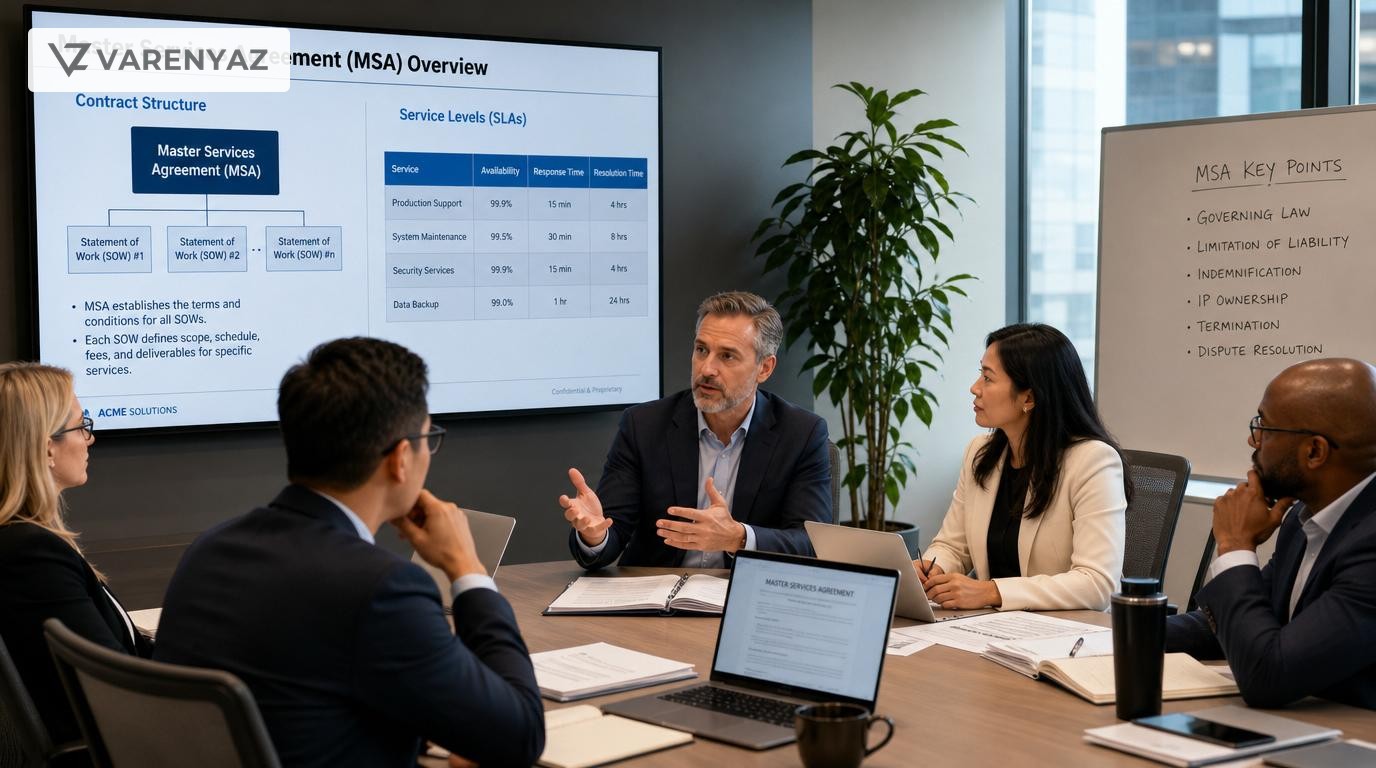
In U.S. software projects, an MSA (Master Services Agreement) is a foundational contract between a customer and a software or technology services provider that sets the overall legal and commercial framework for their relationship. It defines standard terms like scope of services, payment, intellectual property ownership, confidentiality, data protection, warranties, liability limits, and dispute resolution. Individual projects or work orders are then added as statements of work (SOWs) that reference the MSA. Using an MSA reduces negotiation time for each new project, provides consistent risk allocation, and creates a scalable structure for ongoing software development, implementation, and support engagements.
Key takeaways
- An MSA is a master contract that sets the legal and commercial framework for multiple software projects between the same parties.
- MSAs and SOWs work together: the MSA covers standard terms, while each SOW defines project-specific scope, deliverables, and pricing.
- Key negotiation areas include IP ownership, data protection, SLAs, limitation of liability, indemnities, and termination rights.
- A well-structured MSA reduces deal cycles, provides consistent risk allocation, and supports scalable vendor or client relationships.
- U.S. companies must align MSA terms with privacy, security, and employment laws that may apply to their software projects.
- Non-lawyers should understand commercial implications but engage legal counsel for drafting and redlining critical MSA clauses.
- Technical teams should review MSA language for feasibility around SLAs, security obligations, and change control processes.
- Standardizing your own MSA template can boost negotiation leverage and protect your organization in recurring software engagements.
What Is an MSA in Software Projects in the United States?
In U.S. software and technology projects, a Master Services Agreement (MSA) is the foundational contract that defines how two parties will work together across multiple projects. Instead of renegotiating legal and commercial terms every time you start a new initiative, you negotiate once in the MSA, then add individual projects as Statements of Work (SOWs) or work orders.
This guide explains what an MSA is in software projects in the United States, why it matters, how it works with SOWs, what business leaders should evaluate, and how to avoid common pitfalls. It is written for founders, business owners, CTOs, operations leaders, marketing leaders, finance, and procurement teams who routinely work with software vendors or clients.
What You Are Trying to Achieve with an MSA
When you ask, “What is an MSA in software projects in United States?” the real question behind it is:
- How can we structure our software relationships so they are fast to launch, low-friction to scale, and well-protected legally?
A strong MSA helps you achieve several business objectives:
- Reduce deal-cycle time: Negotiate core legal terms once, reuse them across many projects.
- Standardize risk allocation: Ensure your company is consistently protected on liability, IP, data, and dispute resolution.
- Improve predictability: Set clear expectations for service levels, acceptance criteria, and communication.
- Enable scale: Support multiple SOWs, geographies, and business units without redoing the legal work each time.
- Align stakeholders: Provide a shared reference for legal, technical, finance, and operational teams.
Why an MSA Matters in U.S. Software Projects
1. U.S. contract law context
In the United States, commercial contracts for software and services are largely governed by state contract law. There is no single federal “MSA law”; instead, an MSA is a common business structure that gathers terms into one framework contract. Most states will enforce written agreements that have clear terms, mutual assent, and consideration.
Because there is flexibility, how you structure and negotiate your MSA deeply influences:
- Your legal exposure if something goes wrong.
- Your ability to protect intellectual property and data.
- Your options to exit a bad relationship or enforce performance.
2. Software-specific risks
Software projects in the U.S. carry specific types of risk that MSAs must address:
- Intellectual property (IP): Who owns the code, configurations, and artifacts? What licenses apply?
- Data and security: How will customer and end-user data be handled, stored, and protected?
- Service reliability: What uptime and performance levels are promised, and what happens if SLAs are not met?
- Change and scope creep: How do you handle evolving requirements without constant disputes?
3. Long-term relationship enablement
Most impactful software relationships in the U.S. are not one-off projects. You may start with discovery, then move to a build, integration, support, and later enhancements. A well-crafted MSA allows all these stages to be added as SOWs, ensuring:
- Faster onboarding of new work.
- Consistent commercial terms across business units.
- Easier scaling with trusted partners.
How an MSA Works with SOWs in Software Projects
The core idea of an MSA is to separate the “rules of the relationship” from the “details of each project.”
MSA: The framework contract
The MSA typically covers:
- Roles and relationship (customer vs. service provider; subcontractors).
- General scope categories (e.g., software development, consulting, support, hosting).
- Payment terms (invoicing, timing, currency, taxes, expenses, late fees).
- IP ownership and licensing for deliverables and pre-existing materials.
- Confidentiality and data protection obligations.
- Security and compliance expectations.
- Warranties and disclaimers.
- Limitation of liability and indemnity provisions.
- Term and termination rights.
- Governing law and dispute resolution (e.g., New York law, arbitration vs courts).
SOW: The project-specific detail
Each SOW (or equivalent document) typically includes:
- Project objectives and business outcomes.
- Scope of work and tasks.
- Deliverables and acceptance criteria.
- Timeline and milestones.
- Pricing model (fixed price, time & materials, retainer, or hybrid).
- Resource model (onsite/offsite, key personnel).
- Project-specific assumptions and dependencies.
The SOW is incorporated by reference into the MSA, making it subject to the same overarching terms.
Why this structure matters to business leaders
For decision-makers, using an MSA + SOW structure means:
- Legal teams focus on the MSA once, rather than on every project.
- Business teams can iterate new initiatives quickly via SOWs.
- Risk is managed consistently, even as the engagement evolves.
Key Clauses in a Software MSA (and What to Evaluate)
You do not have to be a lawyer to spot issues in an MSA, but you must understand the business impact of core clauses. Below are the main areas to evaluate in U.S. software projects.
1. Scope of services and relationship structure
What to look for:
- High-level description of permitted services (development, support, hosting, consulting, training, etc.).
- Clarity that SOWs govern the detailed scope and can be added under the MSA.
- Whether the provider is exclusive for certain services or not.
Business implications: An overly narrow scope can require constant amendments; an overly broad scope can introduce unplanned liability. Ensure the scope language supports your likely future needs.
2. Commercial terms and payment
What to look for:
- Invoicing frequency (e.g., monthly, milestone-based).
- Payment terms (e.g., net 30, net 45 days).
- Handling of expenses, travel, and taxes.
- Rate escalation provisions or caps over multi-year terms.
- Consequences of late payment (interest, suspension of services).
Business implications: Finance and procurement must validate that cash-flow, budget processes, and audit requirements align with the MSA terms.
3. Intellectual property (IP) ownership and licensing
This is one of the most critical areas in a software MSA.
What to look for:
- Who owns custom software, configurations, and documentation the vendor builds.
- Licensing rights: are they perpetual, term-limited, transferable, sublicensable?
- Treatment of pre-existing IP (e.g., frameworks, libraries, tools the vendor brings).
- Rights to use deliverables for marketing, demos, or other clients (for vendors).
- Open-source components and the responsibilities for license compliance.
Business implications:
- If you are the customer, ensure you have sufficient rights to use and modify the software as your business evolves.
- If you are the vendor, protect your reusable components and avoid giving away broad rights that limit your future business.
4. Data protection, confidentiality, and security
Software projects often involve processing personal or sensitive business data. Your MSA must align with reasonable U.S. security expectations and any applicable regulations.
What to look for:
- Definitions of confidential information and exclusions.
- How long confidentiality obligations last after termination.
- Data protection clauses addressing access, storage, encryption, and transmission.
- Security control expectations, often referencing standards such as NIST SP 800-53 or similar frameworks.
- Incident notification timelines and responsibilities if data is breached.
Business implications: Security and compliance teams should verify that commitments are both adequate and achievable. Overpromising on security controls in an MSA can create legal exposure if later breached.
5. Service levels, support, and SLAs
For ongoing software services, the MSA or an attached SLA document defines performance expectations.
What to look for:
- Uptime targets (e.g., 99.5% monthly uptime).
- Response and resolution times by severity level.
- Maintenance windows and planned downtime.
- Escalation procedures and communication channels.
- Service credits or other remedies for SLA failures.
Business implications: Unrealistic SLAs may look attractive but increase the risk of constant non-compliance. Technical leaders should confirm that SLAs align with architecture, staffing, and monitoring capabilities.
6. Warranties and disclaimers
Most software MSAs in the U.S. include limited warranties.
What to look for:
- Warranties that services will be performed in a professional and workmanlike manner.
- Any performance or uptime warranties for software.
- Disclaimer of implied warranties (e.g., merchantability, fitness for a particular purpose).
Business implications: Overly broad disclaimers may leave the customer with too little recourse; excessive warranties may overexpose the vendor. Seek a balance that fits the project’s criticality and value.
7. Limitation of liability
This clause caps the amount one party can recover from the other for damages.
What to look for:
- Overall liability cap (e.g., fees paid in the last 12 months).
- Exclusions from the cap (e.g., IP infringement, confidentiality breach, data breach, willful misconduct).
- Exclusions of indirect or consequential damages (e.g., lost profits, loss of business).
Business implications: Liability caps should be proportionate to deal size and risk. For example, a small pilot may justify a low cap, while a mission-critical platform may warrant a higher one or specific carve-outs.
8. Indemnities
Indemnity provisions require one party to defend and cover costs if certain claims arise (e.g., third-party IP infringement claims).
What to look for:
- IP infringement indemnities: who covers claims that the software infringes another’s rights.
- Data breach or security indemnities, where negotiated.
- Conditions to obtain indemnity (e.g., prompt notice, control of defense).
Business implications: Indemnities can be high-impact if rare events occur. Ensure they are clearly defined and that your insurance strategy aligns with these obligations.
9. Term, renewal, and termination
What to look for:
- Initial term (e.g., 1, 2, or 3 years) and automatic renewal language.
- Termination for convenience rights, notice periods, and associated fees (if any).
- Termination for cause (e.g., material breach, insolvency).
- Exit assistance obligations and data return or deletion requirements.
Business implications: You should know how you can exit the relationship and what happens operationally and financially when you do.
10. Dispute resolution, governing law, and jurisdiction
What to look for:
- Which state’s laws govern the agreement (e.g., Delaware, California, New York).
- Dispute resolution mechanism (court litigation vs. arbitration; mediation requirements).
- Venue (specific courts or locations where disputes must be resolved).
Business implications: Governing law and venue can influence cost, speed, and predictability of dispute resolution. Larger enterprises often insist on their home state law and courts.
Step-by-Step: How to Evaluate and Negotiate an MSA
You may not draft the legal language yourself, but you should orchestrate the business process. Here is a structured approach.
Step 1: Clarify your relationship and risk profile
Before opening a draft MSA, answer internally:
- Is this a one-off project or the start of a multi-year, multi-project relationship?
- What is the expected annual and lifetime value of this relationship?
- How mission-critical are the systems and data involved?
The answers guide how hard you negotiate particular clauses (e.g., liability caps, SLAs, IP ownership).
Step 2: Decide whose template to start from
In U.S. practice, the “drafting party” often sets the baseline terms. Consider:
- If you have strong internal legal support and recurring deals, favor using your own MSA template.
- If you are a smaller party dealing with a large enterprise, you may have to start from their template but can still negotiate key points.
Step 3: Conduct a cross-functional requirements review
Bring together stakeholders from:
- Legal – for contract risk and compliance.
- Security/IT – for data protection and security commitments.
- Technology/CTO – for feasibility of SLAs, architecture, and integration expectations.
- Finance/Procurement – for pricing, payment, and financial controls.
- Operations or Product – for practical deliverable and support needs.
Document non-negotiable requirements and preferred positions before you start redlining the MSA.
Step 4: Review and mark up core commercial and risk terms
Work through the MSA in this order to keep focus:
- Scope framework – ensure it supports your likely services and SOW types.
- Payment and commercial terms – validate with finance and procurement.
- IP ownership and licensing – align with your product and strategy.
- Data, confidentiality, and security – check with security and compliance.
- SLAs and support – validate against technical reality.
- Liability and indemnities – calibrate caps and carve-outs to risk.
- Termination and exit – ensure you can exit without operational chaos.
Step 5: Align SOW templates and processes
Alongside the MSA, define a standard SOW template that references the MSA and consistently includes:
- Clear scope and out-of-scope items.
- Dependencies on your team or third parties.
- Acceptance criteria and testing approach.
- Milestones and payment triggers.
- Named contacts and governance structure.
Confirm that your operational teams know how new SOWs will be initiated, reviewed, and approved.
Step 6: Finalize review and internal approvals
Before signing:
- Run a final cross-functional review focused on any unresolved redlines.
- Obtain internal approvals based on your authorization matrix (e.g., spend limits, risk thresholds).
- Ensure signatures align with corporate formalities (authorized signatories, correct legal entity names).
Common Mistakes to Avoid with Software MSAs
Understanding what an MSA is in software projects in United States is not enough; you also need to avoid predictable pitfalls.
Mistake 1: Treating the MSA as a purely legal artifact
When business and technology leaders disengage, the MSA may contain terms that are impractical or misaligned with reality, such as impossible SLAs or unclear scope definitions. Non-lawyers must stay involved to assess feasibility and impact.
Mistake 2: Ignoring IP and data rights until there is a dispute
Vague language about who owns deliverables, code, or data often becomes a source of conflict later. Clarify ownership, licensing, and usage rights up front, especially around reusable components and data analytics.
Mistake 3: Over-focusing on price and under-focusing on risk
Negotiating a lower rate but accepting unfavorable liability caps, security obligations, or termination terms can result in far greater costs if something goes wrong. Evaluate the total risk-return profile, not just price.
Mistake 4: Using one-size-fits-all SLAs
Copying SLA language from another contract or template without tailoring it to your architecture, staffing, and monitoring often leads to chronic non-compliance. Design SLAs with real capabilities and business impact in mind.
Mistake 5: Poor change control and scope management
Many disputes in software projects arise from scope creep and informal changes. Your MSA and SOWs should define:
- What constitutes a change.
- Who can approve changes.
- How changes affect timelines and pricing.
Mistake 6: Neglecting exit planning
Companies sometimes sign MSAs without thinking through exit scenarios. Consider:
- How will data be returned, migrated, or deleted?
- Do you need transition assistance to move to another provider?
- Are there minimum notice periods that could lock you in longer than expected?
When to Bring in Technical and Legal Help
Founders and business leaders should understand the MSA at a business level, but they should not attempt to manage everything alone.
When to involve legal counsel
Engage legal professionals, preferably with experience in U.S. technology contracts, when:
- The relationship has significant financial or strategic value.
- The counterparty’s MSA includes aggressive limitations of liability or unusual indemnity demands.
- Your software or data involves regulated industries (e.g., healthcare, finance, education).
- There are cross-border data transfers or non-U.S. entities involved.
Legal experts can help interpret state law nuances and craft acceptable compromises.
When to involve technical and security experts
Bring in CTOs, architects, and security leaders to review:
- Service levels, performance metrics, and maintenance windows.
- Security and data protection commitments, including incident response processes.
- Integration obligations with existing systems and APIs.
- Feasibility of timelines and resource assumptions.
The goal is to avoid promising what cannot be delivered or accepting obligations that will materially strain your teams.
Practical Strategies for Using MSAs to Scale Your Software Relationships
Once you understand what an MSA is in software projects in the United States, you can leverage it more strategically.
1. Develop a standard MSA playbook
Rather than renegotiating from scratch every time, define a playbook that includes:
- Your preferred clause language for key topics.
- What is non-negotiable, where you can be flexible, and red-line examples.
- Suggested fallback positions if the other side resists.
2. Classify MSAs by risk tiers
Not every engagement requires the same depth of review. You can define tiers such as:
- Low-risk: small pilots, non-critical systems, low data sensitivity.
- Medium-risk: core business processes, moderate data sensitivity.
- High-risk: mission-critical platforms, sensitive personal or financial data.
Each tier can have a different review intensity and approval path.
3. Align MSAs with your vendor and client management strategy
For vendors you use repeatedly (or customers you serve repeatedly), use MSAs to:
- Standardize expectations across regions and business units.
- Make it easier to launch new SOWs and experiments.
- Ensure consistent handling of IP, data, and security across all engagements.
4. Periodically review and update templates
As laws, technology, and your business evolve, your MSA should too. Periodically review your templates and key signed MSAs to ensure they reflect:
- Current security and privacy practices.
- Learnings from past disputes or near-misses.
- Changes in your service offerings or pricing models.
How This Guides Your Next Decisions
Understanding what an MSA is in software projects in the United States gives you a framework to make informed decisions about:
- Whether you need an MSA for a given relationship or a simpler contract.
- Which terms you must prioritize in negotiation to protect your business.
- How to involve legal and technical experts efficiently without slowing down deals.
- When to invest in your own MSA templates and playbooks for scale.
If you want help designing, reviewing, or operationalizing MSAs and SOW structures for your software projects, you can reach the VarenyaZ team at https://varenyaz.com/contact/.
Conclusion
An MSA in U.S. software projects is far more than a legal formality. It is the operating system for your relationship with software vendors and clients. By understanding its structure, knowing which clauses matter most, and following a deliberate evaluation and negotiation process, you can reduce risk, accelerate deals, and create a scalable foundation for digital growth.
Whether you are a founder signing your first major software contract or a seasoned CTO refining your vendor portfolio, mastering MSAs will pay off in fewer disputes, clearer expectations, and more predictable outcomes.
Practical checklist
- We have identified whether this is a one-off project or a multi-project relationship.
- We know whether we prefer to use our own MSA template or the counterparty’s.
- Our legal, security, and technical teams have reviewed the draft MSA.
- IP ownership and licensing for all deliverables and pre-existing materials are clearly defined.
- Data protection, confidentiality, and security clauses meet our compliance needs.
- SLAs, uptime targets, and support hours are realistic and aligned with business impact.
- Limitation of liability and indemnity clauses are proportionate to deal size and risk.
- Termination rights and exit assistance obligations are clearly articulated.
- We have a defined process for change requests and scope adjustments.
- Each SOW references the MSA and clearly describes scope, deliverables, and pricing.
Frequently asked questions
What is an MSA in software projects in the United States?
In U.S. software projects, an MSA (Master Services Agreement) is a master contract between a customer and a technology or software services provider that sets general legal and commercial terms for the relationship. Separate statements of work (SOWs) then define specific projects and deliverables, all governed by the MSA.
How is an MSA different from a statement of work (SOW)?
An MSA defines the overall relationship, including payment terms, intellectual property rights, confidentiality, data protection, liability limits, and dispute processes. A SOW is project-specific and sets out scope, deliverables, timelines, and pricing for a particular engagement. Multiple SOWs can sit under a single MSA.
Do small companies in the U.S. really need an MSA for software projects?
Yes, even small companies benefit from an MSA when they expect ongoing or repeat work. It reduces negotiation time on each project, clarifies expectations, and allocates risk. For a one-off, small engagement, a single combined services agreement may be sufficient, but recurring work usually justifies an MSA.
Who typically drafts the MSA in a software engagement?
Often the party that provides services or software (the vendor) proposes its standard MSA, but larger customers or enterprises may insist on using their own template. In practice, the final MSA is a negotiated document, regardless of which side drafts first.
When should we involve a lawyer in negotiating our MSA?
You should involve legal counsel when the deal value or risk is significant, when the other party insists on substantial limitations of liability or broad IP rights, or when data protection, security, and regulatory exposure are material. Non-lawyers should not finalize an MSA without at least a targeted legal review of key clauses.
Is an MSA legally required for software projects in the U.S.?
No specific law requires an MSA format, but U.S. contract law generally enforces written agreements that meet basic requirements. An MSA is a business best practice structure rather than a separate legal category, commonly used to organize ongoing software and technology services relationships.
Sources
- American Bar Association – Business Law Section: Contract basics and master agreements
- National Institute of Standards and Technology (NIST) – SP 800-53 security and privacy controls (relevant to data and security obligations in MSAs)
- U.S. Federal Trade Commission – Guidance on data security practices for businesses
Related terms
Related guides
VarenyaZ support
Need help turning this guide into a working product, website, or AI system?
VarenyaZ helps teams plan, design, build, automate, and improve web apps, mobile apps, AI workflows, and digital growth systems.
Talk to VarenyaZ