
What Is a Statement of Work for Modern Businesses?
Learn what a Statement of Work (SOW) is, why it matters for modern businesses, what to include, how to draft and negotiate it, and how to avoid costly mistakes.
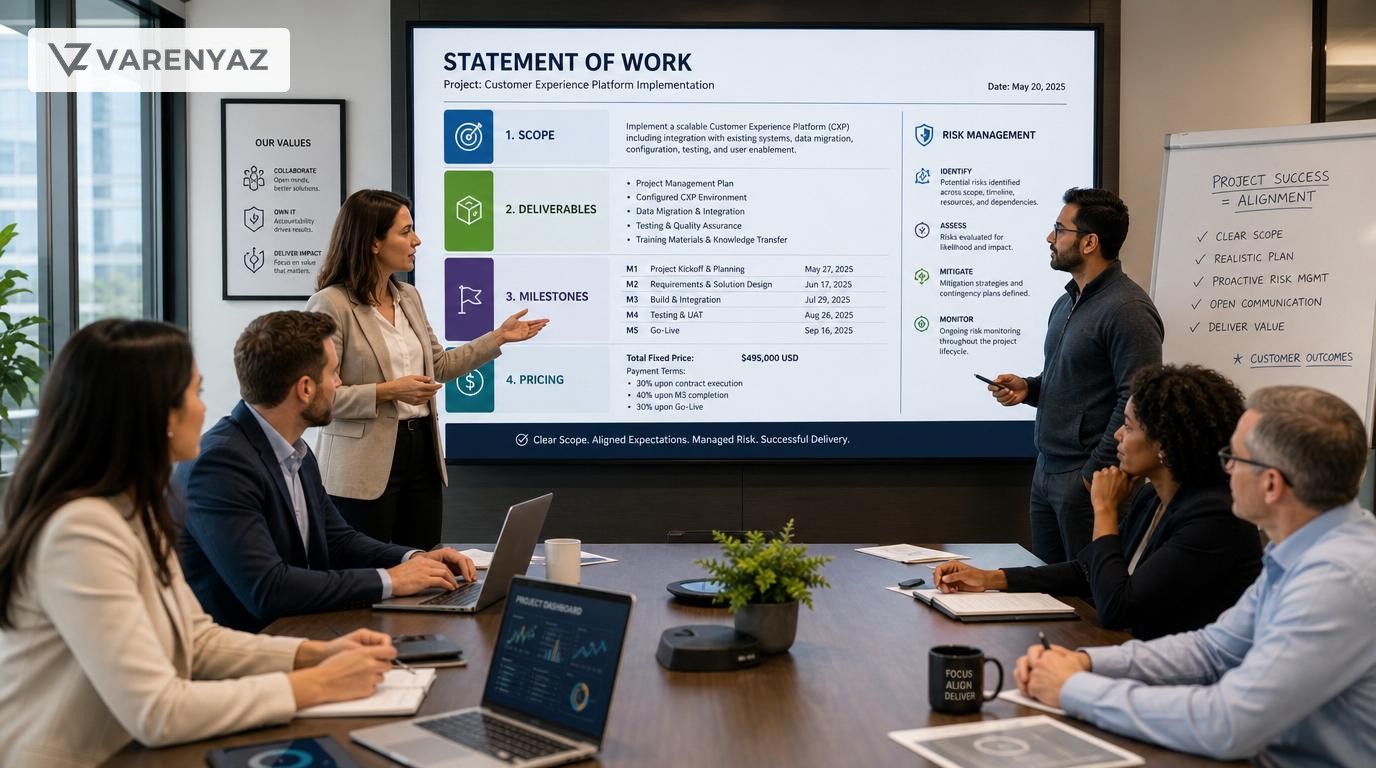
Guide details
- Type
- business terms
- Cluster
- Business terms explained
- Reviewed by
- VarenyaZ Editorial Desk
Direct answer
What you need to know
A Statement of Work (SOW) is a formal document that defines the scope, deliverables, timelines, responsibilities, assumptions, and commercial terms for a specific project or engagement between a buyer and a supplier. For modern businesses, a well-structured SOW turns high-level intent into clear, testable commitments so both sides understand exactly what will be done, when, by whom, at what quality level, and how success will be measured and paid for. It reduces delivery risk, prevents scope creep, and provides a shared reference point across legal, procurement, finance, and delivery teams.
Key takeaways
- A Statement of Work converts business intent into specific, measurable commitments for a project or engagement.
- Modern SOWs must support change, iteration, and collaboration, not just fixed, one-time deliveries.
- Clear scope, deliverables, acceptance criteria, and responsibilities are the backbone of an effective SOW.
- Tying payment milestones to objective acceptance criteria reduces disputes and cash flow surprises.
- Align your SOW with your master services agreement, purchase order, and internal governance processes.
- Common SOW failures include vague scope, missing assumptions, unrealistic timelines, and unpriced change control.
- Bring in legal, technical, and procurement experts when complexity, risk, or contract value are high.
- A reusable SOW template and playbook can dramatically speed up deal cycles and reduce delivery risk.
What is a Statement of Work for modern businesses?
A Statement of Work (SOW) is a formal document that defines exactly what work will be done, how it will be done, by whom, and under what commercial terms. It is typically used when a business hires an external supplier, agency, consultant, or implementation partner for a specific project or ongoing service.
In modern businesses, where projects are often digital, cross-functional, fast-moving, and sometimes agile, a good SOW does more than describe a list of tasks. It acts as a shared operational blueprint that connects leadership intent, commercial commitments, and day-to-day delivery decisions.
At its core, a Statement of Work answers these questions in precise, testable language:
- What are we trying to achieve and deliver?
- How will we deliver it (methods, tools, processes)?
- When will key milestones and deliverables be completed?
- Who is responsible for what, on both client and supplier sides?
- How much will it cost, and how will payment be tied to delivery?
- How will we handle change, risk, and disputes as work progresses?
For founders, CTOs, operations leaders, and marketing heads, understanding and using SOWs well can be the difference between a controlled, value-creating engagement and a painful, expensive project that drifts off course.
Why Statements of Work matter for modern businesses
They reduce risk and ambiguity
Many project failures do not stem from poor execution, but from poor alignment on what was actually agreed. A structured SOW reduces this risk by:
- Turning vague goals ("improve the website") into specific outputs ("design, build, and launch a responsive e-commerce site with defined features").
- Documenting assumptions and constraints so both sides share the same starting point.
- Providing a reference document when memories or expectations diverge mid-project.
They align legal, commercial, and delivery realities
In most organizations, different teams care about different aspects of an engagement:
- Legal cares about liability, intellectual property, and data protection.
- Finance cares about budget, cash flow, and revenue recognition.
- Procurement cares about comparability, risk, and supplier performance.
- Delivery teams care about feasibility, quality, and resourcing.
The SOW sits at the intersection. If it is vague or inconsistent, each function fills gaps differently, creating downstream friction. A clear SOW lets everyone operate from the same set of commitments.
They are essential in digital, agile, and service-heavy work
Modern businesses increasingly buy:
- Software development and integration services.
- Cloud migrations and managed services.
- Marketing, creative, and growth programs.
- Data analytics and AI consulting.
These are complex, interdependent, and often iterative. A modern SOW must support:
- Change (because priorities evolve).
- Iteration (because solutions are tested and refined).
- Collaboration (because client teams and suppliers work as one blended team).
That means moving beyond static lists of features to frameworks that define how decisions will be made, how backlog items are prioritized, how success is measured, and how changes impact time and cost.
Key concepts and types of Statements of Work
Core components of an SOW
While every organization has its own template, most effective Statements of Work cover these essentials:
- Background and objectives – why the work is being done and what business outcome is desired.
- Scope of work – what activities and responsibilities are included, and what is not.
- Deliverables – concrete outputs, with format, ownership, and acceptance criteria.
- Timeline and milestones – key dates, phases, and dependencies.
- Roles and responsibilities – for both client and supplier, including decision rights.
- Commercials – pricing structure, payment terms, and invoicing schedule.
- Assumptions and constraints – dependencies, access requirements, and limits.
- Change control – how scope changes are requested, assessed, approved, and billed.
- Governance and communication – meeting cadences, reporting, and escalation paths.
- Alignment with other agreements – how this SOW interacts with master services agreements or purchase orders.
Types of SOW by commercial model
Modern SOWs usually align with one of these commercial models, or a hybrid:
- Fixed-price SOW
- Specifies clearly defined deliverables for an agreed price.
- Works best when scope is relatively stable and requirements are well understood.
- Supplier carries more delivery risk; the SOW must be precise to avoid disputes.
- Time and materials (T&M) SOW
- Client pays for the time and expenses actually used, often with rate cards for different roles.
- Works well when scope is uncertain or discovery-heavy, such as R&D or complex integrations.
- Requires strong governance so costs do not drift without value.
- Retainer or managed services SOW
- Defines an ongoing service with service levels (SLAs), response times, and capacity bands.
- Common for support, maintenance, and continuous marketing or growth services.
- Focuses on outcomes, capacity, and performance, not just one-off deliverables.
- Outcome or value-based SOW
- Links some portion of fees to business outcomes (e.g., cost savings, conversion uplift).
- Useful when impact can be measured and both parties can influence results.
- Requires robust measurement methods and data access clauses.
Types of SOW by project style
Beyond pricing, SOWs also differ by how work is structured:
- Waterfall SOW
- Phased (e.g., discovery, design, build, test, deploy).
- Detailed requirements upfront; changes are formal and often costly.
- Agile SOW
- Defines team composition, sprint cadence, and governance rather than fixed feature lists.
- Describes how backlog items are prioritized, estimated, and accepted.
- Aligns commercial model (often T&M or capped T&M) with agile ways of working.
- Hybrid SOW
- Combines fixed-price components (e.g., initial migration) with T&M elements (e.g., optimization sprints).
- Useful when some parts of the work are certain and others are exploratory.
What to evaluate before you sign a Statement of Work
Before you approve or sign an SOW, evaluate it through several lenses: strategic alignment, risk, feasibility, and commercial soundness.
1. Strategic and business alignment
- Does the SOW clearly state the business objective and success criteria?
- Are the deliverables obviously connected to the outcomes you care about (e.g., revenue, cost, risk, customer experience)?
- Is the timeframe compatible with your product roadmap, launch dates, or regulatory deadlines?
2. Technical and operational feasibility
- Has a technical leader or architect reviewed whether the proposed solution is feasible in your environment?
- Are critical dependencies (APIs, data access, third-party approvals, hardware) clearly called out?
- Does the plan reflect realistic effort and quality expectations, considering your internal capacity?
3. Scope clarity and boundaries
- Is it obvious which features, channels, or regions are in scope?
- Are there clear out-of-scope items to prevent assumptions (e.g., content creation, translations, licenses)?
- Are assumptions about your team’s contributions (content, testing, user access) explicitly documented?
4. Commercial model and incentives
- Does the pricing model drive the right behavior (speed, quality, flexibility) for this engagement?
- Are payment milestones tied to verifiable deliverables or time periods, not vague notions like "substantial completion"?
- Is there a clear mechanism to assess and approve change requests with transparent pricing?
5. Risk, compliance, and data
- Will the supplier process or store personal data, financial data, or commercially sensitive information?
- Does the SOW reference an appropriate data protection agreement or addendum where relevant?
- Are IP ownership, licensing rights, and use of open-source or third-party tools described or referenced correctly?
6. Governance and collaboration
- Is there a named project owner on both sides?
- Are meeting cadences, status reports, and escalation paths defined?
- Does the SOW specify how conflicts will be resolved and who has decision rights?
Step-by-step: How to draft a modern Statement of Work
The process for creating a practical SOW will differ depending on whether you are the buyer or the supplier, but the principles are similar. The following steps assume you are leading the engagement from the client side; suppliers can invert the perspective.
Step 1: Clarify the business outcome and constraints
Start away from the document. Talk to stakeholders and capture:
- The primary business objective (for example, "reduce cloud infrastructure costs by 20%" or "launch a lead generation engine for the new product").
- Key constraints such as deadlines, budget ceilings, regulatory requirements, or technology choices.
- Any non-negotiables on security, brand, or compliance.
Write a crisp problem statement and objective that both sides can agree on; this will anchor the SOW and reduce later scope debates.
Step 2: Gather requirements and context from stakeholders
Next, collect input from those who will be impacted:
- Business owners: target metrics, revenue or cost goals, user segments.
- Technical teams: architecture constraints, integration points, environments.
- Operations/support: handover needs, SLAs, training expectations.
- Security, legal, compliance: data handling, access controls, audit needs.
Translate this into a prioritized list of needs. Avoid designing the entire solution in this step; instead, focus on what success looks like and what constraints are non-negotiable.
Step 3: Choose the right SOW type and commercial model
Decide how work and risk will be shared:
- For well-understood, stable projects (e.g., implementing a known tool using a standard playbook), consider a fixed-price SOW.
- For exploratory or innovation work (e.g., building new AI features), a T&M or capped T&M SOW may be safer.
- For ongoing services (e.g., performance marketing, support), use a retainer or managed services SOW with clear SLAs and capacity bands.
- For engagements where outcomes are measurable and shared, consider a hybrid or outcome-based SOW, but invest in robust measurement detail.
Ensure stakeholders understand the tradeoffs: fixed price may feel safer but requires tighter scope and less flexibility; T&M provides flexibility but demands stronger governance.
Step 4: Define scope and out-of-scope items
This is the backbone of the SOW.
- List activities and responsibilities that are clearly in scope. Use verbs ("design", "develop", "configure", "train", "migrate", "optimize").
- Define out-of-scope examples to avoid misunderstandings (for example, "ongoing content production is excluded" or "on-premises hardware is not included").
- Include explicit assumptions such as "client will provide test users within five business days" or "existing API documentation is accurate and up to date".
Use language that a non-specialist could understand, but precise enough that specialists can implement it without guessing.
Step 5: Specify deliverables and acceptance criteria
For each major deliverable, document:
- Name and description (for example, "UX wireframes for mobile and desktop flows").
- Format (e.g., Figma file, PDF, code repository, configuration in a SaaS tool).
- Owner and reviewers on both sides.
- Acceptance criteria – objective conditions for sign-off (e.g., all agreed user stories implemented; passes regression tests; meets defined performance thresholds).
Objective acceptance criteria reduce subjective debates about whether work is "good enough" and help finance and procurement justify milestone payments.
Step 6: Outline timelines, milestones, and dependencies
Define a realistic plan:
- Group work into phases where helpful (discovery, design, implementation, testing, launch, optimization).
- Identify key milestones and tie them to tangible outputs, not activities (for example, "UAT environment ready" vs. "environment work started").
- Call out dependencies on the client side (access, decisions, content) and external parties (regulators, other vendors).
Flag high-risk milestones that may need extra contingency or management attention, such as data migrations or cut-over events.
Step 7: Define roles, responsibilities, and governance
Modern projects often involve blended teams. Avoid assuming roles are obvious.
- List key roles from both organizations (e.g., product owner, project manager, tech lead, UX lead, security reviewer, marketing owner).
- Clarify decision rights – who can approve changes, designs, or go-live decisions.
- Specify governance structures: steering committees, sprint reviews, status meetings, risk reviews.
- Define escalation paths for when issues threaten timelines, scope, or budget.
A simple RACI (Responsible, Accountable, Consulted, Informed) model can be summarized in text if your template does not allow tables.
Step 8: Detail pricing, payment terms, and change control
Pricing and payment must be transparent and closely linked to delivery:
- Describe the pricing model (fixed, T&M, retainer, hybrid) and rate cards if relevant.
- Tie payments to milestones or time periods with clear acceptance and invoicing triggers.
- Include rules for out-of-pocket expenses (travel, software licenses, third-party costs).
- Describe a step-by-step change control process: how changes are requested, impact assessment, approval, documentation, and billing.
Make sure finance and procurement teams understand and agree with the structure so there are no surprises later.
Step 9: Align with legal and compliance requirements
The SOW usually references a master services agreement or standard terms and conditions. Ensure consistency on:
- Intellectual property (IP) – who owns new IP, who can reuse artefacts, and any licensing terms.
- Confidentiality and data protection – which data will be accessed or processed, and which security controls or frameworks apply.
- Liability and warranties – that the SOW does not unintentionally override or contradict agreed caps or exclusions in the main contract.
For regulated industries or cross-border data transfers, your legal or privacy team may need to add or reference specific clauses and documents.
Step 10: Review, negotiate, and agree
Before sign-off, share the draft SOW with:
- Business owners, to confirm objectives and prioritization.
- Technical and operations teams, to verify feasibility and resource impact.
- Finance and procurement, to check budget compatibility and commercial terms.
- Legal or contracts teams, especially for high-value or high-risk engagements.
Then negotiate with the supplier on items that need adjustment. Use the project objectives as a decision lens: if a clause or deliverable does not materially support the outcome, simplify it.
Common mistakes to avoid with Statements of Work
Mistake 1: Vague or generic scope definitions
Phrases like "assist", "support", or "as needed" without specifics invite disagreement. Replace them with concrete activities or outputs. For example, instead of "support the launch", specify "deliver a launch checklist, on-site support during the go-live window, and post-launch incident triage for two weeks".
Mistake 2: Missing assumptions about client responsibilities
Many delays come not from supplier performance but from slow client decisions or missing inputs. If the SOW does not document the client’s obligations (such as providing access, content, feedback, or internal approvals within defined timeframes), it becomes difficult to hold either side accountable or to adjust timelines fairly.
Mistake 3: No pricing for change
Change is inevitable in modern projects. If your SOW lacks a clear change control process and pricing basis, any adjustment can turn into a negotiation from scratch, slowing down execution and damaging trust. Define how effort, rates, and impacts will be estimated and approved upfront.
Mistake 4: Over-optimistic timelines
Compressed schedules might help win internal approvals but tend to fail in reality. Unrealistic dates also pressure teams into cutting corners later. Build in reasonable lead times and contingency, especially around external dependencies and critical data or infrastructure changes.
Mistake 5: Ignoring integration with your internal governance
An SOW may look strong on paper but fail when it meets your internal processes. Ensure your SOW is compatible with:
- Procurement and vendor onboarding processes.
- Security reviews and change management practices.
- Budget approvals and capitalization rules for finance.
- Product or project portfolio governance.
Aligning the SOW with internal realities reduces friction and delays after signature.
Mistake 6: Treating the SOW as a one-time document
Some teams sign the SOW and never look at it again. In practice, the SOW should be a living point of reference:
- Used in kick-off meetings to align teams.
- Revisited in status reviews to track scope, deliverables, and changes.
- Updated via change orders if material shifts occur.
If teams constantly work from side agreements or email threads instead of the SOW, risk and confusion increase rapidly.
When to bring in technical, legal, and procurement help
Bring in technical experts when:
- The project involves complex architectures, integrations, or migrations (e.g., multi-cloud, legacy systems, data lakes).
- New technologies are being used (e.g., AI/ML, edge computing, new marketing platforms).
- There are performance, scalability, or security requirements that must be measurable.
Technical leaders can validate feasibility, identify hidden dependencies, and suggest better acceptance criteria and testing approaches.
Bring in legal or privacy experts when:
- The contract value or strategic importance is high.
- Personal, financial, or sensitive data will be accessed or processed.
- There are cross-border data transfers or industry regulations to observe.
- Intellectual property ownership or licensing is complex or shared among parties.
Legal experts can ensure the SOW aligns with your standard terms and external obligations, and that it does not accidentally create new exposures.
Bring in procurement and finance when:
- You need to compare multiple suppliers’ proposals using common structures.
- The commercial model is non-standard or outcome-based.
- The engagement may span multiple fiscal years or business units.
Procurement helps enforce consistency and leverage, while finance ensures the SOW supports budgeting, forecasting, and reporting requirements.
Practical tips for making SOWs work day-to-day
Use a single source of truth
Store the signed SOW, change orders, and related documents in a shared repository accessible to all relevant team members. Reference it in project kick-offs and major decisions so everyone works from the same base.
Create a summary one-pager
Turn long SOWs into an internal one-pager that highlights:
- Objective and key success metrics.
- Scope and major deliverables.
- Timeline and critical milestones.
- Commercial model and key financials.
- Risks and dependencies.
This helps busy executives and cross-functional stakeholders stay aligned without reading the full document each time.
Link SOW deliverables to your project or product tools
Map SOW deliverables to tickets, epics, or tasks in your project management system. This creates a traceable line from contractual commitments to the backlog, making it easier to monitor progress and ensure nothing critical is missed.
Refresh your SOW templates regularly
Review SOWs at the end of large or strategic engagements:
- Capture lessons learned around ambiguous clauses, missed assumptions, or recurring disputes.
- Update templates and playbooks to reflect improvements.
- Standardize recurring patterns, such as common deliverables or governance setups for certain project types.
Over time, this makes your SOWs sharper and your contracting cycles faster.
How to decide if your organization needs better SOW practices
If any of the following are frequent issues, your SOW approach likely needs improvement:
- Scope creep or "surprise" work that drains capacity or erodes margins.
- Repeated disputes with suppliers or clients about what was actually agreed.
- Delays caused by unclear responsibilities or slow decisions.
- Budgets that are regularly exceeded without clear traceability.
- Difficulty comparing supplier proposals or justifying vendor choices.
Improving SOWs is often one of the fastest ways to reduce project risk, increase predictability, and improve supplier and stakeholder relationships, especially for digital and cross-functional work.
If you want help designing modern, practical SOW templates and playbooks tailored to your business, you can talk to VarenyaZ at https://varenyaz.com/contact/.
Next steps: Operationalizing Statements of Work in your business
To make SOWs a strategic advantage instead of an administrative burden, consider these next steps:
- Standardize: Create 2–4 standard SOW templates aligned to your most common engagement types (implementation, agile product development, marketing retainers, managed services).
- Educate: Train sales, delivery, and procurement teams on how to use these templates, including example clauses and checklists.
- Govern: Define thresholds for when legal, technical, or finance review is mandatory, and automate as much of the workflow as your tools allow.
- Improve: After each major engagement, run a short retrospective focused specifically on what worked and did not work in the SOW, and update your templates accordingly.
Done well, Statements of Work cease to be bureaucratic paperwork and become one of your most powerful tools for aligning expectations, managing risk, and delivering business outcomes reliably.
Practical checklist
- Is the project objective written in one clear, testable sentence?
- Have you clearly defined what is in scope and explicitly listed what is out of scope?
- Are all deliverables listed with formats, owners, and objective acceptance criteria?
- Is the timeline realistic, with high-risk dependencies and client tasks clearly identified?
- Are roles and responsibilities for both parties documented, including decision rights and escalation paths?
- Does the pricing model match the type of work and risk profile (fixed, time and materials, retainer, or hybrid)?
- Are payment milestones tied to verifiable deliverables or time periods, not vague progress statements?
- Is there a clear, written change control process including how changes impact cost and schedule?
- Does the SOW align with your master services agreement and not contradict core legal terms?
- Have legal, procurement, technical, and delivery leads reviewed the SOW for high-value or high-risk deals?
- Is there a shared understanding of success measures and how performance will be reported and governed?
Frequently asked questions
What is a Statement of Work in simple terms?
A Statement of Work (SOW) is a document that clearly describes what a supplier will deliver for a buyer, how and when it will be delivered, what it will cost, and how success will be measured. It turns a general agreement like “build a website” into specific tasks, deliverables, timelines, and responsibilities everyone can follow.
How is a Statement of Work different from a contract?
A Statement of Work usually sits under a broader contract, such as a master services agreement. The contract defines legal terms, risk allocation, and boilerplate clauses, while the SOW defines the specific project scope, deliverables, timelines, and pricing. Together they form the full agreement, but they serve different purposes.
Do agile or ongoing services still need a Statement of Work?
Yes. Agile or ongoing services often need SOWs even more because work can evolve over time. The SOW defines the engagement framework: team composition, sprint cadence, governance, how backlog items are prioritized, how changes are approved, and how pricing is tied to time, outcomes, or service levels rather than a fixed feature list.
Who is responsible for creating the Statement of Work?
Responsibility varies. In many cases the supplier drafts the first SOW based on the client’s brief, then both sides negotiate and refine it. In larger organizations, procurement, legal, and delivery leaders often provide standard templates and must review or approve SOWs before they are signed.
What happens if work is not in the Statement of Work?
If an activity, deliverable, or service is not clearly included in the SOW, suppliers can reasonably argue it is out of scope. The parties then need to negotiate a change order or new SOW. This is why precise scoping, assumptions, and change control mechanisms are critical in modern SOWs.
When should I bring a lawyer into the SOW process?
Bring legal counsel in for high-value, high-risk, or regulated engagements, or when liability, data protection, or intellectual property are complex. For smaller or routine work, using pre-approved templates and playbooks may be enough, but legal should still define the guardrails and review changes to key risk clauses.
Sources
Related terms
Related guides
VarenyaZ support
Need help turning this guide into a working product, website, or AI system?
VarenyaZ helps teams plan, design, build, automate, and improve web apps, mobile apps, AI workflows, and digital growth systems.
Talk to VarenyaZ