
What Is a Statement of Work in the United States?
Learn what a Statement of Work (SOW) is in the United States, why it matters, what it must include, and how to use it to reduce project risk and disputes.
Guide details
- Type
- business terms
- Cluster
- Business terms explained
- Reviewed by
- VarenyaZ Editorial Desk
Direct answer
What you need to know
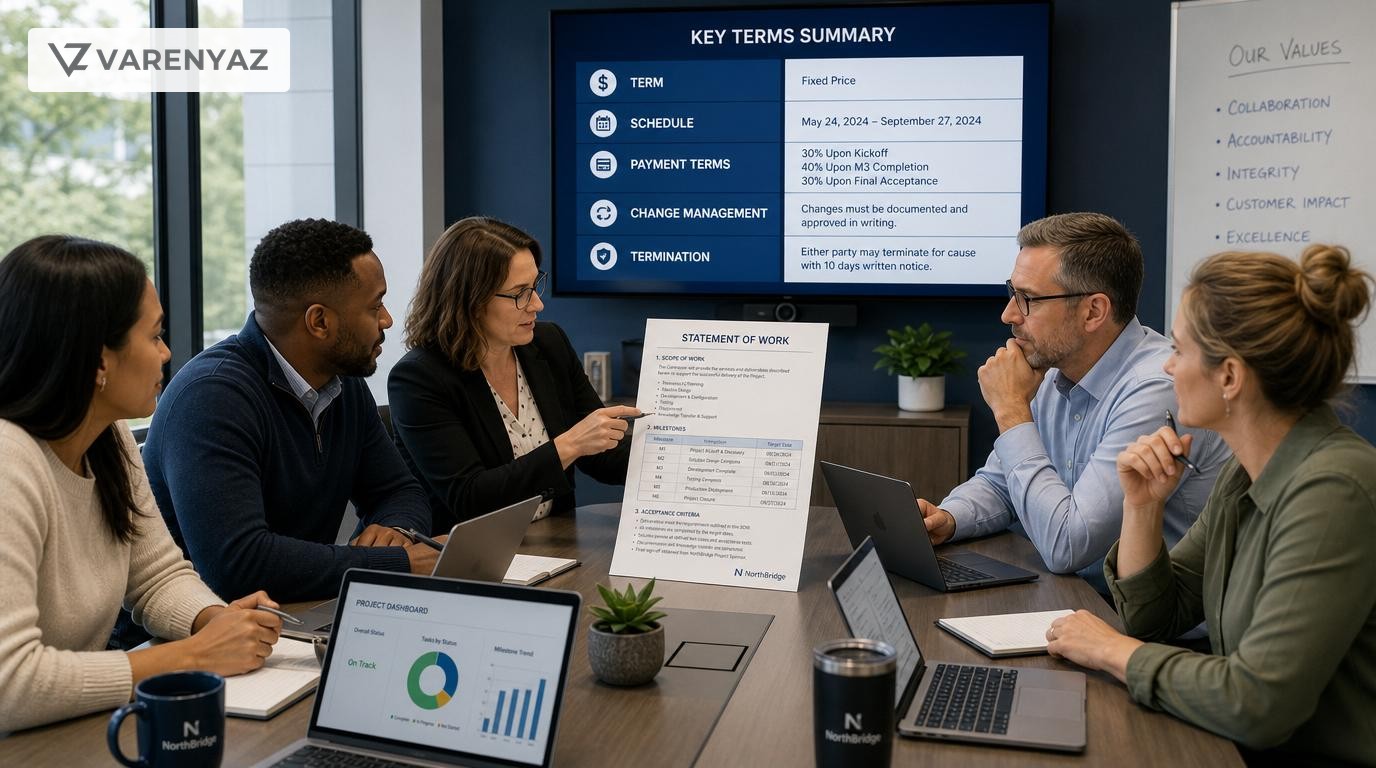
In the United States, a Statement of Work (SOW) is a formal document that describes exactly what work a vendor, contractor, or service provider will do for a client, how and when it will be delivered, and how success will be measured and paid for. It typically sits under a master services agreement or contract and translates commercial intent into concrete scope, deliverables, timelines, responsibilities, and acceptance criteria, so both sides share the same expectations and have less risk of disputes.
Key takeaways
- A Statement of Work in the U.S. turns high-level commercial agreements into concrete, enforceable project terms.
- Strong SOWs define scope, deliverables, timelines, pricing, and acceptance criteria with enough detail to avoid ambiguity.
- SOWs usually sit under a master services agreement or contract and inherit its legal and risk terms.
- Clear SOWs reduce scope creep, invoice disputes, and misaligned expectations between business and vendors.
- Founders and leaders should involve technical, finance, and legal stakeholders when drafting or approving SOWs.
- Poorly written SOWs are a major source of schedule overruns, quality issues, and strained vendor relationships.
- Using templates and checklists improves consistency but each SOW must reflect the specific project context.
- Bring in legal counsel for high-value, high-risk, or regulated projects, and for cross-border SOWs touching U.S. law.
What Is a Statement of Work in the United States?
In the United States, a Statement of Work (SOW) is a formal document that specifies exactly what work a vendor, contractor, or service provider will perform for a client, and under what conditions. It turns a high-level commercial understanding into a concrete, actionable plan.
For founders, business owners, CTOs, operations leaders, and marketing leaders, understanding SOWs is essential. Most non-trivial technology, marketing, or operations projects in the U.S. market are governed by some form of Statement of Work, even if it is not labeled that way.
Think of the SOW as the bridge between your strategy and the day-to-day work your partner will actually do. If that bridge is weak, the risk of delays, disputes, and overruns rises sharply.
Why Statements of Work Matter for U.S. Businesses
What you are trying to achieve with an SOW
Across industries, organizations use SOWs to achieve several consistent goals:
- Align expectations between business stakeholders and vendors about what will be delivered.
- Reduce ambiguity that leads to scope creep, rework, and friction.
- Link payment to outcomes with milestones, deliverables, and acceptance criteria.
- Support governance and compliance, particularly in regulated sectors or when handling data.
- Enable repeatable procurement so finance and legal can manage risk in a structured way.
Why it matters specifically in the U.S. context
While the concept of an SOW is global, there are a few U.S.-specific realities to keep in mind:
- Contract-centric business culture: Many U.S. organizations expect a written SOW as part of standard risk management, even for mid-sized projects.
- Legal environment: The U.S. has a highly developed legal system around contracts. A well-structured SOW can provide clarity and protection if disagreements arise.
- Government and enterprise practices: U.S. public sector and large enterprises often rely on SOWs and related documents (e.g., Performance Work Statements) as part of formal procurement processes.
- Complex services: U.S.-based technology, cloud, and marketing projects often involve multiple stakeholders and dependencies, making structured SOWs critical.
In short, SOW discipline is not just legal hygiene; it is operational risk management.
How a Statement of Work Fits with Other U.S. Contract Documents
A Statement of Work rarely stands alone. In most U.S. business relationships, the SOW is one part of a broader contract structure.
Typical contract stack
- Master Services Agreement (MSA) or main contract
- Defines the general legal framework: liability, indemnity, confidentiality, data protection, IP ownership, dispute resolution, and governing law (often a specific U.S. state).
- Applies across all projects, orders, and SOWs with that vendor.
- Statement of Work (SOW)
- Defines the specific project or engagement: scope, deliverables, timelines, assumptions, and pricing model.
- Usually attached as an exhibit to the MSA, and references it explicitly.
- Purchase Order (PO) (if used)
- Financial document that authorizes spend for a given SOW or portion of work.
- Often references the SOW and MSA but is primarily used by finance and procurement to control budgets and payments.
In some smaller U.S. engagements, the SOW and the main contract are merged into a single document. In that case, the SOW section carries more legal weight and must be drafted more carefully.
Core Elements of a U.S. Statement of Work
While formats vary, most effective U.S. SOWs share a common set of elements. You can use this as a blueprint when drafting or reviewing.
1. Background and objectives
This section sets the context and explains why the work is being done:
- Business problem or opportunity.
- High-level goals and success outcomes.
- Relevant background (prior phases, systems, vendors).
Clarity here helps prevent misalignment later on when the vendor makes tradeoffs.
2. Scope of work and out-of-scope
The scope section defines what is included in the engagement. It should cover:
- Specific tasks and activities the vendor will perform.
- Systems, products, or processes in scope.
- Geographies, business units, or user groups affected.
Equally important is an explicit out-of-scope list:
- Tasks the vendor will not perform.
- Systems and use cases that are excluded.
- Assistance the client must obtain elsewhere.
In the U.S., disputes often arise not from what is written, but from what was assumed. A clear out-of-scope list is one of the best defenses against scope creep.
3. Deliverables and milestones
Deliverables translate scope into tangible outputs. For each key deliverable, specify:
- Name and description.
- Format (document, report, code repository, training session, etc.).
- Owner and stakeholders.
- Due date or milestone it belongs to.
Milestones are larger checkpoints, often linked to payments. They might represent:
- Completion of discovery or design.
- Delivery of a prototype or MVP.
- Go-live or launch.
- End of hypercare or warranty period.
4. Schedule, assumptions, and dependencies
A realistic schedule depends on assumptions and dependencies being spelled out. Include:
- Key dates and phases.
- Dependencies on client resources (e.g., access to data, subject-matter experts, test environments).
- Third-party dependencies (e.g., cloud providers, API access, hardware delivery).
- Assumptions about decision-making timelines, change requests, and access approvals.
This is where you define what happens if assumptions fail or dependencies slip. For example: timelines shift, costs change, or scope is re-evaluated.
5. Pricing, fees, and payment terms
U.S. SOWs typically express pricing in one of three ways, or a hybrid:
- Fixed-price
- A defined scope is delivered for a set price.
- Best when scope and requirements are stable and well-understood.
- Time and materials (T&M)
- Billing is based on actual hours or days at agreed rates, plus expenses.
- Best for exploratory work, agile development, or rapidly evolving needs.
- Milestone-based
- Payments tied to completion and acceptance of specific deliverables or milestones.
- Common in implementation projects, marketing campaigns, and large transformations.
The SOW should clearly state:
- Rate cards, unit prices, and eligible expenses.
- Billing frequency and payment terms (often 30 days in U.S. B2B).
- How changes in scope impact fees.
- Any caps, not-to-exceed amounts, or volume discounts.
6. Acceptance criteria and testing
Acceptance criteria give both parties a shared definition of “done”. They should be:
- Specific and objective.
- Testable (via review, demonstration, or formal testing).
- Linked directly to each deliverable or milestone.
Include practical questions such as:
- Who performs acceptance review on the client side?
- What is the review period?
- What happens if a deliverable is rejected?
- Are there partial acceptances for multi-part deliverables?
Without defined acceptance criteria, payment disputes become much harder to resolve.
7. Roles and responsibilities
A clear R&R section helps avoid the “invisible work” problem. You might define:
- Vendor responsibilities: project management, reporting, delivery, quality assurance.
- Client responsibilities: providing data, approvals, facilities, integration resources.
- Decision-makers and escalation paths.
Many U.S. enterprises expect a simple responsibility matrix for larger SOWs, even if not in formal table form.
8. Data, security, and compliance (when relevant)
If the work touches customer data, personal data, or regulated information, your SOW should align with your master agreement and internal policies. Typical topics include:
- Types of data the vendor will process.
- Security requirements (encryption, access controls, logging).
- Applicable regulations or internal standards (for example, U.S. sector-specific rules or internal security standards).
- Incident reporting expectations and contacts.
The legal specifics normally live in your main agreement or separate data processing addendum, but the SOW should identify any project-specific obligations that go beyond the standard baseline.
9. Change control
SOWs are written at one point in time, but projects evolve. A basic change control section should explain:
- How changes are proposed (e.g., written change request).
- Who can request and approve changes on each side.
- How schedule, cost, and scope impacts are assessed.
- How approved changes will be documented (e.g., change orders, SOW amendments).
In the U.S., finance and procurement teams often rely on this process to avoid untracked cost growth.
Evaluating a Proposed Statement of Work
When a vendor sends you a draft SOW, your task is to determine whether it is:
- Aligned with your business objectives.
- Operationally realistic.
- Financially sound.
- Consistent with your risk appetite and contract standards.
Key evaluation questions for business and product leaders
- Does this SOW clearly support the outcomes we want? Or does it describe activities without a clear path to value?
- Is the scope concrete enough? Could two reasonable people interpret it differently?
- Are deliverables meaningful to the business? PowerPoint slides and reports are not value in themselves without decisions or changes they enable.
- Is the schedule realistic? Based on your prior experience with similar projects and your internal constraints.
- Is the pricing model aligned with risk? For example, a heavily exploratory project with a rigid fixed-price and aggressive timeline may incentivize under-delivery.
Key evaluation questions for technical leaders (CTOs, heads of engineering, IT)
- Are technical assumptions accurate for your stack and environment?
- Are integration points, APIs, and environments clearly described?
- Is testing and handover well-defined so your teams can support the result?
- Are performance, reliability, and security expectations explicit where necessary?
Key evaluation questions for operations, finance, and procurement
- Are payment terms, rates, and caps clear and consistent with your policies?
- Does the SOW align with the master agreement or any approved template?
- Is there a clear change control mechanism to manage additional spend?
- Are internal approval workflows supported (e.g., PO creation, milestone billing)?
Common Types of SOWs in the United States
Not all SOWs look the same. Understanding the dominant types helps you choose the right structure.
1. Performance-based SOW
Focuses on the outcomes and results the vendor must achieve rather than prescribing the exact tasks. Common in:
- Managed services (IT operations, application support).
- Marketing campaigns (lead targets, performance metrics).
- Some government and enterprise contracts.
Advantages include flexibility and innovation; the vendor can choose how to deliver. The challenge is drafting clear and measurable performance standards.
2. Level-of-effort or T&M SOW
Defines resources and hours more than fixed deliverables. Typical in:
- Agile software development.
- Consulting and advisory work.
- Early-stage discovery and design phases.
It offers flexibility as requirements evolve, but requires strong governance and prioritization to ensure effort translates into outcomes.
3. Fixed-scope, fixed-price SOW
Specifies a clearly defined set of deliverables for a set fee. Common for:
- Implementing specific SaaS modules.
- Migration projects with well-understood parameters.
- Website builds or defined marketing assets.
This model shifts more delivery risk to the vendor and demands a much more detailed SOW. Changes must be carefully managed through change control.
4. Hybrid SOW
Many real-world U.S. SOWs are hybrids, for example:
- Fixed-price for discovery and design, T&M for build and iteration.
- Fixed-fee for core deliverables, T&M for optional enhancements.
- Base managed service fee plus performance incentives or penalties.
The key is to make sure every part of the hybrid model is clearly described and that interactions between components (e.g., how performance impacts fees) are unambiguous.
Step-by-Step: How to Create a Strong SOW
Whether you are drafting from scratch or adapting a vendor template, this step-by-step process helps you move from idea to signed document.
1. Clarify objectives and constraints
Start with a short, non-technical summary that answers:
- What problem are we solving, and why now?
- How will we know this project succeeded?
- What must not happen (e.g., extended downtime, data exposure, budget overrun)?
- What hard constraints exist (budget, technology, compliance, timing)?
Share this one-page brief with stakeholders and the vendor before drafting the detailed SOW. It will keep discussions grounded.
2. Choose the commercial and delivery model
Decide, with finance and technical leads, whether the engagement is best suited to:
- Fixed-price with a tightly defined scope.
- T&M based on hours, with not-to-exceed caps.
- Milestone or performance-based payments.
- A hybrid structure.
Tradeoffs to consider:
- Predictability vs. flexibility: Fixed price offers cost predictability but less flexibility to change scope without formal change orders.
- Innovation vs. control: Performance-based models encourage innovation but require careful metric design and monitoring.
- Internal maturity: If your teams cannot provide rapid decisions and inputs, overly aggressive fixed timelines can backfire.
3. Draft scope, deliverables, and acceptance
With objectives and model in mind, draft:
- Scope of work: Break work into logical phases or workstreams.
- Deliverables: Specify format, content, and expected users.
- Acceptance criteria: Describe measurable tests, demos, or checks for each critical deliverable.
Tech and product teams should validate that the described work is technically sensible, and operations should confirm that outputs are usable in daily workflows.
4. Define roles, responsibilities, and dependencies
Co-create a simple list of responsibilities:
- Vendor: project management, status reporting cadence, documentation standards.
- Client: providing environments, users for testing, decision-makers, data migration inputs.
Call out dependencies that, if unmet, will affect schedule or cost. This is essential for realistic project planning.
5. Align with your master agreement and policies
Review your standard MSA and internal policies on:
- IP ownership and licensing.
- Data security and privacy.
- Open-source or third-party component use.
- Insurance and liability limits.
Ensure the SOW references the correct master agreement and does not introduce conflicting terms. If the vendor’s template includes legal language in the SOW itself, involve legal counsel to harmonize it with your standards.
6. Review cross-functionally
Before finalizing, circulate the SOW to:
- Technical leads to validate feasibility.
- Operations and marketing leads (if relevant) to confirm the work supports practical needs.
- Finance and procurement to review pricing, payment terms, and budget alignment.
- Legal for higher-risk or higher-value projects, or when non-standard terms are proposed.
Capture comments in one place, prioritize them, and collaborate with the vendor to refine language.
7. Finalize, sign, and operationalize
Once both sides are satisfied:
- Ensure authorized signatories are identified and signatures are obtained (e.g., via e-signature).
- Verify that all referenced documents (MSA, policies, schedules) are attached or accessible.
- Translate SOW milestones into internal project plans, budgets, and POs.
- Agree on how progress will be tracked and how issues will be escalated.
Remember: the SOW is not just a legal artifact; it should be a living reference for the project team.
Common Mistakes to Avoid with SOWs
Many U.S. organizations repeatedly run into the same SOW pitfalls. Being aware of them can save significant time and cost.
1. Vague or aspirational language
Phrases like “implement best practices”, “optimize performance”, or “user-friendly design” sound positive but mean little in a dispute. Replace them with:
- Concrete outcomes (e.g., target response times, specific number of user tests).
- Measurable criteria (e.g., defined KPIs, acceptance tests, or service levels).
2. Missing out-of-scope definition
Without a clear out-of-scope section, every new idea or request risks being perceived as included. This is a major driver of:
- Scope creep.
- Budget overruns.
- Strained vendor relationships.
Always list at least a few examples of work that is explicitly excluded, especially where stakeholders might reasonably assume it is included.
3. No clear acceptance criteria
If acceptance is based on subjective satisfaction, disagreements become personal and difficult to resolve. Establish:
- Concrete review steps.
- Objective acceptance standards.
- Deadlines for feedback and acceptance decisions.
4. Overlooking internal responsibilities
Even the best vendor cannot succeed if your organization does not provide timely inputs, access, or decisions. Many SOWs fail to specify:
- Who on the client side must be available and when.
- How quickly the client must review deliverables.
- What happens if client delays occur.
Clarify these expectations explicitly to avoid schedule disputes.
5. Mixing legal and operational language haphazardly
Some SOWs conflate operational details with legal terms, creating contradictions with the MSA. A better pattern is:
- Keep legal and risk allocation in the main agreement.
- Use the SOW for practical, operational clarity.
- Flag any deliberate deviations from your standard legal terms clearly and with legal review.
When to Bring in Technical or Legal Help
Not every SOW requires heavy review, but some clearly do. Being deliberate about when to involve experts is a mark of a mature organization.
Bring in technical expertise when:
- The work touches core systems, data flows, or critical infrastructure.
- You are implementing or integrating new platforms (cloud, ERP, CRM, marketing automation).
- The vendor proposes architecture or approaches your team does not fully understand.
- Performance, scalability, or security requirements are material to the business value.
Your technical leads should validate that the scope is realistic, that dependencies are understood, and that the SOW will not undermine long-term maintainability.
Bring in legal and procurement expertise when:
- Contract value or strategic importance is high.
- You operate in or near regulated industries (e.g., healthcare, financial services, education, critical infrastructure).
- Data processing or cross-border data transfers are involved.
- The SOW includes non-standard or vendor-favorable legal terms.
- The project introduces new categories of risk (e.g., public-facing platforms, new data sources).
Legal counsel ensures that the SOW integrates properly with your MSA, preserves your IP and data rights, and does not inadvertently expand your liability.
Practical SOW Governance for Ongoing Success
Having a good SOW is helpful; using it as an active governance tool is better.
Integrate SOWs into project management
- Use SOW milestones as anchors in your project plan.
- Align internal sprints or workstreams with SOW deliverables.
- Review SOW assumptions and dependencies regularly as the project evolves.
Align reporting with SOW commitments
Ensure vendor status reports speak directly to what is promised in the SOW:
- Progress toward specific deliverables and milestones.
- Risks and issues related to SOW assumptions or dependencies.
- Upcoming acceptance reviews and decision points.
Use change control, not email threads
When scope changes, resist the temptation to rely on informal emails only:
- Document the requested change and its rationale.
- Have the vendor estimate impact on cost and schedule.
- Approve via a formal change order that references the SOW.
- Update budgets and expectations accordingly.
This discipline reduces surprises and improves trust with both internal stakeholders and vendors.
How VarenyaZ Can Help
Designing and governing Statements of Work that protect your U.S. business while enabling agility is a strategic capability, not just paperwork. If you want expert support in structuring SOWs, aligning them with your technology and data strategy, or building repeatable templates for your organization, reach out to the VarenyaZ team at https://varenyaz.com/contact/.
Recap: Using SOWs as a Strategic Tool
Understanding what a Statement of Work is in the United States is only the starting point. Used well, SOWs become a strategic tool to:
- Translate business intent into concrete, manageable work.
- Align cross-functional stakeholders and vendors.
- Control risk, cost, and timelines.
- Protect your organization in a complex legal and regulatory landscape.
For founders, CTOs, and operations leaders, investing in SOW discipline is one of the highest-impact ways to improve the predictability and quality of external engagements, from software development and cloud projects to marketing campaigns and operational outsourcing.
Practical checklist
- [object Object]
- [object Object]
- [object Object]
- [object Object]
- [object Object]
- [object Object]
- [object Object]
- [object Object]
- [object Object]
- [object Object]
Frequently asked questions
What is a Statement of Work in the United States?
In the United States, a Statement of Work (SOW) is a formal document that describes the specific services, deliverables, timelines, and expectations for a project or engagement between a client and a vendor or contractor. It typically sits under a master services agreement or contract, and it operationalizes the business deal by clarifying scope, responsibilities, pricing structure, and how acceptance and payment will work.
Is a Statement of Work a legally binding contract in the U.S.?
A Statement of Work can be legally binding in the U.S. when it is properly executed and supported by a master agreement or overall contract. The SOW usually becomes an exhibit or attachment to the main agreement and is interpreted together with that agreement’s terms on liability, confidentiality, IP rights, and dispute resolution. If no master agreement exists, some organizations use a stand-alone SOW that incorporates necessary legal terms directly.
What should be included in a U.S. Statement of Work?
A strong U.S. SOW typically includes: project background and objectives; detailed scope of work; deliverables and milestones; schedule and dependencies; pricing and payment terms; assumptions and constraints; roles and responsibilities; acceptance criteria; change control; and any project-specific data security, compliance, or reporting obligations. The level of detail should be sufficient so that a third party could understand what was agreed without guesswork.
How is a Statement of Work different from a proposal?
A proposal is usually a sales or pre-contract document created by the vendor to suggest an approach, pricing, and timeline. A Statement of Work is a formal, mutually agreed document that defines what will actually be delivered under contract terms. In many U.S. organizations, the SOW is based on the vendor’s proposal but is negotiated, clarified, and adapted to align with the client’s legal, procurement, and operational requirements before being signed.
When do I need legal review of a Statement of Work in the United States?
Legal review is advisable for high-value projects, long-term engagements, regulated industries (such as healthcare, financial services, or education), cross-border work touching U.S. law, complex intellectual property or data processing arrangements, and any SOW that materially changes risk allocation from your standard contract. Legal counsel can ensure the SOW aligns with your master agreement, does not introduce conflicting terms, and properly addresses compliance, data use, and liability.
Can a Statement of Work be changed after it is signed?
: "Yes. In the U.S., SOWs are commonly changed through a formal change order or change request process that both parties sign. The SOW should specify how changes to scope, timelines, or pricing will be proposed, evaluated, and approved. Ad hoc, undocumented changes are a leading cause of disputes, so it is critical to use a structured change process and update the SOW or its exhibits accordingly."
Sources
Related terms
Related guides
VarenyaZ support
Need help turning this guide into a working product, website, or AI system?
VarenyaZ helps teams plan, design, build, automate, and improve web apps, mobile apps, AI workflows, and digital growth systems.
Talk to VarenyaZ