
Generative AI Content for Modern Logistics
Explore how generative AI content can modernize legacy transportation and logistics systems, from control towers to customer content, with practical 2026 roadmaps.

Quick Answer
Generative AI content creation in transportation and logistics can modernize legacy systems by 2026 by turning fragmented operational data into usable, contextual narratives and actions. By layering LLMs on top of TMS, WMS, and telematics platforms, companies can build copilots for planners and drivers, automate documentation, and personalize shipper communication. Success depends on robust data foundations, human-in-the-loop review, and clear governance. This article outlines key use cases, architecture patterns, risks, and a phased roadmap, with practical guidance on how partners like VarenyaZ can help design, build, and integrate AI solutions.
In this article
Coverage signals
14 min
Jun 9, 2026
VarenyaZ Editorial Desk, Technical Content Review
Updated Jun 9, 2026
Key Takeaways
- Generative AI content works best as an experience and workflow layer on top of legacy TMS, WMS, and telematics rather than a wholesale replacement.
- High-value use cases by 2026 include AI copilots for planners, automated shipment documentation, exception narratives, and personalized shipper communication.
- Strong data foundations, access control, and prompt governance are more critical than model choice for early generative AI success in logistics.
- Human-in-the-loop review, audit trails, and guardrails are mandatory to manage hallucinations, safety, and compliance risks in operational content.
- A phased roadmap—starting with narrow copilots and content automation—reduces risk while proving ROI for broader AI modernization.
- Marketing, sales, and operations can share the same AI content layer to ensure consistent, real-time narratives from a single operational truth.
- Working with a partner experienced in logistics, web platforms, and AI accelerates architecture decisions, integrations, and UX for AI copilots.
- By 2026, generative AI content will be a differentiator for customer experience and network resilience across transportation and logistics markets.
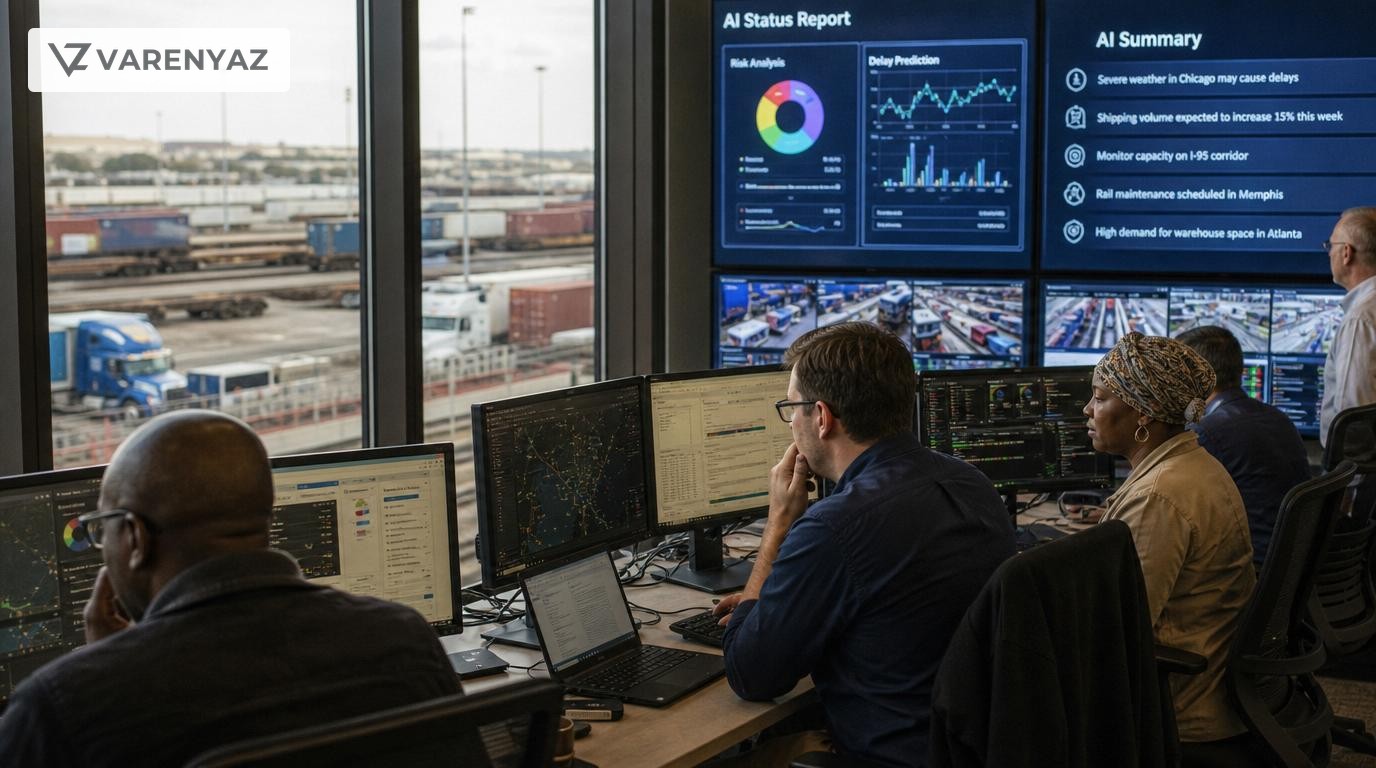
Why generative AI content matters for transportation and logistics in 2026
Most transportation and logistics companies are running 2026 operations on systems designed for a pre-AI world. Your TMS, WMS, ERP, telematics, and spreadsheets still hold the truth of your network, but they communicate that truth poorly: cryptic codes, rigid reports, and static dashboards that require expert interpretation.
Generative AI content changes that. Instead of humans constantly translating raw data into emails, SOPs, status updates, and presentations, large language models (LLMs) can do the heavy lifting. They sit on top of legacy systems and turn data into narratives, instructions, recommendations, and customer-ready content—at scale.
By 2026, this isn't just a nice experiment. For many mid-sized and large players, it's the pragmatic path to modernizing legacy systems without ripping everything out. You add an AI content layer that:
- Helps planners, dispatchers, and drivers with AI copilots.
- Automates shipment documentation and status communications.
- Explains routing, capacity, and cost decisions in plain language.
- Feeds consistent, real-time content into customer portals, apps, and sales decks.
The result: a more modern operation built on top of your existing stack, with less manual effort and more transparency for everyone from drivers to shippers.
Direct answer: how generative AI modernizes legacy logistics systems
Generative AI modernizes legacy transportation and logistics systems by acting as a content and decision layer above them. Instead of replacing TMS, WMS, or telematics, LLMs ingest their data through APIs or data platforms and generate human-readable outputs: shipment summaries, exception narratives, draft customer emails, SOP updates, dispatch notes, and route rationales. These AI-generated artefacts plug into existing workflows—control towers, customer portals, driver apps, and internal knowledge bases—allowing teams to operate as if they had a modern, integrated system while still leveraging existing infrastructure. With strong governance and human review, this approach reduces manual work, speeds decisions, and improves customer experience without a full core-system migration.
From legacy clutter to AI-enabled workflows
The reality of 2026 logistics tech stacks
By 2026, most logistics organizations have:
- An "old but reliable" TMS that is hard to customize.
- One or more WMS instances, often acquired through M&A.
- Telematics and IoT systems with varying data quality.
- Operational data lakes or warehouses that are underused.
- Dozens of spreadsheets and point tools filling workflow gaps.
This patchwork creates three main problems:
- Content bottlenecks – Staff spend hours drafting emails, updating portals, and manually explaining what the data means.
- Decision friction – Planners and leaders must mentally join data from multiple systems before acting.
- Experience gaps – Customers and partners still get generic updates or occasional PDFs instead of real-time, contextual insights.
Generative AI can't magically fix bad processes or missing data, but it can radically reduce the friction of turning data into action and communication.
Generative AI as the "content fabric" of your network
Think of generative AI as a content fabric that runs across your transportation and logistics tech stack. It connects to data sources and then:
- Understands structure (shipments, orders, stops, lanes, contracts).
- Understands context (SLAs, priorities, past issues, customer profiles).
- Outputs tailored content for specific roles and channels.
For example, from the same data set a generative model could simultaneously produce:
- A concise internal exception summary for your control tower.
- A plain-language email for a shipper explaining a delay and options.
- A set of driver instructions simplified for mobile display.
- An updated FAQ entry for your self-service help center.
The underlying data doesn't change. What changes is how easily people can act on it.
High-impact generative AI content use cases for logistics
1. AI copilots for planners, dispatchers, and control towers
Operational teams spend much of their day translating system data into decisions and explanations. An AI copilot embedded in their tools can:
- Summarize the current network state in natural language.
- Highlight the top 10 loads at risk with reasons and likely outcomes.
- Draft mitigation plans and communication templates.
- Answer questions like "Which customers are likely to be impacted by weather in the Northeast in the next 24 hours?"
Instead of clicking through multiple screens, a dispatcher can ask questions in natural language and get answers drawn from multiple systems, enriched with recommendations.
2. Automated shipment documentation and compliance content
Documentation is one of the biggest steady drains on logistics capacity: bills of lading, packing lists, customs descriptions, incident reports, claims narratives, and SOP updates.
Generative AI can help by:
- Drafting structured descriptions and narratives from shipment and order data.
- Pre-filling incident or claim reports from telemetry and event logs.
- Standardizing language across documents to reflect current policies.
- Suggesting missing fields or anomalies for human review.
Humans still approve and sign, but the AI handles the first 70–90% of the writing and formatting work, especially for repetitive, template-based content.
3. Dynamic routing narratives and scenario explanations
Routing engines and optimization tools have existed for years, but they're often black boxes. Planners and customers ask: "Why this route? Why this cost? Why this carrier?"
Generative AI can translate the optimization's logic into plain language narratives:
- Explaining trade-offs between cost, time, and emissions.
- Describing why a given carrier, mode, or hub was chosen.
- Outlining how time windows, capacity, and regulations constrained the solution.
- Comparing alternative scenarios ("What if we move these lanes to rail?").
This doesn't change the optimization mathematics—it changes transparency and trust. Business users get answers they can share with customers and leadership without needing data science expertise.
4. Customer communication and experience content at scale
Customers expect real-time, contextual, and personalized updates. Yet your teams are often still sending manual, ad-hoc messages.
Generative AI helps you create:
- Proactive, tailored updates – Delay notifications that explain cause, impact, and alternatives in customer-friendly language.
- Multilingual communication – Localized updates, FAQs, and how-to guides across markets without duplicating effort for each language.
- Self-service knowledge bases – AI-curated help centers fueled by real shipment data and historical interactions.
- Context-aware marketing content – Case studies, lane-specific insights, or industry summaries generated from your operational history.
The key advantage: every message can be grounded in actual operational data from your systems, not generic marketing language.
5. Internal knowledge and SOP modernization
Logistics operations run on tacit knowledge: senior planners who "just know" how to handle certain lanes, carriers, and edge cases. This knowledge often lives in scattered SOPs and email archives.
Generative AI can:
- Aggregate SOPs, guidelines, and past tickets into a searchable assistant.
- Keep procedures updated as policies or regulations evolve.
- Offer contextual guidance in tools ("What's the SOP for hazmat on this lane?").
- Suggest training content tailored to specific roles and routes.
Instead of onboarding taking months and depending on a few experts, colleagues can ask questions and get consistent, up-to-date answers, backed by your own knowledge base.
Architecture: how to layer generative AI over legacy systems
The core pattern: data, models, and experience
To modernize with generative AI, you don't start by picking a model vendor. You start with architecture. A practical 2026 pattern looks like this:
- Data layer: Cleaned, governed access to TMS, WMS, telematics, and ERP data via APIs or a data warehouse/lakehouse.
- Model layer: One or more LLMs (hosted or on-prem) plus tools for retrieval-augmented generation (RAG), fine-tuning, and guardrails.
- Experience layer: Web apps, portals, mobile apps, and chat-style copilots embedded in existing tools.
From a modernization perspective, the most valuable shift is moving away from custom, one-off reports and manual email drafting into reusable, AI-powered content and decision services.
Connectors and data products
LLMs work best when they can reason over structured, relevant data. To enable that, you'll need:
- Connectors to extract key entities (orders, shipments, legs, assets, customers) and events (tender, pickup, departure, delay, delivery) from TMS/WMS/telematics.
- Data products that present these entities and events in AI-friendly schemas, often via APIs or views in your warehouse.
- Embeddings and indices for unstructured content such as SOPs, contracts, and email threads.
This work is also an investment in broader analytics and optimization, not just generative AI. You're essentially building a more coherent digital representation of your network.
LLM strategies: base models, fine-tuning, and RAG
For transportation and logistics, the best-performing generative AI setups in 2026 typically combine:
- Strong base models for language fluency and general reasoning.
- Retrieval-augmented generation (RAG) to ground responses in your real data and documents.
- Selective fine-tuning on your domain-specific terms, document styles, and workflows.
RAG is especially important to reduce hallucinations and ensure that generated content reflects current reality: current rates, policies, schedules, and customer terms.
Embedding AI into web, mobile, and internal tools
The value of generative AI content is only realized when it shows up where people work:
- Customer portals – Dynamic shipment narratives, FAQ chat, and tailored dashboards.
- Driver and field apps – Simplified, contextual instructions, checklists, and voice-friendly interaction.
- Internal web apps – Planner copilots, knowledge search, and auto-drafted communication.
- Business intelligence tools – Natural language summaries alongside traditional dashboards.
This is where strong web design and web development capabilities matter: the AI layer must be intuitive, fast, and clearly separated from human approvals and system-of-record fields.
Business value: where generative AI pays off
Operational efficiency and cost savings
Generative AI content doesn't replace drivers or planners, but it can reclaim significant time from routine communication and documentation. Major consultancies project that generative AI could contribute substantial productivity gains in operations when applied to documentation, planning, and knowledge tasks, especially in complex, data-rich environments like logistics.
Key levers include:
- Reduced time spent on manual status emails and report writing.
- Faster exception handling with AI-prepared context and options.
- Less rework and fewer errors in documentation and data entry.
- Shorter onboarding and training time for new staff.
Customer experience and retention
Modern shippers and consignees expect consumer-grade visibility and communication. Generative AI gives you the capacity to:
- Provide near-real-time, personalized updates.
- Explain disruptions transparently and propose alternatives.
- Offer self-service answers 24/7 via chat and knowledge bases.
- Deliver insights and content tailored to specific industries and lanes.
This doesn't just reduce support load; it increases trust and loyalty—especially when your competitors still rely on generic tracking messages.
Decision quality and network resilience
When exceptions hit—weather, strikes, port congestion—leaders need fast, well-contextualized overviews. Generative AI can:
- Summarize the impact across customers, regions, and modes.
- Generate scenario comparisons using existing optimization and cost models.
- Translate technical data into board-ready narratives and visuals.
Combined with human expertise, this can improve both speed and quality of decisions in volatile conditions.
Risks, tradeoffs, and governance
Managing hallucinations and accuracy
LLMs can produce confident but incorrect answers if they're not properly grounded. In logistics, that can quickly become dangerous or expensive.
Mitigations include:
- Grounding all operational content in real system data via RAG.
- Highlighting sources and linking back to system-of-record entries.
- Enforcing human approval for high-risk outputs (e.g., safety instructions, contractual terms).
- Using smaller, domain-constrained models for critical workflows.
Data privacy, security, and compliance
Transportation and logistics data often includes confidential customer information, pricing, and sensitive routing details. When using generative AI you must:
- Ensure data is handled in compliance with relevant privacy regulations and customer agreements.
- Decide which data can be used to train or fine-tune models and which must remain only for inference.
- Set fine-grained access controls for content and AI tools by role.
- Maintain audit trails of inputs, outputs, and approvals for key communications.
Different geographies may require different deployment models (e.g., regional hosting or private models) to comply with local regulations.
Change management and trust
Even the best AI will fail if people don't trust it. In operations environments, skepticism is rational. To build trust:
- Start with assistive, not autonomous, use cases.
- Show clearly how AI reached certain recommendations or summaries.
- Include feedback mechanisms ("mark as helpful", "flag as incorrect").
- Train teams on both capabilities and limitations of AI tools.
When planners see that AI helps them get through their day faster—and that they remain in control—adoption follows.
Practical implementation roadmap to 2026
Phase 1: Discovery and foundations (3–6 months)
Start by understanding where generative AI can add the most value:
- Map key processes: tender-to-invoice, order-to-delivery, exception-to-resolution.
- Identify content-heavy steps: emails, reports, SOP lookups, documentation.
- Assess data readiness: API coverage, data quality, access controls.
- Prioritize 2–3 use cases with clear business value and limited risk.
In parallel, establish basic governance:
- Policies for data use, storage, and model training.
- Guidelines for acceptable AI use and human oversight.
- Initial metrics: time saved, error rates, response times, NPS/CSAT.
Phase 2: Pilot AI copilots and content automation (6–12 months)
Next, build narrow but impactful pilots, for example:
- An AI assistant that drafts shipment status emails for operations teams to review and send.
- A knowledge copilot that answers SOP and policy questions for planners.
- An internal dashboard with AI-generated daily operations summaries.
Key practices at this stage:
- Use RAG to ground all responses in your own data and documents.
- Embed AI into existing web and internal tools rather than adding new portals.
- Collect qualitative feedback from users and iterate on prompts and UX.
- Log prompts and outputs to continuously improve safety and relevance.
Phase 3: Scale to customer-facing and cross-functional experiences (12–24 months)
Once pilots are stable and trusted, expand their scope:
- Add AI-generated content to customer portals, tracking pages, and apps.
- Introduce multilingual support and domain-specific tuning for verticals.
- Integrate AI content into sales enablement tools and marketing workflows.
- Align operations, customer service, and marketing around shared AI content strategies.
At this stage, governance and observability become even more critical. You'll want monitoring for drift, bias, and performance across regions and business lines.
Phase 4: Deep modernization and system rationalization (24+ months)
As AI content and decision layers mature, you can:
- Rationalize overlapping systems, moving functionality into more modern platforms.
- Use insights from AI-generated content and feedback to simplify processes.
- Standardize data models and APIs across regions for global copilots.
- Experiment with more advanced automation where safety and value justify it.
By this phase, generative AI isn't a bolt-on—it's woven into how your network thinks and communicates.
Geo considerations: India, United States, United Kingdom
India: leapfrogging with AI on uneven infrastructure
In India, many logistics firms operate across a mix of modern and highly fragmented infrastructure. Generative AI can help:
- Unify data from regional partners into consistent narratives for shippers.
- Provide multilingual driver instructions and customer communications.
- Cover gaps where systems are limited by creating content from partial data.
Because digital adoption is accelerating, there's a chance to "leapfrog" directly to AI-enabled workflows instead of replicating legacy patterns from other regions.
United States: scaling across complex networks
In the U.S., large networks and tight labor markets make productivity and retention crucial. Generative AI can:
- Reduce burnout from repetitive communication tasks.
- Provide decision support for complex multimodal and cross-border operations.
- Support sophisticated customer expectations for transparency and analytics.
Given the regulatory and contractual complexity, governance, auditability, and legal review of AI-generated content are especially important.
United Kingdom: compliance and customer expectations
In the U.K., compliance norms and customer expectations for sustainability and reliability are high. Generative AI can:
- Explain emissions trade-offs and sustainability metrics in accessible language.
- Support tight service-level communications for time-critical logistics.
- Operate within strong data protection expectations through controlled deployments.
This makes careful architecture and deployment choices essential—from model hosting to access control and logging.
How to choose the right generative AI partner
Most logistics organizations don't need to build everything in-house. You can combine your domain expertise with a partner's experience in AI, software design, and integration.
Look for a partner who can:
- Understand logistics processes deeply enough to spot high-value use cases.
- Design data and integration architectures around your TMS/WMS and BI tools.
- Build AI copilots and content workflows that fit your brand and UX.
- Implement governance, testing, and monitoring frameworks for AI outputs.
- Support global deployments with attention to local markets and regulations.
You'll also want a partner who can co-create a roadmap with you, not just deliver a proof of concept. That includes helping educate your teams, define KPIs, and plan for scale.
Where VarenyaZ fits: web, AI, and product for logistics
VarenyaZ works at the intersection of web design, web development, and AI development—exactly where generative AI content has the most impact. For transportation and logistics businesses, that means we can help you:
- Design AI-first experiences – Intuitive portals, dashboards, and copilots that surface AI-generated content in ways your teams and customers can trust.
- Integrate with legacy systems – Build secure, scalable connectors and data products around your TMS, WMS, telematics, and ERP.
- Develop custom generative AI solutions – RAG pipelines, domain-tuned models, and guardrails tailored to your processes and risk profile.
- Modernize your digital stack – Evolve your web and mobile platforms so AI is native to how people work, not an extra tab.
- Establish AI governance – Set policies, approval flows, and monitoring around AI-generated content for operations, customer service, and marketing.
If you're planning or accelerating generative AI initiatives in transportation and logistics, you can reach the VarenyaZ team at https://varenyaz.com/contact/.
Conclusion: modernizing legacy logistics systems through generative AI content
By 2026, generative AI content creation will be one of the fastest practical ways to modernize transportation and logistics operations. Instead of waiting for multi-year system replacements, you can:
- Add AI copilots that make sense of complex network data.
- Automate documentation and customer communication with human oversight.
- Turn scattered SOPs and expertise into a living, searchable knowledge layer.
- Deliver modern, transparent, and personalized experiences through web and mobile interfaces.
The critical success factors aren't hype or experimentation for its own sake—they're clean data, thoughtful architecture, strong governance, and user-centric design. With the right approach and partners, your legacy systems become the foundation for an AI-powered future, not a barrier to it.
VarenyaZ brings together web design, web development, and AI development expertise to help logistics and transportation companies build that future: turning core data into intelligent content, developing AI-native digital products, and delivering experiences that keep shippers, consignees, and teams aligned in real time.
Editorial Perspective
Expert Review Notes
"The real power of generative AI in logistics is not replacing core systems, but turning the messy data they hold into clear conversations, insights, and actions for humans across the network."
"By 2026, transportation companies that treat generative AI as a shared content and decision layer across operations, sales, and customer service will pull ahead in reliability and transparency."
"Human-in-the-loop design, domain-anchored prompts, and thoughtful UX matter more than chasing the latest model when you bring generative AI into live logistics workflows."
Frequently Asked Questions
What is generative AI content creation in transportation and logistics?
Generative AI content creation in transportation and logistics is the use of large language models and related AI tools to transform operational data into human-readable text, recommendations, and workflows. Examples include AI-generated shipment status updates, driver instructions, exception narratives, route rationales, contract summaries, and dynamic FAQs for customers and agents.
Do we need to replace our TMS and WMS to use generative AI?
In most cases, you do not need to replace your TMS or WMS to benefit from generative AI. Instead, you can expose existing system data through APIs or data warehouses, then layer LLM-based services on top to generate content and recommendations. This approach protects previous investments while modernizing the user experience and workflows through AI copilots and automated content generation.
What are the biggest risks of generative AI in logistics operations?
Key risks include hallucinated or inaccurate content, regulatory or contractual non-compliance, data leakage, bias in decision support, and over-automation of safety-critical actions. To mitigate these, organizations should combine human-in-the-loop review, strict access controls, guardrail models, domain-specific fine-tuning, and explicit policies for what AI can and cannot decide or publish autonomously.
How can generative AI improve shipper and consignee experience?
Generative AI can personalize and scale communication by turning real-time operational data into clear, contextual updates for shippers and consignees. It can generate proactive delay explanations, alternative options, multilingual notifications, and tailored onboarding or self-service content. This reduces manual email work for teams and gives customers more transparency and control over their shipments.
What should our first generative AI project be in 2026?
A strong first project is a narrow AI copilot or content assistant focused on a single high-friction workflow, such as drafting shipment status emails, generating load tender responses, or summarizing incident tickets. This scope is manageable, connects to existing data, and quickly proves productivity and customer experience gains before you expand into more complex AI copilots or automation.
How can a partner like VarenyaZ help with generative AI in logistics?
A partner like VarenyaZ can help you define a pragmatic AI roadmap, design the data and API architecture around your TMS and WMS, build custom AI copilots and content workflows, and integrate them into your portals, mobile apps, and internal tools. They also help with governance, testing, and UX so that AI is safe, usable, and aligned with business outcomes.
Selected References
Further Reading
Related perspectives
Future-Proofing Manufacturing with UI/UX
Future-proofing manufacturing now depends as much on UI/UX design as on machinery. UI UX design in manufacturing reduces errors, speeds training, and makes complex Industry 4.0 systems usable on the shop floor. By mapping critical workflows, simplifying interfaces, and designing data-rich dashboards for real operators, manufacturers can unlock value from MES, IoT, and AI. This article outlines best practices for industrial HMI, mobile apps, and AI copilots, the risks of poor UX, and a practical roadmap. It ends with how VarenyaZ can help design, build, and scale these experiences.
Predictive Analytics for Real Estate Efficiency
Predictive analytics in real estate uses historical and real-time data to forecast demand, pricing, maintenance issues, and operational risks so teams can act before problems arise. It increases operational efficiency by reducing downtime, optimizing occupancy and rental yields, and targeting capital where it matters most. This article outlines core use cases, data and technology requirements, implementation steps, governance and risk considerations, and how leaders can practically start with pilots and scale to portfolio-wide predictive capabilities, often with support from specialized web, data, and AI partners like VarenyaZ.
Legacy Modernization for Real Estate Growth
Legacy modernization in real estate means upgrading core property, leasing, and finance systems so they can support today’s digital, data-driven operations. It involves replacing or refactoring old software, consolidating data, and building a modern, API-first architecture. Done well, it improves decision-making, reduces manual work, and enables AI-driven use cases like dynamic pricing or predictive maintenance. This guide explains the business case, modernization options, risk controls, and practical steps real estate leaders can follow, and how a partner like VarenyaZ helps design and implement modern web, data, and AI solutions.