
Future-Proofing with IoT Fleet Management
Learn how IoT-driven fleet management helps e-commerce and retail brands cut costs, boost delivery performance, and future-proof logistics operations.

Quick Answer
IoT fleet management helps e-commerce and retail brands future-proof logistics by connecting vehicles, drivers, and warehouses with real-time data. With telematics, GPS tracking, sensors, and AI routing, businesses can reduce fuel and maintenance costs, improve delivery time and reliability, and offer accurate customer ETAs. The article explains architecture options, data and compliance risks, and how to build a phased roadmap from pilot to scale. It also covers integration with existing commerce stacks and highlights how VarenyaZ supports web, platform, and AI development around IoT data.
In this article
Coverage signals
14 min
Jun 10, 2026
VarenyaZ Editorial Desk, Technical Content Review
Updated Jun 10, 2026
Key Takeaways
- IoT fleet management connects vehicles, assets, and logistics systems to provide real-time visibility, control, and optimization.
- For e-commerce and retail, IoT delivers tangible gains in delivery speed, on-time performance, and customer transparency.
- A clear architecture across edge devices, connectivity, IoT platforms, and data pipelines is essential to scale securely.
- AI and analytics on IoT data enable predictive maintenance, smart routing, and capacity planning for peak seasons.
- Data privacy, driver consent, and cybersecurity must be designed in from day one, not retrofitted later.
- Start with a focused pilot on a high-impact use case, then standardize data models and integrations before scaling.
- Cross-functional governance between operations, IT, and customer experience teams is critical for adoption.
- A partner like VarenyaZ can help build the web, platform, and AI layers that turn raw IoT signals into business outcomes.
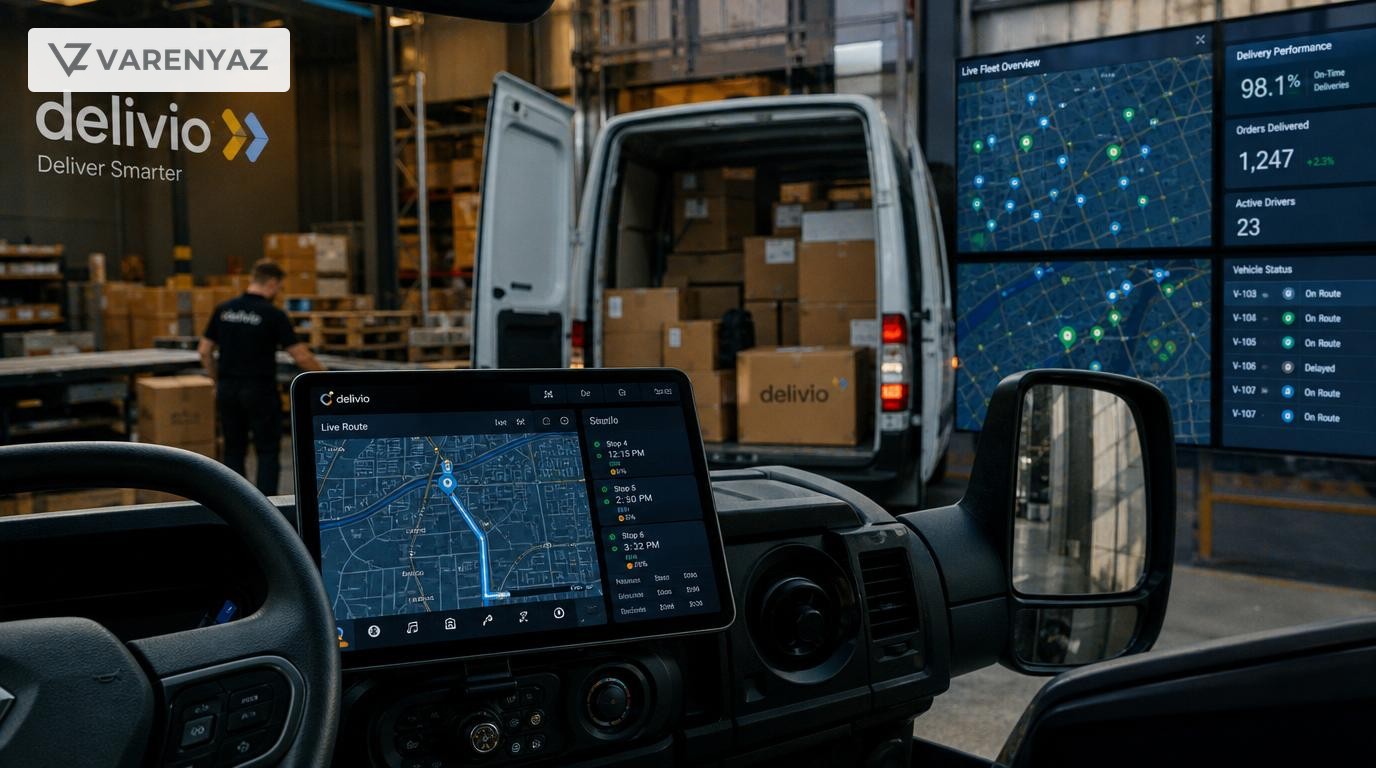
Why IoT Fleet Management Now Defines Competitive E-commerce & Retail
Two curves are crossing in e-commerce and retail logistics. Customer expectations for fast, transparent delivery are climbing, while margins on each parcel are getting thinner. Between those curves sits your fleet strategy.
For years, fleet decisions focused on capacity and cost: How many vehicles do we need, and how cheaply can we run them? Today, the question is broader: How do we turn every vehicle, driver, and route into a real-time, data-driven asset that fuels growth rather than erodes margins?
This is where IoT fleet management becomes a future-proofing move rather than a tech experiment. It connects vehicles, drivers, and depots through sensors, telematics, and cloud platforms, then layers analytics and AI on top to drive smarter decisions, faster.
Quick Answer: What Is IoT Fleet Management and Why Does It Matter?
IoT fleet management uses connected sensors, GPS, telematics units, and software platforms to monitor and control vehicles, drivers, and assets in real time. In e-commerce and retail, it helps you:
- Track vehicles, orders, and ETAs live across the network
- Optimize routes to cut fuel and time costs
- Detect risky driving and reduce accidents
- Apply predictive maintenance to minimize breakdowns
- Improve customer experience with more accurate delivery windows and updates
Put simply: it converts every trip into data, and that data into faster, safer, cheaper, more reliable delivery.
The Business Case: From Delivery Cost Center to Growth Engine
1. E-commerce and Retail Have Outgrown Analog Logistics
A decade ago, customers accepted vague delivery windows and limited tracking. Now, they compare you directly to marketplaces and quick-commerce players that provide near real-time updates.
If your current state looks like this:
- Dispatchers rely on phone calls and spreadsheets
- Drivers use consumer navigation apps with no integration
- Customer service teams manually chase ETAs
- Management sees performance in weekly or monthly reports
then you are competing against brands that operate with minute-by-minute data—a structural disadvantage that compounds with every new customer, order, and city you add.
2. IoT Fleet Management Directly Hits P&L Levers
IoT isn't just "better tracking." It affects line items you recognize:
- Fuel costs – Route optimization and smoother driving behavior reduce wasted kilometers and idling.
- Maintenance and downtime – Predictive diagnostics and usage-based maintenance lower breakdowns and extend vehicle life.
- Labor productivity – Smarter routing, batching, and automated ETAs support more deliveries per shift without overloading drivers.
- Customer service load – Real-time self-service tracking reduces "Where is my order?" contacts.
- Revenue and retention – Reliable delivery windows and proactive updates improve NPS and repeat purchase rates.
As connected fleet capabilities mature globally, companies that don't tap these levers risk permanent cost and service disadvantages.
How IoT Fleet Management Works: From Vehicle to Platform
Core Building Blocks
Effective IoT-driven fleet management is usually built from four layers:
- Edge layer (on-vehicle and on-asset)
- GPS and telematics devices plugged into vehicle systems
- Sensors for temperature, door open/close, fuel, tire pressure, and cargo conditions
- Mobile apps for drivers as an additional sensor and interaction point
- Connectivity layer
- Cellular (4G/5G), LPWAN (NB-IoT, LTE-M), or Wi‑Fi backhaul
- Protocols for secure data transmission and remote updates
- IoT and data platform layer
- Device management and configuration
- Data ingestion, cleaning, and storage
- Rules engines, alerting, and event processing
- Application and experience layer
- Fleet dashboards for operations and dispatch
- APIs into OMS, WMS, TMS, ERP, and CRM
- Customer-facing tracking pages and notifications
Once this stack is in place, you can add AI and analytics capabilities for forecasting, optimization, and anomaly detection.
Key Capabilities That Matter in E-commerce & Retail
- Real-time location tracking – Know exactly where each vehicle and high-value shipment is, along with history and route replay.
- Digital trip and route planning – Assign deliveries, sequence stops, and reroute in response to traffic, weather, or cancellations.
- Load and asset monitoring – Track conditions like temperature or door status for grocery, pharma, and high-value goods.
- Driver behavior and safety – Monitor speeding, harsh braking, and idling to reduce accidents and improve fuel efficiency.
- Predictive maintenance – Use usage and sensor data to maintain vehicles before failure, reducing downtime.
- Customer delivery experience – Power branded tracking pages, live maps, and proactive "running late" alerts.
Future-Proofing: Why IoT Fleet Management Is a Strategic Bet
1. Data Moats in Last-Mile Logistics
In high-volume e-commerce and omnichannel retail, last-mile logistics is a game of pattern recognition. The more granular delivery data you own—across routes, traffic, time-of-day performance, and customer responses—the more accurately you can plan.
IoT-driven fleets continuously feed this dataset. Over time, you gain:
- Micro-level demand signatures at neighborhood or building level
- Route performance profiles under varied conditions
- Driver and fleet performance benchmarks for coaching and incentives
- Infrastructure insight (e.g., problematic addresses, difficult delivery windows)
Competitors without this data are flying semi-blind, especially as delivery models become more complex: same-day, scheduled slots, lockers, store pickup, and dark stores.
2. Resilience Against Supply Chain Disruption
The last few years made it clear: delivery networks face shocks from demand spikes, labor shortages, fuel price swings, and regulatory changes.
IoT fleet management helps you respond by:
- Re-routing in real time around bottlenecks or local disruptions
- Flexing capacity across own fleet, 3PLs, and gig partners with better visibility
- Prioritizing critical orders with rule-based orchestration
- Feeding accurate ground data into inventory and demand forecasting models
Resilience is no longer about excess capacity alone; it's about how quickly you see and respond to what's happening on the road.
3. Foundation for Automation and Autonomy
Whether you believe fully autonomous delivery is five years away or fifteen, one thing is clear: connected, data-rich fleets are the precondition.
Investing now in telematics, standardized data models, and integration pipelines sets you up to:
- Adopt autonomous or semi-autonomous vehicles faster when viable
- Integrate micro-fulfillment centers, drones, or bots more easily
- Automate dispatch, exception handling, and driver workflows with confidence
You are building not only for today's vans and bikes, but for tomorrow's mixed-mode delivery networks.
Architecting an IoT-Driven Fleet Stack for Commerce
Edge and Device Strategy
Start with clarity on what you need to sense and control:
- Vehicle telemetry – Location, speed, fuel, engine health, odometer, battery status (for EVs).
- Cargo conditions – Temperature and humidity for perishables, tilt and shock for fragile goods, door status for security.
- Driver interface – Tasks, navigation, proof-of-delivery, digital signatures, photos, and exception reporting.
Decide between:
- OEM-built telematics – Cleaner integration, often better data depth, but heterogeneous if fleet is mixed-brand.
- Aftermarket devices – Faster rollout and vendor independence but more integration and management overhead.
Connectivity Choices
For urban and intercity e-commerce delivery, cellular (4G/5G) is typically the default. For rural or cross-border operations, you may mix in:
- LPWAN (NB-IoT, LTE-M) for low-power trackers on pallets or cages
- Wi‑Fi offload when vehicles return to depots
- Store-and-forward logic in devices for intermittent coverage
Future-proofing here means avoiding tight lock-in to any single network provider or hardware vendor—standard protocols and open APIs are your friends.
IoT, Data, and Integration Platform
This is the layer that often determines success or failure. Your platform should be able to:
- Register, authenticate, and manage thousands of devices at scale
- Ingest high-velocity telemetry reliably
- Normalize and enrich data (e.g., map-matching, weather or traffic overlays)
- Expose clean APIs and event streams to your core systems
- Support rules, alerts, and workflows without constant engineering intervention
For most e-commerce and retail players, a hybrid approach works well: use a mature telematics or IoT vendor for device management and raw ingestion, then build your own integration, analytics, and experience layers so you control the customer and operations logic.
Application and Experience Layer
Here is where fleet becomes visible and valuable across your organization:
- Operations dashboards for dispatch, exceptions, and capacity view
- Store and warehouse views showing inbound and outbound flows
- Customer experience via tracking pages, apps, and proactive notifications
- Analytics for performance, cost, and driver coaching
A critical decision: do you let this layer be defined by your telematics vendor, or do you design experience-first, then integrate IoT data into your own web and mobile properties?
The latter usually wins for brands that care about differentiation. This is exactly where a partner like VarenyaZ can help you design and build tailored dashboards, apps, and APIs that fit your current stack and roadmap.
Turning IoT Data into Decisions: AI & Analytics in the Fleet
From Tracking to Optimization
Simply knowing where vehicles are is no longer a differentiator. Future-ready fleets apply analytics and AI to answer richer questions:
- Given today's orders, traffic, and capacity, what is the optimal assignment and route set?
- Which stops or geographies consistently underperform and why?
- Which vehicles are at highest risk of failure in the next month?
- How much capacity do we really need for festive seasons or sales events?
Examples of AI and advanced analytics use cases include:
- Dynamic route optimization with constraints like time windows, vehicle capacity, and driver shifts.
- ETA prediction using historical route performance and real-time traffic inputs.
- Predictive maintenance models based on engine, mileage, and operating conditions.
- Anomaly detection for suspicious stops, deviations, or unsafe behavior.
Closing the Loop with Operations and CX
Analytics only deliver value when they change behavior. That means tight loops between models and workflows:
- Dispatchers see AI-suggested plans and can adjust with local knowledge.
- Drivers receive routes and updates via intuitive mobile apps, not PDFs or ad-hoc messages.
- Customers get realistic time windows with clear options if something changes.
- Managers review weekly or monthly performance with clear recommendations, not raw charts.
Designing those loops is a product and UX challenge as much as a data science problem.
Risks, Tradeoffs, and How to Address Them
1. Data Privacy, Driver Trust, and Compliance
Monitoring drivers and vehicles raises legitimate privacy and labor questions. In regions covered by regulations like GDPR, you must be clear about what you collect and why.
Practical actions include:
- Transparency and consent – Share policies on what is monitored, retention periods, and acceptable uses.
- Use data for safety and support, not just discipline—recognize good performance, offer training.
- Limit sensitive data access to roles that truly need it.
- Align with security standards such as ISO 27001 for data management and controls.
2. Cybersecurity for Connected Fleets
Every connected device is a potential entry point. Attacks on vehicles, logistics systems, or customer data can be costly and reputationally damaging.
Mitigation strategies:
- Choose devices and platforms that support secure boot, firmware updates, and encryption.
- Segment networks so fleet devices can't reach critical systems directly.
- Regularly patch and update firmware and software, with clear ownership.
- Run security assessments on APIs and mobile apps exposed to external users.
3. Integration and Vendor Lock-in
Most e-commerce and retail stacks are already complex. Adding an IoT layer shouldn't create another silo.
To avoid long-term constraints:
- Favor open APIs and documentation when choosing telematics vendors.
- Invest early in a canonical delivery and fleet data model that sits above vendor-specific schemas.
- Keep critical business logic (routing rules, customer experience) in your own services, not embedded in vendor black boxes.
4. Change Management and Adoption
Even great technology fails if drivers, dispatchers, and store teams don't adopt it.
Key enablers:
- Involve frontline users early in design and pilot phases.
- Provide clear training and simple interfaces; don't overload dashboards with metrics nobody uses.
- Align incentives (for example, rewards for safe driving or high on-time performance).
- Roll out in phases, proving value on one region or fleet segment before going network-wide.
Practical Roadmap: From Pilot to Scaled IoT Fleet Program
Step 1: Define Business Outcomes, Not Features
Start with specific outcomes tied to financial and customer metrics, such as:
- Reduce last-mile cost per order by 10–15% over 12–18 months.
- Improve on-time delivery rate by 5–8 points.
- Cut breakdown-related delays by half.
- Reduce "Where is my order?" contacts by 20%.
These targets guide scope, vendor selection, and prioritization.
Step 2: Choose a Focused Pilot Use Case
Good pilots are large enough to prove impact but small enough to manage risk. Examples:
- One metro city for last-mile delivery
- A set of high-volume stores offering same-day or next-day delivery
- A specific vertical like grocery or electronics where service levels are critical
Equip a subset of vehicles with IoT devices, integrate basic tracking into your operations view, and run for a clearly defined period.
Step 3: Map Data Flows and Integrations
Before scaling, invest time in understanding and standardizing data flows:
- How does an order flow from your e-commerce platform to your OMS/WMS and into dispatch?
- How is that linked to vehicles, drivers, and routes?
- Where and how do you record proof-of-delivery?
Then design integrations so that IoT data (locations, statuses, events) enriches these flows rather than bypassing them. Use APIs and event-driven architectures to keep systems decoupled but synchronized.
Step 4: Build the Right Interfaces
For the pilot, you may start with vendor dashboards. As you move to scale:
- Design role-based views for dispatch, store teams, customer service, and management.
- Plan customer-facing experiences that surface tracking and ETAs in your own brand environment.
- Ensure mobile-first experiences for drivers and on-the-go managers.
This is a strong moment to bring in UX, product, and development partners who understand both web/app design and logistics workflows.
Step 5: Add Analytics and AI Gradually
Don't wait for a "perfect model" to start. A staged approach works best:
- Phase 1: Descriptive analytics – what happened, where, and when.
- Phase 2: Diagnostic – why routes performed poorly or vehicles failed.
- Phase 3: Predictive – forecasting ETAs, breakdowns, and capacity needs.
- Phase 4: Prescriptive – suggesting optimal routes and load plans automatically.
At each stage, validate with operations teams and close the loop with process changes, not just dashboards.
Step 6: Standardize, Then Scale
Once the pilot shows value and the integrations are stable:
- Document standard operating procedures (SOPs) for dispatch, drivers, and stores.
- Extend device rollout to more vehicles and regions.
- Refine data governance, including ownership, quality checks, and access controls.
- Iterate on customer communication flows based on feedback.
This is the moment when IoT fleet management stops being a project and becomes an ongoing capability.
What Future-Ready Looks Like: Operating Model Shifts
From Reactive to Proactive Logistics
In traditional fleets, issues are discovered when delays become visible to customers or stores. In future-ready fleets:
- Potential delays are detected early as deviations and traffic are flagged.
- Systems propose reroutes and customer updates automatically.
- Dispatchers manage by exception, not by micro-coordinating every trip.
That shift from firefighting to proactive management is where a lot of the human and financial ROI appears.
From Fleet-Centric to Network-Centric Thinking
When you see the entire delivery landscape in real time, you stop thinking in "our vehicles vs. third parties" and start optimizing the whole network:
- Blending own fleet, 3PLs, and on-demand couriers intelligently
- Allocating orders to the best node—warehouse, store, dark store—based on cost and SLA
- Experimenting with new delivery models like lockers, pickup points, or crowdsourced drivers
IoT fleet data becomes the substrate for orchestration across modes and partners.
From Reporting to Continuous Experimentation
With granular telemetry and flexible dashboards, logistics becomes a testbed:
- Test time-window changes in one city and see the impact on cost and NPS quickly.
- Trial new packaging or loading schemes and measure damage or delay rates.
- Run A/B tests on customer communication journeys around delivery.
Future-proofing isn't just about enduring shocks—it's about continuously iterating and improving based on data.
How VarenyaZ Fits: Turning IoT Signals into Digital Experiences
Most e-commerce and retail teams don't need to become hardware companies. Where they consistently need help is in:
- Designing web and mobile interfaces for operations teams, store staff, drivers, and customers.
- Building scalable backend services and APIs that ingest, transform, and expose IoT data.
- Developing AI and analytics models that turn raw telemetry into recommendations and alerts.
- Integrating fleet data into existing commerce, OMS, WMS, TMS, and CRM stacks.
VarenyaZ specializes in exactly these layers—web design, web development, and AI development around data-rich systems such as IoT fleets.
If you're exploring a pilot or scaling an existing initiative, you can start a conversation with the VarenyaZ team here: https://varenyaz.com/contact/
Conclusion: From Connected Vehicles to Connected Value
Future-proofing your e-commerce or retail business isn't about buying trackers for every vehicle. It's about building a connected logistics fabric that:
- Lets you see what's happening on the road in real time
- Converts that visibility into better routes, safer fleets, and lower costs
- Delivers a delivery experience that customers trust and remember
IoT-driven fleet management is the foundation of that fabric. The winners in the next decade will be the brands that treat it not as a side project, but as a core capability woven into their digital platforms and customer experiences.
VarenyaZ helps businesses make that leap by designing human-centered web interfaces, building robust backend and integration layers, and crafting AI models that extract real value from IoT fleet data—so your logistics operations become a strategic differentiator, not just a cost line.
Editorial Perspective
Expert Review Notes
"For modern e-commerce and retail brands, IoT fleet management is less about tracking dots on a map and more about creating a real-time control layer for the entire delivery experience."
"The biggest ROI from connected fleets rarely comes from hardware alone; it comes from the digital platforms and AI models that turn sensor data into better routing, maintenance, and customer updates."
"Future-proof logistics requires treating fleet data as a shared product across operations, product, and customer teams, not as a siloed tool inside dispatch."
Frequently Asked Questions
What is IoT fleet management in e-commerce and retail?
IoT fleet management uses networked sensors, GPS devices, telematics units, and connectivity in vehicles, trailers, and assets to collect real-time data. This data flows into platforms that support routing, tracking, maintenance, and performance analytics for delivery fleets serving e-commerce and retail operations.
How does IoT fleet management reduce delivery costs?
IoT fleet management reduces delivery costs by optimizing routes to cut unnecessary mileage, monitoring fuel usage and driving behavior, scheduling maintenance based on actual usage, and improving asset utilization. These levers help lower fuel spend, reduce downtime, extend vehicle life, and decrease failed delivery attempts.
What are the main risks of implementing IoT fleet management?
Key risks include data privacy and driver monitoring concerns, cybersecurity vulnerabilities in connected devices, integration complexity with existing logistics and commerce systems, and change management challenges for drivers and dispatch teams. Addressing these with clear policies, secure architectures, and training is essential.
How can small and mid-sized retailers adopt IoT fleet management?
Smaller retailers can start with off-the-shelf telematics devices, SaaS-based fleet platforms, and simple APIs to connect tracking data into their order management or customer-facing applications. Beginning with a limited pilot on a high-density route or region keeps risk low while proving value before larger rollout.
What role does AI play in IoT-driven fleet operations?
AI analyzes the large volumes of IoT data from vehicles and deliveries to predict maintenance needs, recommend optimal routes, forecast delivery times, detect anomalies, and support capacity and workforce planning. It turns raw sensor data into practical decisions that humans can act on in real time.
How can VarenyaZ help with IoT fleet management initiatives?
VarenyaZ can design and develop the web dashboards, mobile interfaces, APIs, and AI models that sit on top of your IoT fleet data. The team helps integrate telematics platforms with e-commerce, OMS, and CRM systems, and builds custom analytics, alerting, and automation tailored to your logistics workflows.
Selected References
Further Reading
Related perspectives
Future-Proofing Manufacturing with UI/UX
Future-proofing manufacturing now depends as much on UI/UX design as on machinery. UI UX design in manufacturing reduces errors, speeds training, and makes complex Industry 4.0 systems usable on the shop floor. By mapping critical workflows, simplifying interfaces, and designing data-rich dashboards for real operators, manufacturers can unlock value from MES, IoT, and AI. This article outlines best practices for industrial HMI, mobile apps, and AI copilots, the risks of poor UX, and a practical roadmap. It ends with how VarenyaZ can help design, build, and scale these experiences.
Predictive Analytics for Real Estate Efficiency
Predictive analytics in real estate uses historical and real-time data to forecast demand, pricing, maintenance issues, and operational risks so teams can act before problems arise. It increases operational efficiency by reducing downtime, optimizing occupancy and rental yields, and targeting capital where it matters most. This article outlines core use cases, data and technology requirements, implementation steps, governance and risk considerations, and how leaders can practically start with pilots and scale to portfolio-wide predictive capabilities, often with support from specialized web, data, and AI partners like VarenyaZ.
Legacy Modernization for Real Estate Growth
Legacy modernization in real estate means upgrading core property, leasing, and finance systems so they can support today’s digital, data-driven operations. It involves replacing or refactoring old software, consolidating data, and building a modern, API-first architecture. Done well, it improves decision-making, reduces manual work, and enables AI-driven use cases like dynamic pricing or predictive maintenance. This guide explains the business case, modernization options, risk controls, and practical steps real estate leaders can follow, and how a partner like VarenyaZ helps design and implement modern web, data, and AI solutions.