

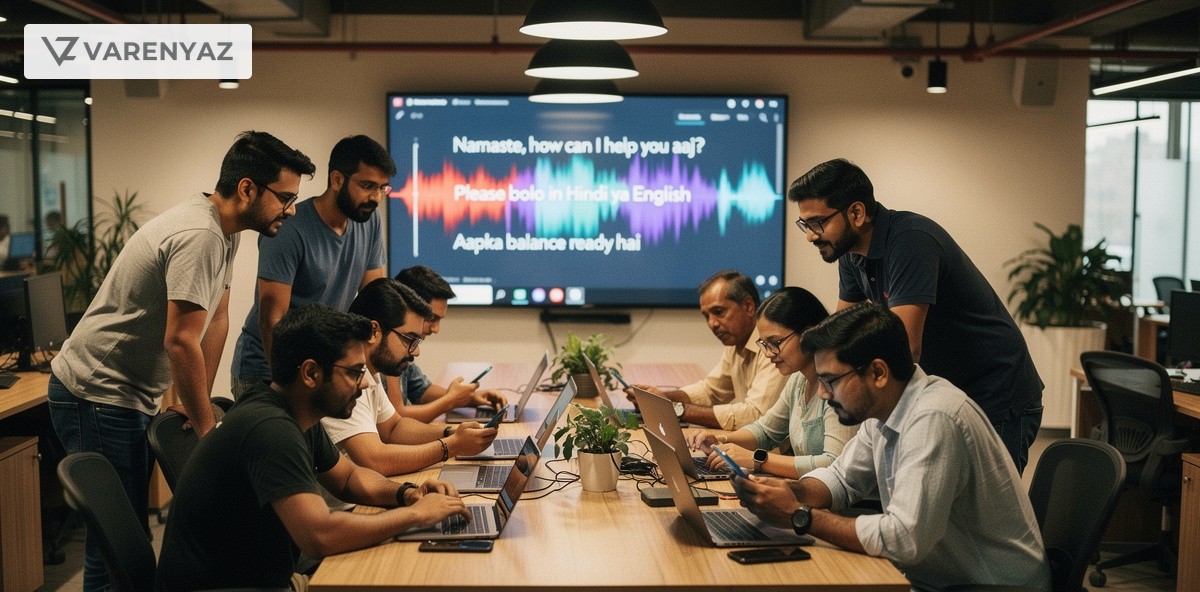
What Happened In Brief
Wispr Flow is expanding its Hinglish-focused voice AI assistant in India, claiming faster growth since launching a Hindi-English hybrid interface. The startup’s bet highlights how localized, multimodal agents could replace traditional app workflows for tasks like search, messaging and productivity. But India’s voice AI market remains difficult, with accent diversity, network constraints, data privacy concerns and unclear monetization models. For business leaders, Wispr Flow is a signal that India is an early test bed for localized AI agents that may shape global product and infrastructure strategies.
News Desk
LiveEditorial Review
VarenyaZ Editorial Desk, Managing Editor
Global
In This Story
Coverage Signals
Key Takeaways
- Wispr Flow reports accelerated growth in India after launching a Hinglish voice AI interface.
- Voice AI in India is constrained by accent diversity, code-switching, and inconsistent network quality.
- Multimodal agents that blend voice, text, and on-screen actions are emerging as app-like experiences.
- Local language support and cultural nuance are now core product requirements, not add-ons, for AI tools.
- Monetizing Indian voice AI users remains challenging given price sensitivity and limited enterprise budgets.
- Data privacy, consent, and evolving AI regulation could reshape how voice data is collected and used.
- Global companies can treat India as a proving ground for scalable, localized AI agent architectures.
- Partnering with specialists like VarenyaZ can de-risk AI design, integration, and deployment across markets.
Wispr Flow leans into Hinglish as voice AI heats up in India
Voice AI may be the hardest way to build an interface for India, but that is not stopping Wispr Flow. The AI startup is doubling down on a Hinglish-first strategy, claiming that its growth in India accelerated after it rolled out support for Hindi-English code-switching across its multimodal assistant.
Rather than position itself as another chatbot, Wispr Flow is trying to function as an AI agent that can listen, talk, and act on a user’s behalf across tasks—searching, drafting, summarising, and coordinating workflows on a smartphone or laptop.
The bet is straightforward: if voice AI can work in India—with its linguistic complexity, low-cost devices, and patchy networks—it can likely scale nearly anywhere else.
What changed: Hinglish as a growth unlock
Wispr Flow’s recent push is centered on Hinglish, the hybrid Hindi-English speech pattern that dominates in many Indian cities and across social platforms. After adding deeper Hinglish support, the company reports faster adoption and engagement in India, suggesting that language localization is not a mere feature, but a foundational growth lever.
India has long been touted as a fertile ground for voice interfaces, especially for users who skipped the desktop era and interact primarily via smartphones. Yet most voice assistants have struggled to move beyond basic commands or scripted responses. Wispr Flow is positioning its agent as a more flexible, LLM-powered layer that can understand context, maintain conversation, and orchestrate multi-step tasks.
In practice, this means users can mix Hindi and English mid-sentence while asking the assistant to summarise a document, respond to a message, or generate content, receiving outputs through a blend of voice, text, and on-screen UI elements.
Why voice AI in India is so hard
Despite the promise, India remains one of the toughest markets for voice AI. Several practical factors make this ecosystem challenging:
- Accent and dialect diversity: India has hundreds of languages and dialects. Even within Hindi, regional accents can be dramatically different. Training robust automatic speech recognition (ASR) for such variation is expensive and data-intensive.
- Code-switching and slang: Real-world conversations weave English technical terms with Hindi grammatical structures, plus regional slang. Models trained on clean, monolingual datasets struggle here.
- Device and audio constraints: Many users operate on entry-level phones with basic microphones in noisy environments—markets, buses, shared homes—which degrades input quality.
- Network variability: Latency-sensitive workloads like streaming audio to the cloud can hit limits on 3G/4G connections or congested networks.
- Trust and reliability: Users will not tolerate hallucinations in critical tasks, especially where money, personal information, or work outputs are involved.
Wispr Flow is effectively testing whether a modern, LLM-backed architecture—with improved ASR, language models, and multimodal fusion—can overcome these structural frictions.
Direct answer: What does Wispr Flow’s India bet mean for businesses?
Wispr Flow’s focus on Hinglish voice AI in India signals that the next wave of AI interfaces will be deeply localized, multimodal agents that sit above apps and automate everyday tasks. For businesses, this means planning for AI-driven voice and chat experiences that understand local speech patterns, handle real-world constraints, and plug into existing systems to execute actions—not just answer questions.
Voice AI as a new application layer
Wispr Flow is part of a broader shift from “bots in apps” to “agents above apps.” Its assistant aims to take natural-language input, break it into sub-tasks, and act across multiple tools. In India, where many users already juggle messaging, UPI payments, and content via chat-based flows, this pattern is intuitive.
For product and engineering leaders, this raises key architectural questions:
- Orchestration: How does an AI agent call APIs, trigger workflows, and reconcile state across systems reliably?
- Observability: How do teams monitor AI actions, understand failure modes, and intervene when the agent goes off track?
- Security and permissions: Which data can the agent see, and which actions is it allowed to perform on behalf of users?
Wispr Flow’s aggressive India expansion effectively stress-tests these questions in one of the most demanding consumer markets.
Business impact: Where voice AI could move the needle
For founders, CTOs, and growth leaders operating in or targeting India, the rise of Hinglish agents like Wispr Flow surfaces several practical opportunities:
- Acquisition and onboarding: Voice-first flows can simplify sign-up, KYC-guided journeys, or product education for users less comfortable with text-heavy UIs.
- Support and operations: AI agents can triage common support queries in Hinglish, escalate complex issues, and generate summaries for human agents.
- Workplace productivity: Knowledge workers and SMB owners can use voice shortcuts to draft emails, summarise chats, and generate reports on the move.
- Vertical-specific workflows: From healthcare intake to logistics dispatch, localized conversational UIs can streamline data capture in the field.
However, to translate these into real ROI, enterprises must go beyond pilots. They will need resilient integrations, clear KPIs, and governance frameworks for AI-driven interactions.
Risks, open questions, and the regulatory lens
India’s regulatory environment for AI is still evolving, but signals are clear: data privacy, consent, and transparency are moving toward center stage. Voice and audio data add extra sensitivity.
Key risks include:
- Data governance: How voice samples are stored, anonymised, and used for model improvement will be under scrutiny.
- Biometric and identification concerns: Voice can act as a biometric marker, raising questions about retention and misuse.
- Hallucinations and safety: As assistants move from answering questions to performing actions, error tolerance approaches zero for payments, health, or compliance workflows.
- Business model uncertainty: India’s price sensitivity and enterprise procurement cycles make sustainable revenue from pure consumer voice AI hard to predict.
Wispr Flow’s trajectory will likely be shaped as much by these regulatory and commercial realities as by the elegance of its models.
What leaders should watch next
For decision-makers evaluating voice AI in India and similar markets, several indicators will matter more than hype:
- Accuracy and latency benchmarks in real conditions, not just lab demos.
- Retention and cohort behavior post-onboarding—do users integrate the agent into daily workflows or drop off?
- Enterprise pilots that move beyond POCs into production-grade deployments with measurable impact.
- Partnerships with telcos, OEMs, or super-apps that could give agents like Wispr Flow distribution and infrastructure leverage.
India, with its Hinglish-heavy usage patterns and mobile-first reality, is likely to remain a global bellwether for localized AI agents over the next 12–24 months.
How VarenyaZ fits in: from concept to deployed AI workflows
Whether you are exploring a Wispr Flow integration or building your own agent, the hard work is rarely just in the model—it is in the product, infrastructure, and compliance layers wrapped around it. This is where experienced design and engineering partners matter.
- Custom AI product design: Mapping user journeys, choosing where voice, text, or visual cues matter, and building accessible experiences for multilingual audiences.
- Systems integration: Connecting agents to CRMs, ERPs, internal APIs, and data warehouses with proper observability and guardrails.
- Performance engineering: Optimising for low-bandwidth and low-spec devices common in India and other emerging markets.
- Automation and orchestration: Turning conversational intent into secure, auditable actions across your stack.
If you are planning to experiment with voice AI, multimodal agents, or India-focused digital products, you can start a focused discovery conversation with our team here: https://varenyaz.com/contact/
Conclusion: India as the proving ground for localized AI agents
Wispr Flow’s Hinglish push underscores a broader industry reality: the future of AI interfaces will not be one-size-fits-all. India is emerging as a proving ground where language complexity, infrastructure constraints, and cost sensitivity collide. Companies that learn to design, build, and operate localized AI agents here will be better positioned everywhere.
At VarenyaZ, we help teams bridge the gap between powerful AI models and usable products—through thoughtful web and app design, robust backend development, automation, and AI integration. As voice AI in India matures, that combination of engineering and user-centric design will be the difference between a viral demo and a durable business.
Editorial Perspective
"India is forcing voice AI builders like Wispr Flow to confront the messy reality of accents, languages, and low-end devices—if it works here, it can likely work almost anywhere."
"Hinglish is not just a language choice; it is a product strategy that acknowledges how Indian users actually speak, search, and get work done on their phones."
"For enterprises, the most important question isn’t whether voice AI is cool, but whether it can reliably plug into existing systems and deliver measurable operational gains."
Frequently Asked Questions
What is Wispr Flow and what is it doing in India?
Wispr Flow is an AI startup building a multimodal assistant that users can interact with via voice, text, and on-screen actions. In India, it is focusing on a Hinglish interface—mixing Hindi and English—to make its voice AI more natural for local users and to replace some traditional app workflows.
Why is voice AI in India considered difficult to build and scale?
Voice AI in India is hard because of extreme language diversity, strong regional accents, frequent code-switching between Hindi and English, and varying audio quality. These factors make automatic speech recognition and natural language understanding more error-prone, especially on lower-end smartphones and unstable mobile networks.
How could Hinglish voice AI affect businesses and startups?
Hinglish voice AI could lower friction for customer onboarding, support, search, and task automation by allowing users to speak naturally rather than navigate complex interfaces. For startups and enterprises, this opens new acquisition channels, conversational support flows, and AI-driven productivity tools tailored to India’s multilingual workforce and consumer base.
What are the main risks with deploying voice AI products in India?
Key risks include poor accuracy for certain accents or noisy environments, user frustration from latency or hallucinated responses, unclear monetization paths in price-sensitive segments, and growing regulatory scrutiny on data collection, biometric identifiers, and AI decision-making. Companies must also navigate trust, consent, and localization expectations carefully.
How can companies prepare to build localized AI agents for markets like India?
Companies should invest in language and accent datasets, design for low-bandwidth environments, and build multimodal experiences that gracefully degrade from voice to text. They also need observability, guardrails, and human escalation paths. Working with partners like VarenyaZ can speed up prototyping, integration, and compliance-aware deployment across web, mobile, and backend systems.
Is voice AI likely to replace apps in India?
In the near term, voice AI is more likely to layer on top of apps than fully replace them. Agents like Wispr Flow may orchestrate actions across multiple services, simplifying complex tasks into conversational flows. Over time, if accuracy, latency, and trust improve, some high-frequency workflows could move primarily to AI-first interfaces.
Selected References
Stay Ahead
Get concise, actionable insights on AI, digital strategy, and innovation. No spam, just value.
More Coverage
Related News
Jun 25, 2026
HaloBraid raises $7M to reinvent salon braiding workflows
HaloBraid has raised $7 million in funding, led by Alexis Ohanian’s Seven Seven Six, to launch a braiding-assistant device for professional salons. The hardware-plus-software tool is designed to reduce multi-hour braiding appointments into more efficient sessions, helping salons increase chair turnover, reduce stylist burnout, and expand textured-hair services. For founders and CTOs, HaloBraid highlights how specialized hardware and workflow automation can unlock value in overlooked, service-heavy verticals like beauty and personal care.
Jun 24, 2026
Menlo Ventures’ $3B AI Fund Raises the Stakes for Anthropic Bet
Menlo Ventures has raised a new $3 billion fund, heavily oriented around artificial intelligence, following the strong paper gains from its high-conviction $750 million investment in Anthropic in 2024. The raise underscores a shift toward larger, concentrated AI bets by top-tier VCs. For founders and enterprise leaders, this signals fiercer competition for AI talent and capital, a premium on defensible infrastructure and workflow products built on foundation models, and a rapid acceleration of AI-first roadmaps in software, cloud, and automation.
Jun 23, 2026
Fika Jobs Raises $4M to Build AI Video-First Hiring Platform
Fika Jobs has raised $4 million to build an AI video-first hiring platform where AI agents conduct initial interviews with candidates. Instead of screening CVs, employers receive structured, asynchronous video responses and AI-generated insights. For business and HR leaders, this signals a move toward conversational, always-on recruitment with potential gains in speed and consistency, but it also raises questions around bias, explainability, data privacy, and how to re-architect hiring workflows in an AI-mediated funnel.