

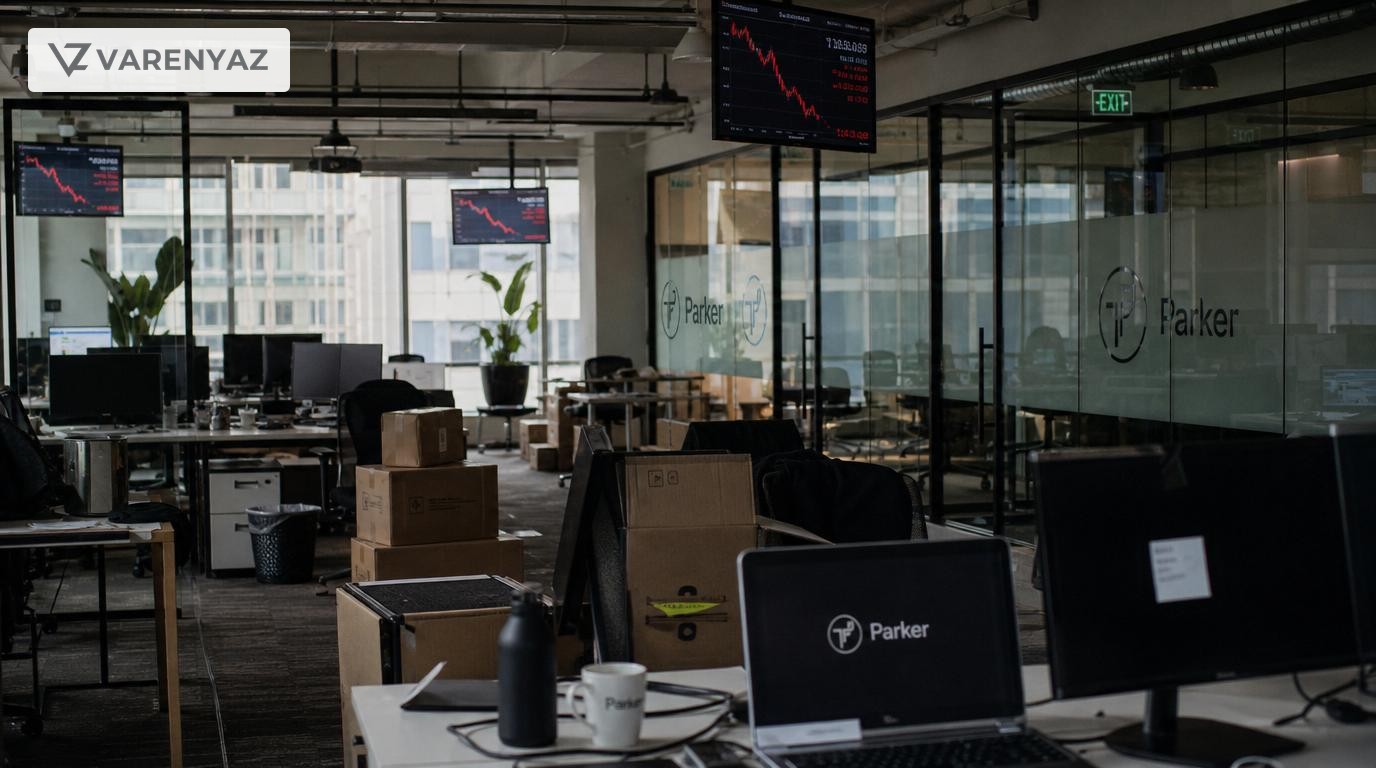
What Happened In Brief
Corporate card and banking startup Parker has filed for bankruptcy, despite being well-funded. The shutdown underscores mounting stress in venture-backed fintech models that depend on extending credit and monetising interchange. For founders, finance leaders and investors, Parker’s collapse is a warning to diversify providers, tighten treasury risk, and reassess exposure to unprofitable fintech platforms built on aggressive growth assumptions, rising funding costs and tightening underwriting standards.
News Desk
LiveEditorial Review
VarenyaZ Editorial Desk, Managing Editor
Global
In This Story
Coverage Signals
Key Takeaways
- Parker, a well-funded fintech offering corporate credit cards and banking services, has filed for bankruptcy and reportedly shut down operations.
- The collapse exposes structural fragility in fintechs that rely on extending credit, interchange fees and VC subsidies to fuel rapid growth.
- Startups and mid-market businesses that concentrated spend or deposits with Parker now face liquidity, continuity and reconciliation risks.
- Higher interest rates and tighter venture funding are forcing fintechs to prioritize profitability and disciplined underwriting over incentives.
- Finance and ops leaders should map their fintech dependencies, diversify banking and card providers, and build clear contingency playbooks.
- Investors are likely to scrutinize unit economics, loss ratios and compliance maturity more aggressively in fintech due diligence.
- Embedded finance, B2B payments and AI-driven underwriting will keep growing, but the bar for risk, regulation and resilience has risen.
- VarenyaZ helps teams modernize finance stacks, build internal tools and automation, and reduce single-vendor risk across web and AI systems.
Parker bankruptcy: a warning shot for venture-backed fintech credit models
Parker, a well-funded fintech offering corporate credit cards and banking-style services to businesses, has filed for bankruptcy and is widely reported to have shut down. For a sector built on speed, incentives and seamless onboarding, Parker’s collapse is a stark reminder of how fragile credit-intensive fintech models can be when market conditions turn.
What happened: a fast-growing corporate card startup hits the wall
Parker positioned itself as a modern finance partner for startups and mid-market companies, bundling corporate credit cards, spend management and banking-like features in a single platform. Backed by venture capital and part of a crowded corporate card race, it competed on flexible limits, software tooling and a user experience that aimed to beat traditional banks.
Despite this momentum and funding, Parker has now filed for bankruptcy protection. While detailed court filings and wind-down terms will emerge over time, multiple reports indicate the company has effectively shut down operations. For customers, that means potential disruption across corporate cards, available credit and access to account data.
The story fits an emerging pattern: fintechs that extend credit or sit close to the balance sheet are facing a harsher funding and regulatory climate than the era in which many of them were born.
Direct answer: what Parker’s bankruptcy means for your business
Parker’s bankruptcy means that businesses relying on it for corporate cards or banking services could face suspended credit lines, declined transactions, reconciliation headaches and uncertainty around access to funds or statements during the bankruptcy process. Finance and operations leaders should immediately assess their exposure, switch spend to backup providers, export all available data and update internal controls to reflect the new risk reality.
Why it matters: the fintech credit model under stress
Corporate card and fintech banking players typically make money from a mix of interchange fees, interest on revolving balances, and sometimes SaaS subscriptions. In the zero-rate, capital-rich decade, these economics were subsidized by venture funding, banking-as-a-service partners and permissive credit markets.
That environment has reversed. Higher interest rates, lower risk appetite and tighter venture funding make it harder to sustain aggressive rewards, generous limits and cash-burning growth plans. Defaults and charge-offs matter more. Access to warehouse lines and bank partners is more constrained. Regulators are more active.
Parker’s bankruptcy is therefore not just a single-company failure; it is a signal that fintechs directly exposed to credit risk will be tested harder and faster than pure software players.
Business impact: immediate steps for finance and operations teams
For CFOs, controllers, heads of finance and operations, the practical questions are urgent:
- Do we have corporate spend, subscriptions or vendor payments running through Parker cards?
- Are any treasury, operating or reserve balances held with Parker-linked accounts?
- How much of our financial data and workflows depend on Parker APIs or dashboards?
Concrete actions leaders should consider:
- Shift spend and payments: Move recurring payments and expenses to bank-issued cards or an alternative provider as quickly as possible.
- Export and back up data: Download statements, transaction exports and receipts while access remains available to avoid future reconciliation blind spots.
- Update risk register: Classify Parker as a failed counterparty in your internal risk frameworks and update continuity plans accordingly.
- Communicate with stakeholders: Inform executives, auditors and, where relevant, investors about exposure, remediation steps and any residual risk.
For businesses in India, the United States and the United Kingdom that increasingly rely on global fintech platforms, Parker’s situation highlights how cross-border vendor risk can quickly become a domestic operational problem.
Signals for investors and boards
For investors, LPs and board members, Parker’s bankruptcy will likely prompt tougher questions in future fintech diligence:
- Unit economics realism: Are interchange, FX and software fees enough to cover credit losses without permanent subsidy?
- Risk management maturity: Does the startup have disciplined underwriting, real-time risk monitoring and capital buffers?
- Dependency on third-party rails: How concentrated is the business on a single bank partner or lending facility?
- Path to profitability: Can the company reach sustainable margins under conservative growth and funding assumptions?
Parker’s fall may not end investor interest in fintech, but it will likely shift preference toward more resilient, less balance-sheet-heavy models and players with demonstrably conservative risk culture.
Fintech, AI and software: where the model still works
Importantly, Parker’s bankruptcy does not invalidate the broader shift to software-driven finance. Businesses still want:
- Real-time spend visibility across teams and geographies
- Automated reconciliation to ERP and accounting systems
- Streamlined onboarding and policy enforcement
- AI-powered anomaly detection and fraud alerts
The distinction is between software that orchestrates financial data and workflows and providers whose core risk is lending off their own or rented balance sheets. The former can be built with diversified, resilient architecture; the latter are inherently more exposed in downturns.
For CTOs and product leaders, this is a prompt to architect finance stacks around modularity and optionality—for instance, integrating multiple banking and card providers via API, centralizing data in internal systems, and using AI for analytics and controls rather than depending entirely on any single vendor’s opinionated platform.
Key risks and open questions
Several important questions remain open around Parker’s wind-down that customers and observers should track:
- Asset handling and customer funds: How are funds, if any, held with Parker or its partners treated in the bankruptcy process?
- Data retention: How long will customers retain access to historical statements and transaction data, and in what format?
- Vendor and partner exposure: How are Parker’s bank and infrastructure partners affected, and are there knock-on impacts to other fintechs using the same rails?
- Regulatory response: Will regulators respond with new guidance or scrutiny around corporate card and BaaS arrangements?
Until these questions are fully resolved, caution is warranted for any business whose financial operations depend meaningfully on emerging fintech vendors.
What leaders should do next
Founders, CFOs, COOs and CTOs can use this event to stress-test their own systems and assumptions:
- Map your fintech stack: List every provider touching cards, banking, payroll, payouts, FX and reporting.
- Assess concentration risk: Identify any single point of failure where one provider controls essential cash flows.
- Plan for rapid migration: Document how you would move spend, payouts and data to an alternative within days if needed.
- Own your data: Ensure all key finance data is regularly exported to systems you control—data lakes, warehouses or internal tools.
- Embed controls and monitoring: Use analytics and alerts to watch for anomalies, outages and counterparty risk signals.
If your team needs help architecting more resilient finance and operations systems, you can start a conversation with VarenyaZ at https://varenyaz.com/contact/.
How VarenyaZ can help: resilient finance and AI-powered operations
As a web, AI, design and custom development company, VarenyaZ sits at the intersection of product, engineering and operations. Parker’s bankruptcy underscores the value of building internal resilience rather than outsourcing all critical capabilities to single vendors.
Areas where we help clients respond to this new reality include:
- Custom finance dashboards and data hubs: Unified views of cash, cards, invoices and subscriptions across multiple banks and fintechs.
- API orchestration layers: Integration with several payment, banking and card providers to reduce vendor lock-in.
- AI-driven monitoring and anomaly detection: Intelligent alerts around spend spikes, failed payouts and unusual vendor behavior.
- Automation of finance workflows: Approvals, reimbursements, closing routines and reconciliation that continue to function even if one provider fails.
- Secure, scalable web apps for ops teams: Internal tools that give finance and operations teams control over data and processes instead of relying solely on third-party dashboards.
Conclusion: from fintech convenience to structural resilience
Parker’s bankruptcy is another reminder that financial infrastructure is not just a tool—it is a dependency that can fail at the worst possible moment. The next generation of winning companies will still embrace fintech, AI and modern web platforms, but they will do so with architecture designed for redundancy, portability and control.
VarenyaZ helps organizations design and build that architecture: robust web applications, automation and AI systems that keep finance and operations running, even when the fintech landscape shifts beneath them.
Editorial Perspective
"Parker’s bankruptcy is less an isolated incident and more a stress test result for the entire venture-backed fintech credit model."
"When a fintech sits between your business and the banking rails, it becomes critical infrastructure—you must treat that relationship with the same rigor as choosing a primary bank."
"The new fintech playbook is shifting from growth-at-all-costs to risk-aware orchestration, where resilience, redundancy and data portability become core product features."
Frequently Asked Questions
What happened to fintech startup Parker?
Parker, a venture-backed fintech that offered corporate credit cards and banking-style services to businesses, has filed for bankruptcy and is widely reported to have shut down operations. Customers are facing uncertainty around access to credit lines, cards, and account data while the bankruptcy process unfolds.
Why did Parker file for bankruptcy?
Specific financial details have not been fully disclosed, but Parker operated in a capital-intensive segment: corporate credit cards and banking. Rising interest rates, tighter venture funding, increased risk costs and competitive pressure likely made Parker’s unit economics and funding model unsustainable, triggering bankruptcy protection.
How does Parker’s bankruptcy impact its business customers?
Customers relying on Parker for corporate cards or banking may face suspended credit, disrupted payments, reconciliation issues and potential delays in accessing funds or statements. Finance teams will need contingency measures such as backup cards, alternate banking relationships, and data exports for accounting and compliance.
What does Parker’s shutdown signal for the wider fintech market?
Parker’s shutdown signals that fintechs built on aggressive growth, thin margins and heavy credit exposure are under pressure. Investors and customers are now prioritizing sustainable economics, robust risk management, capital access and regulatory maturity over promotional incentives and fast onboarding alone.
What should founders and CFOs do in response to Parker’s bankruptcy?
Founders and CFOs should assess concentration risk across corporate cards, banking, payouts and payroll providers; maintain relationships with at least one backup provider; regularly export and reconcile financial data; and evaluate each fintech partner’s balance-sheet strength, regulatory posture, and reliance on external credit facilities.
Can automation and custom tools reduce reliance on fragile fintech providers?
Yes. By building internal finance dashboards, data pipelines and automated workflows that connect multiple banks, card issuers and ERP systems, companies can reduce lock-in to any single fintech provider and switch providers more smoothly if needed while maintaining operational continuity and data integrity.
Selected References
Stay Ahead
Get concise, actionable insights on AI, digital strategy, and innovation. No spam, just value.
More Coverage
Related News
Jun 25, 2026
HaloBraid raises $7M to reinvent salon braiding workflows
HaloBraid has raised $7 million in funding, led by Alexis Ohanian’s Seven Seven Six, to launch a braiding-assistant device for professional salons. The hardware-plus-software tool is designed to reduce multi-hour braiding appointments into more efficient sessions, helping salons increase chair turnover, reduce stylist burnout, and expand textured-hair services. For founders and CTOs, HaloBraid highlights how specialized hardware and workflow automation can unlock value in overlooked, service-heavy verticals like beauty and personal care.
Jun 24, 2026
Menlo Ventures’ $3B AI Fund Raises the Stakes for Anthropic Bet
Menlo Ventures has raised a new $3 billion fund, heavily oriented around artificial intelligence, following the strong paper gains from its high-conviction $750 million investment in Anthropic in 2024. The raise underscores a shift toward larger, concentrated AI bets by top-tier VCs. For founders and enterprise leaders, this signals fiercer competition for AI talent and capital, a premium on defensible infrastructure and workflow products built on foundation models, and a rapid acceleration of AI-first roadmaps in software, cloud, and automation.
Jun 23, 2026
Fika Jobs Raises $4M to Build AI Video-First Hiring Platform
Fika Jobs has raised $4 million to build an AI video-first hiring platform where AI agents conduct initial interviews with candidates. Instead of screening CVs, employers receive structured, asynchronous video responses and AI-generated insights. For business and HR leaders, this signals a move toward conversational, always-on recruitment with potential gains in speed and consistency, but it also raises questions around bias, explainability, data privacy, and how to re-architect hiring workflows in an AI-mediated funnel.