

What Happened In Brief
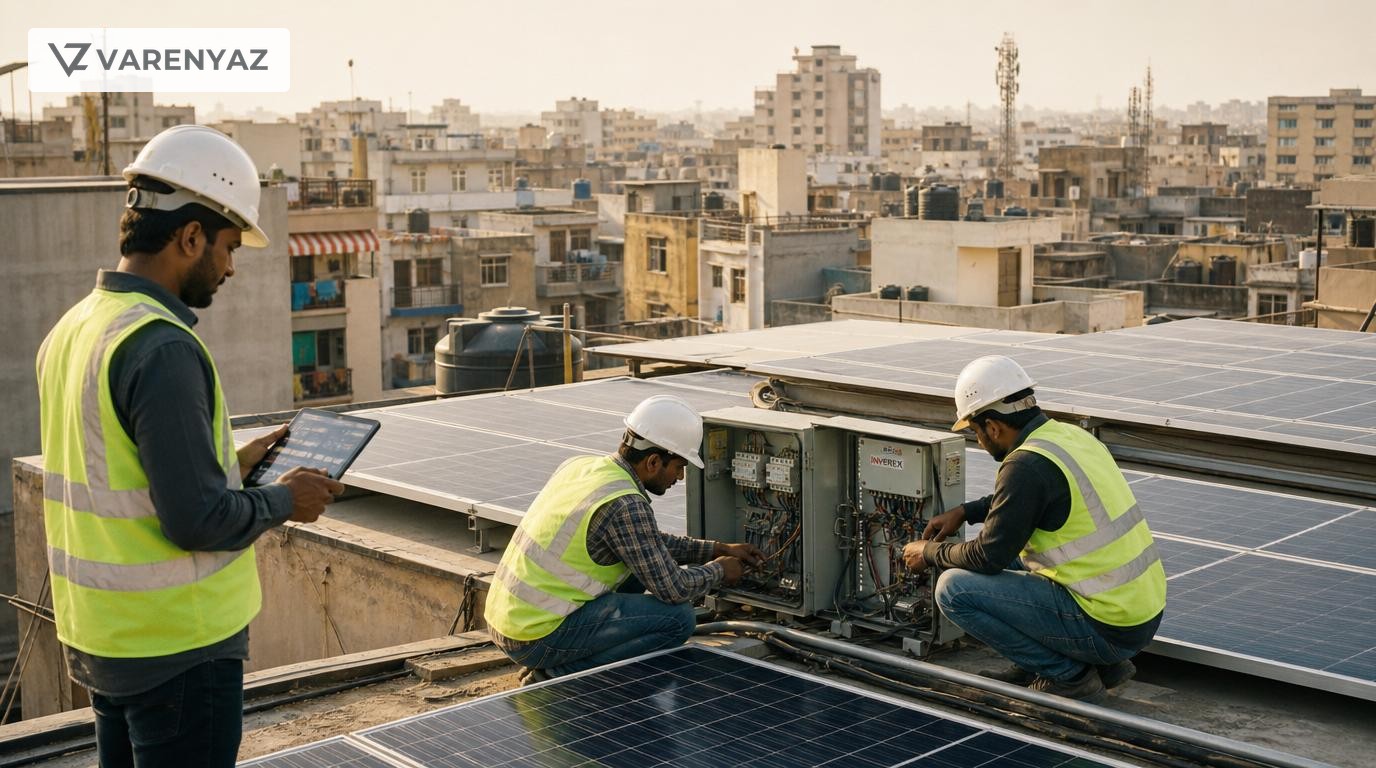
SolarSquare is reportedly in talks to raise up to $60 million in new funding, potentially valuing the Indian rooftop solar startup at around $500 million. The capital would enable faster expansion beyond major cities, deeper investment in software, and stronger competition in India’s rapidly growing distributed solar market, amid rising power demand and supportive government policies.
News Desk
LiveEditorial Review
VarenyaZ Editorial Desk, Managing Editor
Global
In This Story
Coverage Signals
Key Takeaways
- SolarSquare is reportedly in talks to raise up to $60 million, at a potential valuation of about $500 million.
- The deal highlights accelerating venture capital interest in India’s rooftop solar and distributed energy sector.
- Rooftop solar is becoming critical as India races to meet rising power demand and renewable energy targets.
- Beyond hardware, software platforms for sales, design, remote monitoring, and lifecycle management are emerging as key differentiators.
- For enterprises and SMEs, rooftop solar is now a digital and financial decision, not just an engineering one.
- Investors see potential for SolarSquare to expand into new cities, financing models, and value-added energy services.
- Execution risk, regulatory shifts, and grid-integration challenges remain significant for rooftop solar players.
- Digital platforms, automation, and AI-driven planning tools can unlock efficiency in design, installation, and operations.
SolarSquare’s reported $60M raise signals a new phase for India’s rooftop solar market
SolarSquare, a fast-growing rooftop solar startup based in India, is reportedly in advanced talks to raise up to $60 million in new funding. The round could value the company at around $500 million, according to coverage from TechCrunch and people familiar with the discussions.
While the deal has not yet been formally announced, it marks one of the most closely watched climate-tech raises in India this year. It also reflects how investor sentiment toward distributed solar in emerging markets is shifting from speculative to conviction-driven.
What’s happening: capital for a platform, not just panels
SolarSquare focuses on rooftop solar installations for homes and small businesses, aiming to simplify everything from site surveys and design to installation and after-sales support. Its reported funding talks indicate several strategic priorities:
- Scaling beyond core metros: Moving from early urban strongholds into Tier-2 and Tier-3 cities where rooftop potential is high but organized players are fewer.
- Deepening technology and software: Investing in tools for system design, workflow management, customer portals, and real-time performance monitoring.
- Strengthening financing options: Partnering with lenders or building digital journeys that make rooftop solar financially accessible to more households and SMEs.
- Defending against intensifying competition: As large energy companies, EPCs, and utilities increase their focus on distributed solar, digital execution becomes a differentiator.
Rooftop solar has historically been treated as a construction project. The new generation of players like SolarSquare is reframing it as a recurring, software-enabled service business — where the system is installed once, but data, insights, and customer engagement continue for 20–25 years.
Why India’s rooftop solar market is drawing major VC attention
India is among the world’s fastest-growing energy markets, with electricity demand projected to rise sharply over the next decade. To meet this demand while containing emissions, the government has set ambitious renewable energy targets, including significant capacity additions from rooftop solar.
Three structural shifts are now converging:
- Policy support: National and state-level schemes are pushing rooftop adoption through subsidies, net metering, and standardized processes, even if execution can be uneven.
- Cost curves: The falling price of solar panels and inverters makes rooftop installations more financially compelling for consumers and SMEs.
- Digitization of energy: As buildings, devices, and grids become more connected, rooftop systems can act as intelligent distributed assets rather than just passive generators.
For venture capital and growth investors, this creates a window to back companies that can build trusted brands, efficient sales engines, and scalable technology platforms across thousands of distributed sites.
Direct answer: what SolarSquare’s reported funding means for business leaders
SolarSquare’s reported plan to raise up to $60 million at a potential $500 million valuation signals that India’s rooftop solar market is entering a scale-up phase where digital platforms, standardized execution, and energy data insights are becoming as important as hardware pricing.
For business decision-makers, this means rooftop solar is no longer a one-off capex conversation; it is emerging as a core pillar of energy strategy, resilience, and ESG performance.
Business and technology implications
1. For enterprises and mid-market businesses
Commercial and industrial consumers in India, the US, and the UK are under pressure to reduce energy costs and emissions, while maintaining uptime.
- Energy cost management: Rooftop solar can hedge against tariff volatility, particularly when paired with analytics and storage.
- ESG reporting: Distributed solar capacity directly supports net-zero and sustainability reporting requirements.
- Multi-site complexity: Chains, campuses, and industrial clusters need centralized visibility into distributed systems. That demands robust web dashboards, APIs, and integration with existing ERP and energy-management platforms.
2. For software, AI, and product leaders
SolarSquare’s trajectory reinforces that solar is gradually becoming a software and data problem:
- Design automation: Algorithms can convert satellite imagery, LIDAR, and building data into optimal system designs and yield projections.
- Predictive maintenance: ML models can flag panel degradation, inverter issues, or shading problems before customers notice under-performance.
- Dynamic energy optimization: AI can help orchestrate rooftop solar, storage, and grid power, especially in commercial sites with complex load profiles.
- Customer experience: Self-service portals, instant quotes, digital KYC, and ticketing bring a fintech-grade UX to what was previously an offline industry.
These capabilities require solid cloud architectures, scalable web applications, and data platforms that are secure, observable, and integrable with partners and regulators.
3. For investors and corporate venture arms
The reported round validates rooftop solar as a platform opportunity, not just an asset class. Investors and corporate venture arms should track:
- Unit economics: Acquisition costs, installation productivity, and lifetime service margins.
- Software leverage: Revenue from monitoring, warranties, performance guarantees, and energy-as-a-service models.
- Partnerships: Ties with lenders, utilities, and large real-estate portfolios that can accelerate customer acquisition.
- Regulatory resilience: Ability to adapt to evolving net metering rules, subsidies, and grid requirements across states or countries.
Key risks and open questions
Despite strong momentum, rooftop solar at scale faces several challenges:
- Policy volatility: Changes to net metering, connection rules, or subsidy flows can affect project viability and payback expectations.
- Execution at scale: Thousands of small, distributed projects create operational risk without standardized processes and technology support.
- Quality and trust: Poor installation quality, opaque contracts, or weak after-sales service can erode consumer confidence and brand value.
- Grid interaction: High penetration of rooftop solar can pose grid-stability issues if not paired with smart inverters, storage, and coordinated dispatch.
How SolarSquare and its peers tackle these challenges — especially via digital tools and automation — will determine which platforms emerge as long-term category leaders.
What to watch next
Over the next 12–24 months, stakeholders should track:
- Official announcement and round structure: The final size of SolarSquare’s round, participating investors, and any strategic partners.
- Geographic and segment expansion: Moves into new cities, states, and customer segments, including SMEs and housing societies.
- Tech stack evolution: Launches of new apps, monitoring portals, and integration with third-party finance or energy platforms.
- Regulatory developments: Updates to rooftop policies, grid codes, and incentives in India and other high-growth solar markets.
- Partnerships with builders, utilities, and platforms: Bundling rooftop solar into new construction, retrofits, and smart-building solutions.
How this connects to AI, web, and software strategy
Rooftop solar growth is inseparable from digital infrastructure. Companies building or partnering in this ecosystem increasingly need:
- Robust web platforms for lead capture, quotation journeys, order tracking, and customer education.
- Custom dashboards and portals that provide real-time system health, generation analytics, and alerts.
- APIs and integrations with financing partners, utilities, and third-party monitoring systems.
- AI-driven tools for design automation, yield forecasting, and predictive maintenance.
- Workflow automation across sales, engineering, logistics, and service to maintain margins as scale increases.
If you are a solar developer, energy services company, or enterprise energy user exploring digital platforms for distributed energy, you can start a tailored conversation with VarenyaZ at https://varenyaz.com/contact/.
Where VarenyaZ fits into the rooftop solar and energy transition story
VarenyaZ works with climate-tech and energy-focused organizations to build:
- Custom web and mobile portals that digitize customer journeys from quotation to commissioning and ongoing support.
- Operations and field apps that help standardize surveys, installations, and maintenance across distributed assets.
- Data platforms and dashboards that aggregate IoT data, inverter feeds, and financial metrics into actionable insights.
- AI-driven planning and optimization tools to improve design accuracy, performance forecasting, and resource allocation.
- Automation workflows to reduce manual overhead across CRM, billing, inventory, and customer support.
Conclusion: rooftop solar is now a digital infrastructure decision
SolarSquare’s reported move to raise up to $60 million at a potential $500 million valuation is more than a funding milestone. It is a signal that rooftop solar in India — and globally — is entering a platform era where software, AI, and user experience are central to growth.
For founders, energy leaders, and investors, the message is clear: the winners in rooftop solar will be those who combine installation excellence with world-class digital products. VarenyaZ helps companies design and build that digital backbone, from customer-facing web platforms to AI-powered energy analytics and automation.
Editorial Perspective
"This reported round suggests that India’s rooftop solar sector is evolving from fragmented installers to platform-led businesses where software, finance, and execution quality drive enterprise value."
"For energy and operations leaders, rooftop solar is rapidly becoming a digital infrastructure decision, where web platforms, APIs, and AI-driven planning are as important as panels and inverters."
Frequently Asked Questions
How much funding is SolarSquare reportedly raising?
SolarSquare is reportedly in talks to raise up to $60 million in new capital. The round, if finalized, could value the Indian rooftop solar startup at around $500 million, reflecting strong investor confidence in the country’s distributed solar market.
Why are investors interested in India’s rooftop solar market?
Investors are drawn to India’s rooftop solar market because of rapidly growing power demand, government targets for renewable energy, and falling solar costs. Rooftop solar serves homes and businesses directly, offering long-term cost savings, resilience, and an opportunity to build scalable, software-driven energy platforms.
What does SolarSquare do in the rooftop solar ecosystem?
SolarSquare focuses on rooftop solar solutions for households and small businesses, handling system design, installation, and after-sales service. The company also uses software for system design, project management, and performance monitoring, positioning itself as both an engineering and digital platform player in distributed solar.
What are the main risks for SolarSquare and other rooftop solar startups?
Key risks include policy changes, subsidy delays, grid-integration challenges, customer acquisition costs, and execution complexity across many small installations. Building robust software, standardizing processes, and managing working capital are essential for sustainable growth in the rooftop solar segment.
How can digital platforms and AI support rooftop solar growth?
Digital platforms and AI can streamline site assessment, system sizing, design optimization, pricing, and remote performance monitoring. They reduce acquisition and operating costs, improve customer experience, and enable new services such as predictive maintenance and energy optimization across many distributed solar systems.
Selected References
Stay Ahead
Get concise, actionable insights on AI, digital strategy, and innovation. No spam, just value.
More Coverage
Related News
Jul 4, 2026
The New Browser Wars: Beyond Search, Toward Privacy and AI
The new browser wars are no longer just about which search engine is set by default. A wave of alternative browsers is competing on privacy, AI-native features, and workflow integration instead. For businesses, browser choice now affects security, analytics, and employee productivity. This article explains what’s changing, highlights key options beyond Chrome and Safari, and outlines what technology and product leaders should consider as they define their browser standards and design customer-facing web experiences for this fragmented ecosystem.
Jul 3, 2026
Venice AI Hits Unicorn Status With $65M Bet on Private AI
Venice AI has raised a $65M Series A round at a unicorn valuation while already profitable and running at over $70M in annualized revenue, according to CEO Erik Voorhees. The company offers a privacy-first generative AI platform aimed at enterprises that want powerful models without giving up control of sensitive data, logs, and infrastructure. This funding underscores strong demand for secure, compliant AI stacks and intensifies competition in enterprise-focused AI infrastructure.
Jul 2, 2026
Neocloud Together AI Soars to $8.3B Valuation With $800M Raise
Neocloud Together AI has raised $800 million at an $8.3 billion valuation to expand its neocloud platform focused on hosting and serving open-source AI models. The new funding, up from a $3.3 billion valuation in early 2025, signals strong investor conviction in specialized AI cloud providers. For enterprises, this accelerates access to flexible, multi-model AI infrastructure beyond hyperscalers, but also raises questions about vendor lock-in, cost management, and platform maturity.