

What Happened In Brief
Atech, a hardware-focused startup, has raised an $800,000 pre-seed round, with participation from Lovable-affiliated investors, a16z’s scout fund, Sequoia Scout Fund, and Nordic Makers. The company aims to bring “vibe coding” principles—fast, exploratory, AI-assisted workflows popularized in modern software tools—into hardware design. For product and engineering leaders, this signals a push toward software-like tooling for physical products, potentially shortening prototyping cycles, reducing iteration costs, and enabling new hardware-as-a-service and custom device business models.
News Desk
LiveEditorial Review
VarenyaZ Editorial Desk, Managing Editor
Global
In This Story
Coverage Signals
Key Takeaways
- Atech has raised a reported $800,000 pre-seed round to apply “vibe coding” principles to hardware development.
- Investors include a16z’s scout fund, Sequoia Scout Fund, Nordic Makers and Lovable-linked backers, signaling strong belief in AI-first developer tools.
- The startup aims to make hardware design and prototyping feel closer to modern AI-assisted software workflows: fast, iterative, and conversational.
- If successful, Atech’s approach could significantly reduce the time and cost of building and iterating on physical products.
- Business leaders should watch how AI-native hardware tools enable new models like hardware-as-a-service and rapidly customized devices.
- The move reflects a broader convergence of software and hardware, where web-style developer experience expectations now extend to electronics.
- Risks include technical complexity, integration with existing CAD/EDA workflows, and convincing conservative hardware teams to adopt new tooling.
- Companies considering smart devices or IoT platforms should evaluate how AI-assisted hardware workflows can align with their digital product roadmaps.
Atech’s $800K bet: bringing “vibe coding” to hardware
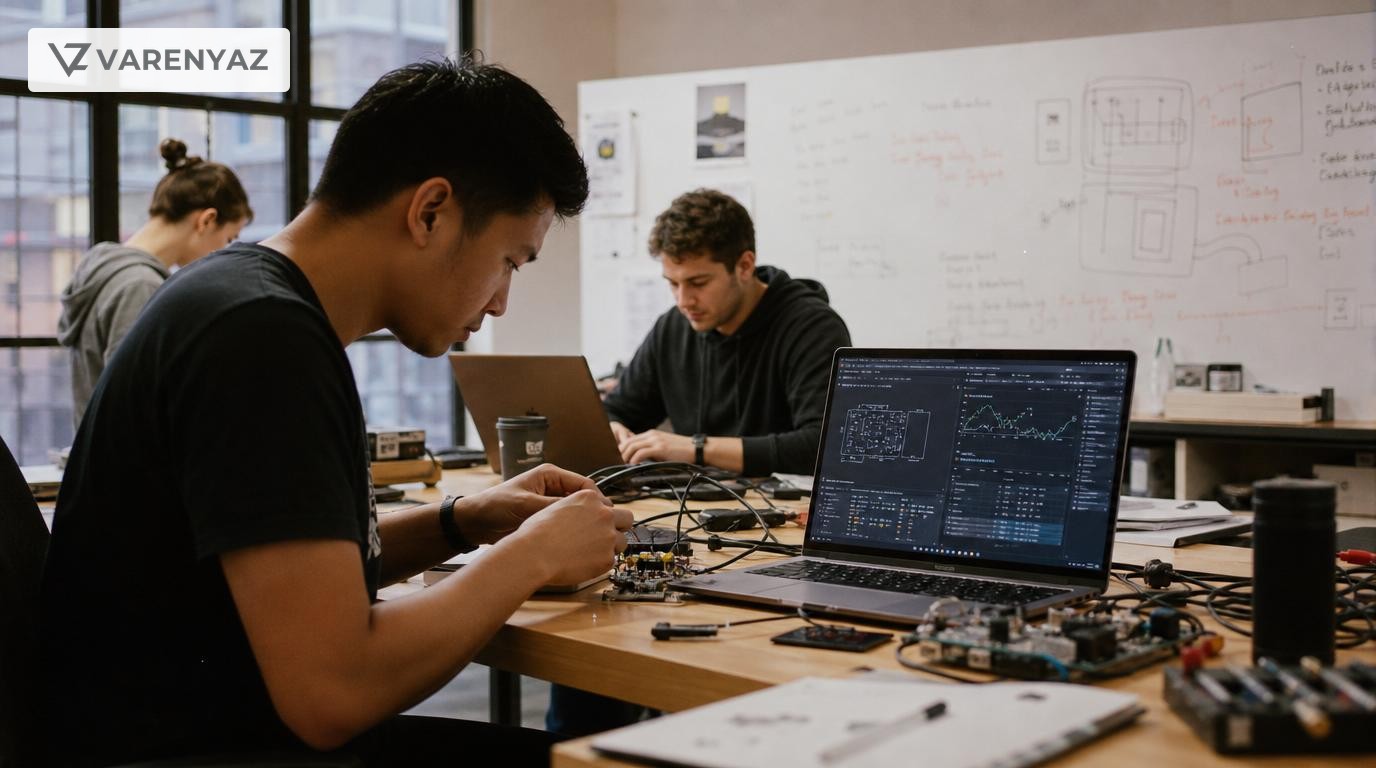
Hardware has always moved slower than software. Prototype cycles are long, tools are rigid, and experimentation is expensive. Atech, a young hardware-focused startup, wants to change that by importing a distinctly software-native idea into the physical world: “vibe coding.”
The company has raised an $800,000 pre-seed round, with participation reportedly including a16z’s scout fund, Sequoia Scout Fund, Nordic Makers, and investors linked to AI-powered coding tool Lovable. The goal is ambitious: to make building hardware feel as fluid, iterative, and AI-assisted as modern software development.
What actually happened in this funding round?
Atech’s pre-seed raise is relatively small in absolute dollars but strategically significant. Scout funds from major firms such as Andreessen Horowitz and Sequoia Capital are designed to place early, thesis-driven bets on teams that may define new categories.
In this case, the category is emerging developer tools at the intersection of AI, hardware, and product design. Atech is positioning itself as the layer that makes hardware prototyping and iteration feel like "vibe coding"—a concept popularized in the AI dev tools world, where builders rely on rapid feedback loops, AI suggestions, and high-level abstractions rather than manual, line-by-line tinkering.
For Lovable-adjacent investors, backing a hardware play that mirrors the user experience of AI coding assistants is a logical extension of their thesis: if AI can dramatically accelerate software creation, why shouldn’t the same principle apply to PCBs, enclosures, and connected devices?
What is “vibe coding” for hardware, really?
In software, vibe coding refers to a highly interactive, often AI-assisted workflow where developers “feel out” a solution through quick experiments, natural language prompts, and instant feedback rather than strictly following a rigid spec.
For hardware, that philosophy could translate into:
- AI-assisted design suggestions for circuit layouts, component choices, and power budgets.
- Fast, simulation-driven feedback that flags likely signal integrity issues, thermal problems, or BOM risks before fabrication.
- Higher-level abstractions where developers specify behaviors or constraints (“low-power Wi-Fi sensor node with 2-year battery life”) and let tools guide the implementation options.
- Integrated firmware-hardware context, reducing the traditional friction between electrical engineers, embedded developers, and cloud teams.
The promise is not to replace engineering judgment, but to lower the cognitive and operational overhead needed to explore hardware ideas and get to a robust prototype.
Why this matters now: the convergence of software, hardware, and AI
Three forces make this moment ripe for a company like Atech:
- AI-native developer expectations: Software teams are rapidly normalizing AI copilots, low-code tools, and instant feedback loops. That UX expectation will inevitably bleed into hardware.
- Exploding demand for connected devices: IoT, industrial automation, smart consumer electronics, and edge AI are all driving new device concepts that must iterate quickly to find market fit.
- Pressure on time-to-market: In both startups and enterprises, the cost of being late with a physical product is rising. Every additional board spin and manufacturing delay is now a strategic risk.
Atech’s thesis is that the next unlock in hardware is not just better fabrication or cheaper components, but better tooling for how humans design and iterate on physical products.
Business impact: what leaders should watch
For founders, CTOs, and product leaders, Atech’s funding round is a signal of where hardware workflows may be heading. If vibe coding for hardware works, you can expect:
- Shorter prototyping cycles: From months and multiple fabrication rounds to weeks and fewer, more informed iterations.
- Lower experimentation cost: Teams can test more ideas before committing capital to tooling and production.
- Closer integration of hardware, firmware, and cloud: Digital product roadmaps become easier to align across disciplines.
- New business models: Faster iteration enables more viable hardware-as-a-service, custom device, and region-specific variants.
For operations and supply chain leaders, a more agile design process could mean fewer surprises late in the lifecycle, better BOM control, and smoother handoff to manufacturing partners.
Direct answer: what does Atech’s raise mean for hardware development?
Atech’s $800,000 pre-seed funding aims to apply “vibe coding” principles—fast, AI-assisted, exploratory workflows—to hardware design and prototyping. If the approach succeeds, hardware development could start to resemble modern AI-native software development: shorter cycles, more experimentation, and tighter integration between devices, firmware, and cloud platforms.
Implications for AI, web, and software ecosystems
Although Atech’s core focus is hardware, the ripple effects land squarely in AI, web, and software ecosystems:
- Unified product stacks: Startups increasingly want one coherent stack: web app, APIs, AI services, and device firmware working together. Developer tools that bridge hardware and software help make that achievable.
- Data as a design loop: As more devices stream telemetry to the cloud, hardware design becomes part of a data feedback loop. AI models can learn from failure modes and feed insights back into the next generation of devices.
- Platformization: Tools that make device design easier can power ecosystems—think reference designs and SDKs that let partners build niche hardware atop a core platform.
For teams building connected products, this means product strategy must integrate hardware assumptions from day one instead of treating devices as a bolt-on after thought.
Risks, constraints, and open questions
Atech is still early, and several challenges could slow or limit its impact:
- Toolchain integration: Hardware teams live in mature CAD and EDA ecosystems. Any new tool must integrate cleanly rather than attempt a full replacement on day one.
- Trust and reliability: In hardware, mistakes are expensive. Teams will be cautious about trusting AI-driven suggestions without transparent reasoning and robust verification.
- Cultural adoption: Many hardware organizations are conservative. Shifting from document-heavy, stage-gate processes to exploratory, vibe-style workflows will require both proof and change management.
- Scope creep: Trying to be the “all-in-one” layer for every part of hardware design risks diluting focus. Atech will need a clear wedge—specific device classes, workflows, or user personas.
These questions won’t be answered immediately, but early pilots with design teams and startups will reveal where vibe coding meaningfully improves outcomes—and where it doesn’t.
What happens next?
With fresh capital, Atech’s next milestones are likely to include:
- Productizing a focused toolset for a well-defined hardware workflow (for example, early PCB exploration or integrated firmware-hardware prototyping).
- Building reference wins with early customers in IoT, consumer hardware, or industrial devices.
- Deep integrations with popular CAD/EDA tools and cloud platforms to embed into existing workflows.
- Proving measurable gains in time-to-prototype, number of re-spins, or cost of iteration compared to traditional flows.
For investors and founders, the key signal will be whether Atech can prove that its vibe coding approach not only feels better for developers but also materially improves business outcomes—faster launches, fewer defects, and more resilient product roadmaps.
How leaders can respond now
Even before Atech’s tools are generally available, there are practical steps decision-makers can take:
- Map your hardware lifecycle: Identify where your teams lose the most time—requirements handoff, design sign-off, prototyping, testing, or supplier integration.
- Pilot AI in low-risk areas: Use AI copilots for documentation, test planning, or early simulation analysis to build comfort with AI-augmented workflows.
- Align hardware and software roadmaps: Ensure your device strategy is not lagging your web, mobile, and AI product plans.
- Partner strategically: Work with specialists who understand both web/AI architectures and hardware realities to avoid fragmented solutions.
If you are exploring connected devices, custom dashboards, or AI-driven control systems, you can start by aligning your digital experiences and backend architecture. To discuss how your hardware or IoT vision can be supported with modern web, AI, and automation foundations, contact the VarenyaZ team at https://varenyaz.com/contact/.
Where VarenyaZ fits in
While Atech tackles the hardware tooling problem, organizations still need cohesive digital ecosystems around their physical products. That includes:
- Web and app interfaces for configuring, monitoring, and managing devices.
- APIs and data pipelines that route telemetry into analytics and AI models.
- Automation workflows that act on device signals in real time.
- AI layers for predictive maintenance, personalization, or optimization.
VarenyaZ works with founders and enterprises to design and build these layers—bridging the gap between hardware vision and the software, AI, and automation stack that turns devices into durable products and platforms.
Conclusion: hardware that feels like software
Atech’s $800,000 pre-seed round is a small but meaningful bet that the future of hardware development will look more like AI-native software: conversational, iterative, and data-driven. For leaders, the message is clear: you cannot treat hardware and software as separate worlds anymore.
As tools like Atech’s emerge, the advantage will go to teams that can orchestrate the full stack—devices, web, cloud, and AI—into a single, coherent experience. VarenyaZ helps organizations design and build that stack, from interfaces to integrations, automation, and AI models, so that when the tooling catches up, your product strategy is already there.
Editorial Perspective
"Vibe coding for hardware is less about a catchy label and more about collapsing the gap between how we imagine products and how we physically realize them, using AI to make that loop almost conversational."
"Investors backing tools like Atech are effectively betting that the next wave of value in hardware will come from developer experience—turning the rigid world of CAD and EDA into something that feels as fluid as modern software tooling."
"For CTOs and product leaders, the strategic question is no longer just ‘Should we build hardware?’ but ‘Can our hardware development lifecycle keep pace with our software and AI roadmap?’"
Frequently Asked Questions
What is Atech and what did it announce?
Atech is a hardware-focused startup aiming to bring “vibe coding” principles—fast, exploratory, AI-assisted workflows—into hardware design and prototyping. The company announced an $800,000 pre-seed funding round from investors that include a16z’s scout fund, Sequoia Scout Fund, Nordic Makers, and Lovable-linked backers.
What does “vibe coding” mean in the context of hardware?
In hardware, “vibe coding” refers to making the process of designing and iterating on physical products feel closer to modern AI-supported software development: highly interactive, low-friction, and exploratory. Instead of rigid, slow CAD or EDA cycles, teams can rapidly test ideas, get smart suggestions, and iterate on device designs with far less overhead.
Why does Atech’s funding round matter for product and engineering leaders?
Atech’s round signals growing investor conviction that hardware tools will need the same AI-native developer experience that software teams now expect. For product and engineering leaders, this could translate into shorter prototyping cycles, lower iteration costs, and a much faster path from concept to manufacturable design for smart devices and IoT products.
How could vibe coding for hardware change time-to-market?
By layering AI and high-level abstractions on top of existing hardware workflows, vibe coding-style tools can dramatically compress feedback loops. Teams can explore more design options upfront, catch errors earlier, and integrate firmware, cloud, and UX requirements sooner, collectively reducing the number of expensive re-spins and accelerating time-to-market.
How can companies get started if they want to build AI-native hardware products?
Companies can begin by mapping their current hardware and IoT product lifecycle, identifying bottlenecks in design, prototyping, and integration, and then piloting AI-assisted tools where risk is lowest. Partnering with a digital product studio like VarenyaZ can help align hardware concepts with web platforms, AI services, and custom software for a cohesive stack.
What are the main risks or uncertainties around Atech’s approach?
Key risks include the technical difficulty of integrating AI-driven workflows with existing CAD and EDA tools, the conservatism of established hardware teams, and the need to prove that any new layer of abstraction does not compromise manufacturability or reliability. Adoption will depend on whether Atech can show clear gains in speed, quality, and cost.
Selected References
Stay Ahead
Get concise, actionable insights on AI, digital strategy, and innovation. No spam, just value.
More Coverage
Related News
Jun 28, 2026
SpaceX Veteran Turns Rocket Engines Into Geothermal Power
Critical Energy, founded by a former SpaceX engineer, has secured a major funding round to repurpose rocket engines for ultra-deep geothermal drilling. By reaching hotter rock layers, the startup aims to provide firm, low-carbon baseload power that can compete with fossil fuel plants. The approach could be attractive for utilities, data centers, and heavy industry seeking 24/7 clean energy. Key questions now are drilling costs, regulatory paths, and how fast power purchase agreements and pilot plants can scale from demonstration to commercial deployment.
Jun 27, 2026
OpenAI’s Jalapeño AI chip turns up heat on Nvidia’s dominance
OpenAI is developing Jalapeño, a custom AI inference chip built with Broadcom, as part of a broader effort to reduce its dependence on Nvidia GPUs. The move aligns OpenAI with Google, Apple, Amazon, Meta, and Tesla, all investing in in‑house silicon. For businesses, Jalapeño highlights a shift toward vertically integrated AI stacks that optimize for cost, latency, and energy efficiency. Leaders should not expect to buy Jalapeño directly soon, but its existence will influence cloud pricing, AI performance baselines, and long‑term hardware strategy.
Jun 26, 2026
General Intuition Bets $2.3B That Games Can Train Real-World AI
General Intuition is making a multibillion-dollar bet that video games are the best simulation layer for training real-world AI agents. After raising hundreds of millions to scale, the company uses millions of hours of gameplay as action data for reinforcement learning, aiming to build agents that generalize to logistics, robotics, and enterprise automation. For leaders, the move signals that synthetic, game-like environments are becoming strategic infrastructure for decision-making AI, with implications for product design, operations, and AI-driven software.