

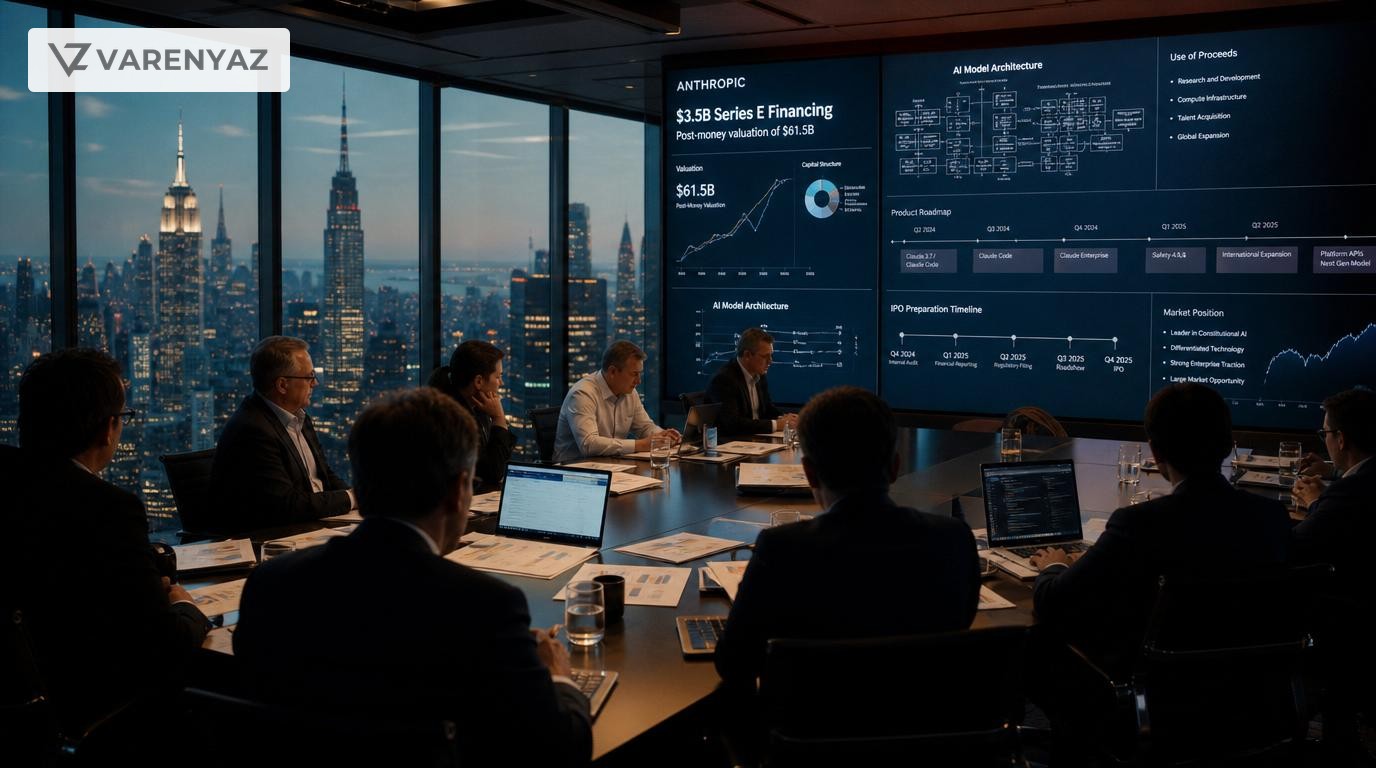
What Happened In Brief
Anthropic has reportedly closed a $65 billion Series H funding round at a $965 billion post-money valuation, putting the Claude maker on the cusp of a $1 trillion valuation ahead of a widely anticipated IPO. This is one of the largest private raises in tech history and further concentrates power among a handful of AI foundation model players. For enterprises, it signals faster product cycles, higher cloud and AI costs, and growing dependency on a small set of model providers, making vendor strategy and architectural flexibility critical.
News Desk
LiveEditorial Review
VarenyaZ Editorial Desk, Managing Editor
Global
In This Story
Coverage Signals
Key Takeaways
- Anthropic has raised $65 billion in a Series H round at a $965 billion post-money valuation, placing it just shy of the $1 trillion mark.
- The round is widely interpreted as Anthropic’s final private raise ahead of a highly anticipated IPO in the U.S. markets.
- The funding consolidates Anthropic’s position as a leading foundation model provider alongside OpenAI, Google, and a small group of hyperscalers.
- Enterprises should expect faster product evolution for Claude and related tooling, but also higher switching costs and stronger ecosystem lock-in.
- The size of the round signals investor belief that foundation models will become core digital infrastructure, not just experimental tooling.
- Regulatory and antitrust scrutiny around AI concentration, safety, and data usage is likely to intensify as valuations approach $1 trillion.
- CTOs and CIOs should prioritize model-agnostic architectures, data governance, and cost observability to avoid over-dependence on any single AI vendor.
- Partnering with experienced AI and engineering teams like VarenyaZ can help design resilient, multi-model AI stacks aligned to business outcomes.
Anthropic’s $65B raise puts AI valuations on a new tier
Anthropic, the company behind the Claude family of AI models, has reportedly closed a staggering $65 billion Series H round at a $965 billion post-money valuation. The deal makes Anthropic one of the most valuable private technology companies in history and moves the AI startup within touching distance of a $1 trillion valuation.
While the company has not yet made a formal IPO filing public, the size, stage, and pricing of the round are being widely read as Anthropic’s final major private raise ahead of a blockbuster listing, likely on a U.S. exchange.
What exactly happened in Anthropic’s new funding round?
The new Series H round injects $65 billion of fresh capital into Anthropic, valuing the firm at approximately $965 billion. This marks an extraordinary step-change from already lofty private AI valuations and firmly establishes Anthropic as a peer to the world’s largest technology platforms by market value.
Though detailed terms and the full investor roster were not disclosed at the time of writing, this kind of late-stage capital typically includes a mix of sovereign wealth funds, large institutional investors, and strategic corporate backers, many of whom are betting on Anthropic’s Claude models as long-term infrastructure for AI applications.
The round follows a series of earlier strategic investments and cloud partnerships, particularly with hyperscale providers eager to secure access to Anthropic’s models and traffic for their cloud platforms.
Why this funding matters for the AI ecosystem
Anthropic’s near-trillion valuation is not just a headline about capital; it is a signal about how investors now see foundation models. The message is clear: these models are evolving from experimental tools into core digital infrastructure that will underpin software, operations, and customer experiences across sectors.
In practical terms, the raise reinforces several trends:
- Concentration of power: A small set of companies—Anthropic, OpenAI, Google, and a few others—are solidifying control over the frontier foundation models most enterprises will use.
- Infrastructure-grade expectations: As valuations climb, so do expectations on uptime, reliability, safety, and compliance. Anthropic will be under pressure to behave more like a critical infrastructure provider than a typical startup.
- Faster model cycles: Capital at this scale funds accelerated research, larger training runs, and a faster cadence of Claude releases and specialized models targeting developers and enterprises.
Direct answer: what this means for enterprise decision-makers
In one line: Anthropic’s $65 billion raise at a $965 billion valuation signals that Claude and similar foundation models are becoming core infrastructure, so enterprises must plan for a world where AI is powerful, centralized, and strategically expensive to switch away from.
For CTOs, CIOs, and product leaders, this means:
- Expect richer, more capable Claude models and tooling in the short to medium term.
- Plan for higher strategic dependency on AI vendors, with lock-in risks if architectures are not model-agnostic.
- Prepare for increased scrutiny around AI safety, compliance, and explainability as regulators react to concentrated AI power.
Business impact: strategy, budgets, and vendor risk
1. AI budgets will keep moving from experimentation to infrastructure. With investors treating Anthropic as an infrastructure-scale asset, enterprises will feel pressure to treat AI similarly—allocating sustained budgets for platform integration, data pipelines, and AI governance rather than ad hoc pilots.
2. Vendor strategy becomes a board-level issue. Depending heavily on a single AI provider now carries balance-sheet and operational risk. Leaders will need to answer questions such as: What happens if pricing changes? How easy is it to switch models? Where is our critical IP and data stored and processed?
3. Product roadmaps can expand faster—but must stay grounded. Claude’s evolution will continue to unlock new use cases: knowledge assistants, copilots, autonomous workflows, decision support, and AI-native interfaces. The risk is over-promising or pushing too many AI features without robust measurement and governance.
How this reshapes AI, search, and software roadmaps
Anthropic’s capital position will allow it to compete aggressively not just on model quality, but on:
- Developer ecosystem: SDKs, APIs, tooling, and better integration paths into web apps, mobile, and enterprise stacks.
- Search and knowledge workflows: Claude’s strengths in reasoning and handling long context windows directly impact how organizations design knowledge bases, internal search, and retrieval-augmented generation (RAG) systems.
- Enterprise SLAs and compliance: To win larger deals, Anthropic will need to keep raising the bar on data handling, auditability, and region-specific compliance—especially in the U.S., U.K., and India.
For software leaders, this means it is no longer enough to simply “plug into a model.” Competitive advantage comes from how you orchestrate models, data, and UX into coherent AI-native products.
Risks, open questions, and regulatory headwinds
The scale of this round also magnifies the risks:
- Market concentration: With so much capital clustered into a few model providers, regulators are likely to ask hard questions about competition, access, and fair pricing.
- AI safety and misuse: As Claude’s capabilities grow, so does the potential for misuse. Anthropic’s origin story is rooted in safety, but the tension between safety, speed, and revenue will only intensify under IPO-level pressure.
- Macroeconomic and market risk: A high valuation assumes sustained demand and pricing power. A shift in investor sentiment or regulatory environment could quickly reprice expectations.
- Enterprise over-dependence: Organizations that hard-wire a single model provider deep into their architecture may find themselves constrained when they need to switch for cost, policy, or performance reasons.
What happens next: IPO trajectory and ecosystem moves
The next likely steps in Anthropic’s journey include:
- IPO preparations: Governance, reporting, and risk disclosures will be formalized. Expect more public-facing detail on revenue mix, customer segments, and AI safety practices through regulatory filings.
- Deeper cloud entanglements: Cloud partners will continue to compete for Anthropic workloads and distribution, bundling Claude access into cloud and data platform offerings.
- Vertical solutions: As the core Claude models mature, Anthropic and partners will intensify efforts around industry-specific solutions in finance, healthcare, retail, and public sector.
What CTOs, founders, and operations leaders should do now
To respond strategically to this new AI landscape, technology and business leaders should consider:
- Designing multi-model architectures: Build systems that can work with Anthropic’s Claude alongside other models, with the ability to swap or route traffic based on performance, cost, or compliance needs.
- Investing in data readiness: Clean, well-governed, and well-structured data will matter more than which single model you pick. Data pipelines, retrieval systems, and governance must be first-class components.
- Embedding AI in core workflows: Move from isolated pilots to AI woven into support, operations, analytics, and customer experiences via custom applications and integrations.
- Implementing clear AI governance: Policies around acceptable use, privacy, IP, and human oversight will become critical as AI touches regulated and high-risk processes.
If your organization is planning to operationalize AI at scale, you can discuss custom implementation, architecture, and product ideas with the VarenyaZ team via https://varenyaz.com/contact/.
How VarenyaZ fits into this new Anthropic-led AI era
As Anthropic’s valuation redefines the stakes in AI, most organizations face a more practical question: How do we turn these models into reliable, differentiated products?
VarenyaZ helps answer that by:
- Designing and building custom web and AI applications that integrate models like Claude into intuitive, high-performing user experiences.
- Architecting multi-model, cloud-native AI stacks that avoid lock-in, optimize cost, and maintain flexibility as Anthropic and other providers evolve.
- Automating workflows and operations with AI agents, copilots, and internal tools that plug directly into your existing systems and data sources.
- Implementing governance, monitoring, and observability so you can track performance, compliance, cost, and business impact of AI in production.
Conclusion: Anthropic’s valuation is a signal, your architecture is the response
Anthropic’s $65 billion raise at a $965 billion valuation is a clear signal that the AI market is consolidating around a handful of powerful platforms. For business and technology leaders in India, the U.S., the U.K., and beyond, the right response is not to chase valuations—but to design resilient, human-centered systems that can harness these models safely and profitably.
Whether you’re planning a new AI-native product, modernizing a legacy platform, or automating complex workflows, VarenyaZ can help you translate this new AI infrastructure into concrete business outcomes through thoughtful web design, robust engineering, automation, and responsible AI development.
Editorial Perspective
"Anthropic’s near-trillion valuation confirms that foundation models are no longer experimental tools—they are becoming core infrastructure that will quietly underpin everything from consumer apps to enterprise resource planning."
"For CTOs, the real implication of this mega-round is not just more powerful models; it is the need to architect systems that avoid being locked into a single vendor while still moving fast enough to capture AI-driven market advantages."
"As capital floods into a small group of AI players, the strategic premium shifts to integration, governance, and cost control—areas where engineering discipline matters more than model hype."
Frequently Asked Questions
How much did Anthropic raise in its latest funding round?
Anthropic reportedly raised $65 billion in its Series H funding round. The round values the AI startup at approximately $965 billion post-money, putting it just short of a $1 trillion valuation and making it one of the most highly valued private technology companies globally.
What is Anthropic’s current valuation after the Series H round?
Following the $65 billion Series H round, Anthropic is understood to be valued at around $965 billion post-money. This puts the Claude developer within striking distance of a symbolic $1 trillion valuation and positions it among the world’s most valuable technology and AI companies ahead of a potential IPO.
Why is Anthropic’s funding round significant for enterprises and CTOs?
The round signals that investors see Anthropic and its Claude models as long-term infrastructure for enterprise AI. For CTOs and CIOs, this means a likely acceleration in new capabilities, tighter integration with cloud ecosystems, and rising strategic importance of vendor selection, interoperability, AI safety, and long-term cost control.
Is Anthropic preparing for an IPO?
While Anthropic has not released a formal IPO filing publicly at the time of writing, the size and stage of the $65 billion Series H round are widely interpreted as its last major private raise before a listing. The company appears to be positioning itself for a high-profile U.S. IPO when market conditions align.
What should technology leaders do in response to Anthropic’s new valuation?
Technology leaders should reassess their AI roadmaps to balance innovation with resilience. That means testing Claude alongside other frontier models, designing multi-model or model-agnostic architectures, tightening data governance, and working with experienced partners like VarenyaZ to build AI capabilities that can adapt as the market and vendors evolve.
How can businesses integrate Anthropic’s Claude into products and workflows?
Businesses can integrate Claude through cloud and API partnerships to power use cases such as copilots, customer support automation, content generation, analytics, and internal knowledge assistants. Many organizations work with specialist engineering partners to design secure data flows, optimize prompt strategies, and embed Claude within custom web apps and enterprise systems.
Selected References
Stay Ahead
Get concise, actionable insights on AI, digital strategy, and innovation. No spam, just value.
More Coverage
Related News
Jul 4, 2026
The New Browser Wars: Beyond Search, Toward Privacy and AI
The new browser wars are no longer just about which search engine is set by default. A wave of alternative browsers is competing on privacy, AI-native features, and workflow integration instead. For businesses, browser choice now affects security, analytics, and employee productivity. This article explains what’s changing, highlights key options beyond Chrome and Safari, and outlines what technology and product leaders should consider as they define their browser standards and design customer-facing web experiences for this fragmented ecosystem.
Jul 3, 2026
Venice AI Hits Unicorn Status With $65M Bet on Private AI
Venice AI has raised a $65M Series A round at a unicorn valuation while already profitable and running at over $70M in annualized revenue, according to CEO Erik Voorhees. The company offers a privacy-first generative AI platform aimed at enterprises that want powerful models without giving up control of sensitive data, logs, and infrastructure. This funding underscores strong demand for secure, compliant AI stacks and intensifies competition in enterprise-focused AI infrastructure.
Jul 2, 2026
Neocloud Together AI Soars to $8.3B Valuation With $800M Raise
Neocloud Together AI has raised $800 million at an $8.3 billion valuation to expand its neocloud platform focused on hosting and serving open-source AI models. The new funding, up from a $3.3 billion valuation in early 2025, signals strong investor conviction in specialized AI cloud providers. For enterprises, this accelerates access to flexible, multi-model AI infrastructure beyond hyperscalers, but also raises questions about vendor lock-in, cost management, and platform maturity.