
What to Include in a Technical Discovery Form for Modern Businesses
A practical blueprint for what to include in a technical discovery form so modern businesses can scope app projects accurately, control risk, and align stakeholders.
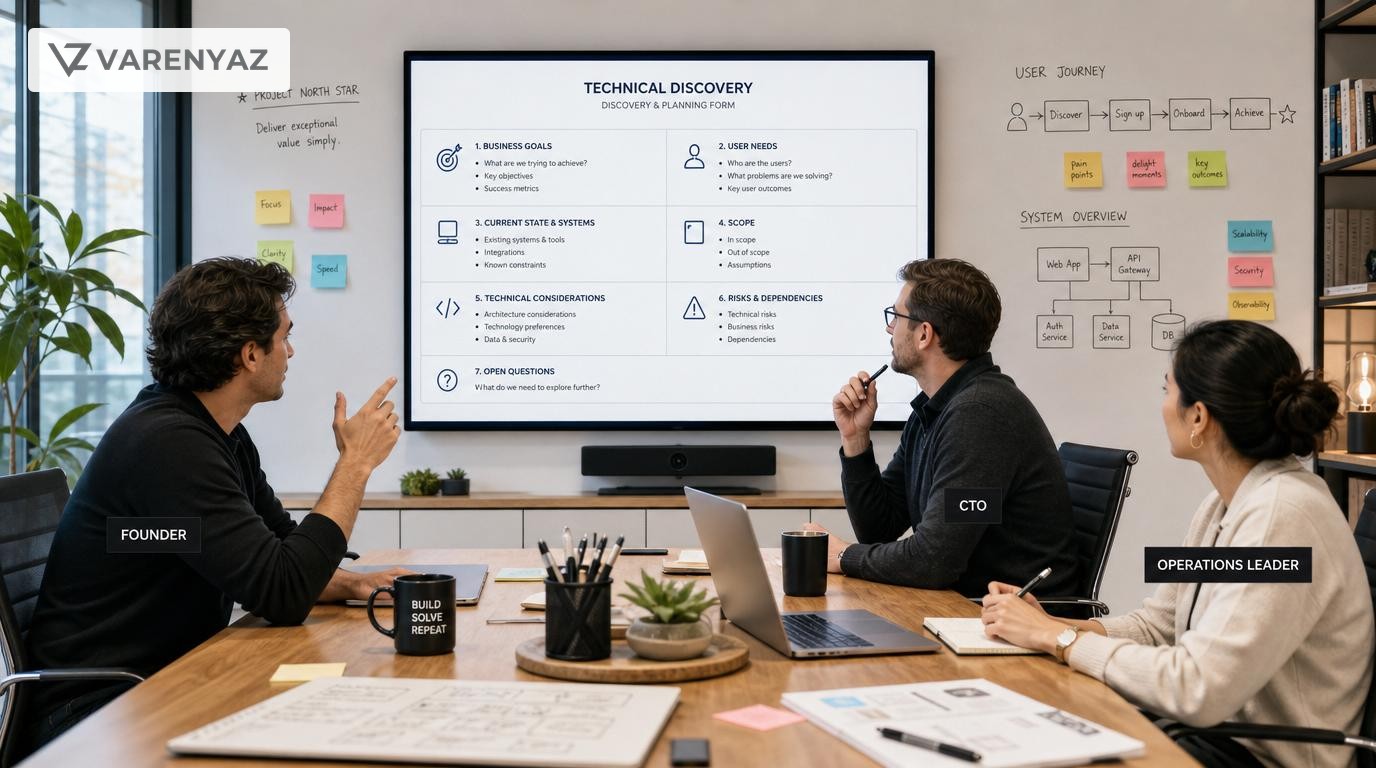
Guide details
- Type
- pillar
- Cluster
- App development planning
- Reviewed by
- VarenyaZ Editorial Desk
Direct answer
What you need to know
A strong technical discovery form for modern businesses captures business goals, user needs, current systems and data, feature priorities, non-functional requirements, risks, compliance, budget, and timeline. It should be structured so non-technical stakeholders can answer clearly while still giving engineers enough detail to estimate effort, choose the right architecture, and flag constraints early. Done well, it becomes a shared source of truth for scope, tradeoffs, and decision-making before you commit serious time or budget.
Key takeaways
- A technical discovery form is a structured way to turn vague ideas into a scoping-ready brief.
- You must capture business outcomes, not just features, to guide tradeoffs and prioritization.
- Include current systems, data flows, and integrations so engineers can plan realistic architectures.
- Non-functional requirements like security, performance, and scalability heavily influence cost.
- Budget ranges and timeline constraints should be explicit and tied to scope flexibility.
- Use the form to surface risks, assumptions, and dependencies before committing to a build.
- Keep language business-friendly while allowing optional technical depth for expert stakeholders.
- Bring in technical help for architecture choices, compliance-heavy projects, and complex integrations.
What a Technical Discovery Form Is Trying to Achieve
Before you design a technical discovery form, you need clarity on what it is for. In modern businesses, discovery forms sit between a loose idea ("we need an app") and serious investment (contracts, timelines, engineering hours). Done well, it becomes a structured conversation and a reusable artifact.
At a minimum, your technical discovery form should help you:
- Translate business ideas into scoping-ready requirements so engineering can estimate and plan realistically.
- Align stakeholders (founders, product, operations, marketing, finance, IT) on the same set of facts and priorities.
- Identify risks and constraints early enough to adjust scope, budget, or timelines.
- Support vendor or partner selection by giving potential partners a consistent, comparable brief.
- Prevent rework and surprises by capturing expectations up front rather than discovering them mid-build.
Think of the form as a decision enabler, not an administrative hurdle. It should be detailed enough to inform architecture options and budget ranges, but simple enough that non-technical stakeholders can complete it without friction.
Why a Strong Discovery Form Matters in Modern App Development Planning
Modern app development planning is more complex than just picking a tech stack. Your choices are constrained by security, privacy, data flows, integrations, scalability, and the operating model of your business.
A robust technical discovery form matters because it:
- Directly influences cost and feasibility: Missing just one major integration or non-functional requirement can double effort later.
- Protects you from scope creep: When requirements are vague, every stakeholder adds "just one more thing" mid-project.
- Improves vendor relationships: Clear, structured discovery reduces misunderstandings and change orders.
- Supports compliance and risk management: Security and privacy requirements (for example, aligned with frameworks like ISO/IEC 27001 or the NIST Privacy Framework) should shape architecture from day one, not as an afterthought.
- Faster internal alignment: Finance needs budget clarity, marketing needs launch horizons, operations needs process impact; the form creates a common reference point.
Without a disciplined discovery step, projects often fall into one of two traps: over-specified too early (rigid and unrealistic) or under-specified (leading to endless revisions and cost overruns). Your form helps you strike the right balance.
Core Sections to Include in a Technical Discovery Form
While every business is different, most modern app projects benefit from a common structure. Below is a practical blueprint for what to include in a technical discovery form for modern businesses, broken into sections and the kinds of questions you should cover.
1. Project Overview and Context
This section sets the stage. It should be answerable by a business sponsor or product owner without any technical jargon.
- Working project name: A simple label everyone can use.
- Project sponsor: Who owns the outcome and budget?
- Product owner or main contact: Who is responsible for day-to-day decisions?
- Elevator pitch: One or two sentences describing what you are building and for whom.
- Business drivers: Why now? Examples: reduce manual work, open a new revenue stream, improve customer retention, meet compliance requirements.
- Background: Any previous attempts, pilot projects, or legacy systems being replaced.
Implementation tip: Offer short example answers in this section so non-technical stakeholders feel comfortable and give complete information.
2. Business Objectives and Success Metrics
Projects fail when teams forget what success looks like. Use the form to make outcomes explicit.
- Primary business goals: Select or describe the top 1–3 outcomes (e.g., reduce onboarding time by 50%, increase self-service sign-ups, cut support tickets).
- Secondary goals: Helpful but not critical outcomes (e.g., improve executive reporting, modernize brand experience).
- How success will be measured: Inputs for KPIs or metrics. For example: conversion rate, processing time, error rate, NPS, monthly active users.
- Time horizon for impact: When do you expect to see results (quarter, year)?
Encourage teams to rank objectives. When tradeoffs arise (for example, speed vs. rich functionality), priorities should be clear.
3. Users and Stakeholders
Good app development planning always starts with the people who will use or be impacted by the product.
- Primary user groups: Who will use the system directly? Examples: customers, internal operations staff, field sales reps, partners.
- Secondary stakeholders: Who is affected indirectly? Examples: finance, compliance, HR, customer support, IT support.
- Top 3 jobs or tasks for each primary user group: What must they be able to do quickly and reliably?
- Usage context: Desktop vs. mobile, online vs. offline, in-office vs. field, frequency of use.
- Accessibility considerations: Any known requirements (screen readers, high contrast, keyboard navigation) or corporate accessibility commitments.
Implementation tip: Use plain language prompts like "What are the most important things this user needs to achieve in the app?" instead of "List functional requirements" for better answers.
4. Current Processes, Systems, and Data
This section grounds your project in reality. Engineers need to understand what exists today to assess complexity, integration needs, and data strategy.
- Current process description: How is the problem handled today (manual workflows, spreadsheets, legacy tools)?
- Existing systems involved: For example: CRM, ERP, marketing automation, data warehouse, payment gateways, identity providers (SSO), ticketing systems.
- Data sources and destinations: Where does critical data originate? Where does it need to end up? (e.g., customer profiles, transactions, content, telemetry).
- Data formats and quality: Known data quality issues, formats (CSV, JSON, databases), and any migration needs.
- Existing APIs or integrations: Which systems already have APIs or integration points? Are there vendor constraints?
- Known pain points: Bottlenecks, error-prone steps, compliance issues, or customer complaints in the current process.
This information influences architecture design, integration effort, and sometimes whether the project is even viable on the desired timeline.
5. Functional Requirements (What the App Should Do)
Functional requirements describe what the system should enable. The goal in the discovery form is not to create a perfect specification, but to capture enough clarity to estimate and sequence work.
- Core use cases or features: Ask for a prioritized list of the most important things the system must support. Encourage bullet points, not essays.
- MVP vs. later phases: For each item, ask whether it is required for a first release (MVP) or can wait for a later phase.
- Key workflows: For 2–3 critical journeys (e.g., client onboarding, order placement, support case resolution), ask for a high-level step sequence.
- Role-specific functionality: Are there different permissions, views, or functions by role (admin vs. regular user vs. manager)?
- Content and configuration: What needs to be editable without engineering (copy, pricing, rules, forms, templates)?
Implementation tip: Include simple examples like "As a field agent, I can capture a new order offline and sync once I have a connection" to guide good requirements statements.
6. Non-Functional Requirements (How the App Should Behave)
Non-functional requirements are often the silent cost drivers. Standards like ISO/IEC 25010 highlight the importance of qualities such as performance, reliability, security, and usability, which have major architectural implications.
- Performance expectations: Typical and peak usage, response time expectations, batch processing windows.
- Scalability needs: Expected growth, geographic distribution of users, multi-tenant vs. single-tenant needs.
- Availability and reliability: Acceptable downtime, maintenance windows, disaster recovery needs, RTO/RPO if known.
- Security posture: Sensitivity of data, required authentication methods (SSO, MFA), access control models, alignment with frameworks such as ISO/IEC 27001 or OWASP ASVS for application security.
- Privacy and data protection: Types of personal data processed, retention needs, cross-border transfer considerations, internal privacy policies or frameworks (e.g., alignment with the NIST Privacy Framework).
- Compliance constraints: Industry or regional regulations to consider (e.g., financial regulations, healthcare privacy rules, sector-specific standards).
- Usability and accessibility expectations: Internal standards, target devices, language and localization needs.
Where stakeholders can’t answer precisely, give them ranges or scenarios. For example, "Is this app business-critical if unavailable for 2 hours? 1 day?" to guide realistic expectations.
7. Integration and Architecture Considerations
Most modern apps live within an ecosystem of systems and services. Even if your business users cannot choose architectures, the form should surface integration points and preferences.
- Systems that must integrate: For each system, ask why integration is needed and what data must flow.
- Direction of data flows: One-way vs. two-way, real-time vs. batch.
- Event-driven needs: Does the system need to react to events (e.g., order placed, ticket reopened) or publish events to others?
- Identity and access: Requirements for SSO, identity providers, role management, or customer identity.
- Technology constraints or preferences: Any mandated platforms, languages, or cloud providers; any forbidden technologies.
- Hosting and environment: Cloud vs. on-premises, data residency preferences, staging vs. production environments.
This section is where you may explicitly invite technical input. Non-technical users can describe needs, while architects or engineers can interpret them later.
8. Data Model and Reporting Needs
Ignoring data at discovery is a common and expensive mistake. Even a high-level view helps enormously.
- Key data entities: For example: customer, order, subscription, asset, ticket, case, product.
- Relationships between entities: High-level descriptions (e.g., a customer can have multiple subscriptions).
- Data lifecycle: Creation, update, deletion, archival. Are there legal or business retention requirements?
- Reporting and analytics: What reports, dashboards, or KPIs are essential? Who needs them and how often?
- Self-service data needs: Will business users need ad hoc queries, exports, or self-service analytics?
Ask for "must have" vs. "nice to have" reporting to avoid overbuilding analytics in an MVP.
9. Budget, Timeline, and Scope Flexibility
Business and finance stakeholders care deeply about this section. Technical discovery without budget signals can lead to unrealistic proposals on both sides.
- Budget range: Provide ranges (e.g., up to a certain threshold, mid-range, higher investment) rather than forcing a single number. This allows technical teams to suggest scope that fits.
- Commercial model preferences: One-time project, retainer, subscription, or hybrid; internal build vs. external vendor vs. mixed.
- Timeline drivers: Fixed dates such as regulatory deadlines, contractual commitments, marketing campaigns, or seasonal peaks.
- Desired milestones: MVP target date, pilot, general availability, and any internal decision gates.
- Scope flexibility: Which dimensions are most flexible: features, budget, or date? Rank them to guide tradeoffs.
Being open about budget and constraints does not weaken your negotiating position; it enables realistic planning and prevents wasted effort on proposals you will never approve.
10. Risks, Assumptions, and Dependencies
No discovery form is complete without a space to capture uncertainty. Risks handled early are far cheaper to manage than surprises uncovered late.
- Known risks: For example, potential regulatory changes, reliance on a single vendor, skills gaps, or change management challenges.
- Assumptions: Things you are treating as true without full verification (e.g., a third-party API will support required functions, data will be cleaned before migration).
- Dependencies: Internal projects, vendor decisions, data migrations, or policy changes that must happen for this project to succeed.
- Risk tolerance: Appetite for experimentation, phased releases, or rollbacks.
Implementation tip: Prompt contributors with questions like "What worries you most about this project?" to surface practical concerns that may not sound "technical" but are critical.
11. Governance, Ownership, and Support
Modern businesses must think beyond launch. Your discovery form should clarify how the app or system will live over time.
- Product ownership: Who owns the roadmap after launch?
- Change management: Who approves changes and prioritizes enhancements?
- Support model: Who will handle user support, incident response, and operational monitoring?
- Training needs: Are training materials, knowledge bases, or onboarding sessions required?
- Documentation expectations: Level of technical and user documentation expected at each stage.
Including this section signals that the project is not just a build, but an ongoing product with lifecycle responsibilities.
Structuring the Form for Business Readability and Technical Depth
Even the best content fails if your form is hard to use. Good structure respects both business and technical contributors.
Keep the Main Flow Business-Friendly
Design the form so a non-technical sponsor can move through the main sections without getting lost in jargon.
- Use plain language headings: "Who will use this system?" instead of "User personas".
- Ask "how" and "why" questions more than "which technology" questions.
- Provide examples and optional hints for complex questions.
- Group questions logically: business first, then users, then systems, then requirements, then constraints.
Add Optional Technical Subsections
For organizations with strong internal technical teams, include optional subsections where architects, security leads, or data teams can add depth.
- "Technical notes" under integration or architecture sections.
- Optional fields for preferred design patterns, tech stacks, or cloud services.
- Security team notes referencing internal standards (for example, mapping to OWASP ASVS levels or information security controls inspired by ISO/IEC 27001).
This layered approach keeps the form usable while still providing enough detail for serious engineering planning.
Common Mistakes to Avoid When Designing a Technical Discovery Form
A well-intentioned form can still lead you astray. Here are high-impact mistakes to watch for.
1. Focusing Only on Features
Many forms over-emphasize "what screens or features do you want?" and neglect why they matter, who they are for, and how they fit into existing systems. This leads to over-scoped wish lists that don’t align with budget or strategy.
2. Ignoring Non-Functional Requirements
Security, performance, scalability, and availability shape architecture as much as any feature. If your form doesn't capture them, teams will default to assumptions. Referencing quality characteristics similar to those defined in frameworks like ISO/IEC 25010 can remind stakeholders to think beyond just functionality.
3. Leaving Out Data and Integration Questions
Data migrations and integrations are often where costs and delays appear. A form that doesn't ask what systems must connect, or what data must move, invites surprises later in the project.
4. Hiding Budget and Timeline Constraints
When business sponsors avoid revealing budget or timelines, developers may propose solutions that far exceed what is feasible, wasting time and eroding trust. Ask for ranges, not exact numbers, to reduce this friction.
5. Using Jargon That Stakeholders Don’t Understand
Overly technical language leads to incomplete or inaccurate answers. If a question requires a specialist, mark it clearly and assign it to that role rather than forcing business stakeholders to guess.
6. Treating the Form as a Contract Instead of a Conversation
Your discovery form is a starting point, not a binding agreement. Overly rigid forms discourage discussion and iteration. Allow for notes, questions, and "unknown" answers that can be revisited.
When to Bring in Technical Help
Business leaders should not be expected to answer every technical detail. Knowing when to pull in specialists is part of effective app development planning.
Situations That Call for Early Technical Involvement
- Complex or critical integrations: Especially with core systems like ERP, CRM, finance, or identity.
- Sensitive or regulated data: Projects handling financial, health, or other sensitive personal information where alignment to recognized security and privacy frameworks is important.
- High-scale or high-availability needs: Customer-facing products where downtime or slow performance directly impacts revenue or reputation.
- Unclear feasibility: When business ideas rely on unproven technology or third-party capabilities that are not fully understood.
- Multi-region or multi-tenant architectures: When data residency, segregation, or complex tenancy models are required.
Which Technical Roles to Involve
Depending on your organization, different experts may be needed:
- Solution or enterprise architect: To translate business goals and constraints into feasible architecture options.
- Security or privacy lead: To ensure security, privacy, and compliance requirements are correctly identified and prioritized.
- Data architect or engineer: For complex data models, migrations, or analytics requirements.
- DevOps or platform engineer: Where deployment, scaling, and observability will be challenging or business-critical.
Even a short workshop with these experts, guided by your discovery form, can dramatically improve the quality of your app development planning.
Practical Steps to Implement Your Own Technical Discovery Form
Designing a discovery form is itself a small project. Here is a pragmatic approach you can follow.
Step 1: Define Purpose and Audience
Clarify what decisions the form should enable (for example, funding approval, vendor selection, internal scoping) and who will complete it. This determines the level of detail and terminology you use.
Step 2: Start from the Core Sections
Use the core sections in this guide as your baseline: project overview, objectives, users, systems, functional and non-functional requirements, data, integrations, budget, risks, and governance. Remove or combine sections that are not relevant to your organization, but be slow to delete anything related to data, security, or integrations.
Step 3: Draft Business-Friendly Questions
For each section, write simple prompts that focus on outcomes and context. Add examples or answer guidelines where stakeholders commonly struggle, such as describing current processes or estimating usage volumes.
Step 4: Add Optional Technical Fields
Under each relevant section, include optional technical notes fields marked for architects, security, or data specialists. This ensures the form can serve both business and technical planning without overwhelming non-technical users.
Step 5: Pilot on a Real or Hypothetical Project
Test your draft form on one current or recent project. Observe where stakeholders get stuck, skip questions, or provide vague answers. Collect feedback from business sponsors and technical leads on what was most and least useful.
Step 6: Refine, Then Standardize
Based on the pilot, refine your wording, reorder sections for flow, and remove redundant or low-value questions. Once refined, standardize your discovery process by making the form a required input for new app or system projects above a certain size or risk level.
Step 7: Align on How the Form Will Be Used
Clarify in writing:
- Who owns filling out each section.
- How the form feeds into estimation, architecture decisions, and approvals.
- How changes to the form (and thus to scope) are tracked as the project evolves.
This turns the form from a document into a repeatable part of your governance and app development planning.
Checklist: Have You Included the Right Elements?
Use this quick checklist to sanity-check your technical discovery form before rolling it out.
- Have you clearly captured business goals and success metrics?
- Does the form identify primary users, their top tasks, and usage context?
- Are current processes, systems, and data flows described in enough detail?
- Are functional requirements separated into MVP and later phases?
- Do you explicitly ask about performance, scalability, security, privacy, and availability expectations?
- Have you listed required integrations and any technology or vendor constraints?
- Is there a section for data entities, reporting, and analytics needs?
- Are budget ranges and timeline drivers captured transparently?
- Does the form surface risks, assumptions, and dependencies?
- Is there clarity on ownership, governance, and support after launch?
- Is the language accessible to non-technical stakeholders, with options for deeper technical detail?
Using Your Discovery Form to Make Better Decisions
Once you have a well-designed technical discovery form, the next step is to use it as a living tool, not shelfware.
- Kick-off workshops: Use the completed form as the agenda for cross-functional workshops where questions and assumptions are challenged.
- Vendor briefs: Share a sanitized version with potential implementation partners so their proposals are aligned and comparable.
- Prioritization and roadmap: Use MVP vs. later-phase fields to shape phased release plans.
- Risk reviews: Revisit the risks and assumptions section at each major milestone; update and adjust scope or design as needed.
- Post-project learning: After launch, compare what was captured in discovery with actual outcomes to refine your form for future projects.
When consistently applied, a strong discovery form becomes a quiet but powerful asset: projects start clearer, teams argue less about scope, and your app development planning becomes faster and less risky over time.
Next Step: Turn This Blueprint Into Your Standard
Designing and operationalizing the right technical discovery form for your context can transform how you plan and deliver digital products. If you want help tailoring this blueprint to your organization, aligning stakeholders, or using discovery to de-risk a specific app initiative, speak with the VarenyaZ team at https://varenyaz.com/contact/.
Practical checklist
- Have we clearly stated the business outcomes and success metrics?
- Does the form capture key user groups and their top jobs or tasks?
- Have we listed current systems, data sources, and required integrations?
- Are core features and nice-to-haves separated and prioritized?
- Have we documented security, privacy, performance, and scalability needs?
- Is budget addressed in realistic ranges tied to scope flexibility?
- Have we identified timeline drivers, milestones, and constraints?
- Are known risks, assumptions, and dependencies clearly captured?
- Is the language understandable to non-technical stakeholders?
- Has a technical expert reviewed the form for completeness?
Frequently asked questions
What is a technical discovery form in app development planning?
A technical discovery form is a structured questionnaire used at the start of a digital or app project to collect essential information about business goals, users, current systems, requirements, constraints, and risks. It gives product, business, and engineering teams a shared baseline for scoping, estimating, and planning the solution before committing significant budget.
Who should complete a technical discovery form in a modern business?
Ideally, the form is completed collaboratively by a business sponsor, product owner, and someone with technical context such as a CTO, engineering lead, or trusted external partner. Operations, marketing, and data or security stakeholders should contribute to relevant sections so the form reflects the full business and technology picture.
How detailed should a technical discovery form be?
It should be detailed enough to support initial solution options and ballpark estimates, but not so granular that it becomes a full specification. The goal is to capture clear objectives, priorities, constraints, and known requirements, while leaving room for deeper discovery and refinement once a direction and budget are agreed.
What are common mistakes when designing a technical discovery form?
Common mistakes include focusing only on features, ignoring non-functional needs like security and performance, skipping data and integration questions, hiding budget expectations, and using overly technical language that business stakeholders cannot answer accurately. Another frequent issue is treating the form as a legal contract instead of a living, collaborative planning tool.
When should we bring in technical experts for the discovery form?
Bring in technical experts whenever your project involves complex integrations, sensitive or regulated data, strict security or compliance requirements, or ambitions for significant scale. Architects or senior engineers can help interpret business answers, spot gaps, and translate them into realistic solution options before you lock in scope, budget, or vendor contracts.
Sources
- ISO/IEC 25010:2011 Systems and software engineering — Systems and software Quality Requirements and Evaluation (SQuaRE)
- NIST Privacy Framework: A Tool for Improving Privacy Through Enterprise Risk Management
- OWASP Application Security Verification Standard (ASVS)
- ISO/IEC 27001 Information Security Management
Related terms
Related guides
VarenyaZ support
Need help turning this guide into a working product, website, or AI system?
VarenyaZ helps teams plan, design, build, automate, and improve web apps, mobile apps, AI workflows, and digital growth systems.
Talk to VarenyaZ