
Securely Preparing Access for a Modern Development Team
A practical, step-by-step checklist to prepare secure, least-privilege access for internal and external development teams, reducing risk while enabling fast delivery.
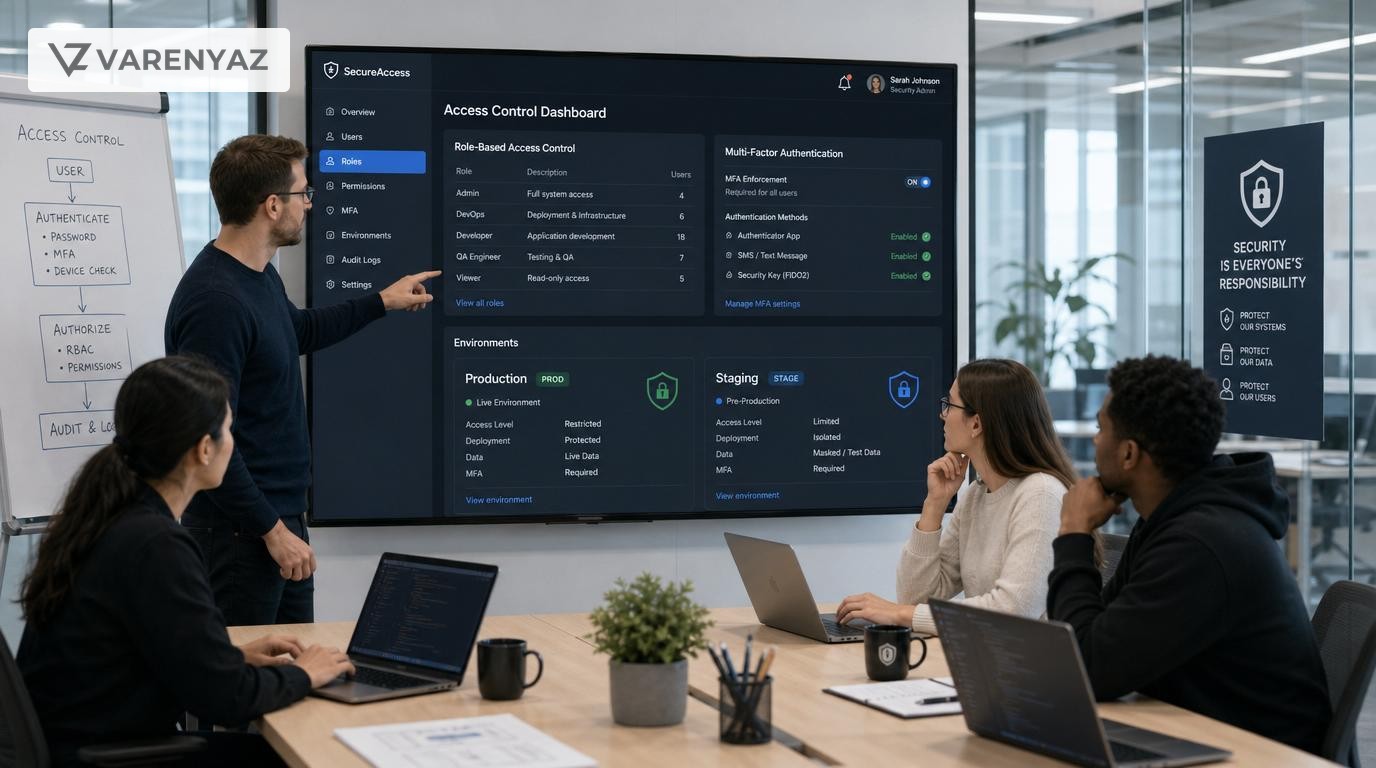
Guide details
- Type
- checklist
- Cluster
- Security and privacy basics
- Reviewed by
- VarenyaZ Editorial Desk
Direct answer
What you need to know
To securely prepare access for a development team in a modern business, you should map exactly what the team must do, classify your data and environments, and then grant access using the principle of least privilege. Centralise identity and access management, separate production from non-production, issue short-lived credentials, and log all activity. Use standard practices like MFA, role-based access, secure secrets handling, and vendor onboarding playbooks. Involve security or external experts when creating your first access model, integrating SSO, or handling regulated or sensitive data to avoid avoidable risk and rework.
Key takeaways
- Define what developers must do before deciding what they can access.
- Separate production and non-production environments with stricter controls on production.
- Use centralised identity, MFA, and role-based access as non-negotiable foundations.
- Grant least-privilege, time-bound access and log all changes to critical systems.
- Treat agencies and contractors as high-risk identities with clear onboarding and offboarding.
- Avoid sharing passwords, personal accounts, and unmanaged devices for business systems.
- Bring in security or DevOps experts when handling regulated data or complex infrastructure.
- Maintain a living access inventory and review developer access regularly.
What you are really trying to achieve when you give developers access
When you invite a development team into your business—whether they are employees, contractors, or an external agency—you are doing two things at once:
- Enabling them to deliver features, fixes, integrations, or new products.
- Exposing your systems and data to new people, devices, and tools.
This guide focuses on how to prepare access for a development team securely for modern businesses: giving them what they need to work effectively, while reducing the risk of outages, data leaks, compliance issues, or lock-in to any one vendor or person.
Done well, secure developer access will:
- Reduce the chance that a mistake in production causes a business-critical outage.
- Limit the damage if an account is compromised or a developer leaves.
- Make audits, security reviews, and due diligence easier and faster.
- Help you scale teams and vendors without constantly reinventing access rules.
The rest of this guide is a practical, business-focused checklist you can use with your CTO, operations, and external partners to design secure, modern access.
Core principles for secure developer access in modern businesses
Before diving into the checklist, anchor your decisions on a few widely accepted security and privacy basics:
- Least privilege: Give each person the minimum access needed to perform their work—no more, no less.
- Separation of environments: Keep development, test, staging, and production environments logically and, where possible, technically separate.
- Strong identity: Every human and machine access should be uniquely identifiable, authenticated, and attributable.
- Defense in depth: Combine multiple controls (identity, network, logging, approvals) so that one failure doesn’t expose everything.
- Lifecycle thinking: Plan for onboarding, day-to-day changes, and offboarding from day one.
These concepts are consistent with widely referenced frameworks like NIST SP 800-53 and OWASP access control guidance, which emphasise least privilege, identity, and access lifecycle management as foundational controls.
Step 1: Clarify what your development team must actually do
Secure access starts with clarity about responsibilities. Most mistakes happen because access is granted for vague reasons (“just in case”, “for convenience”) instead of specific tasks.
Define responsibilities and tasks
Work with your CTO, product, or vendor lead to answer these questions:
- Scope of work: What concrete outcomes is the team responsible for? (e.g., building a new web app, maintaining an existing platform, integrating a payment gateway).
- Operational duties: Will they handle on-call, incident response, or only planned work?
- Data access: Do they need real customer data, or can they work with test data?
- Change rights: Are they allowed to deploy to production, or only to non-production environments?
- Tooling: Which tools must they interact with (code hosting, CI/CD, cloud console, analytics, CRM, etc.)?
Document these in a short, plain-language access brief. This will become your reference point for deciding what access is necessary.
Decide who owns access decisions
Assign clear ownership so access is not granted informally over chat or email:
- Business owner: Approves what the team is allowed to do and which systems they can touch.
- Technical owner: Designs and implements the access model (CTO, DevOps lead, or trusted partner).
- Security/governance owner: Reviews high-risk access (e.g., production, financial data) and ensures it aligns with company policy.
In small companies, one person may wear all three hats, but they should still follow an explicit process.
Step 2: Classify systems and data before granting access
You cannot sensibly decide access without understanding the sensitivity of what you are protecting. A lightweight classification helps you decide where you can be flexible and where you must be strict.
Create a simple classification model
You do not need a complex framework; start with three categories:
- High sensitivity: Production systems, customer data, payment flows, critical integrations, core intellectual property.
- Medium sensitivity: Staging and pre-production environments, internal dashboards, analytics without direct identifiers, internal tools.
- Low sensitivity: Local development setups, demo environments with fake data, public websites without admin access.
Mark each system your developers might touch with one of these categories. Use this to drive:
- Which environments external developers can access directly.
- Where multi-factor authentication (MFA) is mandatory (hint: anything high or medium).
- Where you allow only read access vs. read-write vs. admin.
Separate production from non-production
Modern security guidance, including NIST and OWASP, emphasises environment separation as a key control. For developer access, this means:
- Different credentials for production and non-production.
- Different access levels: Developers often have broad rights in non-production but restricted, controlled access to production.
- Clear labelling in your tools (e.g., repository names, cloud accounts, dashboards) so nobody accidentally changes the wrong environment.
As a business leader, push for a default rule: routine work happens in non-production; production access is exceptional, time-bound, and audited.
Step 3: Design roles and least-privilege access profiles
Random, one-off permissions quickly become unmanageable. Instead, design a small set of roles that reflect how your teams work and the sensitivity of your systems.
Define role types
For many organisations, you can start with a simple model:
- Developer (non-production): Full access to code, non-production environments, and logs; no direct changes to production.
- Developer (with production access): As above, plus limited production access for troubleshooting under additional controls.
- DevOps/Platform engineer: Manage infrastructure, CI/CD, and monitoring; stricter approvals for production changes.
- Read-only observer: Can see dashboards, logs, or code but cannot change or deploy.
- Vendor developer: Scoped as tightly as possible to the project and environment, often non-production only.
Tune these roles to your context, but keep the number small and consistent across tools where possible.
Map roles to concrete permissions
For each role, define what that means in your key systems:
- Code repository: Which repos? Can they create branches, merge, or administer settings?
- CI/CD: Can they trigger builds, change pipelines, or manage secrets?
- Cloud or hosting: Which accounts or resource groups? Create or modify infrastructure? View logs?
- Databases: Read-only vs. read-write; which schemas or tables?
- Admin consoles (e.g., CMS, CRM, analytics): Which tenants or projects? Config vs. data access?
Where possible, use the platform’s built-in role-based access control (RBAC) features rather than custom ad hoc permissions.
Decide on just-in-time vs. standing access
For high-risk permissions, consider just-in-time (JIT) access, where developers request elevated rights for a limited time and specific purpose. This can be manual or tool-assisted, but the principle is:
- Default: No permanent admin rights to production.
- Exception: Temporary elevation with approval and logging when needed for an incident or deployment.
For many small teams, this may be as simple as a documented approval process combined with time-limited credentials.
Step 4: Centralise identity, SSO, and multi-factor authentication
Identity is the foundation of secure access. If you get it wrong, it becomes impossible to audit who did what or react quickly when someone leaves.
Use a central identity provider
Wherever feasible, integrate your core systems with a central identity and access management (IAM) solution or single sign-on (SSO) platform. This gives you:
- One place to create, update, and deactivate user accounts.
- Consistent application of MFA policies.
- Easier application of role-based access and group-based permissions.
At a minimum, connect your:
- Code hosting platform.
- Cloud providers and hosting platforms.
- Key admin consoles (CMS, CRM, analytics, payment portals).
- Secrets management and CI/CD tools.
Enforce multi-factor authentication (MFA) on critical systems
MFA is now considered a baseline control for any high- or medium-sensitivity system. NIST and other security bodies highlight it as one of the highest-impact defences against account compromise.
Make MFA mandatory for:
- Cloud infrastructure and hosting consoles.
- Code hosting and CI/CD tools.
- Production databases and admin dashboards.
- Any system holding customer or financial data.
Ensure your external vendors are subject to the same MFA requirements through your identity provider or directly in the tools they use.
Step 5: Secure code repositories and CI/CD pipelines
Your source code and deployment pipelines are high-value targets. If attackers or unauthorised users compromise them, they can introduce malicious code or cause outages.
Protect source code access
Apply the same security and privacy basics to your code hosting platform:
- Organisation-level control: Developers must work within an organisation or company-owned workspace, not personal accounts.
- Least-privilege repo access: Grant access to only the repositories required for the project.
- Branch protections: Require reviews or approvals for main branches; restrict who can merge or force push.
- MFA enforcement: Enforce MFA for all organisation members and collaborators.
Make sure access to private repositories ends when people leave the project or company.
Secure CI/CD pipelines
CI/CD systems often hold credentials and have direct paths into production. Treat them as sensitive:
- Scoped access: Limit who can modify pipelines, deployment targets, and environment variables.
- Protected environments: Require approvals and, where possible, separate credentials for production deployments.
- Secret isolation: Store deployment keys, API tokens, and passwords in the CI/CD platform’s secure storage or a dedicated secrets manager, not in plain environment variables or config files.
Document who is allowed to trigger production deployments and under what conditions (e.g., only main branch, only after tests pass).
Step 6: Implement robust secrets management
Secrets—API keys, database passwords, SSH keys, certificates—are often where security and privacy basics break down. OWASP’s secrets management guidance highlights that many breaches trace back to poorly handled secrets.
Set rules for handling secrets
Adopt and communicate clear, non-negotiable rules:
- No secrets in source code repositories, even private ones.
- No secrets shared over email, chat screenshots, or unencrypted docs.
- No long-lived, shared credentials where individual access cannot be tracked.
Use a dedicated secrets manager
Work with your technical team to select and configure a secrets management approach that fits your scale and stack. Key expectations:
- Central storage for secrets used by apps, pipelines, and services.
- Fine-grained access control: Control which apps, services, or roles can read which secrets.
- Rotation processes: Ability to update secrets without code changes, with plans for regular rotation.
For external developers, provide project-specific, environment-limited credentials rather than giving them access to the entire secrets store whenever possible.
Plan for incident response involving secrets
Define in advance what happens if a secret is suspected to be leaked or misused:
- Immediate rotation of the affected secrets.
- Review of logs to understand what was accessed.
- Communication steps internally and, if needed, externally.
This planning greatly reduces response time if anything goes wrong.
Step 7: Build a structured onboarding and offboarding process
The most common access risk is not an advanced cyberattack; it is overlooked offboarding or uncontrolled permissions over time.
Onboarding: give access intentionally
Create a simple onboarding checklist that includes:
- Identity creation: Create company-controlled accounts for developers in your identity provider.
- Role assignment: Assign them to predefined roles and groups based on their responsibilities.
- MFA setup: Verify that MFA is enabled for all critical tools.
- Device requirements: Communicate minimum security expectations for the devices they use (updates, antivirus, disc encryption where appropriate).
- Training: Share concise, practical guidance on handling data, secrets, and production access.
For agencies and contractors, include contractual clauses on:
- How access will be provided and protected.
- Prohibitions on sharing accounts or bypassing security controls.
- Obligations to notify you of any suspected compromise.
Offboarding: remove access completely and quickly
Offboarding must be just as structured as onboarding. Your offboarding checklist should include:
- Disable central identity account: Immediately deactivate or suspend the user in your identity provider.
- Revoke tool access: Confirm removal from code hosting, cloud, CI/CD, admin consoles, and any third-party tools.
- Rotate shared secrets: If you had to share any secrets (preferably short-lived), rotate them at offboarding.
- Review long-lived tokens: Revoke personal access tokens, SSH keys, and API keys created for that user.
Make sure offboarding covers both internal job changes (e.g., developer moves to marketing) and external departures (contract ends, vendor replaced).
Step 8: Secure remote work and devices used by developers
Many development teams work remotely or from multiple locations. This expands the attack surface beyond your office network.
Clarify device and network expectations
Define minimum expectations for any device accessing your systems:
- Up-to-date operating system and security patches.
- Basic antivirus or endpoint protection where appropriate.
- Disc encryption for laptops that store or access sensitive data.
Whenever possible, prefer company-managed devices for full-time employees and clear requirements for contractor devices.
Secure remote access paths
For remote developers, consider:
- VPN or zero trust access to sensitive internal services and tools.
- MFA for remote access to any high-sensitivity environment.
- Browser-based access to some admin consoles to avoid storing credentials locally.
Ask vendors to document how their teams secure devices and networks used to access your systems, and include this in your vendor assessment.
Step 9: Log, monitor, and review access regularly
Even with good upfront controls, you need visibility into how access is used. This is both a security and an operational requirement.
Ensure logging is enabled for critical systems
Work with your technical team to confirm logging for:
- Authentication events (logins, MFA prompts, failed attempts).
- Permission changes (granting or revoking access, role changes).
- High-risk actions (deployments, configuration changes, data exports).
Logs should be retained for an appropriate period and accessible to those responsible for security, audits, and incident response.
Conduct regular access reviews
Schedule periodic reviews, such as quarterly, where you:
- Export lists of users and permissions from key systems.
- Check for inactive accounts or roles no longer needed.
- Verify that vendor accounts still correspond to active contracts and staff.
Some identity and access management tools can automate parts of this review process, but even manual reviews are better than none.
Step 10: Common mistakes to avoid when granting developer access
Even well-intentioned teams fall into predictable traps. Watch for these, and design your processes to avoid them.
1. Shared accounts and passwords
Problem: Multiple developers use a single admin account or generic login.
Risks: No individual accountability, harder to offboard, difficult to investigate incidents.
Better: Give every person a unique account with appropriate roles, and use group-based access where possible.
2. Permanent production admin rights
Problem: Developers or vendors have full production admin access by default.
Risks: Simple mistakes or compromised accounts can cause large outages or data breaches.
Better: Restrict production admin rights to a small group, use just-in-time access, and require approvals for changes with logging.
3. Over-reliance on personal accounts
Problem: Developers use personal email or accounts for code hosting, cloud, or admin consoles.
Risks: Loss of control when they leave, legal ambiguity over ownership, harder to enforce security policies.
Better: Use company-controlled accounts and organisations, even for contractors; remove access when the engagement ends.
4. Untracked access through third-party tools
Problem: An agency uses a separate tool stack and invites you into their systems, but also needs access to yours.
Risks: Fragmented logs and unclear visibility into who has access to what.
Better: Agree upfront which systems will be “source of truth”, and ensure that any access to your data or production flows through accounts you can audit and revoke.
5. No plan for vendor transitions
Problem: You change vendors but leave old accounts and keys active for “just in case”.
Risks: Former vendors retain access to code, data, or infrastructure.
Better: Treat vendor transitions as high-risk events: revoke access, rotate secrets, and document knowledge transfer before granting access to the new team.
When to bring in technical or security help
Not every organisation needs a full-time security team, but there are clear signals that you should involve a specialist—internal or external—when designing developer access.
Bring in expertise if any of these are true:
- You handle regulated data (e.g., health, payments, government-related data) or must comply with specific standards.
- Your infrastructure spans multiple cloud providers, data centres, or regions.
- You are planning a major scale-up of your engineering team or a shift to multiple external vendors.
- You are introducing SSO, identity governance, or complex RBAC for the first time.
- You have had a prior incident linked to access, such as a leaked key or unauthorised use of an admin account.
A good specialist will help you:
- Design a future-proof access model that can scale.
- Choose and configure appropriate identity and secrets management solutions.
- Align access controls with regulatory and contractual obligations.
- Set up monitoring and incident response processes related to access.
If you need support designing or reviewing secure developer access for your business, you can contact VarenyaZ at https://varenyaz.com/contact/.
Practical access-preparation checklist for modern development teams
Use this final checklist to review your current state or to plan secure access for a new development engagement.
Business and scope
- We have documented what the development team is responsible for delivering.
- We know which systems and data they truly need to access.
- We have a named business owner and technical owner for access decisions.
Classification and environment separation
- Systems and data are categorised as high, medium, or low sensitivity.
- Production and non-production environments are clearly separated.
- Production access is treated as exceptional and controlled.
Identity, SSO, and MFA
- All developers use individual, company-controlled accounts.
- A central identity provider or SSO solution is used wherever possible.
- MFA is enforced on all critical systems, especially code, cloud, and production.
Roles and permissions
- Roles are defined for developers, DevOps, read-only observers, and vendors.
- Roles are mapped to specific permissions in each major system.
- High-risk permissions use just-in-time access where possible.
Code, CI/CD, and secrets
- Code repositories are organisation-owned, with least-privilege repo access.
- Branch and deployment protections are in place for main/production branches.
- Secrets (API keys, passwords) are stored in a dedicated secrets manager.
- There are clear rules against sharing secrets via insecure channels.
Onboarding and offboarding
- We have a written onboarding checklist for internal developers and vendors.
- We have a written offboarding checklist that includes disabling accounts and rotating shared secrets.
- Vendor contracts specify access, security responsibilities, and offboarding requirements.
Remote access and devices
- Device security expectations are clearly communicated and, where possible, enforced.
- Remote access to sensitive systems uses VPN, zero trust, or equivalent controls with MFA.
- Vendors have documented how they secure devices used to access our systems.
Monitoring and review
- Logging is enabled for authentication, permission changes, and high-risk actions.
- We perform regular access reviews for critical systems.
- We have a plan for responding to suspected access misuse or credential leaks.
By following this structured, least-privilege approach, you can safely enable development teams—internal and external—to build and operate your digital products while maintaining strong control over your systems and data.
Practical checklist
- We have documented what the development team must do and which systems they need.
- Systems and data are classified by sensitivity, with production clearly separated from non-production.
- We use a central identity provider for all critical tools and systems.
- Multi-factor authentication is enforced for admin, cloud, code, and production access.
- Developers use company-controlled, named accounts rather than shared or personal accounts.
- Access is granted via least-privilege roles and, where possible, is time-bound.
- All code repositories and CI/CD tools are protected with MFA and organisation-level controls.
- API keys, passwords, and certificates are stored in a dedicated secrets manager.
- We have a documented onboarding checklist for internal developers and vendors.
- We have a documented offboarding checklist that is consistently followed.
- Remote access is secured through VPN, zero trust, or equivalent controls with MFA.
- We log and monitor production access and critical configuration changes.
- We review and update access rights for developers at least quarterly.
- Vendor contracts include security and access management responsibilities.
- There is a clear escalation path to security or DevOps experts for complex access needs.
Frequently asked questions
What is the safest way to give a development agency access to our systems?
First, define exactly what the agency must do and which systems they truly need. Create company-controlled accounts for them using your identity provider, enforce MFA, and assign least-privilege roles. Avoid sharing passwords or using personal emails. Restrict access to non-production where possible, require approval for any production access, and ensure all sessions and changes are logged. Document start and end dates in their contract and have a clear offboarding checklist for when the engagement ends.
Should developers ever have direct access to production?
In many modern setups, routine development work is done in non-production environments, and production changes are deployed via automated pipelines. However, some teams may need limited production access for incident response or troubleshooting. In those cases, use just-in-time access, strong MFA, granular roles, and session logging. Production access should be exceptional, time-bound, and auditable, not a default convenience.
How do we handle secrets like API keys and passwords for development teams?
Never store secrets in spreadsheets, chat, or source code. Use a dedicated secrets manager or secure key vault integrated with your cloud or CI/CD tools. Limit who can view or retrieve secrets, rotate them regularly, and remove access when people or vendors leave. For external developers, provide environment-scoped keys with minimal permissions and clear rotation procedures.
What access controls are mandatory for a small business working with developers?
Even small businesses should treat identity and access management seriously. At minimum, use unique accounts for each person, enforce MFA on all critical systems, centralise user lifecycle management through a core identity provider, and keep production and non-production separate. Have a basic onboarding and offboarding checklist for any developer or vendor, and review access for inactive or changed roles regularly.
When do we need a security or DevOps specialist to design developer access?
You should seek specialist help when you handle regulated data (such as health or payments), run complex cloud or multi-region infrastructure, or are planning to scale your team or vendors quickly. It is also smart to bring in expertise when introducing SSO, role-based access models, or secrets management platforms, as poor initial design can create security gaps and technical debt that are costly to fix later.
How often should we review development team access rights?
A good baseline is a quarterly access review for all critical systems, with additional reviews after role changes, project completions, or vendor offboarding. High-risk environments, such as production and data warehouses, may warrant monthly or event-driven reviews. Automating reports from your identity or access management tools can make these reviews much more manageable.
Sources
Related terms
Related guides
VarenyaZ support
Need help turning this guide into a working product, website, or AI system?
VarenyaZ helps teams plan, design, build, automate, and improve web apps, mobile apps, AI workflows, and digital growth systems.
Talk to VarenyaZ