
Legacy Modernization for Real Estate
Learn how real estate companies can modernize legacy systems safely, unlock data, and deliver digital experiences that match today’s market.

Quick Answer
Legacy modernization for real estate is the process of upgrading old property, leasing, and asset management systems so they can support today’s digital, data-driven business. It combines cloud migration, modular architectures, better data integration, and new digital experiences. Done well, it improves operational efficiency, automates manual workflows, unlocks portfolio-wide insights, and enables AI-powered decision-making—all without disrupting day-to-day leasing or property operations. This guide outlines the business case, patterns, risks, and a practical roadmap that real estate leaders can use.
In this article
Coverage signals
14 min
Jun 23, 2026
VarenyaZ Editorial Desk, Technical Content Review
Updated Jun 23, 2026
Key Takeaways
- Legacy modernization for real estate is about unlocking business value, not just upgrading technology.
- Start with customer and operations pain points, then map them to specific systems and data gaps.
- Combine patterns like rehosting, replatforming, refactoring, and strangler-fig to reduce risk and downtime.
- Invest in a unified data foundation so portfolio, leasing, and operations data can power analytics and AI.
- Treat modernization as a product: prioritize a roadmap, ship in releases, and measure business outcomes.
- Change management, training, and process redesign are as important as cloud architectures and APIs.
- A capable partner can accelerate UX redesign, integrations, and AI use cases while your teams run the business.
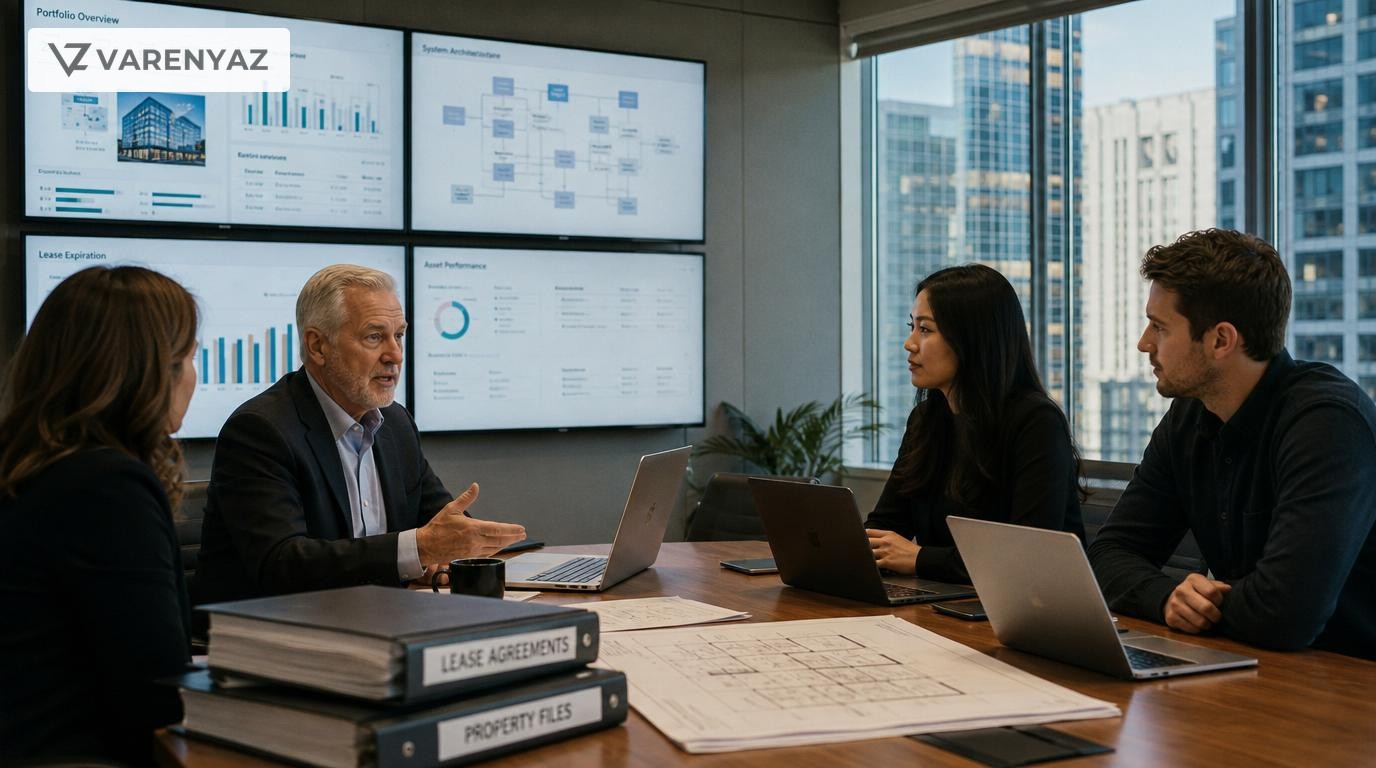
What Legacy Modernization Really Means for Real Estate
For many real estate companies, “modernization” still sounds like an expensive, risky IT project that distracts from leasing, occupancy, and NOI. But when you dig into why portfolios underperform, why tenant experiences lag, or why reporting takes weeks, the root cause is usually the same: legacy systems that were never designed for today’s digital, data-driven reality.
Legacy modernization for real estate is the intentional upgrade of these old platforms—property management systems, leasing CRMs, accounting tools, spreadsheets, and home-grown apps—so they can support modern workflows, analytics, and AI without disrupting day-to-day operations.
Done well, it’s less about ripping everything out, and more about building a flexible, future-ready foundation while your business keeps running.
Direct Answer: What Is Legacy Modernization for Real Estate?
Legacy modernization for real estate is the phased process of upgrading or replacing outdated property, leasing, and asset management systems with modern, cloud-ready, API-driven platforms that unlock data, automate manual work, support better digital experiences, and enable analytics and AI—while minimizing disruption to leasing and property operations.
Practically, it includes:
- Migrating on-premise or desktop tools to more stable, scalable cloud platforms.
- Unifying scattered property, lease, and financial data into a consistent model.
- Introducing modular, API-first architectures so new apps can plug in quickly.
- Redesigning user experiences for tenants, owners, and internal teams.
- Preparing the ground for AI-driven forecasting, automation, and insights.
Why Legacy Systems Hold Real Estate Back
Real estate businesses grew up on systems that prioritized stability and accounting accuracy—not speed, experimentation, or customer experience. Over time, that stability became a constraint.
Common Signs Your Stack Is Legacy
- Core systems older than 10–15 years, often heavily customized and difficult to upgrade.
- Reliance on spreadsheets for portfolio analysis, rent rolls, and investor reporting.
- Manual, paper-based workflows for leases, approvals, and maintenance requests.
- Data silos between leasing, property management, asset management, and finance.
- Limited or no APIs, making it hard to integrate new PropTech or AI tools.
- High vendor lock-in, where small changes require costly, slow vendor projects.
Business Impact of Staying Legacy
These technical symptoms translate directly into business friction:
- Slower leasing and approvals because processes rely on email, spreadsheets, and manual checks.
- Weak tenant experience with clunky portals, poor mobile support, or no self-service at all.
- Blind spots in portfolio performance due to inconsistent, delayed data.
- Inability to adopt new PropTech solutions that demand clean data and modern APIs.
- Higher operational risk from unsupported software, security gaps, and single points of failure.
In parallel, multiple industry studies highlight how digital and analytics are reshaping commercial real estate, from rent pricing and tenant retention to portfolio optimization. Firms that cannot plug into this data-driven ecosystem risk falling behind on returns and service quality.
The Business Case: Why Modernize Now?
Modernization is easy to postpone when systems are “still working.” But the opportunity cost of delay is rising quickly.
Tenants Expect Consumer-Grade Digital Experiences
Whether you manage offices, retail, logistics, or residential assets, tenants now expect:
- Mobile-first portals for payments, service requests, and communications.
- Real-time updates on issues, amenities, and building operations.
- Simplified digital leases and renewals with minimal paperwork.
Delivering this on top of rigid, closed legacy systems is extremely difficult. Modernization enables these experiences without building fragile, one-off workarounds.
Data and Analytics Drive Portfolio Value
Modern real estate performance isn’t just about location and occupancy; it’s about how you use data. Leading firms apply analytics to:
- Optimize pricing and concessions by asset, segment, and season.
- Identify underperforming properties earlier.
- Forecast capital expenditure and maintenance more accurately.
- Understand tenant behavior and churn risk.
Without a modern data foundation—where leasing, operations, and finance data can be combined and analyzed—these capabilities remain aspirational.
AI and Automation Are No Longer Optional
Artificial intelligence is reshaping how real estate firms forecast demand, prioritize leads, and manage maintenance. But AI systems need reliable, accessible data and modern integration points.
Legacy modernization sets the stage for AI use cases such as:
- Rent and occupancy forecasting across portfolios.
- Automated document processing for leases and contracts.
- Lead scoring and routing for leasing and sales.
- Smart maintenance scheduling based on equipment and usage data.
Key Modernization Patterns for Real Estate
Modernization is not one big switch. It is a set of patterns you apply selectively, based on your systems and risk appetite.
1. Rehost (Lift and Shift)
What it is: Moving applications from on-premise servers to cloud infrastructure with minimal code changes.
When it works:
- You need to stabilize performance and reduce hardware overhead quickly.
- Your application is relatively self-contained and not heavily integrated.
- You want to create a foundation for gradual refactoring later.
Tradeoffs: You gain some benefits (scalability, availability) but keep architectural constraints. It’s often a first step, not the final state.
2. Replatform
What it is: Moving to a new runtime or platform (e.g., managed databases, container platforms) while making moderate changes to improve scalability, security, or operations.
When it works:
- Your legacy system is broadly fit-for-purpose but costly to operate.
- You want to adopt managed services without rewriting everything.
- You’re preparing to expose APIs or gradually decouple modules.
Tradeoffs: Needs higher engineering investment than rehosting, but creates more options for future modernization.
3. Refactor and Modularize
What it is: Restructuring the code to be more modular, often moving toward a service-oriented or microservices architecture.
When it works:
- Your team has access to the source code and skills to refactor.
- Certain workflows (like leasing or maintenance) change frequently and need agility.
- You want to incrementally introduce new technology without big-bang replacement.
Tradeoffs: Requires strong engineering discipline, clear boundaries, and robust testing. Benefits include better scalability, faster change cycles, and easier integration with PropTech products.
4. Replace with SaaS
What it is: Retiring legacy systems and adopting modern SaaS products for specific functions like CRM, marketing automation, or maintenance management.
When it works:
- Your requirements are close to industry-standard best practices.
- You want to offload maintenance and upgrades to a vendor.
- The SaaS solution offers robust APIs for integration with your broader stack.
Tradeoffs: Lower control over roadmap and customization. Vendor lock-in and data portability must be considered carefully.
5. Strangler-Fig Pattern
What it is: Building new functionality around an existing system and gradually routing traffic away from the old components until they can be retired.
When it works:
- Your legacy system is deeply embedded but you cannot risk a full replacement.
- You need to modernize specific capabilities—like tenant portals or reporting—first.
- You can introduce an API or integration layer in front of the legacy system.
Tradeoffs: Requires careful integration design and governance. The benefit is significantly reduced risk and downtime compared with big-bang replacements.
Step 1: Start with Business Outcomes, Not Technology
Successful modernization programs start with a brutally honest business conversation: what outcomes matter most in the next 12–36 months?
Clarify the Business North Star
Typical modernization-linked goals in real estate include:
- Faster leasing cycles and higher conversion from leads to signed leases.
- Improved tenant satisfaction and retention through better digital experiences.
- More accurate and timely reporting for investors, lenders, and regulators.
- Lower operating expenses via automation and process standardization.
- Higher asset performance through data-informed decisions.
Pick two to three measurable outcomes to guide priorities. Tie every modernization initiative back to at least one of these.
Map Pain Points to Systems
Next, identify where the current stack blocks these outcomes. For example:
- Leasing teams re-enter prospect data into multiple systems.
- Maintenance requests are received via email instead of a unified portal.
- Investor reports are compiled manually from disparate data sources.
For each pain point, note the systems involved, data flows, and manual steps. This becomes your modernization backlog.
Step 2: Prioritize Use Cases and Scope
Trying to modernize everything at once is a guaranteed way to stall. Instead, prioritize scopes that are high-value but reasonably contained.
Prioritization Framework
Score each potential initiative on:
- Business impact: revenue, cost, or risk reduction potential.
- User impact: how many tenants, owners, or staff will benefit.
- Complexity: integration depth, data migration needs, vendor dependencies.
- Risk: downtime impact, compliance sensitivity, security implications.
Plot these initiatives on a simple matrix: high impact / low complexity projects become your early wins—ideal for building momentum and trust.
Example High-Value Starting Points
- Unified tenant portal: Consolidate payments, service requests, and communications into a modern web and mobile experience.
- Digital leasing workflow: Integrate marketing websites, CRM, e-signature, and core property systems.
- Portfolio analytics dashboard: Create a central view of rent rolls, occupancy, and key KPIs across assets.
Step 3: Design Your Target Architecture
Once priorities are clear, define a target architecture. The goal is not to specify every component, but to set guiding principles so each modernization project moves you in the same direction.
Principle 1: Cloud-First, Not Cloud-Only
Most real estate organizations benefit from a cloud-first strategy—leveraging major cloud providers for compute, storage, and managed services. But cloud-first doesn’t mean abandoning every on-premise system immediately. Use the cloud where it adds resilience, scalability, and innovation agility, while integrating with on-premise systems as needed during transition.
Principle 2: API-First Integrations
Modern real estate ecosystems rely on a mix of in-house applications and third-party PropTech products. An API-first approach ensures that:
- Data flows consistently between leasing, property management, and finance.
- New solutions can be added without rewriting the core.
- Mobile apps and portals can access functionality in a standardized way.
Design and document APIs as products in their own right—not as afterthoughts.
Principle 3: Unified Data Layer
At the heart of modernization is a unified data layer that brings together property, lease, tenant, financial, and operational data. That can take the form of:
- A data warehouse for structured reporting and BI.
- A data lake or lakehouse for semi-structured data like documents and IoT streams.
- Data pipelines that keep data synchronized and clean across systems.
This unified layer becomes the backbone for analytics dashboards, investor reporting, and AI initiatives.
Principle 4: Security and Compliance by Design
As you modernize, security and compliance must be designed in from the start:
- Apply role-based access control for sensitive financial and tenant data.
- Use encryption in transit and at rest.
- Align with regional data protection and real estate regulations (e.g., in India, the United States, and the United Kingdom).
Step 4: Data Migration and Integration Strategy
Data is where most modernization projects get complicated. Real estate data is often inconsistent, duplicated, and scattered across systems and spreadsheets.
Audit and Clean Your Data
Start with a data audit:
- List core entities: properties, units, tenants, leases, owners, vendors, contracts.
- Map where each entity exists today: systems, files, spreadsheets.
- Identify duplicates, inconsistencies, and missing attributes.
Then design standard definitions and business rules. For example, define what constitutes an active lease, how units are coded, and how often data must be updated.
Choose Migration Patterns
Depending on risk tolerance and system criticality, you can use:
- Big-bang migration: Move all relevant data at once and cut over to the new system on a specific date. Suitable for smaller scopes or non-critical functions.
- Phased migration: Move data asset by asset, segment by segment, or function by function, running old and new systems in parallel for a period.
- Event-driven synchronization: Use integration tools so updates in one system automatically sync to another via events or change data capture.
APIs and Integration Layer
To avoid point-to-point chaos, introduce an integration layer such as an API gateway or iPaaS platform. This layer can handle:
- Authentication and authorization between systems.
- Data transformation and mapping.
- Monitoring and logging of data flows.
In complex portfolios spanning India, the United States, and the United Kingdom, this approach ensures local systems can still feed a global data and analytics strategy.
Step 5: Experience Modernization – Web, Mobile, and Portals
The most visible part of modernization is the set of experiences tenants, owners, and teams use daily.
Modern Tenant and Resident Portals
A modern portal should provide:
- Self-service capabilities: payments, maintenance requests, documents, visitor passes.
- Real-time updates: status of requests, building notices, amenity bookings.
- Omnichannel access: responsive web and mobile apps.
Design UX and UI around actual tenant journeys, not internal system layouts. This often means building custom front-ends that talk to both legacy and new systems via APIs.
Owner and Investor Dashboards
Owners and investors expect concise, accurate, and timely views of portfolio performance. Modern dashboards can integrate:
- Occupancy, rent rolls, and collections.
- Capital and operating expenditure trends.
- ESG metrics and building performance data where relevant.
With a unified data layer, these dashboards can be updated near real-time instead of being monthly manual reports.
Internal Tools for Leasing and Operations
Frontline teams benefit from intuitive tools that streamline their work:
- Leasing workspaces that combine leads, tours, proposals, and approvals.
- Operations consoles consolidating tickets, vendors, and asset conditions.
- Document and workflow automation for approvals and compliance checks.
These internal tools are often where modernization delivers the fastest productivity gains.
Step 6: Enabling AI and Advanced Analytics
With modern systems and data foundations in place, you can responsibly introduce AI into your real estate operations.
High-Value AI Use Cases
- Forecasting and pricing: Predict occupancy, rent levels, and demand by submarket.
- Lead scoring: Prioritize inquiries more likely to convert or renew.
- Document intelligence: Extract key terms and risks from leases and contracts.
- Maintenance optimization: Predict equipment failures and prioritize work orders.
Prerequisites for AI Success
Before deploying AI models or LLM-powered assistants, ensure:
- Your data is reasonably clean, labeled, and accessible.
- Access controls are clear so AI tools see only what they should.
- There is human oversight for high-impact decisions.
This is where an AI development partner familiar with real estate data structures and workflows becomes particularly valuable.
Managing Risk: Governance, Change, and Vendor Strategy
Even the best architecture fails if governance and change management are weak.
Strong Program Governance
Establish a cross-functional modernization steering group that includes:
- Technology leaders (CTO/CIO or head of IT).
- Business owners (asset management, leasing, operations).
- Finance and risk/compliance representatives.
Give them clear authority to prioritize initiatives, resolve conflicts, and adjust scope as business conditions change.
Change Management and Training
For frontline staff and property teams, modernization can feel like disruption. Counter this with:
- Early involvement of users in design and testing.
- Clear documentation and in-context training within applications.
- Change champions in each region or major property.
Measure adoption, not just technical launch dates.
Vendor and Partner Strategy
Real estate ecosystems typically mix global platforms, local solutions, and custom builds. When selecting vendors or partners:
- Assess integration capabilities: APIs, webhooks, documentation quality.
- Review data ownership, export options, and lock-in risks.
- Align roadmaps with your modernization direction and timeframes.
A specialized modernization partner can orchestrate this ecosystem so core systems, SaaS tools, and custom apps work together coherently.
Geo Considerations: India, United States, United Kingdom
Modernization principles travel well, but implementation details differ across regions.
India
In India, rapid urbanization and a vibrant PropTech ecosystem create both opportunity and complexity. Legacy modernization must account for:
- Diverse asset types and ownership structures.
- Fast-changing regulatory and tax requirements.
- Mobile-first user expectations among tenants and brokers.
Cloud adoption is rising, but organizations may operate hybrid environments where some sensitive data remains on-premise.
United States
In the US, portfolios often span multiple states and product types. Modernization programs must navigate:
- Complex jurisdictional variations in regulations and taxes.
- Integration with established property management and accounting systems.
- High expectations from institutional investors for timely, accurate reporting.
Here, emphasis often falls on robust data governance and analytics across large, diversified portfolios.
United Kingdom
In the UK, modernization is frequently driven by:
- Pressure to meet ESG and sustainability reporting standards.
- Dense urban portfolios where tenant experience is a differentiator.
- Stringent data protection rules and cybersecurity considerations.
Organizations may prioritize integrated systems that combine building performance, occupancy, and financial data.
A Practical Roadmap for Legacy Modernization in Real Estate
To bring all these concepts together, here is a pragmatic sequence you can adapt:
- Discovery and vision: Align leadership on business outcomes, scope, and principles.
- Landscape assessment: Inventory systems, data flows, risks, and pain points.
- Target architecture blueprint: Define cloud, integration, and data strategy.
- Prioritized use cases: Select 2–3 initial projects with clear ROI.
- Pilot delivery: Implement with careful change management and measurement.
- Scale and industrialize: Extend patterns to additional assets and functions.
- AI and optimization: Layer in advanced analytics and automation.
Throughout, treat modernization as a product, not a one-off project—continually refine, measure, and adapt.
How VarenyaZ Can Help Real Estate Teams Modernize
Most real estate organizations know where legacy systems hurt; the challenge is turning that awareness into a safe, staged modernization program. This is where a focused technology partner makes a difference.
VarenyaZ works with real estate businesses to:
- Shape modernization strategies: Translate business objectives into practical roadmaps, architectures, and data strategies.
- Design modern digital experiences: Build tenant, owner, and internal portals with thoughtful UX and strong brand alignment.
- Develop and integrate custom web applications: Create cloud-ready, API-first applications that bridge legacy systems and new capabilities.
- Implement AI solutions: Use your data to power forecasting, workflow automation, and intelligent assistants across leasing and operations.
If you are planning to modernize legacy systems in your real estate business, or want an external view on where to start, you can reach the VarenyaZ team at https://varenyaz.com/contact/.
By combining deliberate strategy with robust web design, web development, and AI development, real estate firms can move beyond patchwork fixes and build technology foundations that truly match the scale and ambition of their portfolios.
Editorial Perspective
Expert Review Notes
"Real estate modernization fails when it is framed as an IT upgrade instead of a portfolio value and tenant experience initiative; the technology must serve a measurable business and asset strategy."
"The most resilient real estate platforms use a modular, API-first architecture—so new PropTech and AI capabilities can be added without repeatedly re-platforming the entire stack."
"Data is the connective tissue of legacy modernization in real estate; without a coherent data model and governance, even the most elegant cloud migration will under-deliver."
Frequently Asked Questions
What is legacy modernization in real estate?
Legacy modernization in real estate is the process of upgrading or replacing outdated property, leasing, and asset management systems so they can support modern digital experiences, cloud infrastructure, integrations, analytics, and AI. It aims to improve operational efficiency, reduce risk, and unlock better use of data while minimizing disruption to daily operations.
Why should real estate companies modernize legacy systems now?
Real estate companies face rising tenant expectations, more complex portfolios, new compliance rules, and intense competition from PropTech-first players. Legacy systems make it hard to integrate data, launch new digital experiences, or adopt AI. Modernization helps reduce manual work, speed up leasing and approvals, support remote collaboration, and generate portfolio-wide insights that directly impact NOI and asset value.
How risky is legacy modernization for real estate operations?
Modernization carries risk if approached as a big-bang replacement. However, using proven patterns like strangler-fig, phased migration, parallel runs, and robust testing can significantly reduce operational risk. Most real estate firms benefit from starting with a limited scope—such as a specific workflow or portfolio segment—while maintaining the stability of core legacy systems during transition.
Which modernization approach is best for property management software?
There is no universal best approach. Many firms start with rehosting or replatforming existing applications to the cloud to gain stability and lower infrastructure overhead. Over time, they selectively refactor high-value workflows—like leasing, maintenance requests, or owner reporting—into modular services or new applications, using APIs to keep the legacy core and new components in sync.
How does AI fit into legacy modernization for real estate?
AI becomes truly valuable only when underlying data is accessible, clean, and connected. Legacy modernization lays this foundation by consolidating data sources, standardizing schemas, and exposing APIs. Once that is in place, real estate firms can deploy AI for rent forecasting, lead scoring, maintenance prioritization, tenant sentiment analysis, and document automation across leases and contracts.
How can a partner like VarenyaZ support modernization?
A partner like VarenyaZ can help with discovery and architecture, UX and web design for portals and dashboards, custom web and mobile development, API-first integrations with existing real estate systems, and AI development on top of your data. This allows internal teams to focus on operations and change management while modernization moves forward with less technical risk.
Selected References
Further Reading
Related perspectives
Personalizing Fintech Journeys with Generative AI
Finance and fintech businesses can use generative AI personalization to transform static, generic experiences into dynamic journeys that react to each user’s context, goals, and risk profile. By combining customer data, behavioral signals, and compliant AI models, firms can generate tailored product recommendations, explanations, nudges, and support while preserving trust and regulatory alignment. Success requires a clear data strategy, human-in-the-loop governance, transparent UX, and rigorous testing. This article outlines key use cases, architecture, guardrails, and an implementation roadmap for decision-makers.
Boost Engagement with Real-Time Finance Dashboards
Real-time data dashboards help finance and fintech businesses boost customer engagement by giving users live visibility into balances, spending, investments, and risk in a clear, interactive interface. This article covers engagement-focused use cases, UX patterns, data and architecture choices, and governance requirements. It also outlines a phased roadmap—from discovery and MVP design to AI-powered personalization—plus key risks, tradeoffs, and how to align dashboards with revenue, retention, and trust goals.
Generative AI Content Creation for Healthcare
Generative AI content creation for healthcare combines large language models with clinical governance to produce accurate, patient-friendly content at scale. Done well, it supports patient education, operations, and marketing while respecting privacy and regulations like HIPAA and GDPR. Effective programs use human-in-the-loop review, guardrails, retrieval-augmented generation from vetted sources, and clear policies on PHI. This guide outlines business value, implementation patterns, risk controls, and practical steps for hospitals, healthtechs, and healthcare marketers to launch safe, production-ready AI content pipelines.